Two-thirds of all house fires in Scotland are caused by electrical faults, a sobering figure that explains why our national safety standards are amongst the most rigorous in the world. As a homeowner or landlord, receiving a report marked ‘Unsatisfactory’ can feel like a heavy burden, particularly when you’re trying to stay ahead of the latest Scottish landlord legislation. We understand the worry that comes with technical jargon and the fear that a few faults might lead to an expensive full property rewire. It’s our job to help you understand exactly what fails an eicr report in scotland so you can maintain a safe environment with complete peace of mind.
We believe in a straightforward, honest approach to electrical safety that puts your needs first. In this guide, we’ll demystify those confusing C1 and C2 codes and explain the mandatory RCD requirements that came into force for private rentals in 2024. You’ll discover the specific defects that lead to a failure and learn how to navigate the 28-day remedial work window with confidence. We’ve laid out everything you need to know to keep your property compliant and your tenants protected, ensuring your home remains a safe haven for everyone inside.
Key Takeaways
- Understand why a single high-risk fault triggers an ‘Unsatisfactory’ result and what this means for your property’s overall safety status.
- Decode the difference between C1 and C2 codes so you can prioritise urgent repairs and eliminate immediate hazards to life.
- Identify the most common issues, such as missing RCD protection or poor earthing, that explain exactly what fails an eicr report in scotland.
- Navigate the strict legal requirements of the Housing (Scotland) Act 2006, including the mandatory 28-day deadline for fixing dangerous faults.
- Learn how to approach remedial works with transparency and integrity, ensuring your home remains legal and safe without the pressure of a full rewire.
Understanding the ‘Unsatisfactory’ Result: What an EICR Failure Actually Means
When you receive your completed Electrical Installation Condition Report, the result isn’t graded on a sliding scale or a percentage. It’s a simple, binary outcome: either ‘Satisfactory’ or ‘Unsatisfactory’. This can feel quite stark for homeowners who have looked after their property for years. You might have a home where the vast majority of the wiring is in excellent condition, yet a single high-risk fault will trigger an overall failure for the entire building. We often see clients surprised by this, but it’s a necessary standard for safety. If one circuit poses a genuine risk of fire or injury, the installation as a whole cannot be deemed safe for continued use.
Understanding what fails an eicr report in scotland starts with recognising that your inspector acts as a protective guardian rather than a judge. We aren’t there to find faults for the sake of it or to look for reasons to charge for repairs. Instead, we are looking at the hidden infrastructure that keeps your family safe. An EICR is far more thorough than a simple visual check or a PAT test. Whilst a PAT test only covers portable appliances like kettles or lamps, an EICR involves detailed testing of the fixed wiring behind your walls and the components within your consumer unit. It’s a deep dive into the heart of your home’s electrical health.
The Purpose of the EICR in Scotland
The primary goal of the inspection is to ensure your home meets the current UK electrical wiring regulations. These standards, currently in their 18th Edition (BS 7671), are designed to prevent the two biggest electrical risks: fire and electric shock. Over time, cables perish, connections loosen, and components become outdated. By identifying this natural wear and tear early, we protect the long-term integrity of your property’s infrastructure. It’s a proactive way to catch a small issue before it becomes a dangerous emergency amongst your household.
Who Can Legally Deem a Report Unsatisfactory?
In Scotland, the law is very specific about who can carry out these inspections. You must use a ‘competent person’ who possesses the right insurance, experience, and qualifications. We always recommend choosing a contractor registered with a professional body like NICEIC or SELECT. These organisations provide a guarantee of quality and accountability that a general handyman simply cannot offer. For landlords, a report signed off by an unaccredited individual isn’t just risky; it’s legally invalid. We take great pride in our accreditation because it reflects our personal commitment to doing things the right way, every time.
Decoding EICR Codes: The Difference Between Danger and Recommendations
Navigating the coding system on your report can feel daunting, but it’s actually designed to give you a clear priority list for your home’s safety. Every observation we record during an inspection is assigned a specific code that determines the final verdict. Understanding these codes is the first step in knowing exactly what fails an eicr report in scotland. We believe in being open and honest about these findings, ensuring you understand the ‘why’ behind every mark on the page.
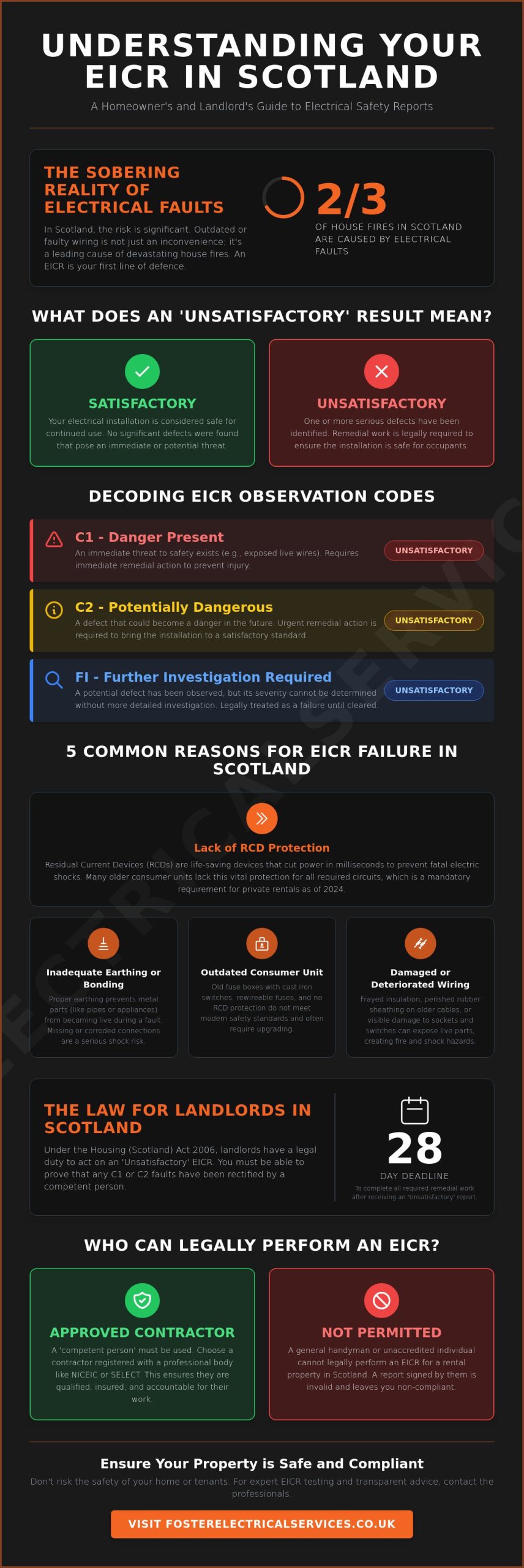
Code C1 is the most critical category. It signifies ‘Danger Present’ and means there is an immediate risk to life or property. If we encounter a C1 fault, we have a professional duty of care to make the installation safe or isolate the dangerous circuit before we even leave your premises. Code C2 is ‘Potentially Dangerous’. Whilst it might not be an emergency this second, it could become one if a fault develops or if a simple component fails. Both C1 and C2 codes result in an automatic ‘Unsatisfactory’ result for your property.
There is also the ‘FI’ code, which stands for Further Investigation. This is often a source of frustration for homeowners and landlords alike. It means we’ve spotted something that doesn’t look right, but we cannot confirm its safety without more invasive testing or gaining access to hidden areas. According to the Scottish Government statutory guidance, an FI code must be treated as an ‘Unsatisfactory’ result until that investigation is complete. It’s a safety-first approach that ensures no hidden dangers are left to chance amongst your wiring.
C1 vs. C2: What Triggers a Fail?
Both of these codes require remedial action to move your report from ‘Unsatisfactory’ to ‘Satisfactory’. We see these frequently in older Scottish properties where the infrastructure has naturally aged.
- C1 Examples: Exposed live conductors, charred or melting sockets, or accessible live parts within a consumer unit.
- C2 Examples: A lack of earthing to metal light fittings or the absence of RCD protection on sockets likely to be used for outdoor equipment.
Once these issues are addressed, we can provide the necessary documentation to prove compliance. If you’re worried about specific faults in your home, we can help with professional fault finding and repairs to get your property back to a safe standard.
The C3 Code: Making Your Property Better, Not Just Safer
Code C3 is ‘Improvement Recommended’. This is the only code that allows you to pass your inspection with a ‘Satisfactory’ result. It essentially means your wiring is safe for continued use, but it doesn’t meet the very latest standards of the 18th Edition regulations. Common C3 examples include older colour-coded wiring or plastic consumer units located in certain areas. Addressing these isn’t a legal requirement, but it’s a wise investment in your home’s future. By fixing C3 recommendations now, you often prevent them from deteriorating into C2 failures by the time your next five-year inspection rolls around. We view this as a traditional way of maintaining a property with diligence and care.
5 Common Reasons Why Properties in Scotland Fail an EICR
Identifying specific faults helps remove the mystery of the inspection process. While every home is unique, we see the same handful of issues appearing on ‘Unsatisfactory’ reports time and again. Knowing what fails an eicr report in scotland allows you to address obvious problems before our engineer even arrives; this saves time and reduces the stress of the remedial process. We believe in being thorough, but we also believe in being fair, focusing on the genuine risks that compromise your safety.
The RCD Requirement: The #1 Reason for Failure
RCDs are essentially life-savers. They monitor the flow of electricity and disconnect the power instantly if they detect a leak, preventing fatal shocks. As of March 1, 2024, the Scottish Government electrical safety guidance mandates that all privately rented properties must have RCD protection fitted in their consumer unit. If your property lacks this modern protection on circuits serving sockets or bathrooms, it will result in an automatic C2 failure. We frequently perform Consumer Unit Upgrades to bring older Scottish homes up to this essential modern standard.
Earthing and Bonding: The Invisible Safety Net
Earthing and bonding act as a safety net by directing fault currents safely to the ground. Earthing protects you from shocks from metal appliances, whilst bonding connects your electrical system to incoming gas and water pipes. In Tayside’s older stone properties, we often find that these connections have corroded or were never properly installed. You can often spot if your bonding is present by looking for a thick green and yellow wire clamped to the pipes near your stopcock or gas meter. If it’s missing or loose, it’s a significant safety risk that requires urgent attention.
The Plastic Consumer Unit Myth
There is often confusion about plastic fuse boxes. Under current standards, new installations must use metal, fire-rated enclosures. However, a plastic consumer unit is usually a C3 recommendation rather than a fail, provided the connections are secure and there are no signs of heat damage. It only becomes a C2 failure if it’s located in a high-risk area, such as a primary escape route or under a wooden staircase. We often suggest upgrading to a metal unit as a wise long-term investment to ensure your home meets the highest possible fire safety standards.
Beyond these major components, we also look for smaller but equally important defects that contribute to what fails an eicr report in scotland. These often include:
- Damaged Accessories: Cracked sockets, broken light switches, or loose fittings that expose live parts.
- Overloaded Circuits: DIY ‘daisy-chaining’ where multiple extension leads are plugged into a single socket, creating a fire hazard.
- Outdated Materials: The presence of perishing lead or VIR (Vulcanised Indian Rubber) cabling, which is common in properties that haven’t been rewired since the 1960s.
Our team takes personal pride in identifying these issues with a diligent eye, ensuring your property remains a safe haven for your family or tenants.
Scottish Landlord Legislation: Deadlines and the 28-Day Rule
For private landlords, the Housing (Scotland) Act 2006 isn’t just a set of guidelines; it’s a legal obligation that ensures every tenant has a safe place to call home. Under this Act, the Repairing Standard requires that the electrical installation in a rented property is safe and fit for purpose. When we carry out an inspection, we aren’t just looking for faults; we are helping you fulfil your duty as a responsible landlord. Understanding what fails an eicr report in scotland is vital because the moment an ‘Unsatisfactory’ result is recorded, a strict legal clock begins to tick.
The law is clear: you have a mandatory 28-day window to complete all required remedial works. This applies to any faults coded as C1 (Danger Present) or C2 (Potentially Dangerous). Failing to provide a ‘Satisfactory’ report to your tenants within this timeframe can lead to significant penalties, including Rent Relief Orders or fines from the local authority. It also impacts the ‘Tolerable Standard’, which is the minimum physical standard for any house to be occupied as a home in Scotland. We take personal pride in helping our clients navigate these rules with straightforward, honest advice.
Compliance for Landlords in Dundee and Angus
In areas like Dundee and Angus, local councils take these regulations very seriously, particularly regarding HMO (House in Multiple Occupation) licensing. If you manage a student property or a shared house, a valid EICR is a non-negotiable part of your licence application. You must provide a copy of the most recent report to any new tenant before they move in, and to existing tenants within 28 days of the inspection. We often work with local landlords to ensure their documentation is pristine, as the council can request these records at any time to verify your compliance. It’s about maintaining a reputation for diligence and care in our local community.
The 28-Day Remedial Window
What happens if a repair is complex and takes longer than 28 days? While the deadline is firm, local authorities may show some leniency if you can provide clear evidence that the work is underway, such as a confirmed appointment with a qualified electrician. However, you must never simply leave a hazard unaddressed. Once the repairs are finished, we don’t just issue a new EICR. Instead, you’ll receive an Electrical Installation Certificate (EIC) or a Minor Works Certificate. You must keep your original ‘Unsatisfactory’ report alongside these proof-of-repair documents to show a complete, legal audit trail of how you restored safety to the property.
If you’ve recently received an unsatisfactory result and the 28-day clock is ticking, we can help you stay compliant. We specialise in efficient, high-standard EICR remedial works and repairs to ensure your property meets every legal requirement without delay.
Navigating Post-Inspection Repairs: How Foster Electrical Restores Safety
Receiving an ‘Unsatisfactory’ verdict isn’t the end of the road. We see it as a professional roadmap to restore your home’s safety and legal standing. Our team specialises in turning these results around quickly, focusing on the essential repairs that keep you compliant with Scottish law. We don’t believe in high-pressure tactics or complicated pricing; we believe in doing a proper job for a fair price. While we’ve discussed what fails an eicr report in scotland in the previous sections, the remedial process is where we truly show our value as your safety guardians.
We understand the stress that comes with a 28-day deadline. Because of this, we prioritise C1 and C2 faults to ensure your property is made safe as a matter of urgency. We take a traditional, sincere approach to our work, treating every client with the respect they deserve. Our goal is to bridge the gap between technical necessity and your domestic comfort, providing a service that is as reliable as it is thorough. You can trust us to be honest about what is required, avoiding any unnecessary work whilst ensuring your home meets every modern standard.
From Failure to Compliance: Our Process
We’ve refined our remedial process to be as smooth and transparent as possible for homeowners and landlords alike. We follow a logical sequence to move your property from a failed state to full certification:
- Step 1: We provide a detailed breakdown of the ‘Unsatisfactory’ report. We sit down with you to explain the findings in plain, accessible language so you understand exactly why a fault was recorded.
- Step 2: Our Tayside-based team carries out efficient fault finding and repairs. We use time-tested methods to rectify issues, from replacing perishing cables to installing modern RCD protection.
- Step 3: Once the work is finished, we perform final testing. We then issue your digital ‘Satisfactory’ certificate, which serves as your legal proof of compliance.
Our commitment to accountability means we stand by every repair we make, ensuring your property remains a safe environment for years to come.
Why Choose a Local Dundee Specialist?
Choosing a local expert means working with a neighbour who understands the unique character of Dundee’s property landscape. From high-ceilinged Victorian tenements to modern new builds, we know the common electrical quirks found in our local area. We pride ourselves on direct, human interaction; you won’t have to navigate corporate call centres or automated systems when you need an answer. We are a hardworking team that takes personal pride in our reputation for punctuality and execution.
We also understand the privilege of entering your private space. Our engineers are meticulous about tidiness and treat your property with the highest standards of care. We don’t just fix wires; we protect homes. If you’ve been wondering what fails an eicr report in scotland or if you’ve already received a report that needs attention, we are here to help you move forward with quiet confidence.
Book your EICR or Remedial Work with Foster Electrical today and let us take the worry out of your electrical safety compliance.
Securing Your Home’s Future with Confidence
Understanding what fails an eicr report in scotland is the first step towards a safer, more compliant home. We’ve seen that whilst C1 and C2 codes require urgent attention, they don’t have to be a source of stress when you have a clear plan. By addressing these issues promptly and staying mindful of the 28-day remedial window, you protect both your investment and your family’s safety. It’s about maintaining high standards with a diligent, proactive approach.
As an NICEIC Approved Contractor, we take immense personal pride in our reputation as specialists in Dundee property compliance. We offer transparent pricing with no hidden corporate fees; this ensures you receive honest, artisanal service from a team that truly cares about your environment. We believe in doing things the right way, the first time, with the sincerity and integrity your home deserves.
Secure your property’s safety with a professional EICR from Foster Electrical and enjoy the quiet confidence that comes with a job done properly. We look forward to helping you keep your home safe and sound.
Frequently Asked Questions
Can I fail an EICR if I don’t have interlinked smoke alarms in Scotland?
Technically, the lack of interlinked smoke alarms won’t cause a failure on the EICR itself, as they fall under different legislation. However, they are a mandatory part of the Scottish Repairing Standard that every landlord must meet. We often check these alongside our inspections to ensure your property remains fully compliant with all Scottish safety laws, as missing alarms are a significant breach of your legal duties.
How much does it typically cost to fix a failed EICR in Dundee?
The cost of repairs depends entirely on the specific defects found during the inspection. A simple socket replacement is far less involved than a full consumer unit upgrade or fixing complex earthing issues. We provide transparent, honest quotes after every inspection, ensuring you only pay for the work required to make your home safe. We don’t believe in hidden corporate fees or opaque pricing structures.
Do I need to rewire my whole house if I get an Unsatisfactory EICR?
An ‘Unsatisfactory’ result rarely means a full property rewire is mandatory. Most issues that contribute to what fails an eicr report in scotland can be resolved with targeted remedial works, such as upgrading your fuse box or repairing specific circuits. We always aim to find the most practical and cost-effective way to restore safety whilst maintaining the integrity of your home’s existing wiring.
What happens if I ignore an EICR failure as a landlord?
Ignoring a failure is a serious matter that can lead to Rent Relief Orders or significant fines from the local council. Beyond the financial penalties, you are legally responsible for your tenants’ safety; a failure to act could invalidate your insurance and lead to prosecution if an accident occurs. We help you navigate the 28-day repair window to keep your reputation and your tenants protected.
Is a plastic fuse box an automatic fail in Scotland?
A plastic consumer unit is usually recorded as a C3 recommendation, which is not an automatic fail. It only becomes a C2 failure if it’s located in a high-risk area, such as a primary escape route or under a wooden staircase. We’ll always be honest about whether your specific unit needs an upgrade to meet modern fire safety standards or if it’s safe for continued use.
How long does an EICR inspection take for a standard 3-bedroom house?
A thorough inspection for a standard 3-bedroom house typically takes between two and four hours. We don’t rush our work because we believe in a diligent, meticulous approach to testing every circuit. This timeframe allows us to identify hidden faults that a quicker, less thorough check might miss, providing you with a cumulative sense of security.
Will an older property always fail its first EICR?
Older properties don’t always fail, though they are more likely to have outdated components that don’t meet current 18th Edition standards. If an older home has been well-maintained and had minor upgrades over the years, it can still achieve a ‘Satisfactory’ result. We treat every property with respect, acknowledging the care you’ve put into your home whilst identifying any genuine risks.
Can I do the remedial repairs myself to save money?
You shouldn’t attempt these repairs yourself, even if you’re confident with DIY. For your property to be legally compliant, all remedial work must be completed and signed off by a competent person who can issue the correct certification. Using a professional ensures the job is done properly and provides the necessary audit trail to prove your property is safe under Scottish law.