Would you leave your electric oven running at maximum heat for ten hours every single night whilst your family sleeps? That is essentially the demand a modern EV charger places on your domestic system. As more of our Dundee neighbours make the switch to electric, the most common question we hear is, “is my wiring safe for an electric car charger?” It is a sensible thing to ask. You might worry about the risk of electrical fires or feel overwhelmed by the latest 18th Edition wiring regulations, but your safety should never be a source of stress or confusion.
We believe in straightforward, honest advice that puts your peace of mind first. We understand the privilege of being invited into your home, and we take that responsibility seriously. In this guide, you will discover how to assess your home’s electrical readiness and ensure your wiring can safely handle the heavy load of a dedicated wallbox. We will explain the latest BS 7671:2018+A4:2026 standards, help you determine if a full rewire is actually necessary, and outline the practical steps to get your home ready for the future with total transparency.
Key Takeaways
- Understand why EV charging is the heaviest load your home will ever face and why standard wiring must be rated for hours of continuous use.
- Learn how to check your main cut-out fuse and household demand to answer the vital question: is my wiring safe for an electric car charger?
- Discover the hidden fire risks associated with using standard 3-pin “granny cables” for daily charging instead of a dedicated, professional wallbox.
- Find out why an Electrical Installation Condition Report (EICR) is the most reliable way to verify the integrity of older wiring before installation.
- See how a professional installation ensures your home stays compliant with the latest safety regulations whilst protecting your property and vehicle warranty.
Is My Wiring Safe for an Electric Car Charger? The Reality of High-Load Charging
Thinking about your home’s electrical system as a series of pipes is a helpful way to understand the pressure of an EV charger. Most people ask, “is my wiring safe for an electric car charger?” because they sense that this new addition is different from a new toaster or a television. They are right. For many Dundee homeowners, particularly those living in our beautiful older stone-built properties or traditional tenements, the existing wiring was never designed to carry such a heavy, sustained load. In the eyes of the 18th Edition Wiring Regulations, specifically the latest amendments, “safe” means more than just having the lights stay on. It means your system can handle the intense thermal stress of a high-load appliance without the risk of fire, cable degradation, or circuit failure over many years of use.
Understanding the Demand: EV vs. Household Appliances
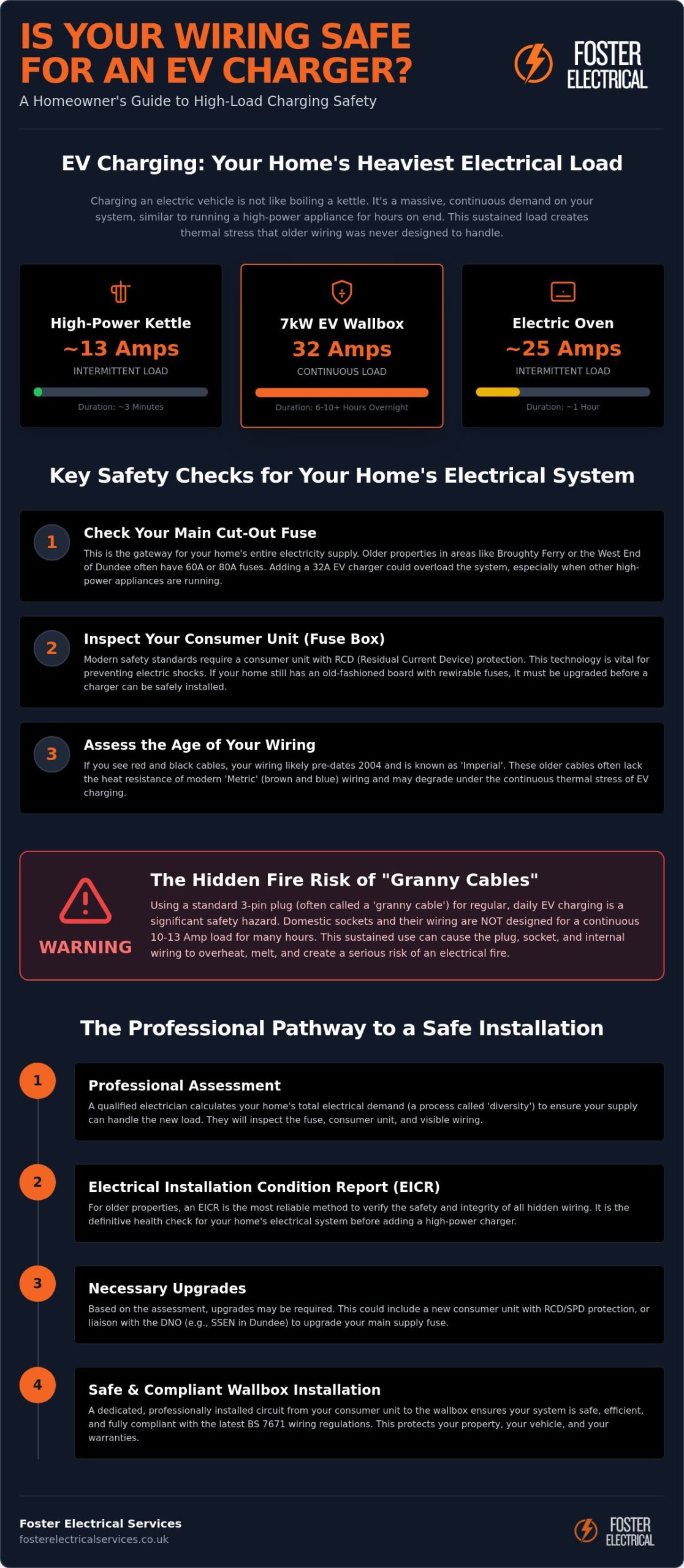
A typical 7kW home electric vehicle charging station pulls about 32 Amps of current. To put that into perspective, it is roughly the same as running three high-power kettles at the exact same time. Whilst an oven or a power shower might use a similar amount of energy, they are what we call “intermittent loads”. They only run for short bursts before switching off. An EV charger is a “continuous load”. It draws that massive amount of energy for six, eight, or even ten hours straight whilst you sleep. If your cables are older, perhaps still using outdated rubber or lead sheathing, this relentless flow of electricity can cause them to overheat and become brittle. We take the time to check the continuous current rating of your cables because your family’s safety depends on it.
The Role of Your Consumer Unit
Your consumer unit, or fuse box, acts as the guardian of your home. It’s the first line of defence against electrical faults and the heart of any EV installation. For a charger to be truly secure, your unit must be equipped with modern RCD (Residual Current Device) protection. This technology detects tiny leaks of electricity and cuts the power instantly to prevent electric shocks. If your home still uses an old-fashioned fuse board with rewirable wire, it simply isn’t up to the task of modern living. We often find that Consumer Unit Upgrades are the most vital step in creating a safe environment for your new vehicle. You can explore our services to see how we help local families modernise their systems with integrity and care. We believe in providing a service that is as durable as the homes we work in.
Assessing Your Home’s Electrical Capacity and Infrastructure
Before we look at the charger itself, we must look at where your power begins. Many Dundee homeowners ask, “is my wiring safe for an electric car charger?” but the answer often starts at the street. Your main cut-out fuse is the gatekeeper of your home’s energy. In older parts of Broughty Ferry or the West End, these fuses are often rated at 60 Amps or 80 Amps. Adding a 32 Amp EV charger to a 60 Amp supply is a significant request that requires a professional calculation. We use a principle called “diversity” to assess your home. This is a method of estimating how much power you use at any one time. If you have an electric shower, a tumble dryer, and an oven running whilst your car is charging, you could easily exceed your home’s total capacity.
The Main Incoming Supply
Locating your service fuse is the first step in our assessment. If your total household demand is too high, the fuse could blow, leaving your entire street in the dark. We take the time to calculate your maximum demand with meticulous care. If your supply is insufficient, we will guide you through the process of contacting Scottish and Southern Electricity Networks (SSEN), our local District Network Operator (DNO). They are responsible for upgrading the main fuse or the cable coming into your property. It is a vital step that ensures your home remains a safe and reliable environment for your family.
We also look for signs of “Imperial” wiring. If your home still has red and black cables, it likely hasn’t seen a significant upgrade since before 2004. These older cables were measured in inches rather than millimetres. They often lack the heat resistance required for modern, high-load charging. Upgrading to modern “Metric” twin and earth cabling is not just about meeting regulations; it is about the long-term durability of your home’s infrastructure. To see how other family-run specialists approach these safety upgrades and renewable energy solutions, you can visit Jelvis.
Earthing and Bonding Requirements
Earthing is a unique challenge in our local Tayside properties. Many homes use a system called PME (Protective Multiple Earthing). Whilst this is standard for indoor appliances, it presents a specific risk for EV chargers located outside. If a fault occurs in the street’s neutral wire, the metal body of your car could become live. To prevent this “touch voltage” danger, we follow the latest Electrical Safety First guidance. This often involves installing a dedicated earth rod or using a charger with built-in “open PEN” protection. We also ensure your gas and water pipes are correctly bonded to the main earth terminal. This is a non-negotiable safety standard that protects you from electric shocks within the home. If you are unsure about the state of your earthing, you might find it helpful to reach out for a professional opinion before you commit to a charger.
The Hidden Dangers of “Granny Cables” and 3-Pin Charging
Many new EV owners in Dundee start their journey by using the portable “granny cable” supplied with their vehicle. It feels like a simple, cost-effective solution. However, when you ask, “is my wiring safe for an electric car charger,” you are often thinking about a permanent unit on the wall. The reality is that using a standard 3-pin socket for daily charging is often far riskier than a dedicated installation. These Mode 2 chargers were designed for emergency use, perhaps when visiting a friend or staying at a holiday cottage, rather than for the heavy, nightly demands of a modern commuter vehicle.
A standard domestic socket is a reliable piece of engineering, but it was never intended to deliver 10 to 13 Amps of current for 12 hours straight. Most household appliances, like a toaster or a vacuum, run for only a few minutes. Even a washing machine cycles its heating element on and off. An EV charger pulls maximum current constantly. This creates a level of thermal stress that can cause internal components to degrade. We have seen instances where the back of a socket has begun to melt because the wiring behind the wall could not dissipate the heat safely.
One of the most dangerous habits we encounter is “daisy-chaining” or using extension leads to reach a vehicle. This is strictly prohibited by all reputable manufacturers and UK government safety standards. Extension leads add extra resistance to the circuit, which generates even more heat. This often leads to “arcing”, where electricity jumps across gaps in a loose connection. Arcing is a primary cause of electrical fires, and it often happens silently behind your skirting boards or within the wall cavity.
Socket Fatigue and Thermal Stress
Every time you plug in and draw high current, the metal pins in the socket expand slightly due to heat. When the charging stops, they contract. Over hundreds of cycles, this loosening of the connection creates a fatigued socket. You might notice signs of failure like discolouration around the pin holes, a faint smell of ozone, or brittle plastic that cracks easily. Because we value the safety of your home as if it were our own, we always recommend a dedicated EV charger installation. It is a more durable, honest way to protect your property and your vehicle.
The Inefficiency of Slow Charging
Beyond safety, 3-pin charging is remarkably slow. It can take over 24 hours to fill a modern battery, whereas a professional wallbox typically does the job in 7 to 8 hours. Ironically, slow charging can be less energy-efficient. The car’s onboard computers and cooling systems must stay active for the entire duration of the charge, wasting electricity that could have been saved with a faster, more direct connection. We believe in doing a job correctly the first time to save you money in the long run.
How to Verify Your Home’s Safety Before Installation
To truly determine if your home is ready, we follow a steady, logical sequence of checks. You shouldn’t have to guess whether your property can handle the strain. We take a practical, step-by-step approach to ensure that when we answer the question, “is my wiring safe for an electric car charger,” we do so with absolute certainty. This process is designed to protect your family and your investment for years to come.
- Step 1: Visual Inspection. We begin by examining your meter tails and consumer unit. We look for signs of wear, such as brittle insulation or outdated components that lack the necessary safety ratings for high-load appliances.
- Step 2: Commissioning an EICR. For older Dundee properties, a visual check isn’t enough. We perform a deep dive into the health of your circuits to find what the naked eye cannot see.
- Step 3: Load Curtailment Calculation. We calculate the total demand of your home to prevent your main fuse from blowing. This ensures your car charges safely even when other appliances are in use.
- Step 4: Cable Route Planning. We plan a route that avoids bunching cables or burying them deep in loft insulation. This prevents thermal issues that can lead to overheating.
- Step 5: Professional Certification. Once the work is complete, we provide full certification and notify local building control. This is vital for your home insurance and vehicle warranty.
The Importance of an EICR
For many of our local stone-built villas and traditional tenements, an EICR certificate in Dundee is the gold standard for safety. This report uncovers hidden faults like undersized neutral wires or poor earthing that could cause serious issues during a ten-hour charging cycle. We treat this as the best insurance policy for your new vehicle. Our approach is meticulous; we look for every safety gap in your older wiring to ensure the system is robust enough for the future. If you want to be sure about your home’s readiness, it’s always best to book a professional safety assessment before you buy your charger.
Load Management Systems
Modern technology offers a clever way to keep your home safe without needing a massive supply upgrade. We often install a “CT Clamp” at your main fuse. This small device talks to your smart charger and acts as a digital traffic warden. If you turn on your electric shower or oven, the system will “throttle” or slightly reduce the power going to your car. This prevents the main fuse from blowing whilst ensuring your vehicle still gets the charge it needs. It’s a sensible, future-proof solution that works perfectly if you eventually add a second EV or a heat pump to your property. For those looking to go even further with energy independence, you can explore Solar and Energy Storage Installations to see how renewable power can be integrated into your home’s management system. We believe in providing these smart, honest solutions that keep your home running smoothly without unnecessary complexity.
Professional EV Installation: Future-Proofing Your Dundee Home
A professional installation is the final piece of the safety puzzle. Whilst it might be tempting to look for a quick fix, choosing a qualified expert is the only way to truly answer “is my wiring safe for an electric car charger” with a definitive yes. We believe that your home is your sanctuary, and any work carried out should enhance that security rather than compromise it. A DIY or “handyman” approach is not just a safety risk; it will almost certainly void your home insurance and your vehicle’s warranty. We provide the legal certification that proves your system meets the highest British standards.
We take immense pride in our reputation across Dundee, Perth, and Fife for meticulous tidiness and professional integrity. We don’t just bolt a box to your wall and leave. We ensure every cable is clipped perfectly, every connection is torqued correctly, and your property is left exactly as we found it. Whilst we are on-site, many homeowners choose to combine their charger installation with LED lighting upgrades or other smart technology. This holistic approach ensures your entire home is as energy-efficient and modern as the car sitting in your driveway.
Our Local Expertise
We have spent years working within Tayside’s diverse housing stock. We understand the specific challenges of installing modern tech into Victorian villas or traditional tenements where space and access can be limited. When you contact us, you won’t be met by an anonymous call centre. You will speak directly with experts who care about our local community. We invite you to explore our services to see how a full safety audit can provide the peace of mind you deserve before making the switch to electric.
Your Next Steps to Safe Charging
Booking a survey is a straightforward, honest process. To help us give you the best advice, it is useful to have your MPAN number (found on your electricity bill) and a few clear photos of your fuse box and electricity meter ready. This allows us to begin assessing your home’s readiness before we even step through your door. We treat every home with the respect it deserves, ensuring that when we finish, your system is not just functional, but a benchmark for reliability. We are here to guide you through this transition with the diligent, person-to-person service that has defined our business for years. Your journey toward safe, sustainable driving starts with a conversation rooted in trust and technical excellence.
Securing Your Home for the Electric Future
Transitioning to an electric vehicle is a significant milestone that represents a commitment to a cleaner, more sustainable future for our local Tayside community. However, this change requires a foundation of absolute electrical integrity within your property. Whether you live in a modern development or a traditional Victorian villa, the high demands of continuous charging mean that safety can never be left to chance. You shouldn’t have to wonder, is my wiring safe for an electric car charger, when you can have the quiet confidence of a professional audit.
As trusted local experts serving Dundee, Perth, and Fife, we are specialists in older property safety and rewiring. We ensure every installation is fully compliant with the latest 18th Edition Wiring Regulations, providing a service rooted in honesty and technical excellence. We treat your home with the meticulous care it deserves, bridging the gap between expert engineering and domestic comfort. If you are ready to ensure your home is prepared for the road ahead, please Book Your Professional EV Safety Survey with Foster Electrical today. We look forward to being the guardian of your home’s safety.
Frequently Asked Questions
Can I charge my electric car from a normal UK socket permanently?
You shouldn’t use a normal 3-pin socket for permanent daily charging. These sockets weren’t designed to deliver high current for ten hours at a time, which can lead to overheating and melted plastic behind the wall. Whilst they are fine for occasional emergency use, a dedicated wallbox is the only way to ensure your home remains a safe environment for your family and your vehicle.
Does an EV charger require a dedicated fuse board?
Most EV chargers don’t require an entirely separate fuse board, but they do need their own dedicated circuit. We typically run this directly from your existing consumer unit to ensure it doesn’t interfere with your other household appliances. However, if your current unit is an older model or is already full, a Consumer Unit Upgrade is often the most practical and safe way to provide the power required.
What is an EICR and do I need one before getting an EV charger?
An EICR is an Electrical Installation Condition Report that acts as a full health check for your home’s wiring. We strongly recommend one for older Dundee properties before installation. It is the most reliable method to answer the question, is my wiring safe for an electric car charger, by uncovering hidden faults or undersized cables in your existing circuits that could pose a risk.
Will my lights flicker when my car is charging?
Your lights should not flicker if the installation is designed correctly and your main supply is robust. Flickering often points to a significant voltage drop or a loose connection somewhere in the system. Our meticulous survey process identifies these issues before the charger is even connected to prevent any disruption to your comfort and to ensure the stability of your home’s power supply.
How much extra load can my Dundee home’s electrical system handle?
Your home’s capacity is determined by the main cut-out fuse, which is typically 60A or 80A in many older Tayside properties. Because a charger draws 32A, we must calculate your maximum demand to see if is my wiring safe for an electric car charger without blowing the main fuse. This careful planning prevents unexpected power cuts and ensures your system isn’t pushed beyond its safe limits.
Is it safe to charge my EV overnight whilst I am sleeping?
It is perfectly safe to charge overnight if you have a professionally installed dedicated charger. These units include built-in safety protections and RCDs that monitor the circuit constantly for any faults. Smart chargers also allow you to take advantage of cheaper off-peak tariffs whilst you sleep with total peace of mind, knowing that the system is designed for long-duration, high-load use.
Do I need to upgrade my wiring if I have an old fuse box?
An old fuse box, especially one with rewirable fuses, usually lacks the RCD protection required by the latest 18th Edition regulations. It’s often necessary to upgrade to a modern consumer unit to provide a safe foundation for the charger. This ensures your home meets current safety standards and protects your vehicle’s sensitive electronics from potential faults, providing a much more durable and reliable connection.
What happens if my car charger overloads my house?
If your home’s demand exceeds the capacity of the main fuse, the fuse will blow and cut power to the entire property. To prevent this, we often install a CT clamp for load management. This allows the charger to automatically reduce its power draw when you turn on a high-energy appliance like an electric shower, keeping your home’s electrical system within its safe operating parameters.