Does your home’s electrical safety have an expiry date you aren’t aware of? Most of us think of our wiring as something that just works in the background, but the reality of modern safety standards is often more complex. We understand the confusion that comes when you’re trying to figure out how often do you need an eicr in scotland, especially whilst navigating the different expectations for landlords and homeowners. It’s natural to feel a bit overwhelmed by the fear of penalties or the worry of inviting an unreliable contractor into your private space.
We’ve put this 2026 guide together to give you total peace of mind and a clear path forward. You’ll discover the exact legal requirements mandated by the Housing (Scotland) Act 2006, including the mandatory five-year rule for the private rented sector and the sensible ten-year recommendations for owner-occupiers. We will also explain how these inspections tie in with the latest interlinked smoke alarm regulations, helping you keep your property compliant and your family safe without any hidden costs or technical jargon. By the time you finish reading, you’ll know exactly how to protect your investment and find a diligent local expert you can trust.
Key Takeaways
- Private landlords must ensure an EICR is carried out at least every five years to remain compliant with the Housing (Scotland) Act 2006 and the Repairing Standard.
- Whilst not a legal requirement for homeowners, an electrical safety check is strongly recommended every ten years to protect your property and ensure your family’s peace of mind.
- Determining how often do you need an eicr in scotland can depend on your property’s age, as older Dundee tenements or high-usage student lets may require more frequent attention.
- A thorough inspection now includes verifying your interlinked smoke and heat alarms to ensure they meet the mandatory Scottish safety legislation introduced in 2022.
- Choosing a local, community-focused expert ensures your home is treated with respect and that all work is completed using honest, time-tested methods rather than impersonal corporate shortcuts.
Understanding the EICR Mandate in Scotland
Think of an Electrical Installation Condition Report (EICR) as a comprehensive MOT for your property’s wiring. It is a thorough assessment of your home’s electrical health. Whilst your lights might turn on and your sockets might seem fine, the cables hidden behind your walls and under your floorboards can degrade over time without showing any outward signs of trouble. Determining how often do you need an eicr in scotland starts with recognising that this isn’t just a piece of paper; it’s a vital safety health check designed to protect what matters most.
Scotland’s electrical safety laws are distinct from those in the rest of the UK. We operate under specific devolved legislation that places a high priority on tenant and homeowner safety. The primary goal of these regulations is to prevent electrical fires, shocks, and injuries within Tayside homes. We take a sincere, grounded approach to these inspections. We don’t believe in corporate box-ticking or rushing through a property just to get to the next job. Instead, we act as protective guardians of your environment, ensuring every connection is secure and every circuit is safe.
What Does an EICR Actually Check?
An inspection goes far beyond a quick visual glance. We examine the integrity of the wiring that remains out of sight, checking for signs of wear, heat damage, or age. We also look closely at your consumer unit, often called the fuse board, to ensure it has the correct protective devices to shut off power instantly if a fault occurs. Our team identifies hidden hazards that you might never notice, such as dangerous DIY mistakes from previous owners or cables that have been damaged by rodents. We look for durability and moral character in the work we find, ensuring your system is fit for purpose.
The Housing (Scotland) Act and You
The legal framework governing rental safety in Scotland is primarily found in the Housing (Scotland) Act 2006. This act mandates that landlords must provide a safe environment for their tenants, known as the Repairing Standard. To ensure the highest standards, inspections must be carried out by a competent person, such as a member of the Electrical Contractors’ Association of Scotland (SELECT), who can accurately judge the system’s condition.
Once the inspection is complete, you will receive a report with either a ‘Satisfactory’ or ‘Unsatisfactory’ outcome. A satisfactory result means your home meets current safety standards, whilst an unsatisfactory result highlights urgent issues that need attention. Having a professional EICR in your files is also your best defence against insurance disputes. If an electrical incident occurs, being able to prove you followed the rules regarding how often do you need an eicr in scotland shows you have acted with diligence and integrity.
Statutory Intervals: How Often Must You Test?
We believe in providing straightforward answers without the typical corporate fluff. When you ask how often do you need an eicr in scotland, the answer depends entirely on how your property is used. For private landlords, the timeline is dictated by law; for homeowners, it is guided by safety and common sense. We see ourselves as protective guardians of your home, and part of that role involves helping you understand these cycles so you never fall foul of the rules or compromise your family’s safety.
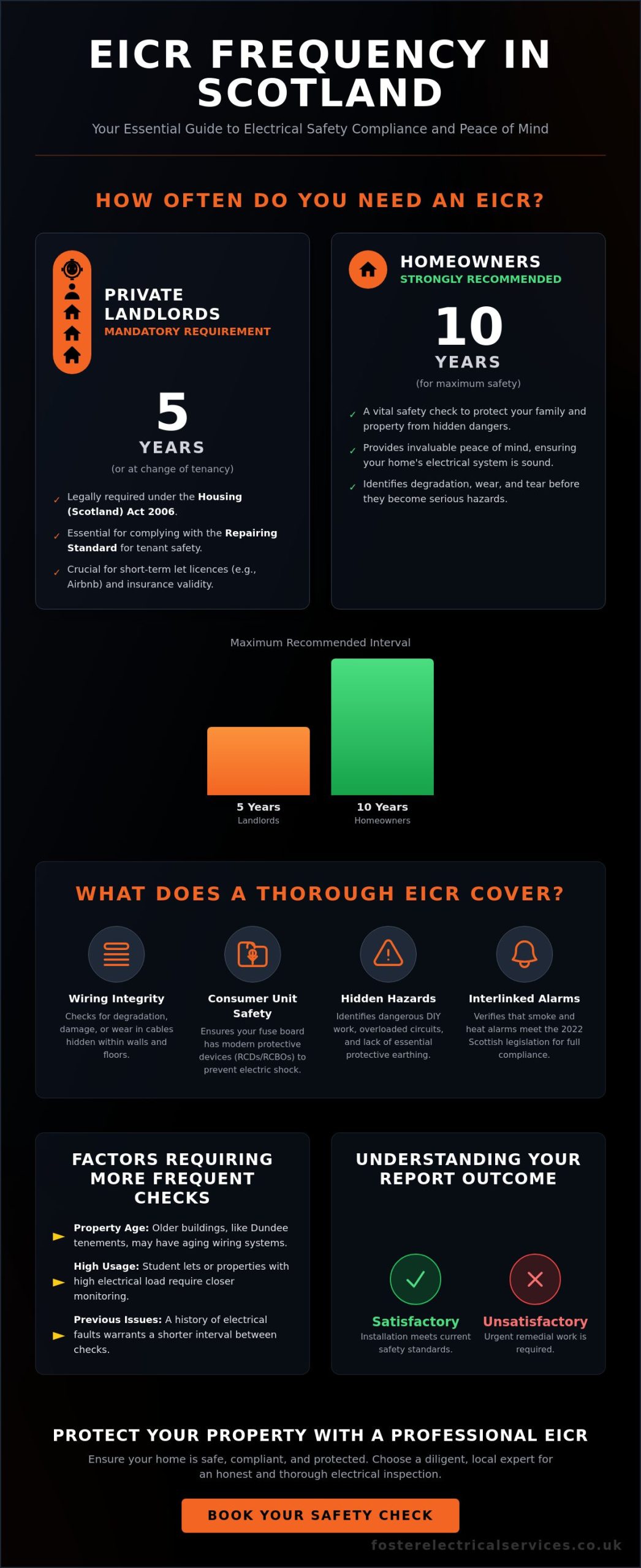
The maximum interval for a private rented property is five years. This is a firm legal ceiling established under the Repairing Standard. You can find the full details within the official Scottish Government guidance, which outlines the responsibilities every landlord must uphold. If you manage a short-term let or an Airbnb in Dundee, the 2026 licensing requirements are even more stringent, requiring a valid certificate as a condition of your operating licence. For commercial properties, whilst there isn’t one single law mandating a specific timeframe, regular testing is essential to meet Health and Safety at Work obligations and satisfy insurance providers.
Landlord Requirements and the 5-Year Cycle
Landlords must arrange an inspection at least every five years or at every change of tenancy, whichever comes sooner. It’s a simple rule that ensures every new tenant enters a property that has been verified as safe. Once the inspection is complete, you are legally required to provide a copy of the certificate to your tenants within 28 days. Failing to do so can lead to significant penalties from the First-tier Tribunal. We understand that managing a rental can be stressful, so we focus on making this process as smooth and honest as possible, providing clear documentation that keeps you fully compliant.
Homeowners: Protecting Your Private Sanctuary
If you are an owner-occupier, the rules shift from mandatory to recommended. The industry standard for a private home is an inspection every ten years. This isn’t about red tape; it’s about peace of mind. Over a decade, cables can loosen and components can age. We often suggest a ‘Move-in’ EICR for anyone buying a new home in Angus. It ensures you aren’t inheriting someone else’s dangerous DIY mistakes. Furthermore, having a recent, satisfactory report can facilitate a much smoother house sale, as it proves to potential buyers that you have maintained the property with diligence and integrity. If you’re unsure about the age of your wiring, we can help you decide if it’s time for a professional EICR assessment.
Whether you are a landlord or a homeowner, staying on top of these intervals is the best way to avoid emergency repairs later. We take personal pride in our high standards of execution, ensuring your electrical system remains a reliable part of your domestic comfort rather than a source of worry.
Why Five Years Might Be Too Long: Factors Affecting Frequency
Whilst the law sets a clear maximum limit, we often find that a property’s specific story dictates a more cautious approach. Determining how often do you need an eicr in scotland isn’t always as simple as looking at a calendar. If you live in one of Dundee’s beautiful but ageing stone tenements, your wiring may have been installed decades ago. These older systems were never designed to handle the sheer volume of modern electronics we use today. In these cases, waiting the full five years can sometimes be a gamble we wouldn’t recommend taking.
Environmental factors also play a significant role in our local area. Scotland’s famously damp climate can take a toll on external electrical fittings, such as outdoor power and lighting. Moisture ingress can lead to corrosion and insulation breakdown much faster than in drier regions. If we discover signs of significant wear or previous poor-quality repairs during an inspection, we might suggest a three-year interval instead of five. This isn’t about creating extra work; it’s about our commitment to your safety and ensuring your system remains durable and reliable. We believe in being honest about the condition of your home, even when that means recommending more frequent checks than the statutory minimum.
High-usage environments, such as busy student lets or commercial hubs, also put more strain on a system. Constant plugging and unplugging can loosen socket connections, whilst high-power appliances can cause heat stress in older circuits. We treat every property with the same level of sincerity and thoroughness. If your property works harder than most, it deserves a more frequent health check to catch potential faults before they become dangerous emergencies. Understanding how often do you need an eicr in scotland requires looking at the actual usage of the building rather than just the legal baseline.
Age and Condition of the Wiring
We encourage you to look out for the subtle warning signs that your wiring is struggling. Flickering lights, frequently tripping circuits, or scorched sockets are clear indicators that an inspection is overdue. Properties still using older fuse boards with rewirable fuses shouldn’t wait for the five-year mark to consider a consumer unit upgrade. We often find that a partial rewire can breathe new life into an older system, making it safer for the years ahead. We take personal pride in identifying these issues early, treating your home with the same care we would our own.
Changes in Occupancy and Property Use
Your electrical load changes as your life does. Installing an EV charger or a suite of high-end kitchen appliances significantly increases the demand on your consumer unit. If you are planning major renovations or building work, it is a sensible time for an EICR to ensure the existing infrastructure can cope with the new additions. Additionally, if you are switching a property from a private home to a rental, you need a fresh EICR immediately to comply with the law. We are here to guide you through these transitions with grounded professionalism, ensuring your property remains a safe sanctuary for everyone who enters.
Beyond the Certificate: Interlinked Alarms and Scottish Compliance
We believe that true safety is holistic. Whilst knowing how often do you need an eicr in scotland is vital for legal compliance, it is only one piece of the puzzle. In our role as protective guardians of your home, we look beyond the wiring to ensure your entire property meets the latest Scottish safety standards. We don’t believe in the ‘minimum effort’ approach often found in larger, anonymous corporations. Instead, we bring a sense of traditional sincerity to every job, ensuring that your domestic comfort is never compromised by an overlooked detail.
Since February 1, 2022, all homes in Scotland have been legally required to have interlinked smoke and heat alarms. This means if one alarm detects danger, every alarm in the house sounds, providing you with the earliest possible warning. We ensure your smoke alarms comply with BS EN14604:2005 and your heat alarms meet BS 5446-2:2003. Our team checks that you have at least one smoke alarm in the living room, one in every hallway or landing, and a heat alarm in the kitchen. For landlords, we also discuss PAT testing during our visit, as ensuring portable appliances are safe is just as important as the fixed wiring itself.
The Interlinked Alarm Standard
The standard requires all alarms to be either mains-powered with a battery backup or powered by a sealed, 10-year lithium battery. They must be ceiling-mounted and interlinked via wires or radio frequency. We also verify the placement of carbon monoxide alarms in any room with a carbon-fuelled appliance, such as your boiler or fire. By addressing these needs whilst we are on-site for your EICR, we save you the hassle of multiple appointments and ensure your property is a fortress against fire and electrical hazards.
Creating a Safer Tayside Community
Electrical faults remain a leading cause of house fires across Tayside. By integrating alarm checks with your EICR, we help create a safer community for everyone. Professional certification is not just a hurdle to clear; it is your proof of diligence that protects your insurance validity if the worst should happen. Understanding how often do you need an eicr in scotland is part of a broader commitment to property maintenance that keeps our local neighbourhoods safe. An EICR functions as a protective shield for both the property and its inhabitants. We take personal pride in this thoroughness, ensuring your home is treated with respect and left as tidy as we found it. If you need to bring your property up to standard, we can assist with Interlinked Smoke & Heat Alarm Installation as part of our commitment to your safety.
Securing Your Dundee Property with a Professional EICR
We believe that choosing a local electrician is about more than just proximity; it is about accountability and community trust. When you search for how often do you need an eicr in scotland, you are often met with generic advice that ignores the specific charm and challenges of Tayside architecture. We are proud to serve our local area with a level of care that impersonal corporate entities simply cannot match. We treat every home as if it were our own, ensuring that our presence is respectful and our work is beyond reproach. Our commitment to traditional sincerity means we value the human connection as much as the technical execution of the job.
If your inspection identifies a fault, we provide a clear, honest path to resolution. There are no hidden fees or opaque pricing structures here. We simply explain the issue, why it matters for your safety, and how we can put it right using time-tested, correct methods. We take personal pride in our high standards, and we never recommend work that isn’t essential for your safety or compliance. This straightforward, practical attitude is what sets us apart from ‘cowboy’ contractors who might try to confuse you with technical complexity.
The Foster Electrical Promise
We promise to communicate with you in plain English at every stage. Technical jargon has no place in a domestic setting where your peace of mind is at stake. We value the privilege of entering your private space, and we show that respect through our meticulous tidiness and punctuality. Our reputation as a trusted neighbour in the Tayside community is built on years of diligent service and a refusal to take shortcuts. We see ourselves as protective guardians of your environment, ensuring that every wire and circuit we test meets the durability and moral character we demand of our own work.
Next Steps for Landlords and Homeowners
Organising your inspection shouldn’t be a chore. We work with you to find a time that fits your schedule, whether you are managing a busy rental or a quiet family home. To prepare for our visit, we simply ask that you ensure clear access to your consumer unit and a representative number of sockets throughout the property. This allows us to work efficiently and thoroughly without disrupting your daily routine. Understanding how often do you need an eicr in scotland is the first step; taking action is the second. We invite you to Secure your EICR certificate in Dundee with Foster Electrical today and experience a service rooted in integrity and professional pride.
Securing Your Tayside Home for the Years Ahead
We hope this guide has brought clarity to the question of how often do you need an eicr in scotland. Whether you are managing a busy rental or relaxing in your own home, understanding these safety cycles is the first step toward true peace of mind. Remember that landlords must comply with the mandatory five-year rule, whilst homeowners should aim for a professional health check every ten years to maintain high standards. We also recommend ensuring your interlinked smoke and heat alarms are fully operational to meet the latest Scottish safety laws.
As a Dundee Trusted Trader member and specialists in Scottish landlord compliance, we take personal pride in our work. We are NICEIC and NAPIT accredited, meaning we bring both technical expertise and artisanal care to every inspection we perform. We don’t believe in corporate shortcuts; we believe in doing things correctly and leaving your property as tidy as we found it. We treat every client’s home with the sensitivity and respect it deserves.
Ready to secure your property? Book your professional EICR inspection with Dundee’s local experts today. We look forward to helping you protect your home and your family with the diligence and integrity you deserve.
Frequently Asked Questions
Is an EICR a legal requirement for homeowners in Scotland?
An EICR is not a legal mandate for owner-occupiers, but we strongly recommend an inspection every ten years. This ensures your home remains a safe sanctuary for your family. Whilst landlords face strict rules, homeowners use these checks as a diligent way to catch hidden wear and tear before it becomes a hazard or an expensive repair.
How much does a landlord EICR cost in Dundee?
The cost of a professional inspection in Dundee depends on the size of your property and the number of electrical circuits we need to test. We believe in honest, transparent communication without hidden corporate fees. A larger tenement flat with more circuits will naturally take more time to inspect thoroughly than a smaller modern apartment.
What is the difference between an EICR and a PAT test?
An EICR covers the fixed wiring within your walls and floors, whilst a PAT test focuses on portable appliances like kettles, lamps, or fridges. Landlords often need both to meet the Repairing Standard. We can help you manage both services to ensure your property is fully compliant and your tenants are safe.
Can I fail an EICR if I have an old-style fuse box?
You won’t automatically receive an ‘Unsatisfactory’ result just for having an older fuse box, provided it’s still safe and functional. However, if the unit lacks modern safety features like RCD protection, we may recommend a consumer unit upgrade to bring your home up to current standards. We always explain our findings in plain English so you can make an informed choice.
Do I need a new EICR every time a new tenant moves in?
Yes, Scottish law requires a valid EICR to be in place at the start of every new tenancy. When you are considering how often do you need an eicr in scotland, remember that five years is the maximum legal interval. A new tenancy is an ideal time to verify that the property remains safe and that no unauthorised electrical changes have been made.
How long does a typical EICR inspection take to complete?
A typical inspection usually takes between two and four hours to complete. This timeframe depends on the complexity of your wiring and the number of sockets we need to test. We take personal pride in being meticulous and tidy, ensuring we don’t disrupt your domestic comfort more than is absolutely necessary.
What happens if my property receives an ‘Unsatisfactory’ EICR result?
An ‘Unsatisfactory’ result means we’ve found faults that require urgent attention to prevent fire or shock. We will provide a clear, honest list of the necessary repairs to make the property safe. We focus on grounded professionalism, offering a straightforward path to getting your system back to a ‘Satisfactory’ status with no high-pressure sales tactics.
Who is qualified to carry out an EICR in Scotland?
Inspections must be carried out by a qualified and competent person who understands the latest BS 7671 regulations. In our local community, this means choosing an electrician registered with a professional body like SELECT, NICEIC, or NAPIT. This ensures the person entering your private space has the proven integrity and expertise to do the job correctly.