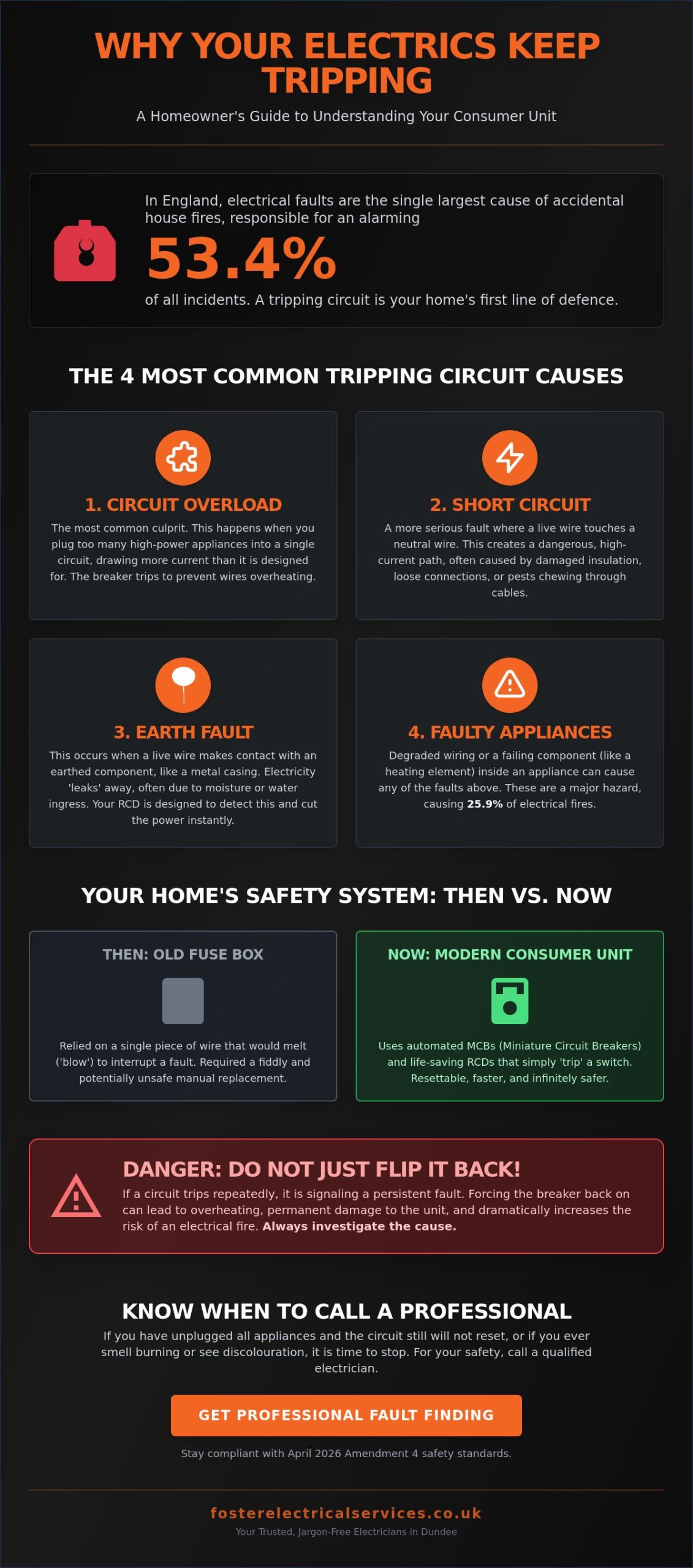
Did you know that electrical faults are the single largest contributor to accidental house fires in England, accounting for 53.4% of all such incidents? It is a sobering thought, especially when you are standing in the dark, wondering why your power has just cut off again. We understand that an unpredictable power cut is more than just a nuisance. It disrupts your home office, puts your appliances at risk, and leaves you worrying about the safety of your family. You might even feel confused by terms like “fuse box” or “consumer unit,” but the most important thing to remember is that a trip is actually your safety system working exactly as it should.
We believe in doing things the old-fashioned way, which means providing honest advice without any confusing jargon. In this guide, we will help you discover the common tripping circuit causes and show you how to safely identify a fault before you need to call a professional. You will learn the difference between a minor appliance glitch and a serious hazard, whilst staying up to date with the latest Amendment 4 safety standards released in April 2026. Our goal is to give you the confidence to manage your home’s electrics safely, ensuring every job is done properly for your peace of mind.
Key Takeaways
- Recognise your consumer unit as a vital safety guardian designed to prevent house fires, rather than just a household nuisance.
- Identify the most frequent tripping circuit causes, distinguishing between a simple overloaded socket and more complex issues like short circuits.
- Learn a safe, methodical process of elimination to pinpoint a faulty appliance without ever needing to touch dangerous internal wiring.
- Discover the life-saving role of RCD protection and why upgrading an old-fashioned fuse box is essential for meeting April 2026 safety standards.
- Know exactly when it is time to stop investigating and call for a professional, jargon-free fault-finding service in Dundee to keep your home safe.
Understanding the Tripping Circuit: Your Home’s Silent Protector
When your lights suddenly vanish or your kettle cuts out mid-boil, your first reaction is likely frustration. It is a natural response, especially if you are working from a home office in Dundee or trying to get the kids’ tea ready. However, we want you to see that “click” of the switch in a different light. A tripping circuit is not a sign that your home’s electrics have failed. It is actually a sign that your safety system is working perfectly. It has detected a danger that could lead to an electric shock or a fire and has stepped in to stop it before a disaster occurs.
In the past, homes relied on old-fashioned fuse boxes. These used a thin piece of wire that would literally melt and “blow” when too much current passed through it. To get the power back, you had to manually thread new wire through a ceramic carrier; a fiddly and often frustrating task. Today, modern consumer units use an automated circuit breaker to do the job. This shift from melting wire to a simple flip switch has made our homes significantly safer and easier to manage.
Most tripping circuit causes fall into three main categories:
- Circuit Overloads: This happens when you ask a single circuit to do too much work at once, such as running a tumble dryer and a dishwasher on the same line.
- Short Circuits: A more serious fault where a “live” wire touches a “neutral” wire, causing a sudden surge of energy.
- Earth Faults: This occurs when electricity escapes the intended path and tries to find a way to the ground, often through a person or a damp surface.
How Modern Consumer Units Work
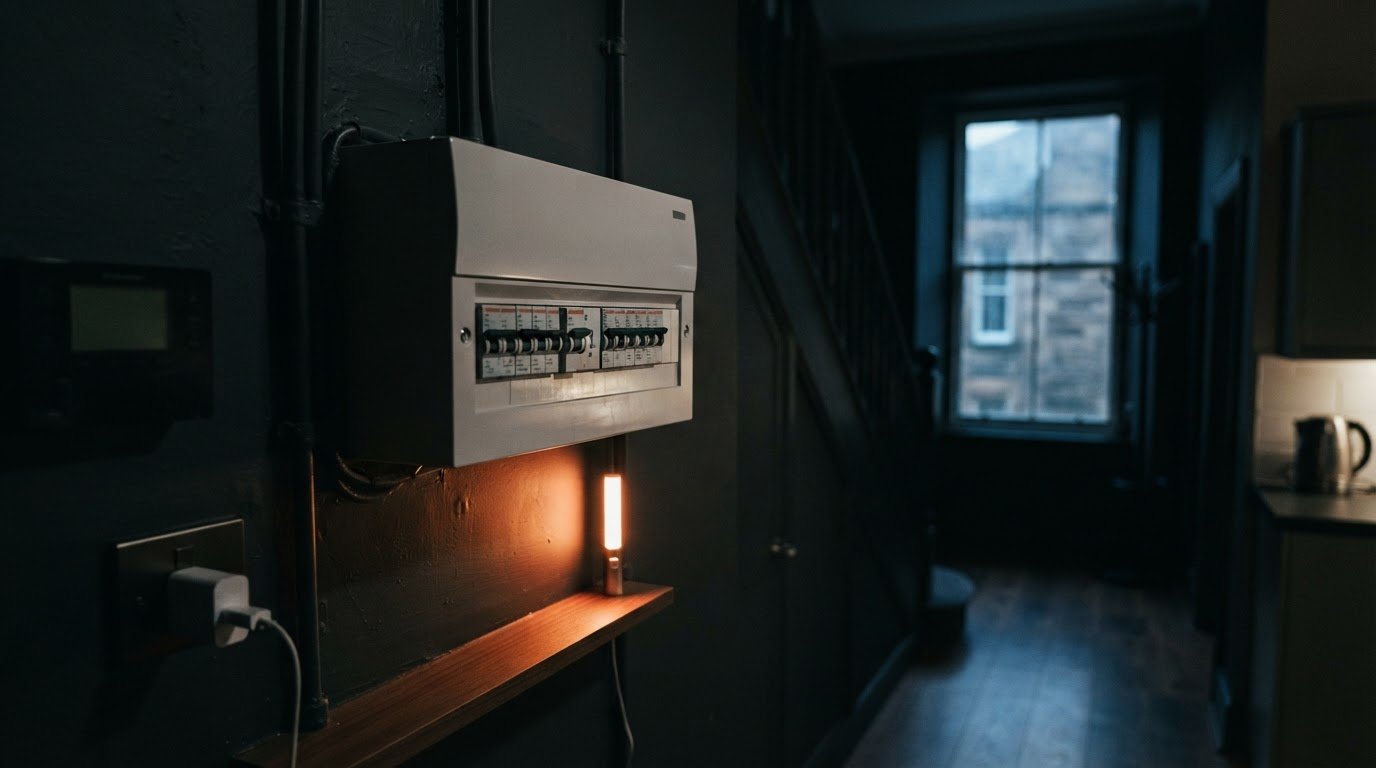
Think of your consumer unit as the “brain” of your home’s electrical system. It organises the flow of power to different areas, such as your kitchen sockets or upstairs lights. Unlike the old fuse boxes that required a toolkit to fix, modern units use Miniature Circuit Breakers (MCBs). A circuit breaker is an automated safety switch that cuts power when it detects an abnormality. When a fault occurs, the internal mechanism reacts in milliseconds, moving the switch to the “off” position to protect your property.
Why ‘Just Flipping it Back’ Can Be Dangerous
It is tempting to simply walk to the cupboard and flip the switch back up without a second thought. If the trip was a one-off, this might work, but if it happens repeatedly, you must stop. Forcing a breaker to stay in the “on” position whilst a fault exists is dangerous. It can lead to overheating and permanent damage to the internal mechanism of the breaker itself. Remember, the trip is just a symptom of an underlying issue. We always say that a job should be done properly; ignoring a persistent trip is like ignoring a fire alarm whilst the room is filling with smoke.
The 5 Most Common Tripping Circuit Causes in UK Homes
Understanding why your power keeps cutting off is the first step toward a safer home. According to UK Electrical Safety Statistics for 2026, there are approximately 19,300 accidental domestic fires of electrical origin across the country each year. Whilst it’s frustrating when the lights go out, knowing the specific tripping circuit causes can help you decide whether you have a simple fix on your hands or a job for a professional. We’ve seen everything from loose wires in Victorian tenements to overloaded sockets in modern apartments, and the culprits usually fall into five categories.
- Circuit Overload: This is the most frequent culprit in modern households. We have more gadgets than ever before, from air fryers to high-spec gaming PCs. When you pull more current than a circuit is rated for, the breaker trips to prevent the wires from overheating.
- Short Circuits: A short occurs when a “live” wire makes contact with a “neutral” wire. This creates a massive surge of electricity. It is often caused by loose connections, damaged cables, or even pests chewing through insulation.
- Earth Faults: Similar to a short circuit, an earth fault happens when the live wire touches the earth wire or a grounded part of an appliance. These are often linked to moisture or water ingress.
- Faulty Appliances: Statistics show that 25.9% of electrical fires are caused by faulty appliances and devices. A heating element in an old kettle or a motor in a washing machine can easily trip your consumer unit.
- Aging Infrastructure: Many Dundee properties were built long before we needed to charge electric vehicles or run multiple high-wattage kitchen appliances. Older wiring simply cannot cope with these modern demands.
Identifying a Circuit Overload
Overloads often happen in home offices or kitchens. If you’ve plugged a multi-way extension lead into a single socket and then try to run a heater and a kettle at the same time, you are asking for trouble. A simple tip is to look for patterns. If your power cuts out the moment you push down the toaster lever or turn on the hairdryer, you’ve likely found your overload. If you’re unsure if your system is up to the task, we can provide a thorough EICR (Electrical Installation Condition Report) to check your home’s health.
The Dangers of Short Circuits and Earth Faults
Short circuits are more aggressive than overloads. You might hear a distinct “popping” sound or notice a faint burning smell coming from a socket or the consumer unit. These faults are dangerous because they involve high levels of heat in a very short space of time. Earth faults often appear in “wet” areas. If your outdoor lighting trips every time it rains, or your dishwasher causes a trip mid-cycle, moisture is likely bridging the gap to the earth wire. These issues require a professional touch to ensure the fault is cleared and the circuit remains safe for your family.
Step-by-Step: How to Safely Identify the Fault at Home
You don’t always need to call an electrician the moment the lights go out. Many tripping circuit causes are simply down to a faulty kettle or a tired old toaster that has finally given up the ghost. Before you pick up the phone, there is a safe, methodical way to investigate the issue yourself. We believe in helping our neighbours in Dundee manage their homes with confidence, but we must start with a simple promise: safety comes first. Never touch your consumer unit with wet hands or whilst standing on a damp floor, such as in a garage or cellar. If you feel even slightly unsure, it is always better to wait for a professional.
The Unplugging Method
To find the culprit, you need to be thorough. Go to every room on the affected circuit and physically remove the plugs from the sockets. Simply clicking the switch off at the wall is not enough; you must pull the plug out to break the connection entirely. Do not forget the “hidden” appliances that we often take for granted. Boilers, integrated dishwashers, and bathroom extractor fans are frequent sources of trouble. Once every single item is unplugged, return to your consumer unit. You will likely see a switch that has dropped down. Push it firmly all the way to the “off” position before flicking it back up to “on.”
If the power stays on, you have confirmed that the fixed wiring in your walls is likely healthy. Now, the process of elimination begins. Go back through the house and plug your appliances in one by one, turning them on as you go. When the switch trips again, you have found your faulty item. This “old-fashioned” way of troubleshooting is incredibly effective and can save you the cost of a call-out for a simple appliance failure. It is about doing the job properly and with patience.
When the Breaker Won’t Reset
There are times when the switch will immediately flip back to the “off” position the moment you try to reset it, even when everything is unplugged. If this happens, do not try to force it or tape the switch in the “on” position. Attempting a reset more than twice when it refuses to stay up can damage the internal safety mechanism or increase the risk of an electrical fire. This behaviour usually points to a “hard fault” in the permanent wiring, such as a loose connection behind a socket or damage caused by a leak. At this stage, the DIY investigation must stop. You need a dependable expert to perform professional Fault Finding and Repairs to identify the root cause safely.
RCD Protection and Aging Consumer Units: The Bigger Picture
We’ve looked at the appliances and the wires, but the “brain” of your home-the consumer unit-is often the real reason you are seeing power cuts. In Dundee, we have a unique mix of beautiful Victorian tenements and modern estates. Many of those older properties still rely on fuse boards that were installed decades ago. Whilst these boards were once the height of technology, they often lack the sophisticated safety features required to handle modern tripping circuit causes. A modern board does more than just cut the power; it acts as a protective guardian for your family.
Is Your Consumer Unit Outdated?
You can usually spot an aging fuse board just by looking at it. If yours has a wooden backing, lacks a “test” button, or still uses rewireable fuses where you have to manually thread wire, it is likely overdue for an upgrade. These older units struggle with the demands of high-wattage gadgets and can become a significant safety risk. Modern boards use RCBOs to provide RCD protection for individual circuits, which means a fault in the kitchen won’t necessarily plunge your entire home into darkness. Upgrading your board, alongside simple changes like LED Lighting Upgrades, can significantly reduce the load on your system and improve overall reliability.
The Role of RCDs in Preventing Electric Shocks
The RCD is a sensitive safety device that disconnects a circuit when it detects a leakage to earth, preventing fatal shocks. It works by constantly monitoring the balance of electricity flowing through the live and neutral wires. If it detects even a tiny “leak”-perhaps from a frayed cable or a damp outdoor light-it cuts the power in milliseconds. This is far faster than a human can react. In our Scottish climate, where moisture is a constant challenge for outdoor power and lighting, having a functional RCD is not just a recommendation; it is a necessity for keeping your property safe from the 19,300 accidental domestic fires recorded across the UK each year.
The electrical landscape changed again in April 2026 with the introduction of Amendment 4 to the BS 7671 wiring regulations. This update places an even greater emphasis on fire prevention, particularly through the use of Arc Fault Detection Devices (AFDDs) in bedroom circuits. If your board looks like it belongs in a museum, it might be time for one of our Consumer Unit Upgrades to bring your home up to modern standards. We believe in doing the job properly, ensuring your home isn’t just compliant with the law, but truly safe for everyone inside.
Professional Fault Finding and Electrical Safety in Dundee
If you have followed the unplugging method and your power still cuts off, it is time to put down the torch. Persistent issues often point to deep-seated tripping circuit causes that require more than just a quick reset. We believe in being honest with our customers; some faults simply cannot be found without specialist training and tools. When you call us, you won’t be put through to a call centre. You will speak to real people who understand that a flickering light or a dead socket is a worry you want resolved quickly and safely. We show up when we say we will, bringing a calm and service-oriented approach to your doorstep.
A professional fault-finding visit is about precision. We use advanced diagnostic equipment that allows us to “see” through your walls and floorboards, testing the resistance and continuity of your wiring without causing unnecessary disruption. We don’t use confusing jargon to hide what we are doing. Instead, we provide a clear explanation of the fault and a straightforward plan to fix it. This is the old-fashioned way of doing business: dependable service, done properly, with no hidden extras at the end of the job.
What to Expect from a Foster Electrical Visit
We understand that inviting someone into your home is an act of trust. That is why we treat your property exactly like it is our own. Our electricians are meticulous about tidiness and will never leave a mess behind. We provide clear, honest pricing from the start, so you aren’t left guessing. Whether we are investigating a minor nuisance or a major hazard, our goal is to restore your peace of mind. For many homeowners and landlords, especially those approaching the five-year renewal deadlines for EICRs in 2026, a formal EICR (Electrical Installation Condition Report) is the best way to ensure every circuit in the house meets current safety standards.
Long-Term Solutions for Persistent Trips
Sometimes, a quick repair is just a temporary fix for a much larger problem. If your home has chronic issues or aging cables that have reached the end of their life, we might discuss Partial Property Rewires or a full upgrade to ensure your system can handle modern demands. Modern safety also means looking at the bigger picture. We often integrate Interlinked Smoke & Heat Alarm Installation into our safety upgrades to ensure your family is protected in every room. Whatever the solution, we never cut corners because your safety is our priority.
If you are tired of being left in the dark and want a permanent solution to your electrical woes, Contact Foster Electrical for expert fault finding in Dundee. We are here to help you get your home back to normal with a simple promise of quality work and integrity.
Restoring Safety and Peace of Mind to Your Home
A tripping circuit is more than just a minor inconvenience; it is a vital safety feature that helps prevent many of the 19,300 accidental domestic fires recorded across the UK each year. You now have the knowledge to methodically investigate tripping circuit causes by using the process of elimination. By unplugging appliances and testing your circuits safely, you can often identify a faulty kettle or toaster without needing a call-out. However, if the problem persists or your consumer unit lacks modern RCD protection, it is time to step back and let an expert handle the task.
We take immense pride in being a Dundee Trusted Trader member and an NICEIC Registered business. Our team is fully insured and specialises in full property rewires and consumer unit upgrades, ensuring every job is done properly. We don’t believe in call centres or hidden extras; we just believe in honest, hard work. You can book a professional fault-finding service in Dundee today to ensure your home remains a safe haven for your family. We are ready to help you get your power back on the old-fashioned way, with integrity and care.
Frequently Asked Questions
Why does my circuit breaker trip when nothing is turned on?
This usually indicates a fault in the permanent wiring or moisture ingress in an external socket. Even if appliances are switched off, a “live to earth” fault can still occur within the walls or at the socket itself. In our damp Scottish climate, outdoor lighting is a frequent culprit for these mystery trips. It’s a sign that electricity is escaping its intended path, requiring a professional to track down the leak using specialist insulation resistance testers.
Is a tripping circuit a fire hazard?
Yes, persistent tripping is a serious warning that should never be ignored. Electrical faults are the single largest contributor to accidental house fires in England, accounting for 53.4% of all such incidents. Whilst the trip itself is a safety mechanism preventing a disaster, the underlying fault can generate significant heat. Addressing the issue early helps protect your property from the 19,300 accidental domestic electrical fires that occur across the UK annually.
How much does it cost to fix a tripping circuit in Dundee?
The cost depends on how long it takes to locate and repair the fault. In 2026, the average hourly rate for a self-employed electrician in the UK ranges between £45 and £60. Most simple tripping circuit causes, such as a loose connection or a faulty socket, are identified and resolved within the first hour. We believe in honest, transparent pricing with no hidden extras, ensuring you only pay for the work required to make your home safe.
Can a faulty lightbulb cause a circuit to trip?
Yes, a lightbulb can definitely cause your consumer unit to trip. When a traditional bulb “blows,” the failing filament can sometimes create a momentary short circuit or a surge of current. This surge is detected by the circuit breaker, which flips to the off position to protect the rest of the lighting loop. If your lights trip the moment you flick a switch, checking for a dark or blackened bulb is a great place to start.
What is the difference between an MCB and an RCD?
An MCB (Miniature Circuit Breaker) is designed to protect your home’s wiring from overloads and short circuits. An RCD (Residual Current Device) is a life-saving switch designed specifically to protect people from fatal electric shocks. Whilst the MCB cares about the wires, the RCD cares about you. Modern consumer units often use RCBOs, which combine both of these vital functions into a single, compact safety switch for each circuit.
Why does my kettle keep tripping the electrics?
Kettles are high-wattage appliances that put a significant strain on your kitchen circuit. If you’re running other heavy appliances like a toaster or dishwasher at the same time, the combined load may exceed the circuit’s rating. However, if it trips even when used alone, the internal heating element has likely failed. Faulty appliances and devices account for 25.9% of electrical fires in English homes, so it’s always best to replace a suspect kettle immediately.
How do I know if my consumer unit needs an upgrade?
You should consider an upgrade if your fuse board has a wooden backing, uses rewireable fuse wire, or lacks a “test” button. Following the introduction of Amendment 4 to BS 7671 in April 2026, modern units now offer advanced protection like Arc Fault Detection Devices (AFDDs). These newer boards are much better equipped to handle the high electrical demands of modern homes, such as EV chargers and heat pumps, whilst meeting the latest safety regulations.
Can I replace a circuit breaker myself?
No, you should never attempt to replace a circuit breaker or work inside a consumer unit yourself. It is a dangerous task that involves working near live components that can cause fatal shocks. A professional electrician must carry out this work to ensure the new breaker is correctly rated and that the circuit is properly tested afterward. We always ensure the job is done properly, providing you with the necessary certification to prove your home’s electrical safety.