Could your Dundee business withstand a fire safety audit tomorrow, or is your compliance resting on a light switch that hasn’t been flicked in months? It’s a stressful thought, especially since the updated BS 5266-1:2025 standards became the benchmark for Emergency Lighting Testing in December 2025. We understand that deciphering technical jargon while trying to run a company feels like an unnecessary headache. You want your staff and tenants to be safe, but you’re likely tired of confusing regulations and electricians who don’t treat your property with the respect it deserves.
We believe in doing things the old-fashioned way, which means providing honest, dependable service that’s done properly. This guide simplifies your legal duties, from the monthly functional checks to the essential annual three-hour discharge tests required by the Regulatory Reform (Fire Safety) Order 2005. We’ll walk you through the new 2026 requirements for logbooks and photometric verifications without any hidden extras or corporate fluff. By the end, you’ll have a clear path to full compliance and the peace of mind that comes from knowing your business is protected by a local expert who cares.
Key Takeaways
- Understand your legal obligations under the latest BS 5266-1:2025 standards to ensure your Dundee business avoids non-compliance fines and stays safe.
- Master the essential schedule for Emergency Lighting Testing, from simple monthly functional checks to the mandatory annual three-hour discharge test.
- Compare manual and self-test systems to find the most cost-effective and reliable safety solution for your specific premises and budget.
- Learn how to maintain a meticulous logbook that serves as your primary legal defence during an official Fire Officer inspection.
- Discover the benefits of partnering with a dependable local expert who provides honest advice and does the job properly without using confusing jargon.
Understanding Emergency Lighting Requirements in Dundee
When the sun sets over the Tay or a sudden power cut hits a busy office in the city centre, your building’s safety systems need to step up immediately. At its most basic level, What is an Emergency Light? It is a battery-backed lighting device that switches on automatically when a building loses mains power. These units aren’t just there for convenience; they are vital life-safety tools designed to illuminate escape routes and help people find fire-fighting equipment in total darkness. For businesses across Tayside, Emergency Lighting Testing is the only way to prove these systems will actually work when the chips are down.
The legal landscape in Scotland is distinct from our neighbours to the south. Whilst English firms follow the Regulatory Reform (Fire Safety) Order 2005, Dundee businesses must comply with the Fire (Scotland) Act 2005. This legislation mandates that all commercial properties provide adequate lighting to ensure the safety of occupants during an evacuation. Relying on a simple “flicker test” where you check if a lamp glows for two seconds is no longer sufficient. Modern safety standards amongst commercial tenants demand rigorous proof that batteries can sustain light for the full duration required by law. The gold standard for this is BS 5266-1. A revised version, BS 5266-1:2025, was released in December 2025, and it sets the benchmark for how we design, install, and maintain these systems to keep people safe.
Legal Responsibilities for Dundee Landlords and Business Owners
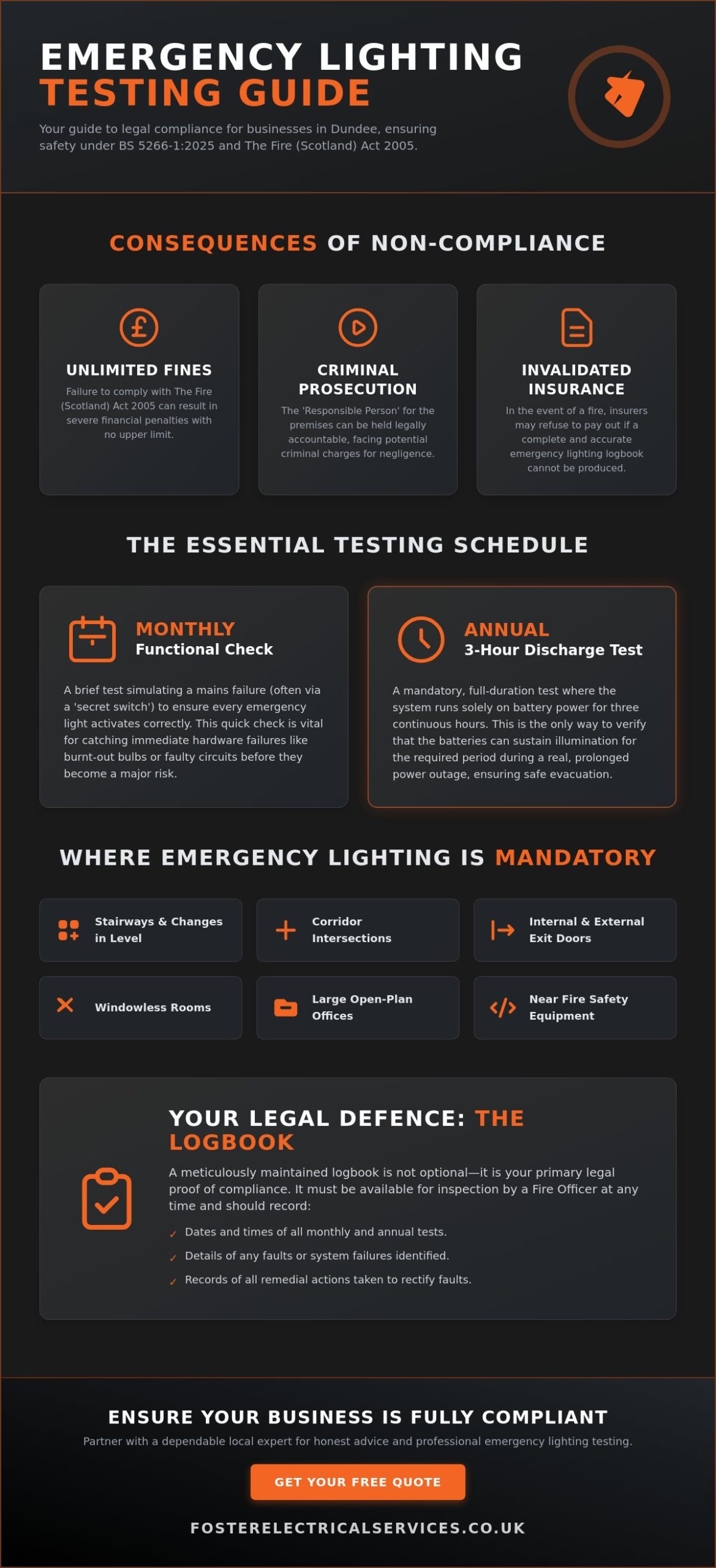
Under Scottish law, the ‘Responsible Person’ is the individual, employer, or entity who has control of the premises to any extent, making them legally accountable for the safety of everyone inside. This could be a shop owner in the Overgate or a landlord managing a multi-occupancy office block. If you fail to keep up with your testing schedule, the consequences are severe. Beyond the risk of unlimited fines and criminal prosecution, non-compliance can completely invalidate your building insurance. We’ve seen cases where insurers refuse to pay out after a fire because the owner couldn’t produce a valid logbook. We believe in doing things the old-fashioned way, which means helping you stay on the right side of the law with honest, dependable service.
Where Emergency Lighting is Mandatory
It isn’t enough to just have a few exit signs above the main doors. You must provide clear illumination at every “point of emphasis” throughout the building. This includes every intersection in a corridor, each change in floor level, and all sets of stairs. In Dundee’s older city centre buildings, windowless rooms and large open-plan offices pose a particular risk. These areas require dedicated emergency units to prevent panic if the lights go out. Finally, don’t forget the outside. External exit points must be adequately lit to ensure staff and tenants can move safely away from the building to a designated assembly point. Proper Emergency Lighting Testing ensures every one of these critical areas remains protected, day and night.
The Testing Schedule: Monthly vs Annual Requirements
We believe in doing things the old-fashioned way, which means consistency is the bedrock of safety. You wouldn’t leave your front door unlocked and hope for the best; the same logic applies to your building’s emergency systems. Emergency Lighting Testing isn’t a bureaucratic chore to be ticked off once a year. It’s a rhythmic commitment to the people who work in and visit your property. By sticking to a steady schedule, you ensure that small faults don’t turn into life-threatening failures during a crisis. This approach aligns perfectly with the Scottish Government Fire Safety Guidance, which emphasises that regular maintenance is a legal necessity for all non-residential buildings in Tayside.
The testing regime is split into two distinct parts: a quick monthly check and a rigorous annual discharge. In many of Dundee’s older properties, particularly those converted from industrial use or historic tenements, electrical components can be temperamental. Skipping these tests is a gamble you don’t need to take. Regular checks allow you to catch a failing battery or a dimmed LED long before an inspector arrives or, worse, an actual power cut occurs. If you’re unsure where to start with your schedule, we can help you set up a dependable maintenance plan that keeps you compliant without any fuss.
How to Conduct a Monthly Functional Test
The monthly functional test is a straightforward check that can often be performed by a competent person on-site. Most systems use a “fish key” to operate a secret switch, usually located near the consumer unit or at the entrance to a room. Inserting this key simulates a mains power failure without actually cutting the electricity to your computers or machinery. Once the emergency units activate, you should walk through the premises with a simple checklist. Look for any lamps that are flickering, significantly dimmed, or failing to light up at all. After you’ve verified every unit is operational, simply turn the switch back. You must then check that the small red or green charging LEDs have illuminated, confirming that the batteries are recharging for the next time they’re needed.
The Annual 3-Hour Discharge Test
While the monthly check is a sprint, the annual test is a marathon. This procedure requires every emergency light to remain illuminated for its full rated duration, which is typically 3 hours for most Dundee commercial sites. Because this test leaves your building’s batteries completely depleted, it requires professional supervision to manage safety whilst the system recovers. We recommend planning these tests during your business’s “down-time” or after hours to avoid disrupting your daily operations. If a unit fails to last the full 180 minutes, it’s a sign the battery has reached the end of its life. In these cases, the unit must be repaired or replaced immediately to maintain your legal compliance and ensure the safety of your staff and tenants.
Manual vs Self-Test Systems: Which is Right for Your Premises?
Choosing the right safety system is about finding a balance between your initial budget and your daily workload. We don’t believe in pushing high-tech gadgets just for the sake of it. If a simple manual switch does the job properly for your small shop, that’s exactly what we’ll recommend. However, for larger sites across Tayside, Emergency Lighting Testing can become a significant drain on your time if you’re doing everything by hand. Understanding the difference between manual and self-test units helps you make an honest, informed decision that protects your Dundee business without adding unnecessary complexity.
We’ve seen many businesses move towards modernising their systems as part of a wider LED lighting upgrade. It’s a sensible way to reduce energy bills whilst improving safety. Our approach is always to provide dependable solutions that don’t rely on complex software or corporate call centres for support. We prefer hardware that is built to last and easy to understand, keeping things straightforward for the real people running the building.
Pros and Cons of Manual Testing
Manual systems are the traditional choice for many budget-conscious landlords and small business owners. The upfront hardware costs are lower because the units don’t require internal microchips to monitor their own health. This makes them a cost-effective choice for a single-room office or a small retail unit in Dundee city centre. The trade-off is the requirement for a dedicated staff member to physically operate the test switches and record every result in the logbook once a month. In large, complex buildings, this reliance on human memory increases the risk of non-compliance. It’s far too easy to miss a single flickering bulb in a back corridor when you’re busy managing a growing company.
When to Upgrade to Automatic Self-Testing
Self-test units take the guesswork out of your safety regime. These units use internal timers to perform their own functional checks and full discharge tests automatically. Instead of you walking around with a fish key, the units communicate their status via a simple LED indicator. A steady green light means the unit is healthy and the battery is charging, whilst a flashing red light signals a fault that needs attention. This is a game-changer for multi-storey buildings in Dundee where manual Emergency Lighting Testing could take an entire afternoon to complete. By simplifying the ‘responsible person’s’ daily walk-through, these systems ensure that faults are identified the moment they happen. We often integrate these units during a consumer unit upgrade to provide a holistic, reliable safety solution that treats your property with the respect it deserves.
Keeping Your Logbook: Compliance Documentation for Tayside Businesses
Imagine a Fire Officer walking into your Dundee business. The first thing they’ll ask for isn’t a demonstration of the lights; it’s your logbook. Think of this document as your ‘Get Out of Jail Free’ card. It’s the only tangible evidence that you’ve been diligent with your Emergency Lighting Testing. Without it, you have no way to prove you’ve met your legal obligations under the Fire (Scotland) Act 2005. We’ve seen businesses face heavy penalties simply because they lacked the paperwork to back up their hard work. We believe in doing things the old-fashioned way, which means keeping records that are honest, clear, and beyond reproach.
A compliant entry isn’t complicated, but it must be thorough. Every time you or a professional carries out a check, you need to record the date, the specific units tested, the result of the test, and the name of the person who did the work. If a fault was found, you must document the remedial actions taken to fix it. Whether you prefer a traditional physical folder or a modern digital backup, the key is accessibility. Your records should be kept on-site and ready for inspection at a moment’s notice. We help our clients by providing clear, ‘no jargon’ reports that can be slipped straight into a logbook, ensuring everything is done properly and transparently.
Managing Failures and Remedial Repairs
When a light fails, the clock starts ticking. Industry best practice suggests that faults should be addressed immediately to ensure the building remains safe for occupancy. You need to record the entire ‘repair path’ in your logbook. This means noting the date the fault was discovered, the temporary safety measures put in place, and the final date the repair was certified. Scottish law requires that you maintain all fire safety records, including emergency lighting logs, for a minimum period of three years. This history shows inspectors that you have a proactive approach to safety rather than just reacting to emergencies. If you’ve discovered a fault today, we can provide expert repairs and certification to get your logbook back up to date.
Preparing for a Fire Safety Audit in Dundee
During a fire safety audit in Dundee city centre, inspectors often look for consistency. They might ask how you manage your monthly checks or who is responsible for the annual discharge. It’s vital that your site map and circuit labels match your logbook entries exactly. If your logbook says ‘Unit 4’ failed, the inspector should be able to find ‘Unit 4’ on your wall and see that a new battery has been fitted. A professional EICR can complement these records by proving the underlying wiring is safe, giving you total peace of mind before the inspector even knocks on your door. By treating your property like it’s our own, we ensure your documentation is as robust as the lights themselves.
Professional Emergency Lighting Testing the Foster Electrical Way
We believe a simple promise goes a long way: we show up when we say we will. In an industry often plagued by anonymous corporate call centres and hidden extras, we offer a straightforward, honest alternative for the Dundee community. Our approach to Emergency Lighting Testing is rooted in traditional values of hard work and integrity. We don’t just see your office, shop, or warehouse as a contract; we treat every commercial property with the same respect and care we’d give our own homes. This means no jargon, no nonsense, and a total commitment to getting the job done properly the first time.
Safety shouldn’t be a source of stress for business owners. Our goal is to act as a protective guardian for your premises, ensuring you remain fully compliant with the latest BS 5266-1:2025 standards without having to navigate technical minefields yourself. We provide comprehensive, easy-to-read certificates for every annual test we conduct. These documents are your proof of diligence, and we take personal pride in ensuring they are accurate and robust enough to satisfy any fire safety inspector who walks through your door.
Our Local Tayside Testing Process
We’ve refined our process to ensure minimal disruption for our clients across the region. From the initial site survey to the final logbook certification, we manage the entire workflow so you don’t have to. We understand that your business needs to stay operational, so we frequently organise our testing hours amongst our Tayside clients to suit their specific schedules. Our service includes:
- A thorough site survey to identify all points of emphasis and escape routes.
- Full duration discharge testing to verify battery health and lamp brightness.
- Expert fault finding to pinpoint why a unit might be flickering or failing to charge.
- On-the-spot repairs for common issues, often saving you the cost of a second visit.
- Detailed logbook updates that meet all Scottish legal requirements.
Contact Your Trusted Dundee Electrician
Getting your safety systems in order doesn’t have to be a headache. You can request a straightforward, honest quote for your annual testing today. Many of our clients find better value and total peace of mind by combining their emergency lighting checks with other essential services. We can easily bundle your testing with PAT testing or a full EICR (Electrical Installation Condition Report) to ensure every aspect of your property’s electrical system is safe and dependable. We don’t cut corners, and we never use high-pressure sales tactics; just real people providing a quality service for our local community.
Book your Emergency Lighting Test with Foster Electrical to ensure your Dundee business stays safe, compliant, and ready for 2026.
Secure Your Dundee Premises for 2026
Staying on top of your fire safety duties doesn’t need to be a jargon-heavy headache. We’ve explored how the Fire (Scotland) Act 2005 and the updated BS 5266-1:2025 standards shape your responsibilities, from the simple monthly flick test to the rigorous three-hour annual discharge. Whether you’re managing a city centre shop or a multi-storey office block, keeping a meticulous logbook remains your best defence against legal penalties and insurance issues.
As a local Dundee business built on old-fashioned values, we take pride in doing things properly. We’re a NICEIC Approved Contractor with specific expertise in Scottish Fire Safety compliance, which means we treat your property with the same respect we’d show our own. We don’t hide behind call centres or use confusing technical talk. Instead, we provide dependable Emergency Lighting Testing that gives you total peace of mind that your building is safe.
Request a no-obligation quote for your Dundee business today and let us help you protect your staff and tenants. You’ll find that having a trusted local craftsman in your corner makes the whole process straightforward and stress-free.
Frequently Asked Questions
How often should emergency lighting be tested in a Dundee office?
Every Dundee office must undergo a short functional test once a month and a full duration discharge test every year. These requirements are set by the BS 5266-1:2025 standard, which was updated in December 2025. Staying consistent with this schedule is the only way to ensure your system remains dependable and compliant with Scottish law.
Can I test my own emergency lighting monthly, or do I need an electrician?
You can carry out the monthly functional checks yourself as long as you are a “competent person” who knows how to operate the test switches safely. For the annual three-hour discharge test, it’s best to use a professional electrician. We provide the expert certification and logbook entries that fire inspectors look for during their visits.
What is the difference between a functional test and a full duration test?
A functional test is a quick check, often called a flicker test, to see if the lamps illuminate when you simulate a power failure. A full duration test is much more rigorous; it drains the battery completely for 180 minutes. This proves the units can provide light for the full time needed to evacuate a building during a major incident.
Is it a legal requirement to have a logbook for emergency lighting in Scotland?
Yes, keeping a detailed logbook is a mandatory requirement under the Fire (Scotland) Act 2005. You must record every test result, fault, and repair, then keep these records on-site for at least 3 years. If you don’t have a logbook, a Fire Officer can issue an enforcement notice that could disrupt your business operations.
What happens if an emergency light fails its annual 3-hour test?
If a unit fails to stay lit for the full 3 hours, you must record the failure in your logbook and arrange a repair immediately. Most failures are caused by batteries reaching the end of their 4-year or 5-year lifespan. We recommend fixing these faults within 24 hours to ensure your staff and tenants stay protected.
Do I need emergency lighting in a small shop or cafe in Dundee?
Most small shops and cafes in the city centre require emergency lighting to cover escape routes, toilets, and windowless storerooms. Even a small premises needs to ensure that customers can find the exit safely if the mains power fails. Your fire risk assessment will pinpoint exactly where these lights must be installed.
How much does professional emergency lighting testing cost in Tayside?
The cost of professional Emergency Lighting Testing in Tayside depends on the number of units in your building and the type of system you have installed. We believe in providing honest, straightforward quotes with no hidden extras. This ensures you get a quality service done properly by a local expert who cares about your safety.
Can LED lighting upgrades include emergency backup functions?
Yes, many modern LED panels and downlights can be fitted with integrated emergency backup batteries. Switching to LEDs is a great way to reduce your energy bills whilst modernising your safety system. We often install these “all-in-one” units during lighting upgrades to keep things simple and dependable for our Dundee clients.