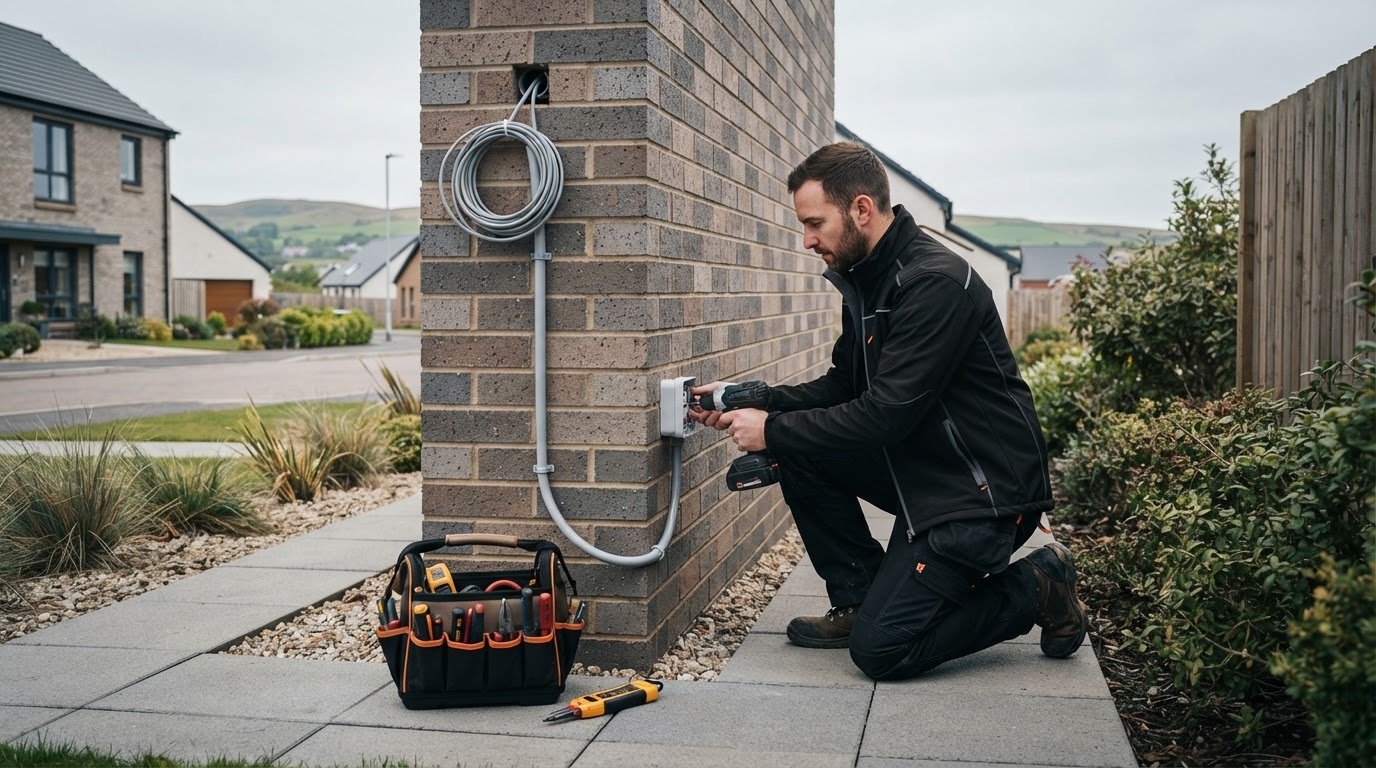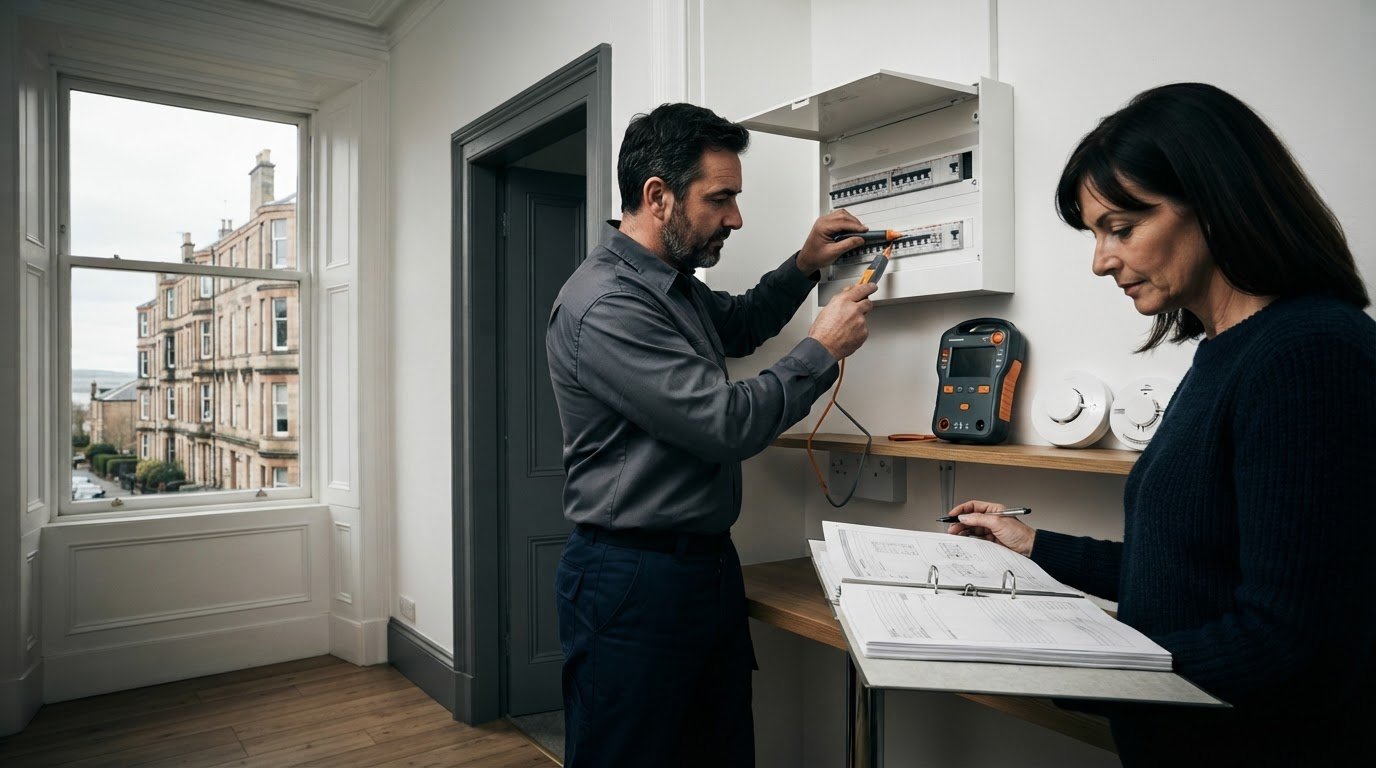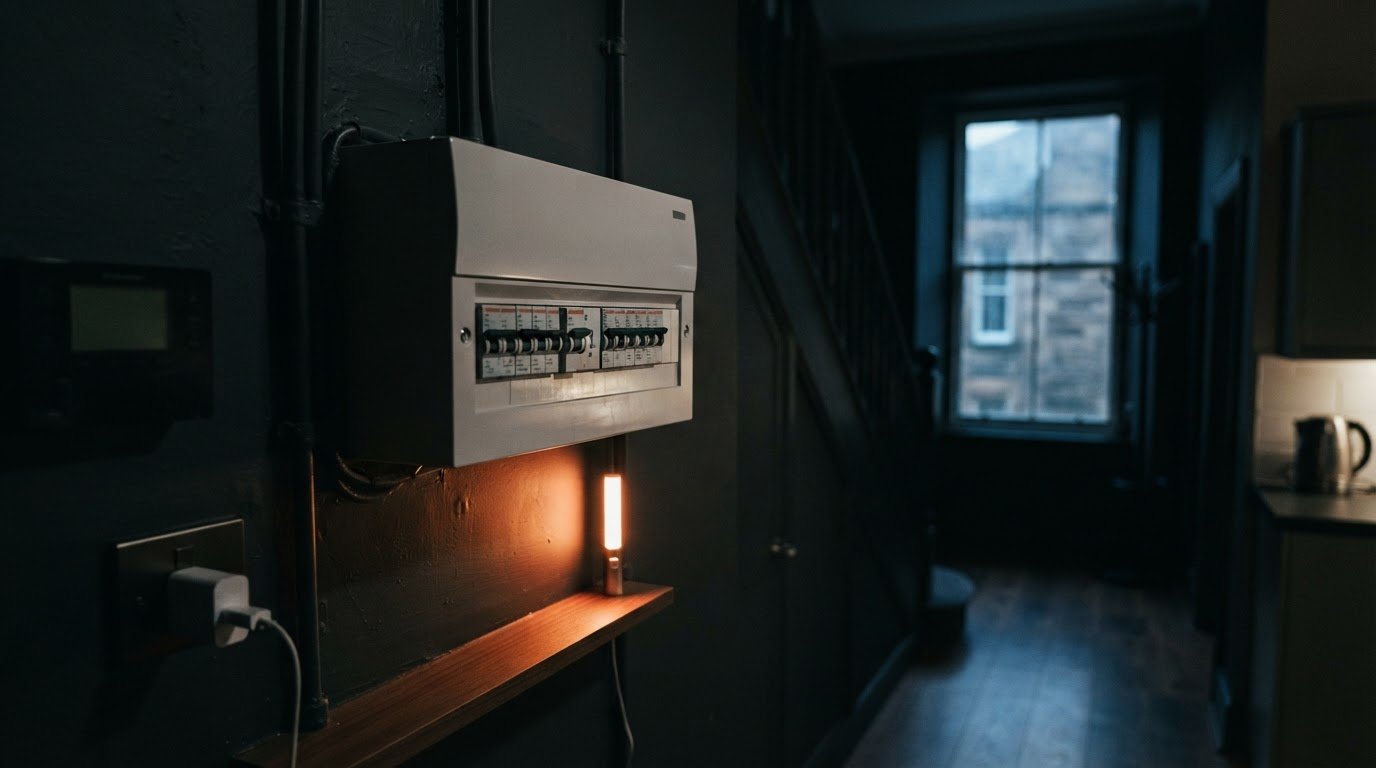
Is your rental property truly as safe as it looks, or is an outdated electrical report quietly putting your landlord registration at risk? We understand that keeping up with the Housing (Scotland) Act 2014 often feels like a moving target. It’s perfectly natural to feel a sense of worry regarding changing laws or the difficulty of finding a tradesman who values integrity over a quick profit. You want to protect your tenants and your investment, but you certainly don’t want to be met with hidden agendas or a list of unnecessary, expensive repairs.
Securing a valid eicr certificate for landlords dundee should be a straightforward process built on traditional sincerity and clear communication. We’ve put together this complete 2026 guide to give you total peace of mind. You’ll learn exactly what Scottish inspectors look for, how to prepare your home for a seamless visit, and how to interpret your report with confidence. From understanding the mandatory five-year renewal cycle to distinguishing between your EICR and PAT testing requirements, we’ve covered every detail to keep you compliant with Tayside councils whilst ensuring your property remains a safe haven for those living there.
Key Takeaways
- Understand your mandatory legal obligations under the Housing (Scotland) Act 2014, including the non-negotiable five-year renewal cycle for every rental property.
- Learn how to secure a valid eicr certificate for landlords dundee through a thorough yet respectful inspection of your property’s fixed wiring and electrical components.
- Gain clarity on industry-standard classification codes, helping you distinguish between minor recommendations and urgent safety failures that require immediate remedial work.
- Discover practical steps to prepare your property for an engineer’s visit, ensuring clear access to consumer units and helping you communicate effectively with your tenants.
- See how choosing a trusted local expert provides a clear, honest assessment that prioritises tenant safety and property longevity over high-pressure sales.
Understanding Your Legal Obligations as a Dundee Landlord
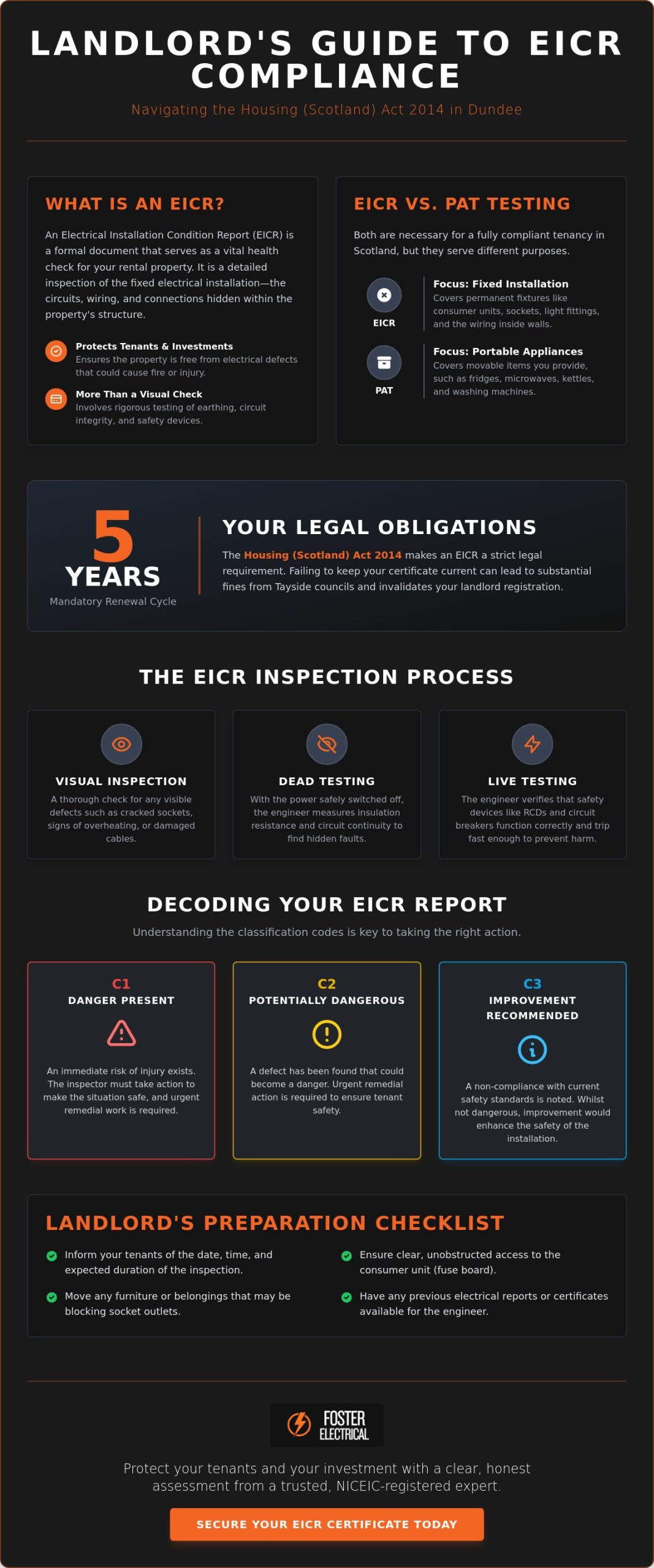
Owning a rental property in Dundee carries a significant weight of responsibility. It is about more than just collecting rent; it is about providing a safe, reliable home for your tenants. An Electrical Installation Condition Report (EICR) is a formal document that follows a detailed inspection of your property’s permanent electrical wiring and fixed connections. Unlike a simple visual check or a PAT test for a kettle, an EICR looks behind the scenes at the safety of the circuits hidden within your walls. We view this not as a bureaucratic hurdle, but as a vital health check for your investment.
Under the Housing (Scotland) Act 2014, obtaining an eicr certificate for landlords dundee is a strict legal requirement. You must ensure this inspection happens at least once every five years. Many landlords who first complied when these rules became mandatory are now finding their certificates are due for renewal in 2026. Failing to keep this current doesn’t just risk your landlord registration; it can lead to substantial fines from local authorities across Tayside. We believe in getting it right the first time so you never have to face those stressful situations.
It is helpful to distinguish between the various types of testing you might encounter. Whilst an EICR focuses on the “fixed” installation like consumer units and sockets, Portable Appliance Testing (PAT) covers movable items you provide, such as fridges or microwaves. In Scotland, both are necessary for a fully compliant tenancy. A quick visual check might catch a cracked light switch, but only a full EICR involves the rigorous testing of earthing and circuit integrity required by the Scottish Government’s standards.
The Private Rented Housing (Scotland) Act requirements
The legislation has evolved significantly to protect families and individuals across Dundee. To meet the “Tolerable Standard” set by the Scottish Government, your property must be free from electrical defects that could cause fire or injury. If you don’t comply, Dundee City Council has the power to issue work notices or even revoke your right to let the property entirely. We treat every inspection with the seriousness it deserves, ensuring your paperwork is robust enough to satisfy any council audit. Our goal is to provide a clear, honest report that keeps you on the right side of the law without any hidden agendas.
Who is authorised to carry out an EICR in Dundee?
Finding someone you can trust with your property is vital. The law requires that a “competent person” carries out these checks, meaning they must have the right qualifications and experience. We take great pride in our NICEIC registration because it represents a hallmark of safety and diligence that rogue traders simply cannot match. Avoiding “paper-only” certificates from anonymous corporations is essential for your protection. We prefer direct, human interaction and an artisanal approach to our work, ensuring that when we sign off on your eicr certificate for landlords dundee, it truly stands for tenant safety and property longevity.
What Happens During the EICR Inspection Process?
We believe that an electrical inspection should be a source of reassurance rather than a cause for stress. When we enter a rental property to provide an eicr certificate for landlords dundee, we do so with a sense of traditional sincerity and respect for the domestic environment. We treat every home as if it were our own, ensuring we are meticulous about tidiness and personal care throughout the visit. Our engineers don’t just rush through a checklist; they perform a diligent balance of visual inspections and rigorous technical tests to ensure the property remains a safe haven for your tenants.
The consumer unit, or fuse board, is the heart of the electrical system and receives our closest attention. We conduct two main types of testing: “dead testing” and “live testing”. Dead testing happens whilst the power is safely switched off. This allows us to measure the resistance of the insulation and the continuity of the wiring, ensuring everything aligns with the Scottish Government guidance for private rentals. Live testing follows, where we verify that your safety devices, such as RCDs, trip fast enough to prevent a dangerous shock. This methodical approach eliminates ambiguity regarding the safety of your installation.
The primary components we inspect
We pay close attention to earthing and bonding, which provides the vital safety path for electricity if a fault occurs. In many older Dundee tenements, we often find outdated wiring materials that have reached the end of their natural life. We also open a representative sample of sockets and switches to check for internal heat damage or loose connections. These are the hidden risks that a simple visual check would never uncover, and identifying them is part of our commitment to your property’s longevity.
Power interruptions and your tenants
Reliability and punctuality are our firm promises to you and your tenants. We always organise our work to minimise disruption. The power will need to be switched off for a period, typically between one and three hours, to conduct the necessary dead tests safely. We recommend communicating this clearly to your tenants in advance to ensure a smooth, stress-free visit. We take personal pride in our high standards of execution and our ability to bridge the gap between technical expertise and domestic comfort. If you are looking for a team to handle your eicr certificate for landlords dundee with a truly human touch, we are ready to help.
Decoding the Results: C1, C2, and C3 Codes Explained
Receiving your final report shouldn’t feel like deciphering a secret language. We aim to bridge the gap between technical expertise and domestic comfort by providing a clear, honest assessment of your property’s safety. Your report will conclude with a simple verdict: either “Satisfactory” or “Unsatisfactory”. Whilst a satisfactory result means you have successfully secured your eicr certificate for landlords dundee, an unsatisfactory result simply means there are specific safety issues that need our attention to protect your tenants and your investment.
The heart of the report lies in the classification codes. A C1 code is the most serious, indicating “Danger Present”. If we discover a C1 during an inspection, such as exposed live parts, we act as protective guardians of the environment and will typically isolate the danger immediately to prevent injury. A C2 code means “Potentially Dangerous”. These are urgent issues that don’t pose an immediate threat but could become hazardous under fault conditions. According to guidance from Electrical Safety First, both C1 and C2 results will result in an unsatisfactory report. Finally, a C3 code is for “Improvement Recommended”. These aren’t failures; they are professional suggestions to help you maintain high standards of execution and property longevity.
When a “Fail” isn’t a disaster
Finding faults in your property can be stressful, but it’s a vital part of our diligent service. We believe in transparency, which is why we provide straightforward, honest quotes for any necessary remedial work with no hidden agendas. We don’t use high-pressure tactics; we simply show you what’s needed to make the home safe again. Under Scottish law, any remedial work identified as C1, C2, or FI must be completed within 28 days of the initial inspection. Once these repairs are finished, your “Unsatisfactory” status is updated, and your compliance is fully restored.
Common failures in older Dundee properties
Dundee is famous for its beautiful traditional tenements, but these older builds often present unique challenges. We frequently find consumer units that lack RCD protection, which is a common reason for a C2 fail. Another recurring issue is “DIY” electrical work. We often see where previous tenants or unqualified handymen have added sockets or lights incorrectly, creating hidden risks behind the walls. Additionally, whilst we are on-site for an eicr certificate for landlords dundee, we often find that interlinked smoke and heat alarms are missing or outdated. We take personal pride in identifying these flaws before they become dangerous, ensuring your property remains a secure, high-standard home.
A Landlord’s Checklist: Preparing Your Property for the Engineer
Preparing for your electrical inspection is a simple way to ensure the process remains logical and transparent. We view our role as a protective guardian of your property, and a little bit of groundwork from you helps us maintain our high standards of execution. By clearing the way, you allow us to focus entirely on the safety of your installation without the distraction of moving furniture or searching for hidden fuse boards. This partnership between landlord and expert is what makes the process truly seamless.
Before we arrive, take a walk through your property with a critical eye. Look for cracked socket plates, burnt marks around outlets, or light switches that feel loose or “spongy” when pressed. These small, visible issues are often the first things we notice during a visit. Addressing these minor repairs beforehand can streamline the visit and help you secure your eicr certificate for landlords dundee without unnecessary delays or secondary visits. If you have previous electrical reports or wiring diagrams from a past rewire, having them ready provides us with a historical roadmap of the property’s electrical behaviour.
- Clear the path: Ensure there is at least one metre of unobstructed space around the consumer unit.
- Test the keys: Verify that you have keys for all locked communal areas or external meter cupboards.
- Notify tenants: Provide at least 24 hours’ notice regarding the specific time of the power-down.
- Check the bulbs: Replace any blown light bulbs so we can accurately test the lighting circuits.
Organising access to every room
We need to test a representative percentage of every circuit in the building to provide an honest and accurate report. This requirement means we must have access to every single room, including attics, basements, and those often-forgotten storage cupboards. If you have a locked unit housing a sub-board or a specific circuit, please ensure the keys are available on the day. Clearing clutter from around the main fuse board is also vital. We take personal pride in being meticulous about tidiness, but having a clear workspace allows us to conduct our tests with the grounded professionalism you expect.
Protecting sensitive electronics
Modern homes are filled with sensitive technology that doesn’t always take kindly to sudden power interruptions. We advise your tenants to shut down computers, gaming consoles, and any smart home hubs before the power-off period begins. Whilst we are careful and treat every property with personal care, we cannot be responsible for data loss on devices left running during a circuit test. We take pride in our “right first time” attitude, and leaving your property exactly as we found it is a core part of our service promise. If you are ready to prepare your property for compliance, you can book your EICR inspection with our local team today.
Why Dundee Landlords Choose Foster Electrical for Compliance
We are proud to be a local business with deep roots in the Dundee community. Our commitment to local safety is not just a marketing slogan; it is a personal pledge we make to every neighbour we serve. When you choose us for an eicr certificate for landlords dundee, you are partnering with experts who understand the specific challenges of Tayside’s housing stock. We don’t believe in high-pressure sales or technical complexity designed to confuse. Instead, we offer a “right first time” attitude that prioritises the durability of your electrical systems and the safety of your tenants.
Honesty is the foundation of our work. We reject opaque pricing structures in favour of a straightforward, service-oriented approach where what you see is what you get. Whether you manage a single domestic rental or a portfolio of commercial properties, we bring the same level of diligence and integrity to every job. Often, a safety inspection reveals that older systems need a bit of care to meet modern standards. This is where our Consumer Unit Upgrades and Property Rewiring services provide a seamless path to total compliance, ensuring your property remains a safe, high-standard environment for years to come.
Traditional values, modern standards
We take immense pride in our meticulous workmanship. Our role is that of a protective guardian for your investment, bridging the gap between technical expertise and domestic comfort. We avoid the impersonal corporate infrastructure that treats landlords like numbers on a spreadsheet. By focusing on genuine safety concerns and maintaining clear, human communication, we ensure that every client feels respected and every property is treated with personal care. It is a time-tested method of working that values the relationship as much as the transaction.
Booking your Dundee EICR with Foster Electrical
Getting started is a simple, human process. We prefer direct interaction, so when you reach out for a quote, you’ll speak with someone who truly understands the local landscape. Once the inspection is complete, we provide your digital certificate promptly, ensuring you have the documentation needed for Tayside council requirements without any unnecessary delays. We believe that reliability and punctuality are firm promises, not just goals. Contact Foster Electrical today to book your Dundee landlord safety inspection.
Ensuring Safety and Compliance for Your Tayside Property
Staying on top of your legal obligations under the Housing (Scotland) Act 2014 doesn’t have to be a source of stress. We’ve explored how a valid electrical report protects your tenants and ensures your landlord registration remains in good standing. By preparing your property and understanding the classification codes, you move from uncertainty to total peace of mind. It is about more than just a tick-box exercise; it is about the long-term health of your investment.
We take personal pride in our reputation as a highly rated local service with traditional values. As a NICEIC Approved Contractor, we act as a protective guardian for your Tayside property. We don’t use high-pressure tactics or hide behind technical jargon; we simply provide an honest assessment of your home’s safety. Our team specialises in Dundee rental compliance, bringing a diligent, artisanal approach to every inspection we conduct.
If you are ready to secure your eicr certificate for landlords dundee, we are here to provide a reliable, person-to-person service. Secure your Dundee property with a professional EICR from Foster Electrical and rest easy knowing your investment is in safe, expert hands. Your compliance is our priority, and we look forward to helping you maintain the highest standards of safety for years to come.
Frequently Asked Questions
How much does an EICR certificate cost for a landlord in Dundee?
The cost typically depends on the size of your property and the number of electrical circuits that require testing. Whilst industry averages in Dundee often range from £100 for smaller flats to over £300 for larger detached houses, we provide clear and honest quotes based on your specific needs. We avoid opaque pricing structures to ensure you receive a fair assessment without any hidden agendas or high-pressure sales tactics.
Does a landlord legally need an EICR every year in Scotland?
No, the standard legal requirement in Scotland is to have a new inspection carried out at least once every five years. This rule applies to all private residential tenancies under the Housing (Scotland) Act 2014. You must also provide a copy of the most recent report to any new tenant before they move in, or to existing tenants within 28 days of a new inspection taking place.
What is the difference between an EICR and a Landlord Safety Certificate?
An EICR is the formal technical document produced after a rigorous inspection of the fixed electrical installation. Many people use the term “Landlord Safety Certificate” as a generic catch-all phrase, but for electricity, the EICR is the specific legal requirement. It is a detailed report that identifies the condition of your wiring, consumer unit, and earthing, rather than just a simple visual check of the property.
Can a tenant refuse access for an EICR inspection in Dundee?
Tenants have a right to quiet enjoyment, but they also have a responsibility to allow access for essential safety checks and repairs. You should provide at least 24 hours’ written notice before the visit to maintain a respectful relationship. We find that clear communication about the safety benefits helps ensure a smooth process, as most tenants appreciate the peace of mind that comes from knowing their home is electrically sound.
Do I need an EICR if I am only renting out a single room (HMO)?
Yes, any property let as a main home requires a valid report, including Houses in Multiple Occupation (HMOs). If you are renting out rooms in Dundee, you must secure an eicr certificate for landlords dundee to remain compliant with local licensing. HMOs are often subject to even stricter scrutiny from the council, so keeping your electrical safety paperwork current is vital for protecting your registration and your tenants.
What happens if my property fails the EICR inspection?
If your report is marked as “Unsatisfactory” due to C1, C2, or FI codes, you have a legal obligation to complete the remedial work within 28 days. We act as a protective guardian for your property by identifying these risks and providing transparent solutions. Once the necessary repairs are finished, we can issue the final documentation to confirm the installation meets the required safety standards for the private rented sector.
Is PAT testing mandatory for Dundee landlords alongside the EICR?
Yes, in Scotland, Portable Appliance Testing (PAT) is a mandatory requirement for any movable electrical items you provide to your tenants. Whilst the eicr certificate for landlords dundee covers the permanent wiring and sockets, PAT testing ensures that appliances like fridges, washing machines, and kettles are safe to use. We often conduct both tests during the same visit to minimise disruption and ensure your property is fully compliant.
How long does an EICR assessment typically take for a 3-bedroom house?
A thorough inspection for a standard three-bedroom home usually takes between two and four hours to complete correctly. This timeframe allows us to be meticulous about our testing, checking a representative percentage of your circuits and inspecting the consumer unit in detail. We take personal pride in our high standards of execution, so we never rush the process, ensuring every safety check is performed with grounded professionalism and care.