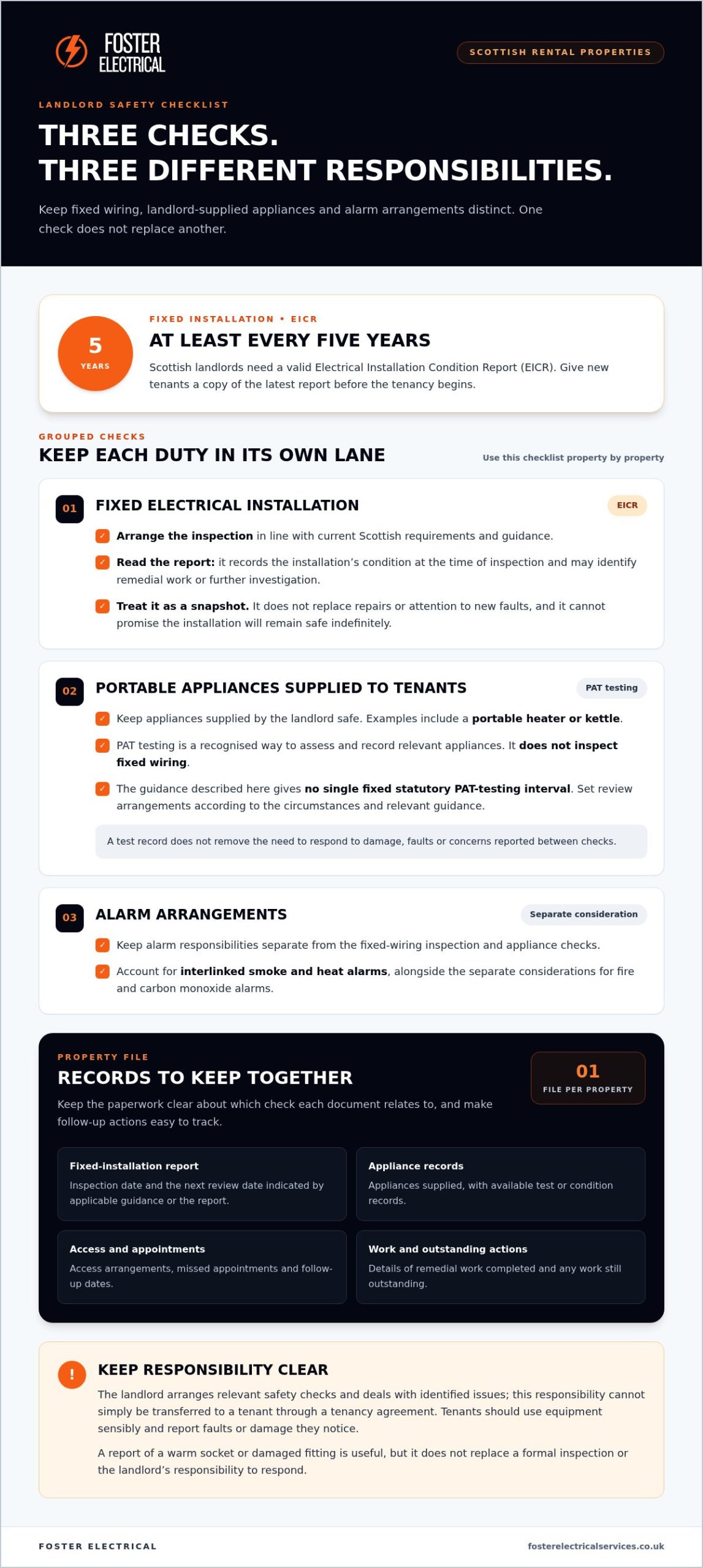
Are you sure an EICR, portable appliance checks and fire alarms cover the same safety duties? They don’t. Keeping each requirement clear is central to a landlord guide to scottish electrical regulations. In Scotland, landlords need a valid EICR at least every five years and must give a copy of the latest report to new tenants before the tenancy begins. Portable appliances and interlinked smoke and heat alarms involve separate considerations.
It’s understandable to feel unsure about which checks apply, what paperwork to retain or what to do when an inspection identifies a fault. A clear record of checks and timely attention to reported findings can make your responsibilities easier to manage.
This guide explains the main electrical safety duties for Scottish rental properties, how EICRs differ from PAT testing and alarm requirements, and which records are useful to keep. It also covers how to approach inspection findings while keeping urgent safety issues in view. Foster Electrical provides EICR inspections, PAT testing, interlinked smoke and heat alarm installation and remedial electrical work for landlords in Dundee, Perth, Angus, Fife and St Andrews.
Key Takeaways
- Use this landlord guide to scottish electrical regulations to separate responsibilities for fixed wiring, portable appliances and alarms.
- Keep EICR findings and PAT testing records together in a property file, while making clear which check each document relates to.
- Read an electrical report carefully and arrange any necessary work according to its findings and current guidance.
- Understand how alarm responsibilities sit alongside electrical checks, including the separate considerations for fire and carbon monoxide alarms.
Scottish landlord electrical regulations: what responsibilities should you understand?
Start by separating the property’s fixed wiring, appliances supplied for tenants’ use and alarm responsibilities. Each serves a different purpose, so one check cannot replace another. A straightforward system for arranging checks, reviewing findings and recording follow-up work helps you keep track of what has been done and what remains outstanding.
This landlord guide to scottish electrical regulations focuses on private rented homes in Scotland. It covers electrical installations, portable appliances provided by the landlord, and related fire and carbon monoxide alarm responsibilities. An EICR on fixed wiring does not document the condition of a kettle supplied with the property or establish whether required alarms are in place and working.
Which Scottish rental-property framework applies?
For Scottish private rentals, the Repairing Standard is set out in the Housing (Scotland) Act 2006. It concerns the landlord’s obligations to keep a property meeting the required repair and condition standards. Electrical safety sits within this wider framework, but not every electrical check or technical detail is stated in the same provision. Use current Scottish legislation and official guidance when planning compliance.
Rules written for England are not automatically Scottish rules. Don’t apply England-specific private-rental regulations to a Scottish tenancy simply because an online checklist uses familiar terms. The legal framework and guidance differ across the UK. For general context on the hazards electricity can present, see Electrical Safety Principles, then use the relevant Scottish requirements to guide landlord decisions.
Who is responsible for electrical safety in a rented home?
The landlord is responsible for arranging relevant safety checks and dealing with identified issues. That responsibility cannot simply be transferred to a tenant through a tenancy agreement. Tenants should use electrical equipment sensibly and report faults or damage they notice, so concerns can be assessed and addressed.
In practice, the landlord’s role is to keep oversight: know which checks apply, arrange them at the appropriate time, review the records and organise necessary work. A tenant’s report of a warm socket or damaged fitting is useful, but it doesn’t replace a formal inspection or the landlord’s responsibility to respond.
Tenancy arrangements can affect access and inspection timing, so clear communication helps the work proceed smoothly. Keep Scottish guidance at the centre of your decisions, and treat inspection records, appliance checks and alarm arrangements as related but distinct parts of a safety plan. Foster Electrical provides electrical services including EICR inspections for landlords in Dundee and nearby areas.
What electrical safety checks should Scottish landlords organise?
Keep the checks distinct from the outset. An inspection of the fixed electrical installation assesses the property’s wiring and associated fittings. Checks of portable appliances concern items supplied for tenants’ use. Neither replaces the other, and a satisfactory report on one category doesn’t confirm the condition of the other.
What does an electrical installation condition report cover?
An Electrical Installation Condition Report (EICR) records the condition of a property’s fixed electrical installation at the time of inspection. It sets out observed findings and may identify remedial work or further investigation. An EICR is a snapshot, not a promise that the installation will remain safe indefinitely, so it doesn’t replace repairs or attention to new faults.
Arrange inspections in line with current Scottish requirements and guidance, and keep a clear diary for each property. Record the inspection date, the next review date indicated by the applicable guidance or report, and any access arrangements that affected the visit. These details are useful when you need to plan an inspection or rearrange an appointment with a tenant.
Keep the report with related correspondence and evidence of completed work. If an inspection notes an issue, record how it was addressed and retain relevant follow-up documentation. This makes outstanding actions easier to identify than relying on memory or scattered messages. A landlord guide to scottish electrical regulations should treat the report as part of an ongoing safety record, not a document to file away without reviewing.
When might portable appliance checks be relevant?
Portable appliances are separate from fixed wiring. They include electrical items the landlord supplies as part of the rental, such as a portable heater or kettle. Scottish landlord guidance requires supplied appliances to be safe. PAT testing is a recognised way to assess and record the condition of relevant appliances, but it doesn’t inspect the home’s fixed installation.
There isn’t a single fixed statutory PAT testing interval in the guidance provided. The appropriate approach is to keep appliances safe and set review arrangements according to the circumstances and relevant guidance. A test record helps show what was checked and when, but it doesn’t remove the need to respond to damage, faults or concerns reported between checks.
For each property, a practical record can include:
- the fixed-installation inspection date and report;
- the appliances supplied and available test or condition records;
- access arrangements, missed appointments and follow-up dates;
- details of remedial work completed and any outstanding actions.
Keep the schedule aligned with current Scottish guidance, as requirements and circumstances can differ between properties. Foster Electrical provides EICR inspections and PAT testing for landlords, helping keep these checks clearly recorded as separate parts of a safety plan. For practical support arranging relevant checks, speak with Foster Electrical.
EICR, PAT testing and alarms: how do the responsibilities differ?
These checks address different parts of a rental property, so keep their purposes and records separate. A satisfactory Electrical Installation Condition Report (EICR) is evidence about the fixed installation, but it doesn’t show that portable appliances have been checked or that required alarms are present and working. This landlord guide to scottish electrical regulations treats each as a separate part of a considered safety plan.
| Category | Purpose and subject assessed | Record and follow-up |
|---|---|---|
| EICR | Assesses the fixed electrical installation, such as wiring and associated fittings, at the time of inspection. | Keep the report and record any recommended investigation or remedial work. Arrange follow-up as indicated by its findings. |
| PAT testing | Assesses relevant portable electrical appliances supplied with the rental. It does not inspect fixed wiring. | Retain appliance test records and address faults or damage. The EICR cannot replace this record. |
| Fire and carbon monoxide alarms | Addresses separate alarm responsibilities, not the condition of wiring or portable appliances. | Keep useful records of installation, checks and follow-up, and act on faults or missing alarms in line with current Scottish guidance. |
EICR and PAT testing are not interchangeable
An EICR concerns the property’s fixed electrical installation. PAT testing relates to portable appliances provided for tenants’ use. For example, an EICR doesn’t establish the condition of a landlord-supplied toaster, just as an appliance test doesn’t assess the fixed wiring. Keep the reports and appliance records distinct so you can see what each check covers and which actions remain.
Use the relevant EICR inspection service information for details about a fixed-installation inspection. The report’s findings should guide any further investigation or work. Neither check removes the need to respond to concerns raised later.
Keep alarm responsibilities distinct from electrical inspection
Scottish guidance requires interlinked smoke and heat alarms in specified areas of the home: a smoke alarm in the living room or most-used room, smoke alarms in hallways and landings, and a heat alarm in the kitchen. Carbon monoxide alarms are a separate consideration for rooms containing a carbon-fuelled appliance or a flue. An EICR or PAT test doesn’t demonstrate that these requirements are met. See the Scottish Government guidance on fire and smoke alarms for the alarm requirements.
Keeping the categories clear makes gaps easier to spot: wiring, supplied appliances and alarms each need attention suited to their purpose. Foster Electrical provides EICR inspections, PAT testing and interlinked smoke and heat alarm installation for landlords.
What should a Scottish landlord do after an electrical report?
A report is most useful when it leads to clear, recorded action. Findings can range from observations to recommendations or issues needing attention. The next step depends on what the report says. Don’t assume every note has the same urgency or apply a deadline without checking the relevant Scottish guidance and the report’s advice.
A measured response helps you act promptly without guessing. Use this workflow to move from findings to follow-up:
- Read the report in full. Check which parts of the property were inspected, what the findings describe and whether further investigation or remedial work is recommended.
- Clarify the recommended action. If a finding or its implications aren’t clear, use the explanation in the report to understand the recommended next step. Keep relevant details with the report so your decisions are documented.
- Assess urgency and arrange work. Base your response on the actual findings and current applicable guidance. Plan access with the tenant, explain what work is needed and arrange any follow-up inspection or investigation identified.
- Keep evidence of completion. Save dated invoices, work records, updated reports or other relevant documentation, and note any actions still outstanding.
How should landlords interpret report findings?
Separate what the report observed from what it recommends. An observation records a condition seen during the inspection; a recommendation may call for improvement, further investigation or remedial work. The report’s wording should guide your response. Avoid assigning a technical code or deadline from memory, especially where current standards or Scottish guidance may affect how findings are treated.
Access arrangements matter too. Tell tenants what work is proposed, why entry is needed and how you’ll organise the visit. If access needs to be rearranged, record the communication and agree a practical next step. Clear, respectful updates help maintain a useful property history and reduce the chance of an unresolved finding being overlooked.
Which records help demonstrate a managed safety process?
Keep a dated record for each property, rather than relying on a folder of reports without context. A useful file brings together the inspection document, relevant appliance records, a summary of the action taken and evidence that recommended work was completed. Include the property address, report and work dates, outstanding items, and communications about access or planned repairs.
If a report identifies a concern about a consumer unit, record the finding and the action taken. A consumer unit upgrade may be relevant where remedial advice indicates that work is needed, but the report’s specific findings should determine the response. Keep work records alongside the original report so the sequence is easy to follow.
This landlord guide to scottish electrical regulations comes down to a straightforward habit: review, respond and retain evidence. Foster Electrical provides EICR inspections and remedial electrical work for landlords. Arrange support with electrical report findings.
Arrange landlord electrical safety support in Dundee and nearby areas
Once you’ve identified which checks or follow-up work a property needs, a local electrical service can help you organise the next steps. Foster Electrical supports landlords with EICR inspections, PAT testing, interlinked smoke and heat alarm installation, and relevant electrical work, including repairs and consumer unit upgrades. These services address different parts of a property’s safety plan, so the work can be considered in light of your report and the concerns you’ve identified.
Foster Electrical is based in Dundee and serves landlords in Dundee, Perth, Angus, Fife and St Andrews. Whether you’re arranging an inspection of a rental property’s fixed installation, assessing landlord-provided appliances or planning work identified in a report, a clear description of the property and issue gives the conversation a practical starting point.
What local support can help a landlord manage?
An EICR inspection provides information about the condition of a property’s fixed electrical installation at the time of inspection. PAT testing is a separate service for relevant portable appliances, while interlinked smoke and heat alarm installation concerns the home’s alarm arrangements. Keeping these categories distinct helps you identify the right work and maintain clear records for each property.
If an existing report identifies a concern, have the relevant finding to hand when discussing electrical work. The recommendation in the report, rather than a general assumption, should guide the next step. Foster Electrical also undertakes electrical repairs and consumer unit upgrades, which may be relevant where the findings point to that kind of work. A considered response starts with the property’s documented needs.
How can landlords start a practical conversation?
To make an initial discussion useful, gather a few straightforward details:
- Property location: note the town or area, such as Dundee, Perth, Angus, Fife or St Andrews.
- What you need: describe whether you’re arranging an EICR, PAT testing, alarm installation or follow-up electrical work.
- Existing information: have relevant report findings, previous records and any concern raised by a tenant to hand.
- Access considerations: explain practical arrangements that may affect work at the property.
This landlord guide to scottish electrical regulations is intended to help you understand the different responsibilities and organise support without treating every check as the same task. Clear property records, careful communication and attention to report findings help keep the process orderly. Foster Electrical takes a practical, considerate approach to electrical work in homes and rental properties across Dundee, Perth, Angus, Fife and St Andrews.
Discuss your landlord electrical safety needs.
Make electrical safety part of your property routine
Good property management is built on steady habits, not a last-minute scramble. Set aside time to review each home’s records, note upcoming actions and make sure information is easy to find when circumstances change. A consistent process helps you approach new concerns with a clear view of the property’s history.
This landlord guide to scottish electrical regulations can be a starting point, but each property has its own condition and needs. If you’re planning electrical work or responding to a report, bring the relevant details into a practical conversation. Foster Electrical can discuss the work needed and help you consider a suitable next step.
Talk through your rental property’s electrical work, and take the next step with greater confidence.
Frequently Asked Questions
How often does a rented property in Scotland need an electrical safety inspection?
A rented property in Scotland needs an EICR at least every five years. Use the report date to plan ahead, and check the report and current Scottish guidance when arranging the next inspection. If a tenancy is due to begin, allow time to give the latest report to the incoming tenant before the tenancy starts.
Do Scottish landlords need an EICR for every rental property?
Yes. Landlords must have a valid EICR for each private rented property, so one report shouldn’t be treated as covering several homes. Keep a separate file for each address, with its report and any follow-up records. For a property bought with an existing report, review its date and any findings that remain unresolved as part of its compliance history.
Can a Scottish landlord use an EICR instead of PAT testing?
No. An EICR concerns the fixed electrical installation, while PAT testing assesses portable appliances supplied by the landlord. A satisfactory installation report doesn’t show that a landlord-provided fridge or lamp has been checked. Scottish landlords must ensure supplied appliances are safe. Keep appliance records separately and respond to damage or faults reported between checks.
What happens if an EICR identifies an electrical problem?
Review the finding and arrange any necessary investigation or remedial work in line with the report and current guidance. The appropriate response depends on the issue identified, so don’t assume every recommendation has the same urgency. Keep a record of the work arranged and its completion. If a concern is unclear, make sure the recommended action is understood before proceeding.
Do Scottish landlord electrical rules differ from the rules in England?
Yes. Scotland has its own private-rental framework, including the Repairing Standard, and England-specific electrical regulations shouldn’t be applied as though they were Scottish law. This landlord guide to scottish electrical regulations focuses on Scottish requirements. If you manage homes in both countries, keep separate compliance records and use the guidance for the relevant nation rather than relying on one UK-wide checklist.
Do smoke alarms form part of an EICR in Scotland?
No. An EICR assesses the fixed electrical installation; it isn’t a report confirming that a home’s smoke or heat alarms meet Scottish requirements. Treat alarm provision and checks as a separate responsibility, even if alarms are connected to the electrical system. Keep relevant alarm information with the property’s other safety documents, but don’t rely on an EICR as evidence that alarm duties are complete.
What electrical records should a Scottish landlord keep?
Keep each property’s EICR, records for landlord-provided appliances, and evidence of completed electrical repairs or remedial work. It’s also useful to retain alarm installation or check information, dated tenant communications about faults, and notes of access arrangements or rearranged visits. A property-specific file helps you trace what was inspected, what action followed and which items still need attention.