What if your home was trying to tell you something critical, but you didn’t quite know how to listen? Most of us take the cables hidden behind our walls for granted until a problem arises. It’s completely natural to feel a sense of unease when you notice a peculiar smell or a flickering lamp. You might worry about the disruption of a rewire or the potential cost involved. We believe that understanding the signs of faulty wiring in house uk homes shouldn’t be a source of stress, but a path to safety.
We’ve spent years acting as protective guardians for local families; we know that your home often provides sensory warnings before a serious hazard develops. In this guide, you’ll learn how to identify these subtle red flags and distinguish between minor repairs and major risks. We’ll walk you through a clear checklist of danger signs and explain the professional steps needed to secure your property. By the end, you’ll have a straightforward plan to achieve the peace of mind that comes with a certified, safe environment for your family.
Key Takeaways
- Learn to recognise sensory red flags, such as peculiar ‘fishy’ odours and crackling sounds, that indicate hidden electrical hazards behind your walls.
- Discover why older properties are more vulnerable and how to spot the specific signs of faulty wiring in house uk homes before they escalate.
- Gain clarity on why the consumer unit is your home’s primary safety barrier and how an EICR provides an expert health check for your peace of mind.
- Know the immediate steps to take during a suspected fault, including the essential ‘no-touch’ rule for scorched sockets and how to isolate power safely.
- Evaluate whether your property requires a full rewire or if a targeted partial upgrade is the most practical path to modern safety standards.
Sensory Warnings: How to Spot the Physical Signs of Faulty Wiring
We believe your home should be a sanctuary, but it also acts as a sophisticated warning system. We often tell our clients that their house will try to “talk” to them before a significant electrical failure occurs. Recognising the physical signs of faulty wiring in house uk properties is largely about paying attention to your senses. Electricity is invisible, yet its effects on the materials around it are very much tangible.
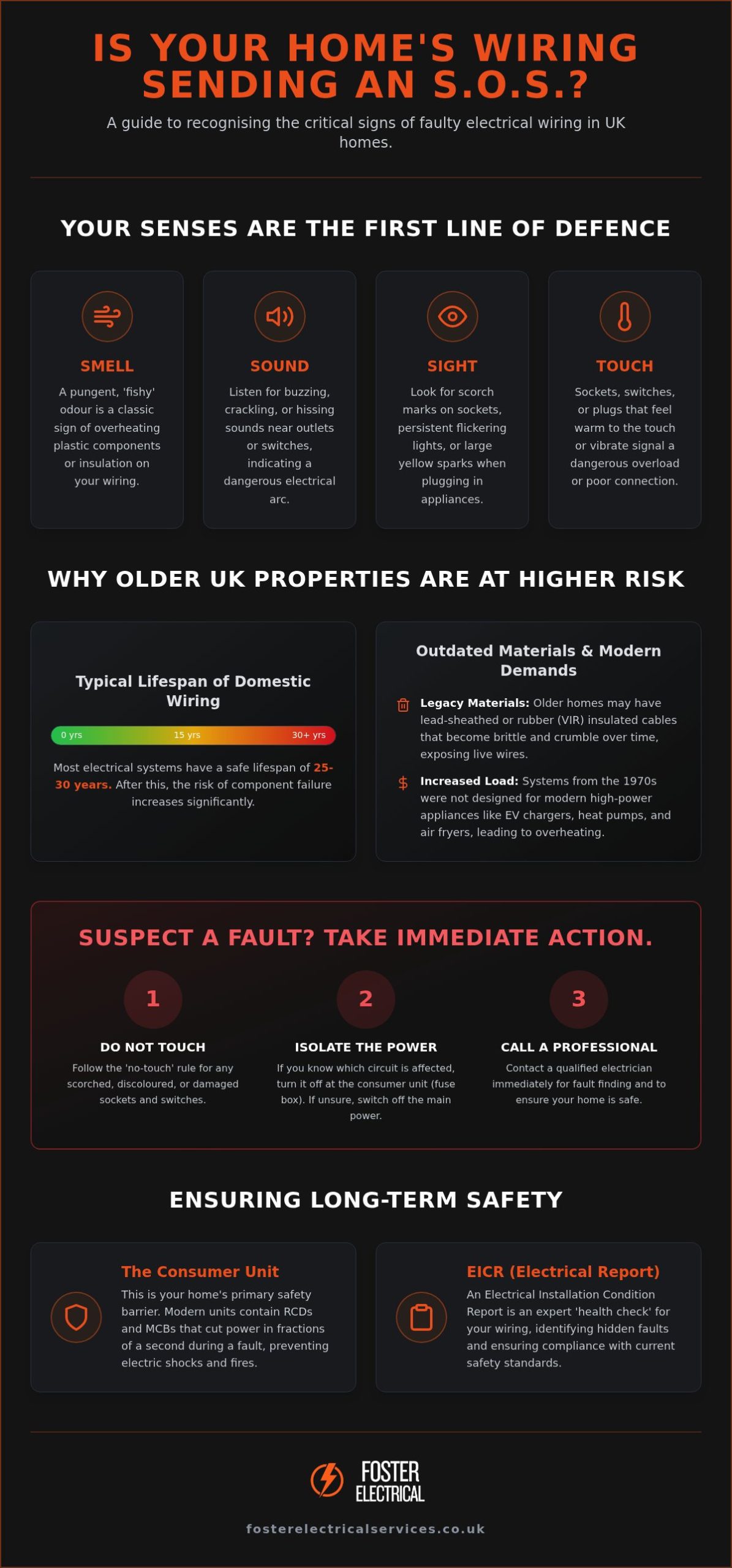
If you suddenly notice a pungent, fishy odour in a room, don’t reach for the cleaning spray. This specific scent is a classic indicator of overheating plastic or urea-formaldehyde insulation. When these components reach high temperatures, they release a chemical signature that mimics the smell of seafood. It’s a distinct warning that a fire could be imminent. We view this as a critical call to action rather than a minor domestic nuisance.
Listen carefully to your walls. A healthy electrical system is silent. If you hear a faint buzzing, crackling, or a persistent “hissing” sound near a switch or socket, you’re likely hearing an electrical arc. This happens when electricity tries to jump across loose connections or damaged insulation. It’s a dangerous behaviour that generates intense heat in a very short space of time.
Sockets and switches should always feel cool to the touch. If a faceplate feels warm or vibrates slightly, it’s a critical red flag. This heat suggests that the internal wiring is struggling to handle the load or is suffering from a poor connection. We take these symptoms seriously because they often precede a total circuit failure.
Identifying the Odour of Overheating
Many modern electrical components are manufactured with specific materials that emit a sharp, acrid smell when they begin to fail. Whilst a brand-new toaster might give off a faint “burnt” scent during its first use, a wiring failure is far more pungent and persistent. If you encounter this smell, we recommend you isolate the affected circuit at the consumer unit immediately. Don’t wait for the smell to dissipate; it’s a sign that the protective coating on your cables is melting and requires a professional fault finding inspection.
Visual Red Flags Around Your Sockets
We often find the most dangerous evidence hidden behind heavy furniture. Move your sofa or sideboard to check for discolouration or brown scorch marks on the socket faceplates. These marks indicate that heat is building up internally, often due to arcing or overloaded circuits. Similarly, whilst a single flickering light might just be a loose bulb, persistent flickering across multiple rooms suggests a wider issue with your home’s circuitry. You might also notice a small spark when plugging in an appliance. Whilst a tiny blue flash is sometimes normal, a large “pop” or a yellow spark is one of the clearest signs of faulty wiring in house uk homes that requires expert attention to ensure your family’s safety.
Understanding the Risks: Why Older UK Properties Face Wiring Issues
Wiring is not eternal. Most domestic electrical systems have a reliable lifespan of approximately 25 to 30 years. Once a property passes this threshold, the risk of component failure increases significantly. Whilst many Victorian homes in Dundee boast beautiful stonework, their internal electrical systems often rely on materials that have long since exceeded their safe working life. Identifying the signs of faulty wiring in house uk properties becomes more urgent as a building reaches the three-decade mark.
Legacy materials are a primary concern in our local housing stock. Before modern PVC became the standard, many homes used lead-sheathed cables or Vulcanised Indian Rubber (VIR) insulation. These materials become incredibly brittle over time. If you disturb an old VIR cable, the insulation can simply crumble away, leaving live conductors exposed. We frequently encounter these hidden hazards during renovations in Tayside and Fife, where decades of “amateur” DIY additions have layered new problems over old, unstable foundations.
The Evolution of Electrical Standards in Scotland
The 18th Edition Wiring Regulations represent the current gold standard for safety in 2026. These rules exist because our modern lives place immense pressure on systems designed for a different era. A house wired in the 1970s was never intended to power electric vehicle chargers, air fryers, and high-performance heat pumps simultaneously. In traditional Tayside tenements, these modern loads can cause antique circuits to overheat rapidly, creating a silent fire risk behind the plasterwork. If you’re unsure about the history of your home’s electrics, we can help you arrange a professional safety check to put your mind at ease.
Rodent Damage and Environmental Wear
Nature also plays a role in electrical degradation. Lofts and floor voids are often home to rodents that find the plastic coating of cables irresistible. Chewed insulation is a common cause of mysterious circuit tripping and can lead to dangerous arcing. Furthermore, older PVC cables manufactured before the late 1970s can suffer from “green goo” leaching. This is a green, sticky surfactant that can leak into switches and sockets, potentially causing high-resistance connections. In coastal areas, persistent dampness can accelerate the corrosion of these older fittings, making it vital to recognise the signs of faulty wiring in house uk before a minor fault becomes a major emergency.
The Role of the Consumer Unit and EICR in Identifying Hidden Faults
We often describe the consumer unit as the brain of your home’s electrical system. Its primary job is to monitor every circuit and intervene before a fault becomes a catastrophe. Whilst the sensory signs of faulty wiring in house uk properties-such as the smells or sounds we discussed earlier-are vital clues, the consumer unit provides the technical protection you cannot see or hear. A tripping circuit is frequently a sign that your system is working correctly to prevent an overload, but a consumer unit that fails to trip when it should is a far greater danger.
Modern safety relies heavily on Residual Current Devices (RCDs). These components are designed to detect tiny leakages of electricity and cut the power in a fraction of a second. Without this level of precision, a minor fault in an older cable can generate enough heat to start a fire without ever blowing a traditional fuse. We believe that every homeowner deserves this layer of protection, especially when modern power demands are higher than ever before.
Is Your Fuse Box Obsolete?
Older homes in Tayside often still feature wooden-backed consumer units or plastic boxes that lack modern fire-rated enclosures. If you still have rewireable fuses, where you must physically wrap a piece of fuse wire around a carrier, your home lacks the sensitive protection required for modern safety. These antique systems offer very little defence against the subtle signs of faulty wiring in house uk homes, such as high-resistance faults. Investing in a Consumer Unit Upgrade ensures your property is equipped with the latest circuit breakers and surge protection devices. Modern safety standards for reliable consumer units and switchboards are universal across the trade; specialist contractors such as Banner Power similarly stress that up-to-date protection devices are vital for safeguarding properties against dangerous overloads.
To truly see behind the plasterwork, a professional Electrical Installation Condition Report is the only definitive way to verify safety. We begin with ‘dead testing’ to check the integrity of cable insulation whilst the power is isolated. We then perform ‘live testing’ to ensure your system can safely disconnect during a fault. If we identify an issue, we use industry-standard codes: a C1 code means ‘Danger Present’ and requires immediate action, whilst a C2 means ‘Potentially Dangerous’. For landlords and homebuyers in Dundee, this report is the most reliable method to ensure a property is safe for habitation.
Immediate Action: What to Do When You Suspect an Electrical Fault
Discovering signs of faulty wiring in house uk properties can be a frightening experience. Your first priority must always be the safety of your family and the integrity of your home. We recommend that you remain calm and act methodically. If you suspect a serious fault, the most effective way to prevent a fire is to isolate the power. Locate your consumer unit and turn off the main switch. This simple action immediately halts the flow of electricity and removes the energy source from a potentially dangerous fault.
We strictly enforce a ‘no-touch’ rule for any visible damage. If you see a scorched socket or a melted switch, don’t attempt to unscrew the faceplate or investigate the wiring yourself. Even with the power off, internal components can retain heat or hide structural damage that only a professional should handle. Whilst you wait for an Emergency Electrician in Dundee, you can help us by safely documenting the symptoms. Take a clear photograph of the affected area and note down exactly what happened. Did the lights flicker before the smell started? Did a specific appliance cause the trip? This information is invaluable for our diagnostic process.
Steps to Take During an Electrical Emergency
- Step 1: Identify the affected area and turn off the corresponding circuit breaker if you prefer not to lose power to the whole house.
- Step 2: Unplug all appliances on that specific circuit. This helps us rule out equipment failure versus a permanent wiring fault.
- Step 3: If you see active smoke or if a burning smell persists after the power is off, evacuate everyone from the property immediately and call the emergency services.
Professional Fault Finding vs DIY Fixes
We often see homeowners attempt to ‘patch’ a symptom by simply resetting a breaker or taping up a frayed wire. This is a dangerous approach. Electricity is unforgiving; a fault that “seems to be working now” is often just a disaster waiting for a moment of high demand to reappear. Our approach to Fault Finding and Repairs involves more than just a visual check. We use advanced continuity testers and thermal imaging to see heat signatures hidden deep within your walls. We believe in finding the root cause of the problem to ensure your home remains a safe haven. If you are concerned about any unusual electrical behaviour, please reach out to us for a professional assessment before a minor worry becomes a major hazard.
Professional Solutions: Full Rewiring and Safety Upgrades in Dundee
When the sensory warnings and technical failures we have discussed become persistent, a Full Property Rewire is often the only responsible path forward. We understand that the prospect of a rewire can feel overwhelming, but it’s the most definitive way to address the underlying signs of faulty wiring in house uk properties. In cases where the damage is isolated, such as in a new extension or a specific high-risk kitchen circuit, a partial rewire may offer a targeted solution that restores safety without the need for a whole-house intervention.
Our approach at Foster Electrical is defined by a commitment to meticulous tidiness and deep respect for your home. We treat your private space with the care it deserves, ensuring that high standards of execution are met at every stage. A rewire also presents a perfect opportunity to future-proof your environment. We often help clients add additional sockets to accommodate modern gadgets or upgrade to energy-efficient LED lighting, transforming a safety necessity into a genuine home improvement that enhances your daily comfort.
The Process of a Professional Rewire
We organise our work to ensure your daily life continues with as little disruption as possible. The process typically involves two distinct stages: the ‘First Fix’, where we install the new cabling behind walls and under floors, and the ‘Second Fix’, where we fit the visible sockets, switches, and light fittings. Once the work is complete, we provide the essential professional certification. This documentation is a vital requirement for your home insurance and serves as a firm guarantee that your system meets the latest 18th Edition safety regulations. For homeowners seeking examples of how modern trade specialists manage comprehensive upgrades, you can learn more about Innovative Electrical Contractors to see how professional electrical projects are delivered safely.
A modern rewire is a significant investment that pays dividends in both safety and property value. For homeowners in Dundee, a certified electrical system is a major selling point that reassures potential buyers and simplifies the surveying process. Beyond the financial aspect, the true value lies in the quiet confidence of knowing your family is protected by a durable, compliant system. We take personal pride in delivering this peace of mind through honest, artisanal service that rejects corporate anonymity. Secure your home today; contact Foster Electrical for a safety consultation and let us help you protect what matters most.
Securing Your Home and Family for the Future
Recognising the signs of faulty wiring in house uk properties is the first step toward a safer domestic environment. We’ve explored how your senses of smell, sound, and sight serve as your home’s early warning system. Whether it’s an outdated consumer unit or the hidden degradation of older cables, these symptoms require a calm and professional response. We take great pride in our reputation as a trusted local expert across Dundee, Perth, Angus, and Fife. Our team specialises in expert fault finding, full property rewires, and landlord EICR compliance.
We treat every home with the meticulous care and tidiness it deserves, acting as a protective guardian for your household. Don’t let minor worries escalate into major hazards. You can book your professional electrical safety inspection today to ensure your wiring meets the highest modern standards. We’re here to provide the peace of mind that comes from a job done correctly and with integrity. Your safety is our priority, and we look forward to helping you secure your home for many years to come.
Frequently Asked Questions
How much does it cost to rewire a house in the UK in 2026?
The cost of a rewire varies significantly based on the size of your property and the complexity of the installation. Factors such as the number of sockets required and the age of the existing infrastructure play a major role. We avoid providing fixed estimates without a site visit because every home in Dundee is different. A professional safety inspection is the most reliable way to understand the specific requirements for your property.
Can I stay in my house whilst it is being rewired?
You can certainly stay in your home whilst the work is carried out. We understand that moving out isn’t always practical for local families. We organise our workflow to minimise disruption, typically working room by room. Whilst there will be some noise and dust, we take personal pride in our meticulous tidiness and ensure you have essential power and lighting at the end of each day.
How long does a full property rewire typically take?
A full property rewire usually takes between 5 and 10 working days to complete. The exact duration depends on whether the house is occupied and the ease of access to floor voids and lofts. We provide a clear timeline before we begin any work. Our goal is to complete the installation efficiently whilst maintaining the high standards of execution our Tayside clients expect from us.
What is the most common sign of faulty wiring in an older house?
Frequent circuit tripping is the most common indicator that your system is struggling. In many older properties across Perth and Angus, you might also notice lights that flicker despite new bulbs or sockets that feel warm. These are critical signs of faulty wiring in house uk homes. They often suggest that the original insulation is failing or that the system is simply overloaded by modern appliances.
Do I need a full rewire if only one socket is scorched?
A single scorched socket doesn’t always mean you need a full rewire, but it does require an immediate professional check. The scorch mark is a sign of localised overheating, which could be caused by a loose connection or a faulty appliance. We use specialised fault finding equipment to see if the problem is isolated or if it’s a symptom of a wider, more dangerous issue within your walls.
Will my home insurance cover damage caused by faulty wiring?
Insurance coverage often depends on whether you have taken reasonable steps to maintain your home’s safety. Many insurers expect electrical systems to be compliant with the latest regulations. If a fire is caused by neglected signs of faulty wiring in house uk, your claim could be at risk. Providing a recent EICR certificate is the gold standard for proving your home is safe and well-maintained.
How often should I have my home’s wiring professionally inspected?
We recommend a professional inspection via an EICR every 10 years for owner-occupied homes. If you are a landlord in Fife or Dundee, you have a legal obligation to carry this out every 5 years or at the start of a new tenancy. Regular testing allows us to identify hidden wear and tear, ensuring your electrical system remains a durable and safe part of your home.
Is a buzzing sound from a light switch always dangerous?
A buzzing sound is almost always a sign of a serious fault known as arcing. This occurs when electricity jumps across a loose or damaged connection, creating a significant fire risk. You should stop using the switch immediately and isolate the circuit if possible. We treat these sounds as urgent safety warnings that require professional attention to prevent damage to your property and ensure your family’s safety.