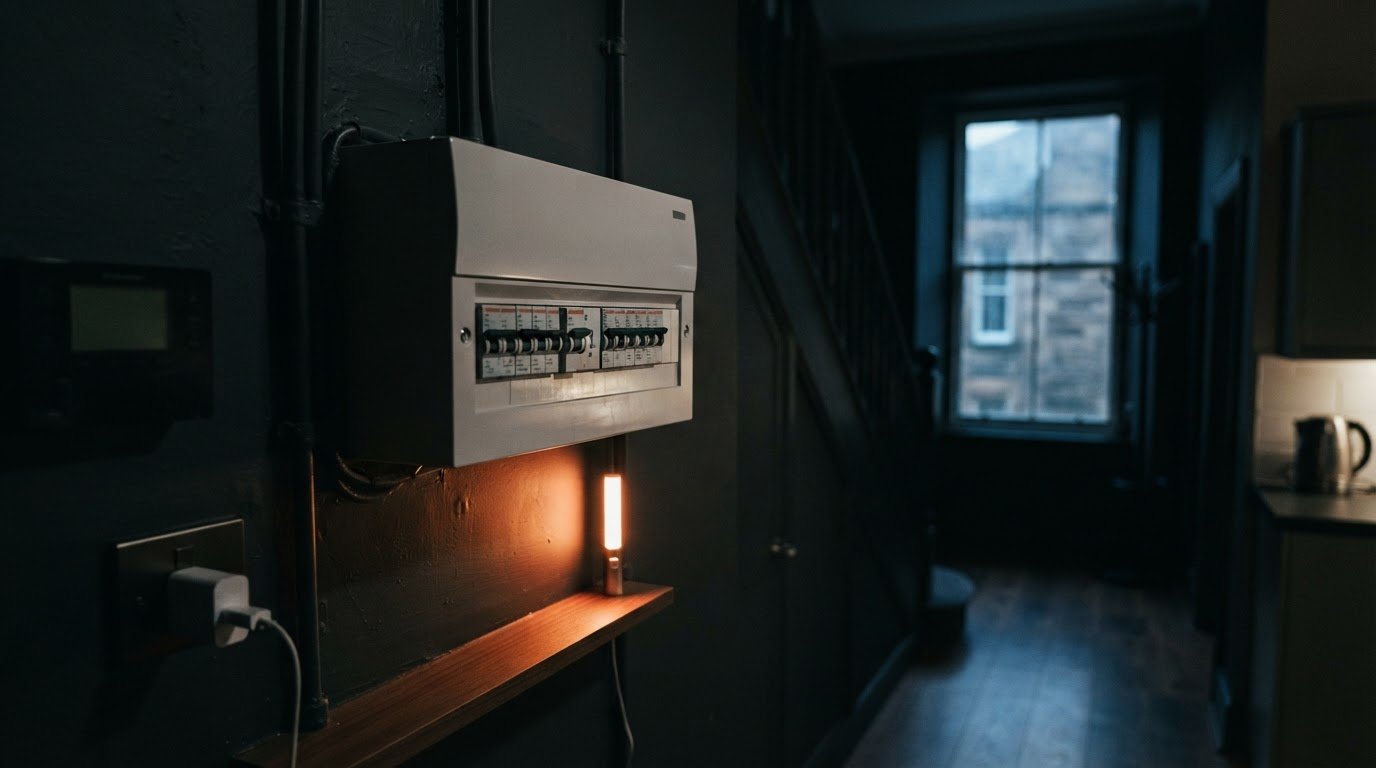
A fuse that trips overnight isn’t necessarily reacting to the clock. Fuse box tripping at night Dundee residents experience can be linked to an appliance switching on, several items running together or a fault on a circuit. The timing is a useful clue, but it doesn’t identify the cause on its own. It’s unsettling when power cuts out while you’re asleep, especially if resetting the switch hasn’t stopped it happening again.
Notice what loses power, which appliances were in use and whether anything had just switched on. These observations are useful, but don’t open the consumer unit or attempt electrical repairs. This guide explains what nighttime tripping may indicate, what you can check safely and when a recurring fault needs professional attention. Foster Electrical provides fault finding and repairs in Dundee to investigate persistent trips, rather than relying on repeated resets.
Key Takeaways
- A trip is a protective response, not a diagnosis. Modern consumer units use circuit breakers or RCD protection.
- With fuse box tripping at night Dundee households can look for timing clues, such as an appliance starting, heating or charging.
- Compare whether the trip happened once or repeatedly, and note whether one appliance, one circuit or several areas were affected.
- If a circuit trips again or you notice warning signs, leave it off and avoid repeated resets.
- When the cause isn’t clear or trips keep returning, professional fault finding can investigate before any repair or consumer unit work is advised.
Fuse box tripping at night in Dundee: what the pattern can tell you
A trip is a protective response: a device in the electrical installation has interrupted power after detecting a condition that needs attention. It’s a warning to investigate, not proof of one particular fault. Modern homes commonly have a consumer unit, often still called a fuse box, containing circuit breakers or RCD protection. The device that has switched off can offer a clue, but its position alone won’t identify the cause.
What does it mean when a fuse box trips?
A circuit breaker generally switches off when it detects an issue such as too much current or a short circuit. An RCD responds to an imbalance in the electrical current, helping protect against certain electrical faults. Their roles differ, but either can interrupt power when it detects a problem. A single trip doesn’t prove that the protective device is faulty. For background on how these devices work, see Circuit Breaker Principles.
Why might the problem happen overnight?
At night, appliances and systems may switch on without anyone noticing. A washing machine or dishwasher may start on a timer, heating controls may call for heat, or a device may begin charging. If several items operate around the same time, their combined use may reveal a load pattern or an issue that needs investigation. These are possibilities, not a diagnosis.
A repeated trip at a similar time can help narrow down when the problem appears. For example, if power cuts out shortly after a timed appliance starts, record the timing. It doesn’t confirm that the appliance is responsible: a circuit or another part of the installation could also be involved. A trip at different times doesn’t rule out a fault either.
For fuse box tripping at night Dundee households are trying to understand, the clock is a clue, not a diagnosis. Note when the trip occurs and what was running, without opening the consumer unit or attempting repairs. If the pattern keeps returning, professional electrical fault finding can investigate the cause before a repair or consumer unit work is considered.
Common reasons a Dundee fuse box may trip during the night
There isn’t one explanation for a night-time trip. The timing and what was operating beforehand can help an electrician decide where to investigate, but they don’t prove the cause. An appliance, moisture, damaged wiring, a circuit fault or an issue with the consumer unit may all be relevant clues.
Could a timer or overnight appliance be responsible?
Possibly. An immersion heater, heating controls, washing machine or charger may start, heat or operate during the night. Make a note of what was scheduled or running before the power went off, and whether the same pattern returns. Don’t dismantle an appliance or try to test its wiring. A suspected appliance is a useful lead, not a confirmed diagnosis.
Could the circuit or consumer unit need attention?
An ageing or damaged circuit may trip when a particular load operates. Moisture or another wiring fault may also need investigation. If a protective device trips repeatedly, don’t bypass it or keep trying to make it stay on. A consumer unit upgrade may be relevant if an inspection identifies an issue that calls for one. Read about consumer unit upgrade work to understand the available electrical support.
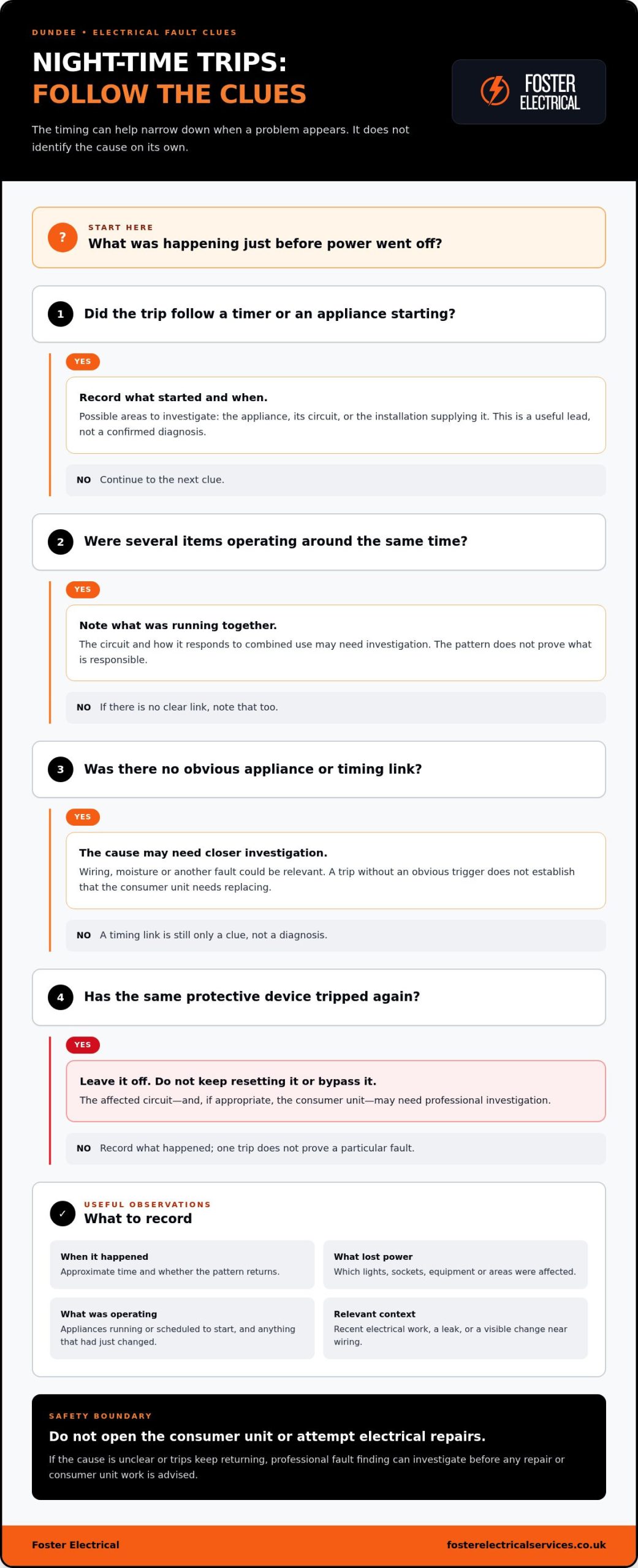
Use observations to describe the pattern, rather than treating them as a diagnosis:
| What you notice | Possible area to investigate |
|---|---|
| The trip follows a timer or appliance starting | The appliance, its circuit or the installation supplying it |
| The trip happens when several items are operating | The circuit and how it responds to the combined use |
| The trip occurs without an obvious appliance or timing link | Wiring, moisture or another fault that needs closer investigation |
| The same protective device trips again | The affected circuit and, if appropriate, the consumer unit |
These are investigation leads, not ranked causes. A trip after a washing machine starts doesn’t prove the machine is faulty, just as a trip with no obvious trigger doesn’t establish that the consumer unit needs replacing. If fuse box tripping at night Dundee homes experience keeps recurring, Foster Electrical’s fault finding and repairs can investigate the electrical fault and establish what work is appropriate.
How to compare the clues before arranging electrical fault finding
A single trip and a recurring pattern don’t tell the same story. One isolated interruption may follow a particular change, whilst repeated trips suggest the underlying issue hasn’t gone away. Note what happened beforehand, but treat those details as clues rather than a way to diagnose the fault yourself.
If only one area loses power, note which lights, sockets or equipment are affected. If several areas go off together, record that too. A trip that seems to follow one appliance operating is different from one affecting multiple circuits, but neither pattern proves what’s responsible. An electrician can use your observations to guide fault finding.
What details are useful to record?
Write down the approximate time, which areas or circuits appear to have lost power, and whether power returned after the trip. Note appliances that were running or scheduled to start, along with anything that had changed beforehand. Recent electrical work, a leak or a visible change near wiring may also be useful context. Don’t open the consumer unit to find out which components are inside.
A brief record can help distinguish a one-off event from a pattern, especially if trips happen while you’re asleep. You don’t need to identify a technical cause. Clear observations are enough to describe what happened.
When is repeated tripping more concerning?
Repeated trips deserve attention, particularly alongside a burning smell, scorch marks, crackling, visible damage or unusual warmth around electrical equipment. Don’t touch exposed wires or remove the consumer unit cover. If you can identify the affected circuit and switch it off safely and straightforwardly, leave it off. Don’t put yourself at risk trying to reach it.
Repeated tripping needs investigation, not repeated resetting. Resetting the switch again and again won’t establish why it operated, and may leave the underlying issue unresolved. If there are signs of heat, damage or burning, treat them as warning signs and seek prompt professional attention.
For fuse box tripping at night Dundee households, the useful record is simple: when it happened, what lost power, what was running and whether it happened again. Foster Electrical provides electrical fault finding and repairs in Dundee to investigate recurring trips. Read about electrical fault finding and repair services if the pattern continues.
What to do if your fuse box trips overnight in Dundee
A sudden loss of power can be unsettling, especially if it happens while you’re asleep. Put safety first, note what happened and don’t keep resetting the switch. With fuse box tripping at night Dundee households can start by observing from a safe position what has lost power, without opening the consumer unit or trying to find the fault themselves.
What can you check without opening the fuse box?
Notice whether lights, sockets or particular appliances have lost power. From a safe distance, look for obvious external signs such as a damaged plug or a water leak nearby, but don’t touch wet, hot or damaged equipment. Write down the approximate time, what was running or scheduled, and which areas seem affected. These details can help an electrician investigate without you testing circuits or removing covers.
What should you avoid doing?
Don’t hold a breaker or RCD in position, bypass its protection or repeatedly reset it. If the same circuit trips again, leave it off. Only switch off the affected circuit if you can identify it and do so safely and straightforwardly. Never touch exposed wires or electrical equipment that is hot, wet or visibly damaged.
Burning smells, scorch marks, crackling, smoke or unusual heat need prompt attention. Keep clear of the affected equipment and seek urgent electrical assistance. If there’s a fire or immediate danger to people, move to safety and call 999. Don’t put yourself at risk to reach the consumer unit or investigate the source.
For broader context, read about electrical fault finding and repairs. The right next step depends on what you observed and whether the trip returns. A reset isn’t proof that the fault has gone.
If the problem recurs or you can’t identify a safe explanation, arrange professional fault finding in Dundee. Foster Electrical investigates electrical faults and carries out repairs, helping establish what needs attention before any work is advised. You can find details of electrical fault-finding support.
When to arrange fuse box fault finding in Dundee
Arrange professional investigation if trips keep returning, affect an essential circuit or happen without a clear and safe explanation. Repeated loss of power can disrupt heating, lighting or other important parts of your home, and resetting the switch won’t reveal what’s causing it. If you’ve noticed a burning smell, visible damage or unusual heat, treat the situation as urgent and keep clear of affected equipment.
What happens during professional electrical fault finding?
An electrician can use your description of the symptoms, timing and affected circuits to guide a methodical investigation. The findings help establish what may need attention and which repair options are appropriate. This is different from assuming that the appliance, circuit or consumer unit is at fault based on timing alone.
Foster Electrical is based in Dundee and provides fault finding and repairs for recurring electrical trips. The investigation helps identify the fault before advising on any repair, rather than relying on repeated resets or jumping straight to replacement work. Foster Electrical serves Dundee, Perth, Angus, Fife and St Andrews.
Could the consumer unit need an upgrade?
Possibly, but an upgrade is only one potential outcome. It should be considered when an assessment identifies a relevant issue with the consumer unit, not simply because a breaker or RCD has tripped. The cause may be elsewhere in the electrical installation. You can read about consumer unit upgrade work to understand the service, whilst keeping in mind that investigation comes first.
If fuse box tripping at night Dundee residents experience keeps recurring, make a note of what happened and arrange appropriate fault finding. Clear details about the timing and what lost power can help the electrician understand the pattern. You don’t need to diagnose the problem yourself, open the consumer unit or attempt a repair.
For help with recurring trips in Dundee, contact Foster Electrical about fault finding. The next step is a careful investigation, followed by advice based on what it shows.
Take the next step with confidence
The timing of a trip can help narrow down what to investigate, but it can’t confirm the cause. Note what was running and which areas lost power, and don’t keep resetting a circuit that trips again. If fuse box tripping at night Dundee homes experience keeps recurring, affects an essential circuit or comes with warning signs, arrange professional fault finding.
Foster Electrical is a Dundee-based electrical business offering fault finding and repairs. An electrician can investigate the symptoms before advising whether a repair is appropriate or whether an issue with the consumer unit needs attention. An upgrade is a possibility only if the assessment supports it.
Contact Foster Electrical to arrange electrical fault-finding support in Dundee. Record what happened and where power was lost, then leave the investigation and any repairs to an electrician.
Frequently Asked Questions
Why does my fuse box only trip at night?
It may trip at night because something starts, heats or charges while you’re asleep, or because several devices operate around the same time. Heating controls, a timed appliance or a charger can provide useful clues, but the timing doesn’t confirm what’s at fault. Note when the trip happens and what was running. If it recurs without an obvious explanation, arrange professional electrical fault finding rather than relying on repeated resets.
Is it safe to reset a fuse box that keeps tripping?
A single reset may be possible if there are no warning signs and you can do it safely, but don’t keep resetting a device that trips again. Leave the affected circuit off if it trips repeatedly. Never hold a breaker or RCD in position, bypass its protection, remove the consumer unit cover or touch hot, wet or damaged equipment. A recurring trip needs investigation to find the cause.
Can a faulty appliance make the fuse box trip overnight?
Yes. An appliance that starts, heats or charges overnight may be involved, particularly if the trip follows its operation. That’s a clue, not proof: the circuit or another part of the electrical installation may also need investigation. Record which appliances were running or scheduled before power went off. Don’t dismantle an appliance or test its wiring yourself; an electrician can investigate the electrical fault safely.
What should I do if the fuse box trips while I am asleep?
Keep clear of anything that looks damaged, wet or unusually hot, and check from a safe position which lights, sockets or appliances have lost power. Note the approximate time and what was operating. Don’t repeatedly reset the switch. If you notice a burning smell, scorch marks, crackling or smoke, treat the situation as urgent, move away from the affected area and seek appropriate help.
How can I tell which circuit is tripping?
Observe which parts of the home have lost power, such as a group of lights, sockets or an appliance, and note whether other areas are affected too. You may be able to see which switch has moved by looking at the consumer unit from outside, but don’t remove its cover or touch exposed parts. These observations can guide an electrician, though they can’t confirm the fault on their own.
When should I call an electrician in Dundee for a tripping fuse box?
Arrange professional fault finding if trips recur, affect an essential circuit or have no clear safe explanation. Seek prompt help if there’s a burning smell, visible damage, unusual heat or crackling, and keep clear of affected equipment. Foster Electrical provides fault finding and repairs for households in Dundee, Perth, Angus, Fife and St Andrews. An electrician can investigate the symptoms before advising on suitable repairs.
Does a fuse box tripping at night mean I need a new consumer unit?
No. A trip on its own doesn’t show that the consumer unit needs replacing. The cause could involve an appliance, circuit, wiring or another electrical issue, so the fault should be investigated before deciding on work. A consumer unit upgrade is one possible option only if an assessment identifies a relevant problem. Avoid assuming replacement is necessary simply because a breaker or RCD has operated.