Did you know that electrical hazards are responsible for over half of all accidental dwelling fires across the UK? With over 20,000 of these fires occurring annually, a tripping circuit or a flickering light is more than just a minor annoyance; it’s a safety warning that shouldn’t be ignored. It’s understandable to feel anxious when these issues arise, especially if you’re worried about technical jargon or the risk of being overcharged for a simple fix. You deserve a home that feels like a sanctuary, not a source of stress.
In this guide, we’ll help you understand the essentials of Fault Finding and Repairs so you can identify common problems safely. We promise to demystify the professional process of tracing faults, showing you how a dependable local craftsman works without cutting corners or hiding extra costs. We will walk through the methodical steps of electrical troubleshooting and explain how the latest BS 7671:2018+A4:2026 regulations keep your property protected, ensuring you have a clear, transparent path to a safe and functional home.
Key Takeaways
- Spot the early warning signs of a deteriorating system, such as buzzing sockets or flickering lights, to prevent hazards before they escalate.
- Understand why professional Fault Finding and Repairs rely on a systematic process of elimination rather than stressful guesswork.
- Learn the safe “Divide and Conquer” method to identify whether a tripping circuit is caused by a faulty appliance or a wiring issue.
- Recognise when a repair requires a competent professional to ensure your home remains safe and stays compliant with UK wiring regulations.
- Discover how to achieve a transparent repair process that prioritises your safety and leaves your property exactly as it was found.
Identifying Common Electrical Faults in Your Property
Your home should be your safe haven, but sometimes the wiring behind the walls starts to show its age. Recognising the early warning signs of a deteriorating system is the first step toward preventing a serious incident. We believe that Fault Finding and Repairs shouldn’t be a source of confusion or fear. Instead, it’s about understanding your home’s behaviour. While some issues like a single bulb blowing are mere inconveniences, others are clear signals that your electrical installation needs professional attention to remain safe and compliant with the latest BS 7671:2018+A4:2026 standards.
A common point of confusion is the difference between a nuisance trip and a genuine safety hazard. A nuisance trip might occur if a single old appliance is slightly “leaky” with its current, but it doesn’t always mean your house is at risk. However, a genuine hazard often presents itself through persistent issues. Understanding what is an electrical fault helps to clarify this distinction. A fault is essentially an abnormal condition in an electrical circuit that interrupts the intended flow of current, which can lead to overheating or even fire if left unaddressed.
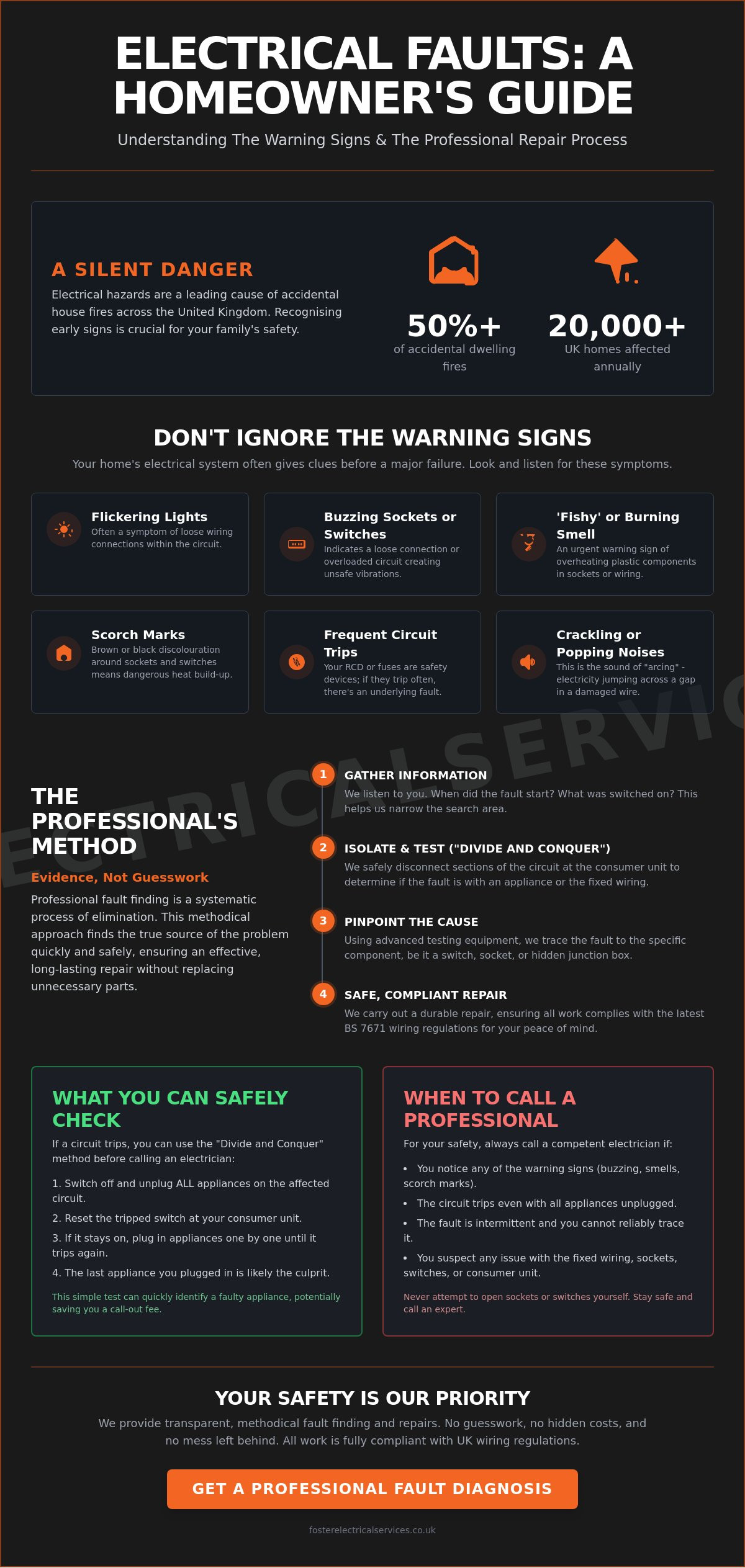
One of the most urgent warning signs is a “fishy” or acrid burning smell. This isn’t just a strange household odour; it’s frequently the smell of plastic insulation or socket components overheating and beginning to melt. If you notice this, or if you find yourself dealing with the frustration of flickering lights and buzzing sockets, your system is trying to tell you something. These intermittent faults are often caused by loose connections that create heat every time you use a switch or plug in a kettle.
Telltale Symptoms of Faulty Wiring
Keep a close eye on your plug sockets and light switches for any signs of brown discolouration or scorch marks. This indicates that heat is building up where it shouldn’t. You might also hear an “arcing” sound, which is a distinct crackling or popping noise inside the wall. This happens when electricity jumps across a gap in a damaged wire. If your fuses are blowing or your RCD is tripping with increasing frequency, it’s a sign that the underlying issue is worsening. We never cut corners when investigating these symptoms because we know that catching a fault early can prevent the 20,000 accidental electrical fires that occur in UK homes every year.
Environmental Factors in Dundee Homes
Our local climate plays a significant role in electrical health. The damp and cold Scottish weather often causes moisture to ingress into outdoor lighting and junction boxes, leading to unexpected trips. In Dundee’s traditional tenement properties, we often find original wiring struggling to cope with the heavy electrical loads of modern life. Furthermore, in more rural areas of Angus, rodent damage in lofts is a frequent cause of faults. Mice and rats can chew through cable insulation, leaving live wires exposed. We treat every property like it’s our own, ensuring these hidden dangers are found and fixed properly.
What is Electrical Fault Finding? A Methodical Approach
Electrical fault finding is a systematic process used to identify and locate defects within an electrical installation. It’s a bit like being a detective in your own home. Instead of guessing or replacing parts at random, we use a logical sequence to narrow down the cause. This methodical approach ensures that we don’t just treat the symptom, but we actually solve the root problem. Whether it’s a flickering light in a Broughty Ferry villa or a tripping circuit in a city centre flat, the goal is always the same: a safe and reliable repair.
We believe that Fault Finding and Repairs should be based on evidence, not guesswork. We start by gathering information. When did the fault happen? What was switched on at the time? By Understanding Your Home’s Electrical System, you can see that domestic circuits are interconnected webs. A fault appearing in one room might actually be caused by a problem originating in another. We isolate different sections of the circuit one by one. If the problem disappears when a specific section is disconnected, we know we’re getting closer to the source. This keeps the work efficient and prevents you from paying for unnecessary components.
One of the first things a professional determines is whether the fault lies within your fixed wiring or a plugged-in appliance. For example, if your RCD trips every time the kettle boils, the appliance is likely the culprit. However, if the trip happens randomly with nothing new turned on, the issue is probably within the cables or sockets of the property itself. Differentiating between these two scenarios is vital for a transparent and honest repair process.
The Electrician’s Toolkit for Repairs
- Multimeters and Continuity Testers: These essential tools help us trace the path of electricity to ensure there aren’t any breaks or high-resistance joints in the circuit.
- Insulation Resistance Testing: This allows us to find hidden “leaks” in your cables where electricity might be escaping through degraded or damaged plastic coating.
- Arcing is the dangerous jumping of electricity between loose connections.
Why Visual Inspections Aren’t Enough
You can’t see what’s happening behind your plasterboard or under your floorboards. While a scorched socket is a clear sign, many faults are completely invisible to the naked eye. A methodical test identifies these issues before they become fire risks, which is crucial given that electrical hazards cause over 50% of accidental house fires. Once the root cause is identified, we transition from finding to fixing, ensuring the job is done properly. If you’re concerned about a persistent trip or a strange smell, we can provide a thorough electrical health check to give you total peace of mind.
How to Safely Troubleshoot Tripping Circuits at Home
It’s a common Saturday night scenario in many Dundee households. You’re halfway through making dinner when the kitchen lights go out and the oven stops. Before you panic or reach for the phone, there are safe, logical steps you can take to identify the culprit. This is the start of the Fault Finding and Repairs process, and knowing how to handle your consumer unit safely can save you time and unnecessary stress. Your consumer unit, or fuse board, is the heart of your home’s safety system, designed to cut power instantly when it detects a problem.
Safety is our absolute priority. You should never attempt to unscrew the cover of your consumer unit or touch any exposed wiring. Your job is simply to operate the switches that are designed for homeowner use. These are usually labelled as MCBs (Miniature Circuit Breakers) or RCDs (Residual Current Devices). If you see smoke, hear loud buzzing, or smell that fishy plastic scent from an earlier section, put the torch down immediately. Some issues require the expertise of a professional who treats your property like it’s their own.
Step-by-Step: The Appliance Reset Test
Since research shows that 71% of electrical fires in UK homes are started by appliances, the “Divide and Conquer” method is your best tool. Follow these steps to see if a faulty device is the cause:
- Unplug everything: Go to every socket on the affected circuit and physically unplug the devices. Simply switching them off at the wall isn’t enough, as a fault can still exist within the neutral wire.
- Reset the switch: Go back to your consumer unit and flip the tripped switch back to the “on” position.
- The plug-in test: One by one, plug your appliances back in and switch them on. The moment the power trips again, you’ve found your “trigger” device.
Evaluating the Results
If you’ve unplugged everything and the circuit still refuses to stay on, the fault likely lies within the fixed wiring of your property. This could be a damp junction box or a loose connection behind a socket. However, if the power only goes out when you plug in the kettle or toaster, you’ve saved yourself a call-out fee by identifying a faulty appliance. Persistent tripping without a clear cause can sometimes be one of the signs your consumer unit needs an upgrade, especially in older properties where the safety components are reaching the end of their lifespan. We believe in honest, dependable service, so if your DIY checks don’t solve the problem, it’s time to call in a real person who can find the fault properly.
When to Call a Professional Electrician for Repairs
Electrical safety isn’t something to gamble with. Whilst the DIY checks we mentioned earlier can help you identify a faulty toaster, any work involving the fixed wiring of your property must be carried out by a competent person. This isn’t just our opinion; it’s a legal requirement under the UK Building Regulations. Professional Fault Finding and Repairs are essential because electricity is unforgiving. Faulty equipment and sockets lead to approximately 70 deaths and 350,000 injuries in UK homes annually, and attempting a “quick fix” yourself can invalidate your home insurance and put your family at risk of fire or shock.
Sometimes, what looks like a simple broken socket is actually a symptom of a much larger issue. If we find that your cables have perished or were installed incorrectly decades ago, a simple repair might signal the need for a partial rewire. We don’t believe in hiding the truth or using jargon to confuse you. If your home needs more than a patch-up to stay safe, we’ll tell you straight. We show up when we say we will, providing an honest assessment so you can make an informed decision about your property’s safety.
Urgent Situations and Emergency Power Loss
Certain scenarios require immediate action from a real person rather than a call centre. If you lose power to your smoke alarms or heating, or if you notice sparking sockets and water ingress into your electrical fittings, you need help fast. These are high-risk situations where the “old-fashioned” value of a dependable local tradesman truly matters. If you find yourself in the dark, knowing what to do during a power loss can help keep you safe whilst you wait for a professional to arrive and restore your home to a safe condition.
Landlord Responsibilities in Scotland
For landlords in Dundee and across Angus, keeping up with regulations is a full-time job. As of October 1, 2026, all new electrical installations must comply with the BS 7671:2018+A4:2026 standards, which place a heavy emphasis on fire risk mitigation and individual competence. Ignoring minor faults can lead to a “Code C1” (danger present) or “Code C2” (potentially dangerous) failure during your mandatory five-yearly EICR. Scottish law requires interlinked smoke alarms to be in full working order at all times. To ensure your rental property remains compliant and your tenants stay safe, you can book a professional fault finding service with a team that never cuts corners.
The Foster Electrical Promise: Fault Finding Done Properly
We believe that inviting a tradesman into your home should never be a stressful experience. At Foster Electrical, we do things the old-fashioned way. This means we show up when we say we will, we work hard, and we tidy up after ourselves before we leave. Our approach to Fault Finding and Repairs is built on a simple promise: dependable service, done properly. You won’t find any high-pressure sales tactics or confusing jargon here. Instead, you get a clear, honest explanation from a real person who values your safety as much as you do. We bridge the gap between technical expertise and domestic comfort, making sure you understand exactly what is happening with your wiring.
Treating your property like it’s our own isn’t just a catchy phrase for us; it’s our core business philosophy. From the smallest socket repair in a city centre flat to a complex circuit investigation in a rural Angus farmhouse, we bring the same level of meticulous attention to every job. We reject the modern trend of anonymous call centres and hidden extras that leave homeowners feeling frustrated. When you call us for Fault Finding and Repairs, you speak directly to the experts who will actually be doing the work. This direct human interaction ensures total transparency and eliminates the ambiguity often found in larger, more corporate organisations.
Transparent Repairs and Safety First
We provide a detailed breakdown of every fault we find and the specific steps required to fix it. We never cut corners on the quality of components or the rigour of our testing. With the latest BS 7671:2018+A4:2026 standards now in full effect as of October 15, 2026, ensuring your home meets these rigorous safety requirements is more important than ever. Our commitment to the local community means we take personal pride in keeping Dundee homes safe and fully compliant. We use professional terminology amongst ourselves, but we translate that into plain, accessible English for you, so there are never any surprises once the work is complete.
Booking Your Fault Finding Appointment
You don’t have to navigate a complex computer menu or wait on hold for an hour to get the help you need. We offer direct contact and flexible scheduling to fit around your busy life. Whether you are a homeowner worried about a buzzing switch or a landlord needing to maintain EICR compliance for a rental property, we are here to help. We are real people who care about our reputation in the local area. Book your electrical safety check or repair today and experience the peace of mind that comes with honest, professional craftsmanship and a job done properly.
Secure Your Home with Professional Expertise
Keeping your property safe doesn’t have to be a source of constant worry. By recognising early warning signs like flickering lights or acrid smells, you can prevent minor issues from escalating into major hazards. Effective Fault Finding and Repairs rely on a methodical process of elimination, ensuring that every fix is based on evidence rather than guesswork. Whether you’re a landlord meeting the October 2026 EICR standards or a homeowner seeking peace of mind, prioritising professional safety checks is the most responsible choice you can make.
We are proud to be NICEIC Registered and a Dundee Trusted Trader, offering honest service with no hidden call-out fees. We treat every property like it’s our own, providing a dependable solution the old-fashioned way. Don’t let a tripping circuit or a buzzing socket disrupt your life any longer. Book a dependable local electrician for your repairs and get your home back to its best. You deserve a property that is safe, compliant, and done properly. We’re ready to help you restore comfort and security to your home today.
Frequently Asked Questions
Why does my fuse board keep tripping for no apparent reason?
Tripping is usually caused by a faulty appliance or a “leak” in your circuit insulation known as an earth fault. Since research shows that 71% of electrical fires in UK homes are started by appliances, we often find that a failing kettle or fridge is the secret culprit. Your consumer unit is simply doing its job by cutting the power before a dangerous situation develops.
How much does electrical fault finding cost in Dundee?
For a non-emergency electrician in the Dundee area, the average hourly rate is between £45 and £60. If you require an emergency call-out or assistance outside of normal working hours, this rate typically rises to between £80 and £150 per hour. Many local tradespeople also charge a call-out fee ranging from £80 to £150, which often covers the first hour of labour.
Can I carry out my own electrical repairs at home?
You should only attempt very basic tasks like changing a lightbulb or a plug fuse, as UK Building Regulations require a “competent person” for any work on fixed wiring. Attempting DIY repairs is risky, especially since faulty equipment and sockets lead to approximately 70 deaths and 350,000 injuries in UK homes annually. It’s always safer to leave Fault Finding and Repairs to a registered professional.
What is the difference between a fuse board and a modern consumer unit?
An old-fashioned fuse board uses individual pieces of wire that melt to cut power, whereas a modern consumer unit uses sensitive switches called RCDs and MCBs. Modern units are much safer because they trip in milliseconds if they detect a fault, providing vital protection against electric shocks. Upgrading to a modern unit is one of the most effective ways to improve your home’s safety.
Is a flickering light a sign of a dangerous electrical fault?
Yes, a flickering light can be a sign of a loose connection that is causing “arcing” behind the fixture or switch. Arcing occurs when electricity jumps across a gap, creating intense heat that can lead to a fire. Given that electrical hazards are responsible for 53.4% of all accidental dwelling fires in England, any persistent flickering should be investigated by a professional immediately.
What should I do if I smell burning near a plug socket?
You must switch off the power at your consumer unit immediately and stop using that socket. That specific “fishy” or acrid smell is a sign of plastic insulation melting due to extreme heat. This is a serious emergency that requires urgent attention to prevent a fire from breaking out inside your walls or floorboards.
How long does a typical electrical fault finding session take?
Most domestic Fault Finding and Repairs are completed within one to two hours of an electrician arriving at your property. Because we use a methodical process of elimination rather than guessing, we can usually narrow down the cause of the trip or fault quite quickly. More complex issues involving hidden cables under floorboards may occasionally take longer to resolve properly.
Do I need an EICR to find a fault in my house?
You don’t need a full Electrical Installation Condition Report just to fix a single tripping circuit, but it is the best way to find hidden faults before they cause a total power loss. An EICR is a comprehensive health check for your home. For landlords in Scotland, these reports are a legal requirement every five years to ensure the property meets the latest safety standards.