Did you know that more than a quarter of Scottish homes affected by fires between 2024 and 2025 didn’t have a working smoke alarm? It’s a sobering thought for any Dundee resident. Since the fire safety laws changed in February 2022, we’ve noticed a lot of confusion amongst our neighbours regarding what is actually required. You might be worried about the mess of a professional Interlinked Smoke & Heat Alarm Installation or perhaps you’re concerned that your insurance might be at risk. The truth is often much simpler and far less intrusive than the rumours suggest.
We agree that your home should be a place of comfort, not a building site, and the worry of rewiring shouldn’t stop you from being safe. This guide will clarify exactly what the Scottish Government expects from you and how to achieve it without the stress. We’ll walk through the current legal requirements, the benefits of wireless technology, and how to protect your family whilst maintaining a tidy, compliant home.
Key Takeaways
- Understand the “one-in-all-out” principle and how an interlinked system ensures every person in your home receives the earliest possible warning.
- Separate fact from fiction regarding Scottish fire safety laws, specifically why standalone battery alarms are no longer sufficient for legal compliance.
- Identify the specific rooms and circulation spaces in your property that require protection to meet current safety standards.
- Evaluate why a professional Interlinked Smoke & Heat Alarm Installation provides a more reliable, mess-free alternative to the potential pitfalls of DIY kits.
- Learn how to choose the right technology to protect your family whilst ensuring your home remains a tidy and comfortable environment.
What is an Interlinked Smoke & Heat Alarm System?
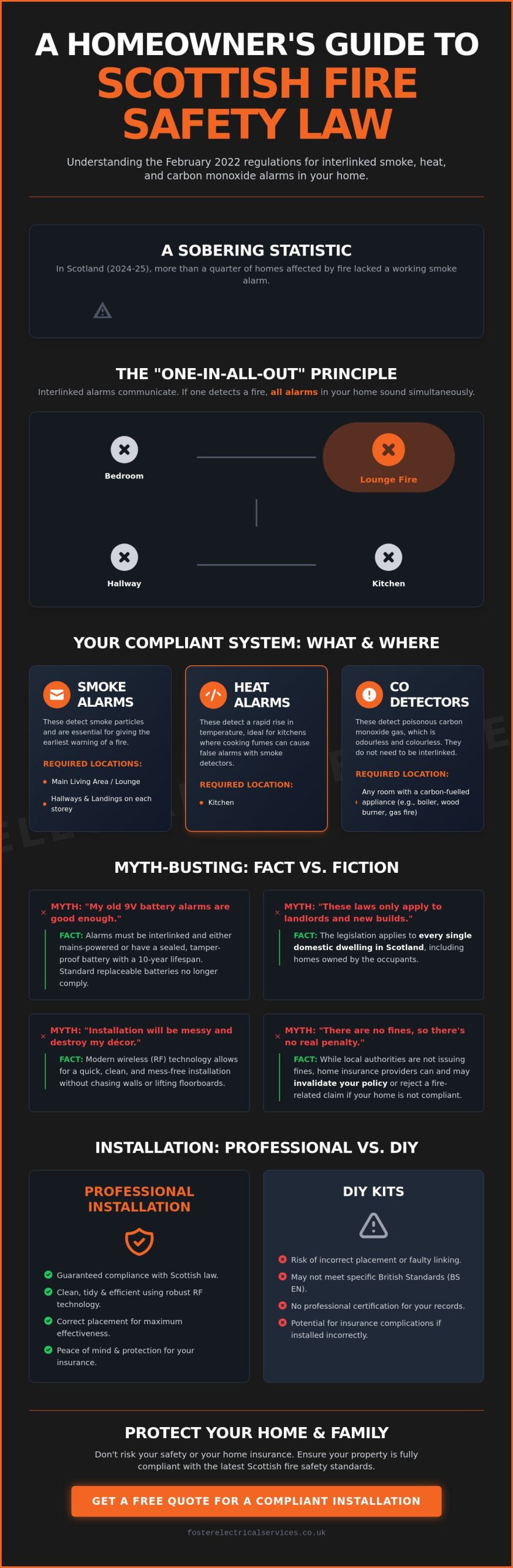
At its simplest level, an interlinked system is a network of alarms that communicate with one another. If a fire starts in the lounge, the alarm in that room triggers every other alarm in your property simultaneously. We call this the “one-in-all-out” principle. It provides the maximum possible warning time, ensuring that even if you’re fast asleep in a bedroom far from the source of the smoke, you’ll hear the alert immediately. To understand the technology behind these devices, it’s helpful to look at the history and development of the smoke detector, which has evolved from basic standalone units to these sophisticated, life-saving networks.
The Scottish Government introduced new legislation in February 2022 making these systems mandatory for every home in Scotland. A common misconception we hear amongst Dundee residents is that these rules only apply to landlords or new builds. That isn’t the case. Whether you own your home outright or you’re a private tenant, the law applies to you. Whilst there aren’t direct fines for homeowners yet, failing to meet these standards can lead to complications with your home insurance. Some providers may have specific clauses in their policies related to fire safety standards. They might look for reasons to reject a claim if they find your property wasn’t compliant with current regulations at the time of an incident.
The Components of a Compliant System
A compliant setup requires specific types of alarms in specific places. You’ll need smoke alarms in your main living area and in every circulation space, such as hallways and landings. Heat alarms are different; they trigger based on temperature rather than smoke. This makes them essential for kitchens where cooking fumes would otherwise cause constant false alerts. If you have carbon-fuelled appliances like a boiler or a wood-burning stove, you’ll also need a carbon monoxide detector. These ensure that every potential risk is monitored by a dedicated sensor designed for that specific environment.
Hardwired vs Wireless Interlinking
When you’re planning an Interlinked Smoke & Heat Alarm Installation, you have two main paths: hardwired or wireless. Hardwired alarms are physically connected by cables, which is often the preferred route during a full property rewire or a major renovation. However, for most established Dundee homes, Radio Frequency (RF) wireless interlinking is a fantastic solution. It’s a common myth that wireless is less reliable than a wired connection. Modern RF technology is incredibly robust. It allows for a mess-free installation without lifting floorboards or chasing walls, which protects the character and tidiness of your home whilst keeping you safe.
Myth-Busting: Common Misconceptions About Interlinked Alarms
We’ve spent many years visiting Dundee homes, and we often hear the same few worries when it comes to fire safety. It’s easy to see why. When laws change, the local grapevine often spreads half-truths that can leave you feeling either unnecessarily anxious or falsely secure. We believe in straightforward, honest advice, so let’s clear up the most frequent misunderstandings we encounter during our daily rounds.
The most common myth is that those old standalone battery alarms with replaceable 9V batteries are still fine. They aren’t. Under the current Legal Requirements and Positioning, alarms must be interlinked and feature either a sealed, tamper-proof battery with a 10-year lifespan or be mains-powered. If you’re still climbing a ladder every six months to swap out a battery, your system likely doesn’t meet the Scottish standard. Another frequent misunderstanding is that this legislation only targets landlords. In reality, these rules apply to every single domestic dwelling in Scotland, including owner-occupied homes.
People also fear that an Interlinked Smoke & Heat Alarm Installation means a week of dust, lifted floorboards, and ruined decor. We take great pride in our tidy work, and thanks to modern Radio Frequency (RF) technology, we can often install a fully compliant system without any invasive wiring at all. This means no chasing walls or peeling back carpets, leaving your home exactly as we found it, just much safer.
The Truth About Scottish Law and Home Insurance
The law changed for all homes because fire doesn’t discriminate between a rented flat and an owner-occupied villa. Whilst there is no “fire alarm police” knocking on doors to hand out fines, your home insurance provider is a different story. If a fire occurs and your alarms don’t meet the 2022 standard, you may find your policy is invalidated. By 2026, most insurers have solidified their terms regarding these safety standards. A compliant system isn’t just a legal tick-box; it’s a shield for your financial security and your family’s safety.
Why “Cheap” Alarms Can Be More Expensive
It’s tempting to grab a bargain kit online, but low-quality imports often suffer from high failure rates or “ghost” alarms that trigger for no reason. A professional installation ensures that your devices meet BS EN 14604:2005 for smoke and BS 5446-2:2003 for heat. We only use trusted components because we believe in doing the job correctly the first time. If you’re unsure if your current setup is up to scratch, we can help with a professional Interlinked Smoke & Heat Alarm Installation that gives you total peace of mind.
Legal Requirements and Positioning in Your Dundee Home
Meeting the new fire alarm legislation in Scotland isn’t just about buying the right kit; it’s about putting it in the right places. We’ve seen many homes where alarms were tucked away in corners or mounted on walls, but the law is quite clear. Every alarm must be ceiling-mounted to ensure it catches rising heat or smoke as quickly as possible. To be fully compliant, your home needs a specific layout of sensors:
- One smoke alarm in the room you spend most of your day (usually the lounge).
- One smoke alarm in every “circulation space” on each floor, such as hallways and landings.
- One heat alarm in the kitchen.
- Carbon Monoxide alarms in any room with a fuel-burning appliance like a boiler or fire.
The kitchen is a special case. To prevent the frustration of false alarms every time you’re cooking, you must install a dedicated heat alarm here instead of a smoke detector. These sensors are tuned to detect significant temperature rises rather than particles in the air. Whilst CO alarms don’t strictly have to be part of your Interlinked Smoke & Heat Alarm Installation, we often recommend linking them anyway for that extra layer of security. It gives you the peace of mind that a silent killer like carbon monoxide will trigger an audible warning throughout the entire property, not just in the boiler cupboard.
Guidance for Different Property Types
Dundee’s housing is diverse, from modern flats in the City Centre to historic tenements in Maryfield. In a single-storey flat, you’ll usually need at least three units: lounge, hallway, and kitchen. For multi-storey houses, the “one per floor” rule for hallways and landings is vital to ensure sound carries through the building. Those living in Dundee tenements often face the challenge of very high ceilings. When we carry out an Interlinked Smoke & Heat Alarm Installation, we ensure every unit is placed exactly where the sensors can perform at their best. We don’t believe in a “one size fits all” approach; we look at the unique layout of your home to ensure total coverage.
Testing and Maintenance Standards
Once your system is in place, a simple “Test it Tuesday” habit keeps your family protected. Pressing the test button on just one unit once a week confirms the interlink is still communicating correctly across the property. We also suggest a quick vacuum around the casing every few months to prevent dust or cobweb build-up, which is a leading cause of nuisance alarms. Most modern sealed battery units are designed to last for 10 years. After this decade of service, the entire unit should be replaced. This is because the chemical sensors inside eventually degrade, and we want to be certain your home remains a safe haven for years to come.
Professional Installation vs DIY: Which Is Best?
It’s natural to look for the most cost-effective way to protect your home. DIY wireless kits often appeal to homeowners because they bypass labour fees and seem straightforward to set up. However, an Interlinked Smoke & Heat Alarm Installation involves more than just sticking a device to the ceiling. If the radio frequency link fails or a unit is placed in a “dead air” pocket where smoke doesn’t circulate, the system is essentially useless. We believe that safety shouldn’t be a gamble. A professional installation provides a formal Certificate of Compliance, which is a vital document if you ever need to prove your home meets Scottish standards to an insurer or a solicitor during a house sale.
For Dundee landlords, professional sign-off isn’t just a preference; it’s a necessity. When we carry out an EICR frequency Scotland landlords must adhere to means verifying that the fire detection system is fully functional and compliant. A DIY setup that hasn’t been correctly commissioned can lead to a “code” on your report, requiring remedial work anyway. We save you that double handling by getting it right the first time. We take personal accountability for every job, ensuring that your property isn’t just legally “covered,” but genuinely safe for your tenants.
What Happens During a Professional Install?
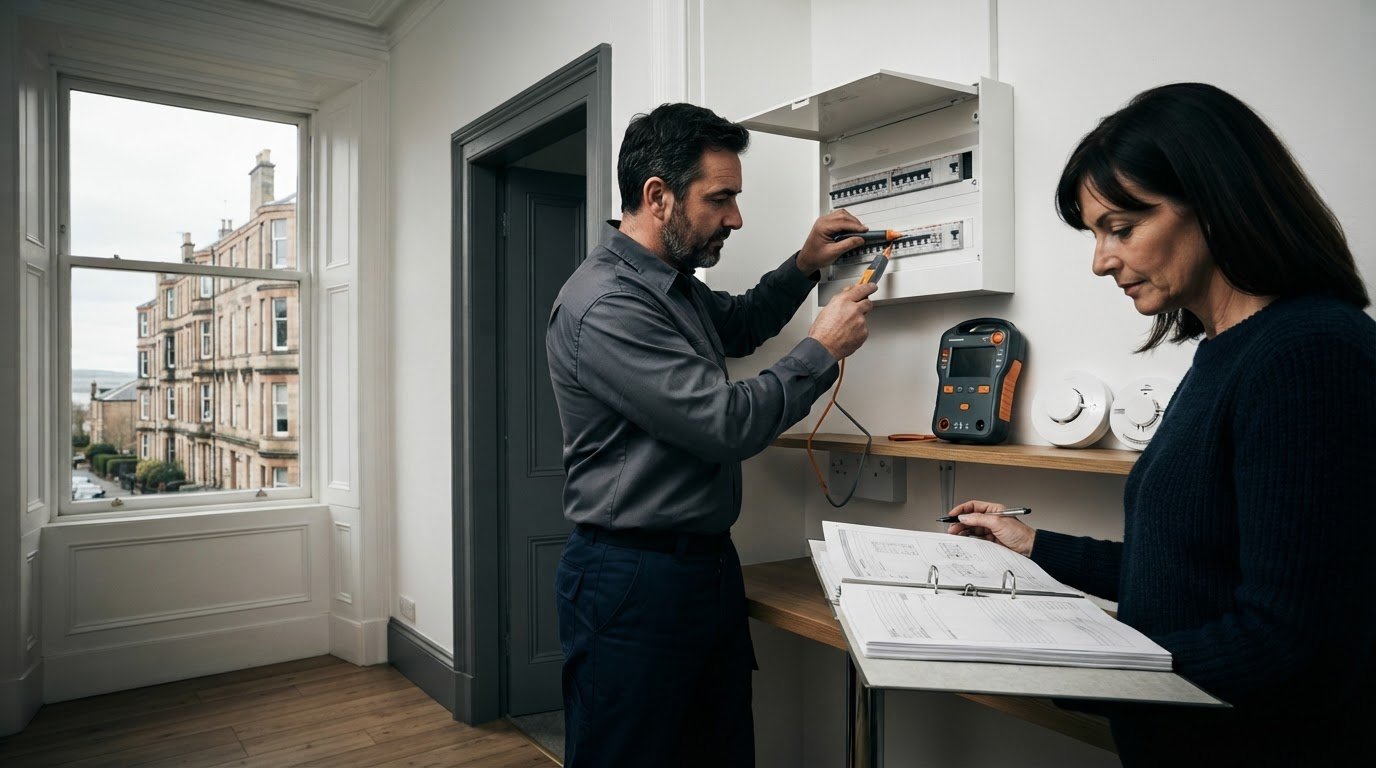
We begin every job with a thorough site survey. We don’t just guess where the alarms should go; we identify the optimal positions to avoid stagnant air zones where smoke might not reach the sensor quickly. Once we’ve securely mounted the units, we link them and perform a full system test to ensure the communication between devices is flawless. We won’t leave until we’ve shown you exactly how the “hush” and “test” functions work. This demonstration ensures you feel confident and in control of your new system without having to pore over a technical manual.
The Value of a Local Dundee Electrician
We are proud to serve our local community. Unlike anonymous national companies, we understand the specific electrical setups found in Dundee’s various property types, from modern builds to traditional stone-walled homes. We treat your home with the same respect we would our own, ensuring every Interlinked Smoke & Heat Alarm Installation is tidy and unobtrusive. There are no corporate call centres here; you deal directly with hardworking experts who take personal pride in their reputation. If you want the certainty that your family is truly protected, you can book your professional installation with us today.
Protecting Your Home with Foster Electrical
We believe that every home in Dundee deserves the highest standard of protection. When we undertake an Interlinked Smoke & Heat Alarm Installation, we aren’t just fitting plastic boxes to your ceiling. We are acting as guardians of your environment. Our team selects only the most reliable, time-tested technology that complies with British Standards. We avoid the flimsy, uncertified imports that flood the market, choosing instead the durable components we would trust in our own homes. This commitment to quality ensures your system remains vigilant long after we’ve left your property.
Honesty is at the heart of everything we do. You won’t find any opaque pricing structures or technical jargon here. We provide clear, straightforward advice so you understand exactly how your home is being protected. We also know that your time is valuable. Our reputation for punctuality is something we take great pride in; we arrive when we say we will. Once we start work, we maintain a meticulous standard of tidiness. We treat your carpets and furniture with personal care, ensuring that every Interlinked Smoke & Heat Alarm Installation is completed without leaving a trace of mess behind.
More Than Just Smoke Alarms
Your safety is a multi-layered responsibility. Whilst interlinked alarms are a legal necessity, they are just one part of a wider protective shield. We often integrate these installations with other essential services like an EICR (Electrical Installation Condition Report) or PAT Testing for your appliances. Whether you need a Consumer Unit Upgrade to modernise your system or a full property rewire, our “Guardian” approach remains the same. We look at the health of your entire electrical system to ensure every circuit and socket is operating correctly and safely.
Book Your Safety Assessment in Dundee Today
We’ve made our contact process as simple as possible because we value direct, human interaction. You won’t be passed around a corporate call centre. Instead, you’ll speak with local experts who understand the unique needs of Dundee homeowners. We offer a fast turnaround to ensure you meet the 2022 fire safety laws without delay. If you’re ready to secure your property with a no-obligation quote, we are here to help. You can Contact Foster Electrical for Interlinked Alarm Installation today and take the first step toward a safer future for your family or tenants.
Securing Your Dundee Home with Confidence
We’ve explored how a professional Interlinked Smoke & Heat Alarm Installation bridges the gap between strict Scottish legislation and your family’s peace of mind. You now know that standalone alarms no longer meet the grade. You need a system that communicates across your entire property to ensure every second counts during an emergency. By choosing a solution that fits your specific property type, you protect both your household and your insurance validity.
As Dundee-based local experts, we take great pride in delivering systems that are fully compliant with Scottish Fire Safety Law. Our approach is grounded in traditional values of diligence and integrity. We promise a clean and tidy installation that respects your living space and avoids unnecessary disruption. Ensure your home is legal and safe; book your installation today.
Protecting your home doesn’t have to be a source of stress or confusion. We’re here to guide you through the process with honesty and care, ensuring your property remains the safe, comfortable haven it was always meant to be.
Frequently Asked Questions
Is it a legal requirement to have interlinked smoke alarms in Scotland?
Yes, it is a legal requirement for every home in Scotland to have an interlinked system. This law came into force in February 2022 and applies to all domestic dwellings, regardless of whether you are a homeowner or a tenant. The standard requires one smoke alarm in the main living area, one in every circulation space, and a heat alarm in the kitchen.
Do I need to rewire my whole house to install interlinked alarms?
No, you don’t need to rewire your entire property. Whilst hardwired systems are excellent for new builds, modern Radio Frequency (RF) technology allows us to perform an Interlinked Smoke & Heat Alarm Installation without any invasive cabling. These wireless units communicate through secure signals, meaning we can protect your home whilst keeping your decor and floorboards exactly as they are.
Can I still use my old battery-operated smoke alarms alongside new ones?
No, old standalone battery alarms cannot be used as part of a compliant system. To meet the Scottish standard, every alarm must be interlinked so that they all sound at once. Older units with replaceable 9V batteries don’t have this communication capability. We replace these with sealed, long-life lithium battery units or mains-powered sensors that are designed to work together as a single network.
What happens if I don’t comply with the Scottish fire alarm law?
There are currently no direct criminal penalties or fines for non-compliance, but the risks are still significant. Local authorities take a measured approach to enforcement, yet failing to meet these standards can lead to serious issues with home insurance claims. If a fire occurs and your system isn’t compliant, your provider may have grounds to reject your claim, leaving you financially unprotected.
Do I need a carbon monoxide alarm to be interlinked as well?
Carbon monoxide (CO) alarms don’t strictly have to be interlinked with your smoke and heat alarms, though it is often a sensible choice. The law requires a CO detector in any room with a fuel-burning appliance, such as a boiler or a gas fire. Whilst these can be standalone units, interlinking them ensures that you’ll hear the warning in every room if a leak is detected.
How much does it cost to have interlinked alarms professionally installed in Dundee?
The cost for a professional installation in Dundee varies depending on the size of your property and the number of sensors required. A standard three-bedroom house will naturally require more units than a single-storey flat. We recommend checking with local qualified electricians for a specific quote tailored to your home’s layout. We provide transparent, no-obligation assessments to ensure you get exactly what you need.
How do I know if my alarms are interlinked correctly?
You can verify the interlink by pressing the test button on any single unit in your home. If the system is set up correctly, every other alarm in the property should sound within a few seconds. We conduct a full system test during every Interlinked Smoke & Heat Alarm Installation to confirm the network is robust. Regular weekly testing is the best way to ensure this communication remains active.
Will interlinked alarms go off if I burn the toast in the kitchen?
No, a correctly installed system shouldn’t trigger every time you burn the toast. This is why we install a dedicated heat alarm in the kitchen rather than a smoke detector. Heat alarms respond to significant temperature increases rather than airborne particles. This setup minimises nuisance alarms whilst ensuring that a genuine fire in the kitchen still triggers the entire network across your home.