Your short-term let licence in Dundee isn’t just a piece of paper; it’s a promise of safety that the council now monitors with absolute strictness. Since the transitional period for existing hosts ended on 1 January 2025, the legal landscape has shifted, making formal compliance a non-negotiable part of your daily operations. We understand that keeping up with these changes can feel like a heavy burden, especially when it comes to technical requirements like pat testing for holiday let dundee. It’s completely natural to feel a sense of unease about the risk of heavy fines or the sudden revocation of your licence if a single detail is overlooked.
We believe that your focus should be on providing a warm, Scottish welcome to your guests, not losing sleep over shifting legislation. This expert guide is here to ensure your property remains both legal and safe by detailing the mandatory PAT testing and Scottish licensing requirements for 2026. We will explain exactly which appliances need checking, how to display your reports correctly for council inspectors, and how to maintain the high standards of safety that keep your insurance coverage fully valid and your guests protected.
Key Takeaways
- Understand the specific documentation Dundee City Council requires to maintain your short-term let licence under current Scottish law.
- Identify which portable appliances in your rental property need testing to ensure full compliance and guest safety.
- Learn why scheduling pat testing for holiday let dundee alongside your EICR is the most efficient way to manage your legal obligations.
- Discover how to prepare your property for an inspection to ensure your electrician can work meticulously without disturbing your booking calendar.
- Gain peace of mind by choosing a local family business that treats your property with the same care and respect as a protective guardian.
Mandatory PAT Testing for Dundee Holiday Lets: Staying Compliant with Scottish Law
As we move through 2026, the rules for short-term lets in Dundee have never been clearer or more strictly enforced. The transitional period for the Scottish Short-term Let Licensing Scheme officially ended on 1 January 2025, meaning every host must now hold a valid licence to operate. Central to this licence is a firm commitment to electrical safety. While some might still view What is Portable Appliance Testing (PAT) as a helpful suggestion, the Housing (Scotland) Act 2006 and subsequent 2023 regulations have made it a mandatory pillar of your business. Dundee City Council requires documented proof that your property is safe. Without a current certificate, your application or renewal will simply be refused.
The distinction between a recommendation and a legal requirement is now absolute. In the past, you might have skipped testing a few lamps or a kettle, but today that oversight carries heavy risks. Non-compliance can lead to significant fines and the immediate revocation of your operating licence. We’ve seen how stressful these administrative hurdles can be for local owners. Our role is to step in as a protective guardian for your property, ensuring every plug and cable meets the high standards expected by Tayside authorities.
Beyond physical safety, managing a successful short-term let involves staying on top of broader business compliance. To help streamline your administrative workload, you can explore Year End Accounts Preparation with Stewart Accounting Services to ensure your financial reporting is handled with the same care as your electrical safety.
The Short-term Let Licence in Dundee
Applying for your licence involves more than just a form; it requires you to pass the “fit and proper person” test. This assessment proves you’re a responsible landlord who takes guest welfare seriously. Part of this responsibility is maintaining an up-to-date log of all electrical checks. Once we complete your pat testing for holiday let dundee, you’re legally required to display your PAT report and your short-term let licence in a prominent place where guests can easily see them. This transparency builds trust and keeps you on the right side of local inspectors who conduct spot checks across the city.
Insurance Obligations for Tayside Hosts
We often speak with owners who assume their standard home insurance covers them for paying guests. In reality, these policies are usually insufficient for the unique risks of a holiday rental. Most specialist providers will only honour a public liability claim if you can prove you’ve met all statutory safety obligations. If a faulty appliance leads to an accident and you lack proof of pat testing for holiday let dundee, your insurer may well invalidate your claim. By keeping your electrical certification current, we ensure your policy remains a robust safety net whilst guests are in residence. It’s about protecting your livelihood as much as your property.
What Portable Appliance Testing (PAT) Covers in Your Rental Property
In the world of holiday rentals, a “portable appliance” is generally defined as any piece of electrical equipment that connects to the mains supply with a plug. This isn’t limited to things you can easily carry; it includes larger items like microwaves and even some heaters. To ensure you are meeting the exact standards of Scottish Law for Holiday Lets, we categorise these items into Class I and Class II equipment. Class I items, such as kettles and toasters, rely on an earth connection for safety. Class II items are double insulated and don’t require an earth. Each type needs a specific testing approach to guarantee it won’t pose a shock or fire risk to your guests.
Our process for pat testing for holiday let dundee follows a rigorous three-step sequence. We begin with a formal visual inspection, followed by manual testing using calibrated equipment, and conclude with detailed documentation. This isn’t a “tick-box” exercise for us. We take the time to look at every item properly. Documentation is particularly vital for Dundee landlords, as you must be able to produce a clear register of all tested items if the council requests it during a licence inspection. If you have any concerns about a specific item in your property, you can always reach out to our local team for advice.
Common Holiday Let Appliances to Test
In a busy Airbnb or cottage, certain items work harder than others. High-wattage kitchen essentials like kettles, coffee machines, and microwaves are considered high-risk due to frequent use. We also pay close attention to entertainment systems, including TVs and games consoles, which often have clusters of cables that can become tangled or damaged. Don’t forget guest comforts like hair straighteners and electric blankets; these are often the most likely to develop faults that could lead to a fire if left unchecked.
The Visual Inspection: What We Look For
The visual inspection is where we find roughly 80% of all electrical faults. We meticulously check for frayed cables, cracked plug casings, and signs of overheating, such as discolouration around the pins. We also verify that every plug has the correct fuse rating; an incorrect fuse is a common but dangerous “DIY” mistake. For Class I items, we use our testing meters to confirm earth continuity. This ensures that if a fault does occur, the safety mechanisms will actually work. We treat your property with the care of a protective guardian, ensuring no detail is missed.
Frequency and Safety Standards: How Often Should You Test Your Tayside Property?
One of the most common questions we hear from local hosts is exactly how often they need to invite us in for an inspection. Under the current Scottish licensing rules, the absolute maximum interval for an Electrical Installation Condition Report (EICR) and its accompanying appliance checks is five years. However, relying solely on this five-year limit can be a risky strategy for a busy rental. The Frequency and Safety Standards set by national regulators suggest a risk-based approach. We always remind our clients that a toaster in a holiday cottage often sees more use in a single season than a domestic one does in three years. Guests aren’t always as careful as homeowners, and high turnover naturally leads to faster wear and tear on cables and plugs.
We’ve found that pat testing for holiday let dundee is most effective when it’s tailored to the specific needs of the property. For a quiet retreat with only a few bookings a year, the five-year rule might suffice. For a city-centre flat with back-to-back bookings, we often suggest more frequent professional checks for high-use items. Maintaining a meticulous log of these tests isn’t just about safety; it’s about having a ready-made “safety file” to hand over whenever a council inspector knocks on your door. It proves you’re a diligent landlord who takes your responsibilities seriously.
Many premier destinations in the region, such as when you visit Silverwood Resort, demonstrate how meticulous safety management contributes to a successful luxury guest experience.
The 5-Year Rule vs Annual Best Practice
While the law sets a five-year ceiling, many Tayside landlords find that an annual professional visit offers much better peace of mind. Between our visits, we encourage you to perform your own simple visual checks during every changeover. Look for frayed wires on the vacuum cleaner or loose pins on the kettle plug. If you spot anything suspicious, it’s always better to set that item aside for an early re-test. Catching a small fault early prevents a minor inconvenience from turning into a dangerous fire hazard or a failed council inspection.
Integrating PAT with EICR and Fire Safety
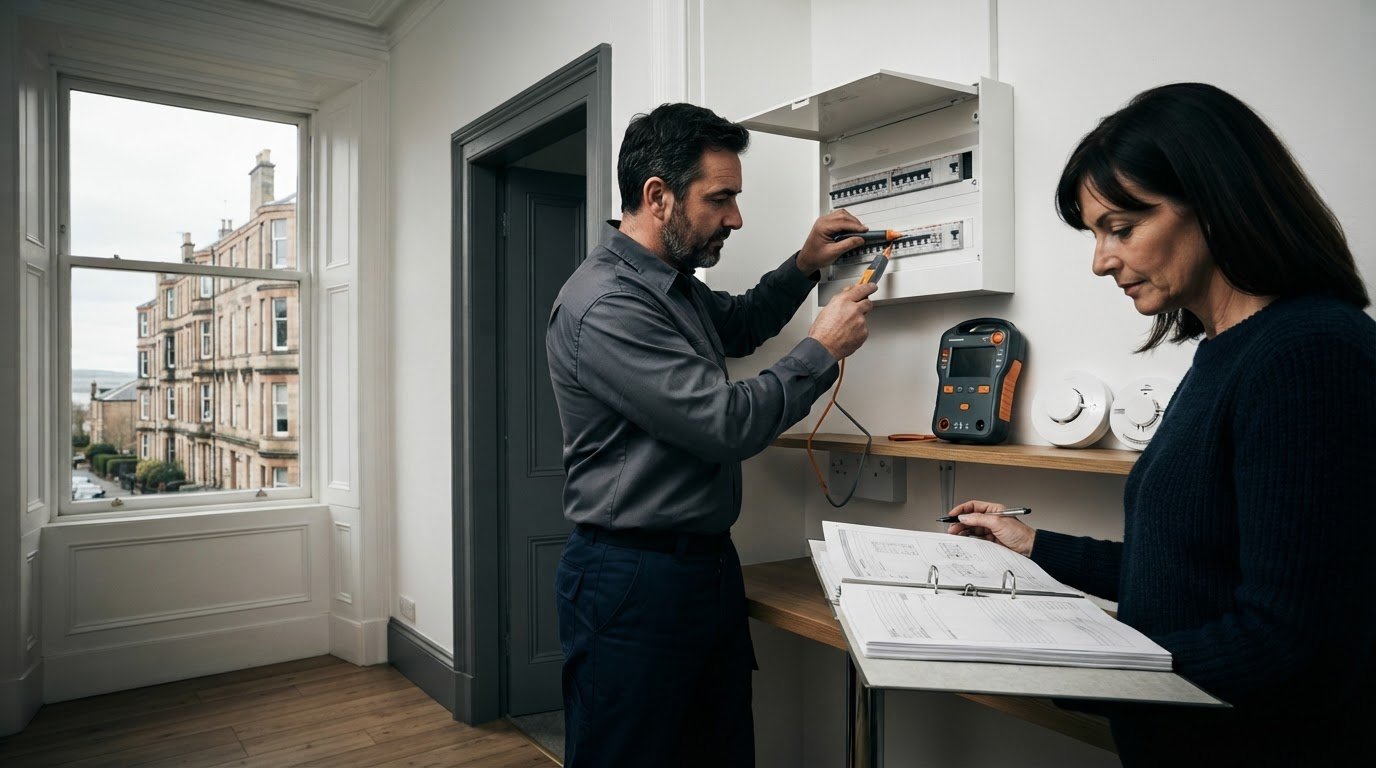
The most efficient way to manage your compliance is to coordinate your appliance testing with your five-yearly EICR certificate Dundee. This ensures your entire electrical system, from the fuse board to the bedside lamp, is verified in one go. We also make sure your interlinked smoke alarms are functioning correctly and meet the 2026 standards whilst we are on-site. By combining these services, we help you create a comprehensive safety record that protects your guests, your property, and your professional reputation as a trusted Dundee host.

Preparing Your Airbnb or Cottage for an Electrical Safety Inspection
We know that your booking calendar is the lifeblood of your business. Arranging pat testing for holiday let dundee shouldn’t feel like a disruption to your guests or a logistical headache for you. A small amount of preparation before we arrive ensures the process is swift, thorough, and effective. We pride ourselves on being meticulous and tidy; we treat your space with the sensitivity and care of a diligent neighbour. By organising the property ahead of time, you allow us to focus on the technical safety checks that keep your licence valid and your guests protected.
If an inspection must happen whilst guests are in residence, clear communication is essential. Most visitors appreciate knowing that their safety is being actively managed by a responsible host. We work quietly and with a high degree of empathy for the guest’s private space, ensuring we’re in and out as quickly as possible. To help us maintain this pace, we recommend identifying any personal appliances you’ve left in the property and removing them before the test begins. If a laptop charger or personal hairdryer is left in a guest-accessible area, we are legally obliged to include it in our report.
The Pre-Visit Checklist for Landlords
To make the most of our visit and ensure every socket is verified, we suggest following this simple preparation routine:
- Unplug non-essential items like bedside lamps, clocks, and fans to speed up the testing sequence.
- Ensure all guest-accessible rooms, utility cupboards, and basement areas are unlocked and easy to enter.
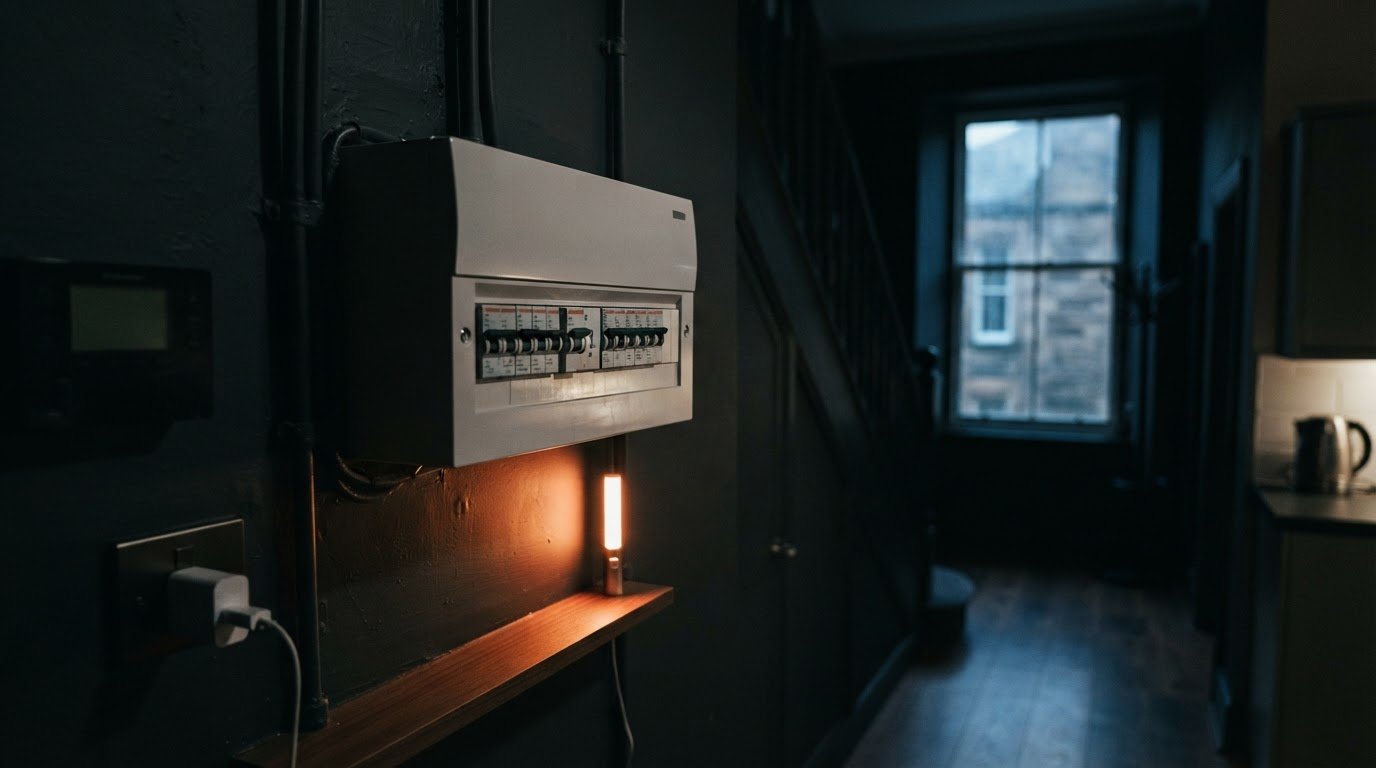
- Check that the consumer unit is not blocked by storage boxes, laundry, or cleaning supplies.
- Move heavy furniture slightly if it completely blocks access to a wall socket we need to test.
Handling Failed Items Safely
If an appliance fails the inspection, we will immediately apply a red “Fail” label. This marker is a vital safety warning and must never be removed until the item has been professionally repaired or, more commonly, permanently decommissioned. For dangerous electronics, the most responsible path is often disposal. There are several recycling centres across Dundee and Angus that handle electrical waste safely. When you purchase replacements, always look for the British Safety Standard kitemark to ensure your new equipment meets the rigorous standards required for Scottish short-term lets. If you have any questions about specific items or need to book a slot between guest check-outs, please get in touch with our Dundee office to discuss your requirements.
Professional PAT Testing in Dundee: Why Local Expertise Matters
Choosing a local expert for pat testing for holiday let dundee is about more than just proximity; it’s about accountability. National contractors often operate through anonymous call centres and dispatch sub-contractors who have no long-term stake in our community. We take a different approach. As a local family business, we are fiercely proud of our reputation and the trust our neighbours place in us. When you work with us, you aren’t just a number in a corporate database; you’re a fellow local business owner who deserves a diligent, personal service.
We hold NICEIC certification, which remains the gold standard for Scottish landlords. This isn’t just a badge; it’s a firm promise that our work meets the highest safety standards in the industry. Dundee City Council officials often look for the stamp of a recognised local business when reviewing licence applications, as it provides an extra layer of certainty. We understand the specific nuances of Tayside property types, from historic tenements to modern waterfront apartments, and we bring that local knowledge to every inspection whilst ensuring we remain a protective guardian of your property.
A Personal Approach to Property Safety
We believe in traditional sincerity. We treat your holiday home with the same care and respect we would show our own, ensuring we leave every room exactly as we found it. Our pricing is transparent and honest, free from the hidden “corporate” fees or opaque structures often found with larger firms. You’ll have direct communication with the electrician carrying out the work, allowing for a straightforward, human interaction that makes the whole process feel calm and manageable. It’s a person-to-person service that prioritises your peace of mind over high-pressure sales tactics.
Beyond PAT: Your Local Partner for Compliance
Compliance is an ongoing journey, not a one-off event. If we identify an issue during our visit, we are here to provide immediate support for fault finding and repairs. We don’t just point out problems; we offer practical, artisanal solutions to keep your property running safely. Whether it’s a minor repair or more significant work like upgrading your consumer unit to meet the latest 18th Edition regulations, we are your reliable partner for the long term. Protect your guests and your licence today by contacting Foster Electrical for your Dundee holiday let safety check. We’ll ensure your property remains a safe, welcoming environment for every visitor who comes to stay.
Secure Your Licence and Your Guests’ Safety
Staying on top of your legal obligations doesn’t have to be a source of constant stress. We’ve explored how a clear focus on mandatory electrical safety protects your investment and ensures your short-term let licence remains in good standing with the council. By integrating your appliance checks with your EICR and fire safety standards, you create a robust safety file that satisfies inspectors and insurance providers alike. It’s about building a reputation for excellence and reliability in Dundee’s thriving holiday rental market.
When you choose us for pat testing for holiday let dundee, you’re partnering with a family-run business that takes personal pride in every plug and cable we inspect. We are NICEIC Registered Electricians and specialists in local compliance; we hold ourselves to a 5-star local reputation built on sincerity and diligence. We act as the protective guardian of your rental, providing the meticulous care your property deserves whilst keeping the process simple and transparent.
Book your Dundee holiday let PAT test with Foster Electrical today to secure your property’s future. We look forward to helping you keep your guests safe and your business thriving for years to come.
Frequently Asked Questions
Is PAT testing a legal requirement for holiday lets in Scotland in 2026?
Yes, Portable Appliance Testing is a mandatory legal requirement for all short-term lets in Scotland. Since the licensing scheme became fully operational for all hosts on 1 January 2025, you must provide documented proof of electrical safety to Dundee City Council. This ensures your property meets the safety standards set out in the Housing (Scotland) Act 2006 and subsequent 2023 regulations.
How much does PAT testing cost for a standard 2-bedroom holiday cottage in Dundee?
The cost of testing varies based on the number of electrical appliances in your property rather than the number of rooms alone. A standard cottage usually contains a mix of kitchen essentials, entertainment systems, and guest comforts that all require individual inspection. We focus on providing transparent, honest pricing that reflects the diligent and meticulous care we take when acting as the protective guardian of your property.
Do I need to test appliances that are still under a manufacturer’s warranty?
Yes, even appliances under warranty must be included in your property’s safety management plan. Whilst a brand-new item might only require a formal visual inspection in its first year, it must still be recorded on your appliance register to satisfy licensing inspectors. This provides the complete paper trail required to prove you are maintaining high standards of safety for every guest who stays in your home.
Can I perform the PAT testing myself if I am a competent DIYer?
The law requires a “competent person” with the correct equipment and technical knowledge to perform these checks. For the purposes of a short-term let licence, Dundee City Council expects professional certification from a qualified electrician. Using an NICEIC-registered expert ensures your documentation is legally robust and keeps your insurance coverage valid, which a DIY approach simply cannot guarantee.
What happens if a guest brings their own electrical equipment into my holiday let?
You are legally responsible for the electrical equipment you provide for guest use within the property. You aren’t expected to test items that guests bring themselves, such as laptop chargers or hair straighteners. Many hosts include a polite note in their welcome pack advising that personal equipment is used at the guest’s own risk, helping to maintain the overall safety of the environment.
How long does a typical PAT testing appointment take for a small Airbnb?
A typical appointment for a small Airbnb usually takes between one and two hours to complete thoroughly. This timeframe allows us to perform a meticulous visual check and manual test on every item without rushing the process. We work with a high degree of empathy for your schedule, ensuring we are tidy and efficient so your property is ready for the next guest check-in.
Will I receive a formal certificate to send to Dundee City Council?
Yes, we provide a detailed PAT report and a register of all tested items immediately after our work is finished. This formal documentation is vital for your pat testing for holiday let dundee records and must be available for council inspection. You are also required to display this safety information in a prominent place where your guests can easily access it during their stay.
Do interlinked smoke alarms need to be tested at the same time as PAT?
Whilst they are separate legal requirements, it’s sensible and efficient to have your interlinked smoke alarms verified during the same visit. Scottish law requires these alarms to be functioning correctly on every storey of your rental property. We often combine these checks to provide a comprehensive safety service, ensuring you meet all fire and electrical standards in one straightforward appointment.