You are halfway through making a cup of tea or finishing a load of laundry when, without warning, the power cuts out and leaves your Dundee home in total darkness. It is an incredibly frustrating moment; it is also one that carries a heavy weight of anxiety about what is happening behind your skirting boards. You aren’t alone in wondering if a simple appliance is to blame or if your house wiring is posing a genuine fire risk. Understanding the most common tripping circuit causes is the first step toward regaining your peace of mind and ensuring your property remains a safe haven for your family.
We believe that your home’s electrical system should be a silent, reliable guardian of your comfort. In this article, we will help you demystify those frequent power cuts by explaining why your consumer unit reacts the way it does. You will discover how to tell the difference between a minor nuisance and a serious fault that requires a professional touch. We will walk you through the practical steps to take when the lights go out so you can feel confident that your electrical installation is safe, secure, and up to the latest standards.
Key Takeaways
- Understand that your consumer unit acts as a protective guardian, tripping to prevent fires and keep your family safe rather than indicating a system failure.
- Identify the most common tripping circuit causes, ranging from simple appliance overloads to more complex hidden wiring faults.
- Recognise the specific risks associated with older properties in Dundee, where ageing rubber or lead cabling can lead to frequent power cuts.
- Learn to distinguish between a minor nuisance and serious hazards like earth leakage or short circuits that require professional intervention.
- Gain the confidence to know when a simple reset is sufficient and when you must call a local expert for meticulous fault finding.
Understanding Why Your Circuit Trips: The Role of the Consumer Unit
Think of your consumer unit as the brain of your home’s electrical system. It is the central hub where safety meets domestic functionality. When your power suddenly cuts out, it is easy to feel a sense of frustration, yet this reaction is actually a deliberate safety measure. Investigating tripping circuit causes often reveals that your system is working exactly as it should to prevent a potential fire or a dangerous shock. It acts as a protective guardian, standing between your family and the invisible dangers of uncontrolled electricity.
A total power failure across your entire property is quite different from a single circuit tripping. If your kitchen sockets have gone off but the hallway lights remain bright, your consumer unit has successfully isolated a specific problem. This precision allows you to maintain some level of comfort whilst you identify the underlying fault. It is a sophisticated way of managing risk that older, more primitive electrical systems simply could not match.
MCBs vs RCDs: What is Actually Tripping?
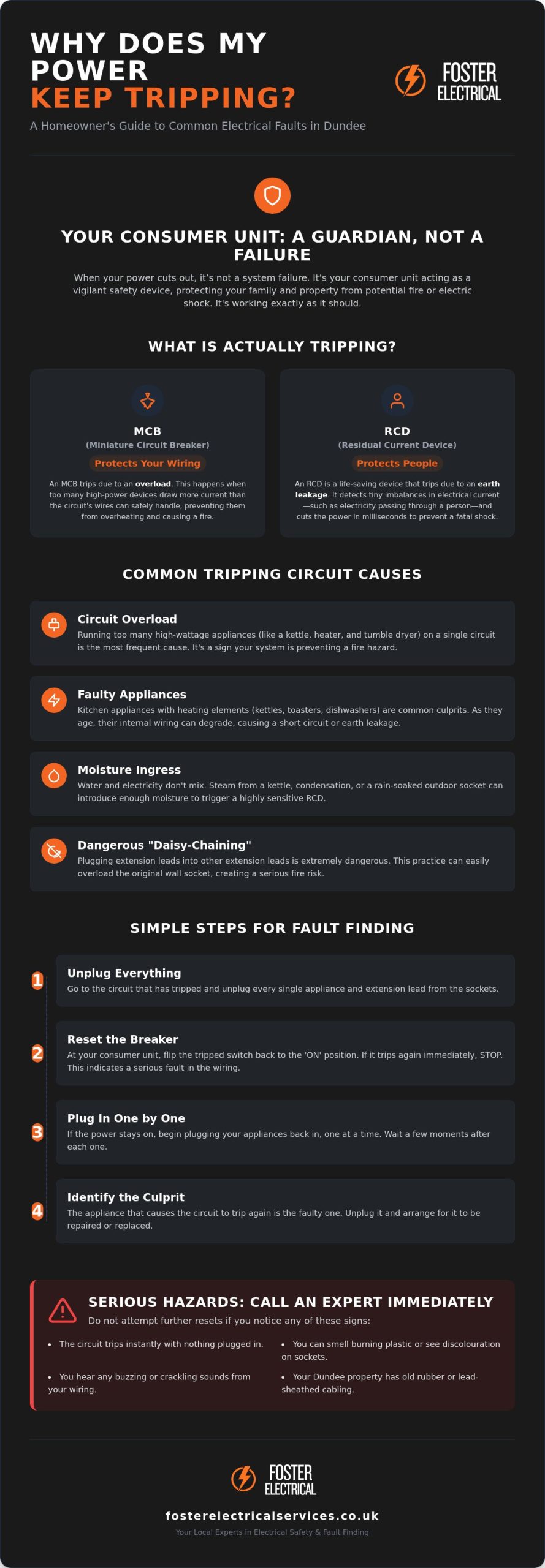
A Circuit breaker, specifically a Miniature Circuit Breaker (MCB), is designed to protect your home’s cabling from overheating. If you plug in too many high-wattage appliances at once, the MCB detects this excessive demand and cuts the power before the wires can melt. On the other hand, a Residual Current Device (RCD) is far more sensitive to human safety. It looks for tiny amounts of electricity escaping the circuit, which could indicate a faulty appliance or someone accidentally touching a live wire. An RCD is a device that monitors the balance of electricity. If that balance shifts by even a fraction, the power is cut in milliseconds to prevent a life-threatening electric shock.
Why Safety Standards Matter in Dundee Homes
Many properties across Dundee still rely on older fuse wire boxes that lack these modern, life-saving protections. Upgrading to a modern 18th Edition board ensures your home meets the latest safety regulations, providing a level of “correctness” that old systems cannot provide. We take great pride in our Consumer Unit Upgrades because they offer genuine, long-term peace of mind. A modern board provides much better protection against common tripping circuit causes than an old-fashioned fuse; it makes your home a safer place for everyone inside.
Common Tripping Circuit Causes: Overloads and Faulty Appliances
Finding the root of the problem often starts with looking at what you were doing the moment the power went out. Most frequent tripping circuit causes stem from simple overloads. This happens when too many high-wattage appliances, such as an electric heater and a tumble dryer, are running on the same ring at once. Your circuit breaker is a vigilant protector; it cuts the power before your house wiring can overheat and become a fire hazard. It is often the cumulative effect of several small loads, like a fridge, a TV, and a few lamps, that eventually tips the balance when one more device is switched on.
Moisture is another silent culprit that we frequently encounter in Dundee homes. Steam from a boiling kettle or a heavy rain shower affecting an outdoor socket can introduce just enough dampness to trigger a trip. Even if your internal wiring is in good condition, these external factors are common tripping circuit causes that seem to happen for no reason. We always advise checking your outdoor power points for any signs of water ingress after a particularly Scottish downpour.
The Kitchen Culprits: Kettles, Toasters, and Dishwashers
Kettles, toasters, and dishwashers are the most frequent offenders in any kitchen. Because these devices use high-powered heating elements, any internal degradation quickly leads to a trip. You can often find the problem by unplugging every single appliance on that circuit and resetting the breaker. If the power stays on, plug your devices back in one by one until the trip happens again. Keep an eye out for any discolouration on the plug pins or a faint smell of burnt plastic. These are clear signs that the appliance has reached the end of its safe working life.
Extension Leads and Power Strips
In many of the older tenement flats across Dundee, there aren’t always enough sockets for modern life. This often leads to “daisy-chaining”, where one extension lead is plugged into another. This is a dangerous practice that can easily cause a circuit to overload. Cheap power strips can also develop loose internal connections over time. These loose parts generate heat and can cause your consumer unit to trip unexpectedly, even if you aren’t using much power at the time. If you find yourself relying on multiple strips, it might be time to consider adding more permanent sockets to your home.
If you’ve unplugged your appliances and the power still won’t stay on, the issue likely lies within the walls. We recommend booking a professional fault finding and repair service to ensure your property is truly safe and to stop the frustration of constant power cuts.
Serious Electrical Faults: Short Circuits and Earth Leakage
While external appliances are often the first place we look, some tripping circuit causes are hidden deep within the fabric of your home. A short circuit is one of the most common serious faults. It occurs when a live wire makes direct contact with a neutral wire, causing a sudden, massive surge of electricity. This high-energy event triggers the circuit breaker instantly to prevent the cables from melting or catching fire. It is a violent disruption to the system that requires a methodical approach to resolve safely.
Earth leakage is a slightly more subtle but equally dangerous issue. This happens when electricity “leaks” out of the intended circuit and finds a path to the ground, often through the casing of a machine or damp patches in the wall. Modern RCDs are designed to detect these tiny imbalances; they cut the power before the leakage becomes strong enough to cause a fatal electric shock. Because these issues often involve damaged cables behind skirting boards or inside ceiling voids, they necessitate professional Fault Finding and Repairs to locate the exact point of failure without causing unnecessary disruption to your decor.
Rodent Damage and Hidden Wiring Issues
In many of the older residential areas of Dundee, lofts and floor voids can sometimes host unwanted guests. Pests such as mice or squirrels have a habit of chewing through the plastic insulation on cables. This exposes the copper cores, leading to intermittent tripping circuit causes that seem to happen at random. Similarly, a simple DIY task like hanging a new picture can go wrong if a nail is driven into a hidden cable. These faults are particularly tricky because the damage is out of sight, often requiring specialist testing equipment to identify the precise location of the break.
The Risk of Persistent Resetting
We often see homeowners who have fallen into the habit of repeatedly resetting a breaker that refuses to stay up. This is a dangerous practice that we strongly advise against. Every time you force a breaker back on against a fault, a small electrical spark, or “arc”, occurs at the point of the problem. Over time, this persistent arcing generates intense heat that can char the surrounding timber or insulation. It also places immense stress on the consumer unit itself. If a circuit trips more than twice in quick succession, it is telling you that a genuine hazard exists. Forcing it to stay on bypasses the very safety system designed to protect your life and property.
Is Your Dundee Property at Risk? Signs of Aging Wiring
Dundee’s architectural heritage is a source of great local pride, from grand Victorian tenements to sturdy post-war semi-detached homes. However, these beautiful buildings often hide electrical systems that are struggling to keep pace with modern life. If your property hasn’t seen an electrician in several decades, you may still have Vulcanised Indian Rubber (VIR) or lead-sheathed cabling hidden behind your skirting boards. Over time, this rubber insulation becomes brittle and simply crumbles away. This physical decay is one of the most persistent tripping circuit causes in our local area; it leaves bare wires exposed and creates a significant fire risk that no simple reset can fix.
The correlation between an old fuse box and modern appliance demands is a frequent source of frustration for homeowners. A system designed in the 1950s was intended for a few light bulbs and perhaps a wireless radio; it was never meant to power the high-current demands of induction hobs, power showers, and electric vehicle chargers. When these old systems are pushed to their limit, they often fail in ways that are difficult to diagnose without the right tools. Booking an EICR certificate is the best way to gain a clear, honest assessment of your wiring health. This report identifies hidden dangers and provides a roadmap for making your home safe and reliable again.
When a Partial Rewire is the Answer
We often find that a house-wide problem is actually concentrated in one high-use area. If your kitchen is the only place where the power constantly cuts out, a partial rewire might be the most practical solution. By replacing the cables in specific zones and adding dedicated circuits for heavy appliances, we can stabilise the entire system. This targeted approach offers a way to address the most common tripping circuit causes without the upheaval or expense of a full property rewire, providing a sensible middle ground for many families.
Upgrading to a Modern Consumer Unit
A Consumer Unit Upgrade is one of the most effective ways to protect your modern electronics. New boards now include Surge Protection Devices (SPD) which act as a shield for your smart TVs, computers, and gaming consoles against external voltage spikes. This level of protection is also vital for high-value items like electric bikes; for those interested in premium cycling options, you can check out The Cycle Centre for their selection of specialist brands. These units also provide much better diagnostic information than old-fashioned fuse boxes. When a trip occurs, the modern layout helps you identify the specific circuit at fault immediately. This clarity eliminates the guesswork and helps us maintain the high standards of correctness that every Dundee home deserves.
If you have noticed flickering lights or a burning smell near your sockets, it is time to act. Please contact our local Dundee team today to discuss how we can help you secure your home’s electrical future with a professional safety check.
Professional Fault Finding in Dundee: Restoring Your Safety
When your power keeps cutting out, it is more than a mere inconvenience; it is a signal from your home that something isn’t right. We approach every call-out with the same level of care we would give to our own families. As your protective guardian, we don’t believe in guesswork or temporary patches that fail a week later. Our team focuses on identifying the specific tripping circuit causes through a methodical, step-by-step process that ensures every inch of your installation is scrutinised for safety and correctness.
Reliability comes from using the right tools for the job. We rely on professional, calibrated test equipment to see what is happening behind your walls. By measuring electrical resistance and continuity, we can pinpoint a fault within centimetres, saving you from unnecessary disruption to your decor. Whether the solution is a simple repair or, in more serious cases, Full Property Rewires, we provide a clear and honest path forward. You will never be left in the dark about the condition of your home.
What to Expect When We Visit Your Home
We understand that inviting a contractor into your private space is a privilege. We take personal pride in our high standards of execution, which begins with being meticulous about tidiness. We arrive on time, use floor protectors, and ensure we leave your home exactly as we found it. Our communication is always straightforward and transparent; we reject technical complexity in favour of plain, accessible language. You will receive a summary of our findings, including results from insulation resistance tests and earth loop impedance checks, explained in a way that makes sense to you.
Serving Dundee, Angus, and Fife
Being a local Dundee-based team means we are deeply rooted in the Tayside community. We aren’t a faceless corporation; we are your neighbours who happen to be experts in our field. This local presence allows us to offer faster response times when you are facing an electrical emergency. We have spent years working in the specific types of housing stock found across Angus and Fife, giving us an artisanal understanding of how these buildings were wired. If you are struggling with persistent tripping circuit causes, get in touch with Foster Electrical for expert fault finding today. We are here to ensure your home remains the safe, comfortable sanctuary it was meant to be.
Secure Your Home’s Electrical Future
We have explored how your consumer unit acts as a protective shield, cutting power to prevent fires or shocks. You now know that whilst many tripping circuit causes are as simple as a faulty kettle, others require the meticulous eye of a professional to find hidden faults deep within your walls. Identifying these issues early is the best way to ensure your property remains a safe and comfortable haven for your family. Understanding the health of your wiring is not just about convenience; it is about the long-term safety of everyone under your roof.
We take great pride in our Dundee Trusted Trader standards and our commitment to meticulous household tidiness. We promise to provide transparent, jargon-free safety advice that puts your peace of mind first. If you are tired of the frustration and anxiety caused by constant power cuts, we are here to help you restore order to your electrical system. Contact Foster Electrical for Reliable Fault Finding in Dundee today to book a comprehensive safety check. We look forward to helping you keep your home safe, secure, and fully powered.
Frequently Asked Questions
Why does my circuit breaker trip when I turn on my kettle?
Your kettle draws a significant amount of current to heat water quickly; if the heating element inside has begun to perish, it will trigger a safety trip immediately. It is also possible that your kitchen circuit is already near its maximum capacity. When you add the heavy load of a kettle to a circuit already running a fridge and a dishwasher, the total demand exceeds the safety limit and the breaker cuts the power to protect your cables.
Is a tripping circuit a fire hazard?
Yes, a circuit that trips frequently should always be treated as a potential fire hazard. Whilst the trip itself is a safety action designed to prevent a fire, the underlying cause is often heat related. Loose connections or damaged insulation can cause “arcing”, where electricity jumps across a gap and generates intense heat. We believe that ignoring these warnings is a risk no homeowner should take with their family’s safety.
How do I know if my consumer unit is faulty or if it is the wiring?
It is almost impossible to distinguish between a faulty component and a wiring issue without professional testing equipment. We use calibrated insulation resistance testers to “pressure test” the wires behind your walls to see if they are leaking electricity. If the wiring tests perfectly but the breaker still won’t stay up, it indicates that the internal mechanism of the consumer unit has likely reached the end of its reliable working life.
Can I reset a tripped circuit myself or should I call an electrician?
You can safely attempt to reset a tripped switch once to see if it was a one off event caused by a bulb blowing or a minor overload. However, if the switch trips again immediately or happens several times a week, you must call a professional. Forcing a breaker to stay in the “on” position can lead to permanent damage to your consumer unit and significantly increases the risk of an electrical fire in your home.
What is the difference between a short circuit and an earth fault?
A short circuit occurs when the live and neutral wires touch directly, causing a sudden and violent surge of electricity that trips the MCB. An earth fault is when electricity escapes the circuit and tries to find a path to the ground, often through a metal appliance casing. This type of leakage is much more subtle and is detected by the RCD, which is the component responsible for preventing life threatening electric shocks.
Why does my electricity trip at the same time every day?
When power cuts follow a strict schedule, it usually points to an appliance or system controlled by a timer or a light sensor. Common tripping circuit causes of this nature include immersion heaters, central heating pumps, or outdoor security lights that switch on at dusk. We often find that a faulty component in one of these automated systems is the culprit, as it only draws power and reveals its fault at specific times of the day.
How much does it cost to find an electrical fault in Dundee?
Most electricians in the UK charge a call out or service fee for the first hour of work, which typically ranges from £100 to £200. For subsequent hours spent on meticulous fault finding, you can generally expect to pay an hourly rate between £45 and £80. These rates ensure that a qualified expert can spend the necessary time to accurately diagnose the problem using professional equipment rather than relying on dangerous guesswork.
For homeowners in the south-east of England seeking a reliable, NAPIT-accredited service, Essex Home Electricians provides expert fault finding and 24/7 emergency call-outs to address these issues safely.
Will a new consumer unit stop my circuits from tripping?
A new consumer unit might actually trip more frequently at first because modern boards are far more sensitive and observant than old fuse boxes. Whilst this can be frustrating, it is actually a sign that the board is doing its job as a protective guardian. A modern unit will detect tripping circuit causes that an old system might have ignored, forcing you to address hidden faults that were previously making your home unsafe.