What if the legally required five-year interval for your electrical safety check is actually leaving your property at risk? While the statutory EICR frequency Scotland mandates is often viewed as a “set and forget” deadline, the reality for our traditional Tayside tenements and older family homes is rarely that simple. We understand the confusion that comes with navigating the specific Scottish Repairing Standard, especially when rules south of the border differ so significantly. It’s natural to feel a sense of anxiety about hidden wiring or the threat of hefty non-compliance fines.
We’re here to provide the clarity you need to keep your tenants safe and your property protected. This guide offers a definitive look at the current intervals for landlords and homeowners in 2026, ensuring you stay ahead of the latest RCD requirements and upcoming electrician qualification deadlines. We’ll walk you through the mandatory five-year rule, explain why some properties need more frequent care, and help you distinguish between a basic legal tick-box and true electrical integrity.
Key Takeaways
- Understand the maximum EICR frequency Scotland mandates and why the five-year rule is a legal limit rather than a safety guarantee for every building.
- Learn how the latest updates to the Scottish Repairing Standard affect your obligations as a landlord, particularly regarding mandatory RCD protection.
- Discover the critical differences between the statutory requirements for private rentals and the recommended safety intervals for owner-occupied homes.
- Identify the specific factors, such as property age and installation condition, that could lead an inspector to recommend more frequent testing.
- Gain clarity on how to maintain full compliance and peace of mind by working with a qualified local expert who understands Tayside’s unique housing stock.
Understanding EICR Frequency in Scotland: The Five-Year Rule
We often meet homeowners and landlords in Dundee who still use the old terminology of ‘Periodic Inspection’ when they call us for advice. While the name has officially changed to a more formal Electrical Installation Condition Report, the core purpose remains the same. It is a deep-dive assessment of your property’s electrical health. This transition to the modern EICR format brought about a much-needed level of standardisation. It ensures that every inspector follows the same rigorous checklist, leaving no room for the guesswork that sometimes plagued older, less formal certificates.
When discussing EICR frequency Scotland has its own distinct set of rules that differ significantly from the rest of the UK. While England eventually followed suit with similar mandates, Scotland led the way in making these five-year checks a statutory requirement for all private rentals. We believe this proactive approach is essential, particularly given the unique character of our local housing stock. Many traditional Tayside tenements feature wiring systems that have been modified over many decades, making regular, professional oversight a necessity rather than a luxury. If you are unsure about your current status, you can view our full range of electrical services to see how we help with local compliance.
What Exactly is the ‘5-Year Rule’?
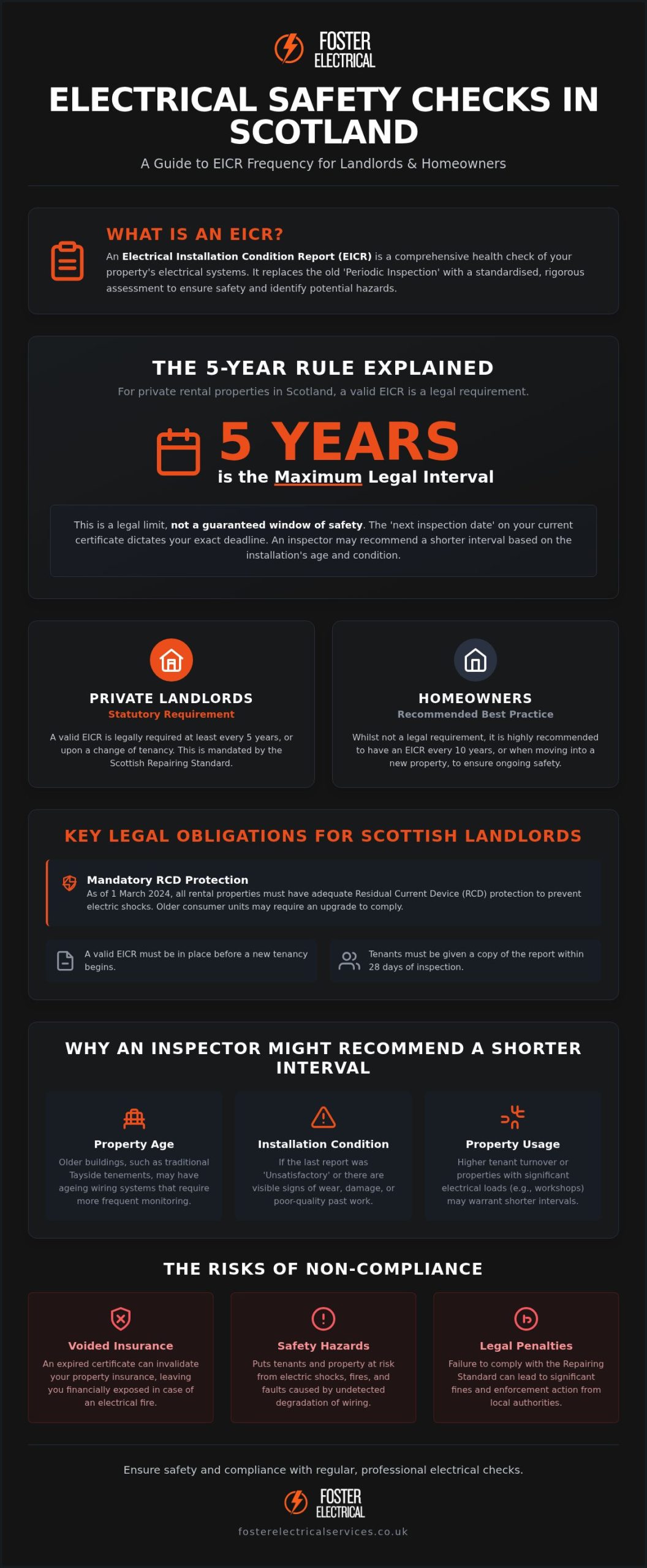
The most important thing to remember is that five years is the maximum legal limit, not a guaranteed window of safety. Your specific EICR frequency Scotland deadline is dictated by the ‘date of next inspection’ stated on your current certificate. If your previous report was completed four years ago, you are now entering the final year of compliance. We always advise our clients to keep their physical and digital records for the entire duration of the certificate’s validity. This provides a clear audit trail should the local authorities or a prospective tenant ever ask to see proof of your diligence.
Why Intervals Matter for Safety and Insurance
Insurance providers in Scotland are becoming increasingly strict about valid documentation. If a fault leads to a fire and your EICR has expired by even a single day, you may find your policy is effectively void. This is a heavy price to pay for a missed deadline. Beyond the financial risk, regular testing is the only way to catch degradation in older consumer units or hidden cable damage before it becomes a hazard. We view the EICR frequency as a vital safeguard that protects both human life and the long-term integrity of your property investment.
Statutory Obligations for Scottish Landlords and the Repairing Standard
Navigating the legal landscape of the Housing (Scotland) Act 2006 can feel like a full-time job for many landlords in Tayside. While the core legislation has been in place for years, ensuring your EICR frequency Scotland records are up to date is no longer a recommendation; it’s a legal necessity. Every private landlord must ensure their property meets the Repairing Standard. A key pillar of this standard is maintaining a valid electrical safety report. You cannot legally move a new tenant into a property without a current certificate in hand. For existing tenancies, you must provide a copy of the latest report to your tenants within 28 days of the inspection.
The Statutory guidance for Scottish landlords makes it clear that the responsibility for safety sits squarely on your shoulders. We often find that landlords like to bundle their electrical checks with the installation of interlinked smoke and heat alarms. Since February 2022, every home in Scotland must have these alarms connected so that if one goes off, they all go off. It makes practical sense to verify your compliance at the same time our team is testing your alarm system. This joined-up approach saves you time and ensures your property remains a safe haven for your tenants.
The Repairing Standard: 2024-2026 Requirements
As of March 1, 2024, the rules regarding Residual Current Devices (RCDs) became much stricter. All rental properties must now have adequate RCD protection in the consumer unit to prevent electric shocks and fires. If your fuse box is an older model, it might not meet these 2024-2026 requirements. Furthermore, a new regulation taking effect on October 1, 2026, will require all electricians carrying out these reports to hold specific Level 3 qualifications. For a deeper look at what we check during these visits, our EICR Certificate Dundee guide provides a comprehensive breakdown for local property owners.
HMO Licensing and Stricter Testing Intervals
Houses in Multiple Occupation (HMOs) are held to even higher standards. Dundee City Council and Angus Council inspectors are known for their meticulous approach to safety documentation. If you fail to produce a valid EICR during a licence renewal, you risk significant fines or even the loss of your licence altogether. Because these properties experience higher wear and tear, local authorities often scrutinise the dates on your certificates more frequently than for standard rentals. We take personal pride in helping HMO landlords stay ahead of these deadlines with straightforward, honest advice. If you’re worried about an upcoming renewal, we’re always happy to chat through your requirements.
Residential vs Commercial: When Should Different Property Types Be Inspected?
While we’ve established that landlords must adhere to a strict five-year window, the rules for other property owners aren’t always as black and white. It’s a common misconception that every building in Tayside follows the same schedule. In reality, the specific EICR frequency Scotland requires depends heavily on how a building is used and who is living or working inside it. We believe in providing honest, straightforward advice that helps you understand your unique responsibilities without the corporate jargon.
Owner-Occupied Homes: Is an EICR Mandatory?
For those who own and live in their own homes, the legal pressure is lighter, but the safety risks remain the same. The general industry recommendation is an inspection every 10 years. However, we often suggest a five-year interval for residents in Dundee’s older districts, such as the West End or Broughty Ferry. Traditional stone-built properties often house aging wiring that doesn’t always play well with modern, high-demand appliances. Organizations like Electrical Safety First champion these regular checks to prevent avoidable domestic accidents. If you’re planning to sell, having a valid report ready can significantly smooth the ‘Home Report’ process. It shows prospective buyers that you’ve been a diligent guardian of the property’s integrity.
Commercial and Industrial Frequency Standards
Commercial spaces operate under a different set of expectations. While there isn’t a single statutory law for business EICR intervals like there is for rentals, your ‘duty of care’ under health and safety legislation makes them practically mandatory. Most insurance providers will insist on a valid certificate to maintain your coverage. Understanding the correct EICR frequency Scotland demands for your specific business sector is the best way to avoid insurance headaches. For standard offices and retail shops in Tayside, a five-year interval is the norm.
High-risk environments require much closer attention to detail. Petrol stations, laundrettes, and swimming pools should be inspected every year due to the increased risk of moisture or hazardous materials. Industrial units and leisure centres typically move to a three-year cycle to account for higher wear and tear. We often help local business owners balance these fixed-wire checks with their annual PAT testing to ensure every plug and socket is beyond reproach. If you are unsure which category your business falls into, we are always here to provide a clear, professional perspective.
Why an Electrician Might Recommend a More Frequent EICR
Many people assume that a successful inspection automatically grants a five-year reprieve. In reality, the EICR frequency Scotland homeowners and landlords receive is entirely at the discretion of the qualified inspector. We believe in being upfront about this. If we find that your installation is safe today but showing signs of significant wear, we might set the next inspection date for three years instead of five. This isn’t about being difficult; it’s about our professional commitment to your safety and the long-term health of your property.
During the testing process, we assign specific codes to any issues we find. A ‘C1’ indicates danger is present, whilst a ‘C2’ suggests a potentially dangerous situation. Both require immediate remedial work before a ‘Satisfactory’ report can be issued. However, even ‘C3’ codes, which are recommendations for improvement, can influence the final decision on your next test date. If a property has multiple ‘C3’ observations, it suggests a system that is nearing the end of its reliable lifespan. We take a holistic view of the installation rather than just ticking boxes on a form.
Condition-Based Intervals
We pay particularly close attention to the integrity of your cabling and the age of your equipment. Older rubber or lead-sheathed cables are prone to becoming brittle and failing unexpectedly. While they might pass a continuity test during our visit, their ongoing reliability is often questionable. The presence of modern RCD protection also plays a huge role in determining certificate longevity. A property with an outdated fuse box is simply more vulnerable than one that has undergone recent Consumer Unit Upgrades. We always prioritise durability and moral character in our assessments.
Environmental and Usage Factors in Tayside
Scotland’s damp climate and the unique structure of our older buildings can lead to faster degradation of electrical components. We often find moisture ingress in the thick external walls of traditional tenements, which can quickly corrode socket terminals and switch gear. High-usage environments, such as a busy family home or a rental with high tenant turnover, also place more physical stress on the system. We also keep a sharp eye out for botched DIY work, which is a common sight in the Tayside area. These unauthorised “quick fixes” often compromise the entire circuit’s safety. Safety, not the calendar, dictates the final recommendation.
If you’re concerned that your property’s electrical health might need a professional eye sooner rather than later, we invite you to get in touch for an honest assessment.
Arranging Your EICR in Dundee, Angus, and Fife with Foster Electrical
We take a great deal of personal pride in being the protective guardians of your homes and rental properties. When you choose us to handle your safety checks, you aren’t just hiring a contractor; you’re inviting a diligent neighbour into your private space. We understand that Dundee housing is unique. From the high ceilings of Broughty Ferry to the complex wiring of Hilltown tenements, we’ve seen it all. Our approach to EICR frequency Scotland compliance is built on traditional sincerity rather than high-pressure sales. We provide straightforward pricing and clear, human communication, ensuring you always know where you stand with the Repairing Standard.
Managing the safety of a property can be a source of anxiety. We aim to bridge that gap between technical expertise and domestic comfort. By combining our deep understanding of local housing with a commitment to time-tested values, we ensure that every inspection is conducted with the highest standards of execution. We also help you manage your future deadlines. Our team keeps track of your certificate dates so that you never accidentally fall out of compliance. This service-oriented approach is designed to give you quiet confidence in your status as a responsible landlord or homeowner.
Our Process: From Fault Finding to Certification
We treat your property with the same level of care we’d give our own. During an inspection, we focus on being meticulous about tidiness and ensuring minimal disruption for your tenants. We won’t leave a mess for you to clean up. If we encounter issues during the testing, we don’t just leave you with a failing report and a list of problems. We provide a clear path forward through our Fault Finding and Repairs guide. We handle any necessary remedial works with professional integrity, ensuring your property is safe and your certificate is issued as quickly as possible.
Total Compliance: Smoke Alarms and PAT Testing
Staying fully legal in 2026 involves more than just a single report. We help you manage the overlap between electrical safety, interlinked alarms, and PAT testing. By bundling these services, we ensure your rental is fully compliant in a single visit. This joined-up approach eliminates the stress of coordinating multiple tradespeople and keeps your EICR frequency Scotland records perfectly aligned with your other safety obligations. We believe the relationship is as valuable as the transaction, and we’re always here to offer honest advice. You can Book your Dundee EICR inspection today to secure your property’s safety for the years ahead.
Securing Your Property’s Future in Tayside
Understanding the correct EICR frequency Scotland requires for your specific property is the first step toward true peace of mind. We’ve explored how the mandatory five-year rule for landlords serves as a vital safety ceiling, whilst homeowners benefit from regular checks to protect their families and investments. Whether you’re managing a traditional Dundee tenement or a modern home in Perth, staying ahead of RCD updates and upcoming qualification deadlines is essential for full legal compliance. We believe that safety is a journey, not just a tick-box on a calendar.
We take personal pride in offering honest, professional advice without the high-pressure tactics found in larger corporations. Our expert knowledge of local housing stock across Angus and Fife allows us to act as protective guardians for your environment. We’re here to help you navigate these regulations with the diligence and integrity your property deserves. Ensure your property is safe and compliant—book your Dundee EICR with Foster Electrical today. We look forward to helping you keep your home or rental safe for years to come.
Frequently Asked Questions
Is an EICR legally required for all homeowners in Scotland?
No, an EICR is not currently a statutory legal requirement for owner-occupied homes in Scotland. Whilst it’s not mandated by law for residents, we strongly recommend a check every 10 years to ensure your family’s safety. For those living in Dundee’s older tenements, a five-year interval is often more appropriate due to the age of the underlying wiring and the increased risk of degradation.
What is the difference between an EICR and a PAT test for landlords?
An EICR assesses the fixed electrical installation whilst a PAT test focuses on individual portable appliances. The EICR checks the “hidden” parts of your home like the consumer unit, sockets, and wiring behind walls. PAT testing ensures that items like kettles, microwaves, or lamps provided by a landlord are safe for tenant use. Both are essential components of meeting the Scottish Repairing Standard.
How much does a landlord EICR typically cost in Dundee?
The cost of an inspection varies based on the size of your property and the number of electrical circuits present. A small one-bedroom flat in the city centre will naturally require less time to test than a large detached house in Broughty Ferry. We believe in straightforward, honest pricing and will always provide a clear, professional quote based on your specific property layout before we begin any work.
What happens if my property fails its EICR inspection?
If your property fails, you’ll receive an ‘Unsatisfactory’ report detailing the specific C1 or C2 danger codes found. Landlords have a legal obligation to carry out remedial repairs within 28 days to bring the property back to a safe standard. We always provide a clear breakdown of the necessary work to help you return to full compliance and protect your tenants as quickly as possible.
Do I need a new EICR every time a new tenant moves in?
No, you don’t need a fresh report for every new tenancy if your current certificate is still within its valid date. As long as the EICR frequency Scotland inspector has set hasn’t been exceeded, the existing report remains legally valid. However, many diligent landlords in the Tayside area choose to have a visual “change of occupancy” check performed just to ensure no unauthorised DIY or damage has occurred between tenants.
Can I carry out my own EICR if I am competent at DIY?
No, you cannot perform your own inspection regardless of your DIY experience. The law requires a “skilled person” with the appropriate qualifications, experience, and insurance to carry out the work. From October 1, 2026, these requirements become even stricter, mandating specific Level 3 qualifications for any electrician performing these statutory safety reports in Scotland to ensure a high standard of execution.
How long does a standard EICR inspection take to complete?
A standard inspection typically takes between two and four hours to complete thoroughly. The duration depends on the complexity of the installation and the ease of access to all sockets and switches. We pride ourselves on being meticulous but also aim to minimise disruption for your tenants, ensuring we work efficiently whilst maintaining our reputation for honesty and thoroughness.
Are interlinked smoke alarms checked during an EICR?
Whilst interlinked smoke alarms are technically a separate requirement under the Repairing Standard, we always verify their operation during our safety visits. Ensuring your EICR frequency Scotland schedule aligns with your alarm testing is the most efficient way to maintain a safe environment. We view ourselves as protective guardians of your property and won’t overlook these vital life-saving systems during our time in your home.