Would you know how to react if your latest safety report landed on your desk with a “C1” marked in red, or would the technical jargon leave you feeling more confused than when you started? It’s a common worry for property owners across Dundee and Angus, especially as the maximum civil penalty for breaching safety regulations has recently increased to £40,000. We understand that your property isn’t just a set of wires and sockets; it’s a home or a livelihood that deserves proper care and honest, straightforward advice.
We agree that keeping up with the latest BS 7671:2018+A4:2026 standards can feel like a daunting task. This guide provides EICR codes explained Scotland landlords and homeowners can use to stay safe and compliant. You’ll learn exactly what each classification means for your legal obligations and your safety. We’ll also clear up any confusion regarding how often these checks must happen in 2026. From understanding the urgency of an “FI” code to knowing your specific deadlines for remedial works, we’re here to help you protect your property with quiet confidence.
Key Takeaways
- Get your EICR codes explained Scotland style to understand the difference between an immediate danger and a simple recommendation for improvement.
- Navigate the mandatory five-year inspection cycle for Scottish landlords and learn how to track your renewal dates to avoid hefty civil penalties.
- Recognise when property age or usage means you should seek an inspection sooner than the legal maximum to keep your tenants truly safe.
- Distinguish between “Satisfactory” and “Unsatisfactory” outcomes so you can plan necessary remedial works with total certainty and clear costs.
- Benefit from the perspective of a trusted local expert who prioritises thoroughness and respect for your home over corporate tick-box exercises.
Understanding EICR Regulations and Classification Codes in Scotland
An Electrical Installation Condition Report (EICR) is essentially a comprehensive health check for your property’s fixed wiring. It isn’t just about checking if the lights turn on; it’s a deep dive into the hidden systems behind your walls. In Scotland, we operate under a stricter set of rules compared to our neighbours in the south. The Scottish Government takes a proactive stance on tenant safety, making these checks a non-negotiable part of property management for anyone letting out a home.
Under the Housing (Scotland) Act 2006, every private landlord has a legal duty to ensure their property meets the “Repairing Standard.” This is a set of conditions designed to ensure a home is safe and fit for habitation. A cornerstone of this standard is electrical safety. We see many landlords who feel overwhelmed by the paperwork, but having the EICR codes explained Scotland context helps clarify that this isn’t just bureaucracy; it’s about protecting lives and maintaining the integrity of your investment.
The Legal Framework: March 2024 and 2026 Updates
The landscape for Scottish landlords changed significantly on March 1, 2024. Updates to the Repairing Standard statutory guidance now require appropriate Residual Current Device (RCD) protection on all circuits in rental properties. This is a critical safety feature that cuts off electricity if a fault is detected, preventing shocks and fires. Looking ahead to October 2026, the rules around who can perform these checks are tightening even further. Individual electricians must now prove their own competence rather than relying on a firm’s overarching accreditation. If you fail to comply, local councils have the power to issue Rent Relief Orders, effectively stopping you from collecting rent until the property is made safe. This is on top of potential civil penalties that were increased to £40,000 in November 2025.
Visual Inspection vs Full EICR: What is the Difference?
We often get asked if a quick look at the fuse box is enough. The short answer is no. A simple visual check might spot a cracked socket, but it won’t find a degraded cable hidden in the ceiling or a poor earth connection. A full EICR involves rigorous technical testing based on UK electrical wiring standards (BS 7671). We carry out insulation resistance tests to check for leaks and earth continuity tests to ensure safety devices will actually trip during a fault. We offer these comprehensive electrical services across Dundee to help you navigate these requirements with total certainty. An EICR is the only valid proof of electrical safety for Scottish landlords under the current legislation.
Decoding EICR Classification Codes: C1, C2, C3, and FI
Think of classification codes as the specific language we use to communicate the safety levels of your home’s wiring. When we provide EICR codes explained Scotland landlords often find that the technical jargon melts away, replaced by clear, actionable information. Every observation we make is categorised into one of four markers. These markers determine whether your property passes or fails the inspection. We believe in being transparent, so you always know exactly where you stand with your property’s safety.
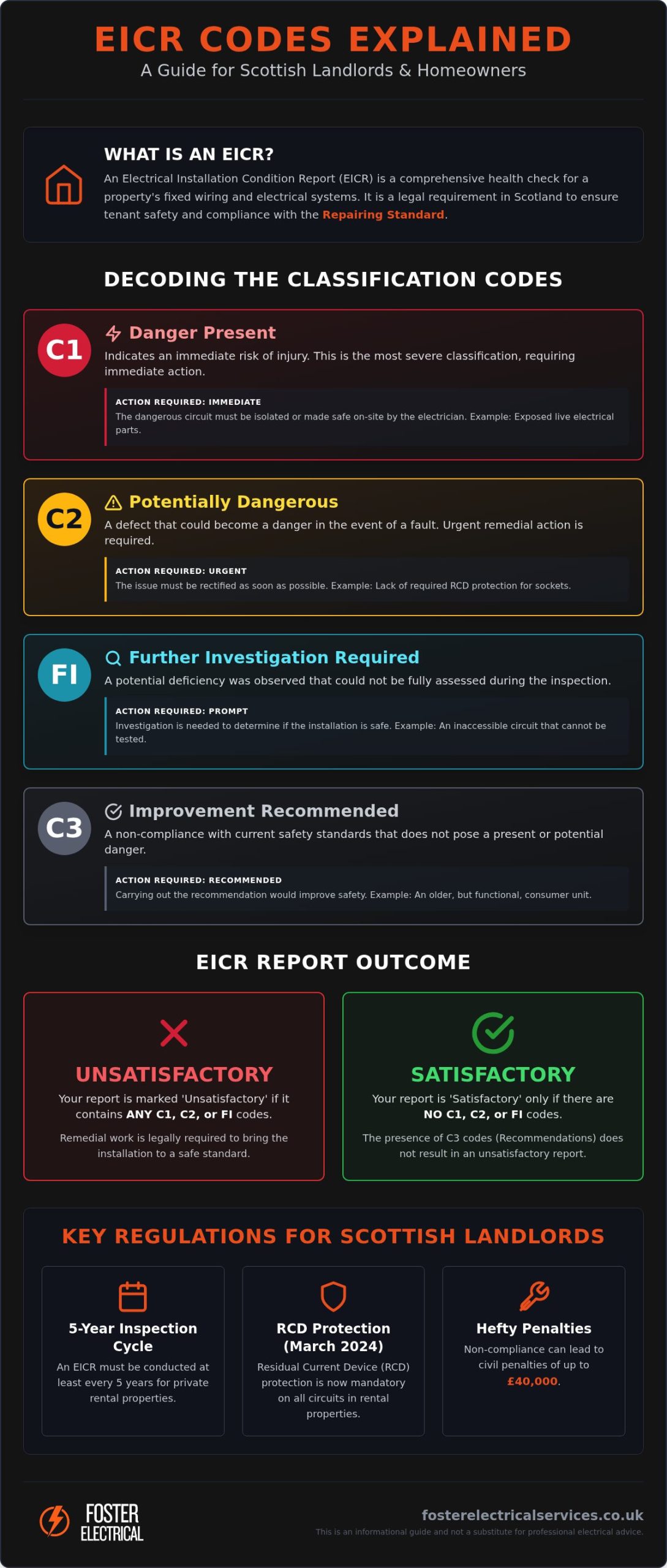
The outcome of your report is binary: it’s either “Satisfactory” or “Unsatisfactory.” To achieve a passing grade, your installation must be free from any high-risk codes. If even a single C1, C2, or FI code appears on your certificate, the entire report is marked as unsatisfactory. This status is critical because it’s what local authorities in Dundee and Angus look for when checking your compliance with the Scottish Government’s Repairing Standard. We take our role as guardians of your safety seriously, ensuring every check is thorough and every code is justified.
C1 and C2: The High-Risk Categories
A C1 code signifies that danger is present and there is a real risk of injury. This is the most serious finding we can record. If we encounter a C1, such as exposed live parts or a charred socket, we have a professional duty to isolate that circuit whilst we are on-site. We won’t leave a property in an immediately dangerous state; our priority is protecting the people living there. It’s a matter of basic diligence and care.
A C2 code means the situation is potentially dangerous. Whilst it might not pose an immediate threat today, a single fault could lead to a fire or electric shock. A common example is the lack of RCD protection on sockets, which is now a strict requirement. In Scotland, you are legally required to complete remedial works for C2 faults within 28 days of the inspection. Meeting this deadline is essential to maintaining your insurance and your legal standing as a landlord. If you’ve received an unsatisfactory report, you can reach out to us for a clear, honest quote for the repairs.
C3 and FI: Recommendations and Investigations
A C3 code stands for “Improvement Recommended.” This is the only code that doesn’t cause your report to fail. It often appears when an installation was safe when it was installed but doesn’t meet the very latest 18th Edition regulations. It’s an advisory note, suggesting how you can bring your property up to modern standards over time. We often describe these as “good-to-know” points that help you plan for long-term maintenance.
FI stands for “Further Investigation.” This is often used when we find something suspicious that requires more time or access to diagnose fully, such as a hidden fault in a floor void. Crucially, an FI code triggers an “Unsatisfactory” result. Because we cannot confirm the circuit is safe, we cannot pass the report. You can find more detail on managing these results in our EICR Certificate Dundee Landlord Guide. We aim to resolve these investigations quickly, keeping disruption to your tenants at an absolute minimum.
The Mandatory 5-Year Frequency for Scottish Landlords
In Scotland, the law is clear: every private rental property must have a valid Electrical Installation Condition Report carried out at least every five years. This isn’t just a recommendation; it’s a core legal requirement under the Housing (Scotland) Act. We often tell our clients in Dundee and Angus that five years is the absolute maximum limit. Depending on the age and condition of your property, an inspector might recommend a shorter interval, such as three years, to ensure the wiring remains safe. Whilst we’ve already seen how the EICR codes explained Scotland standards dictate what needs fixing, the frequency of these checks is what keeps your compliance record continuous.
We recommend setting a calendar reminder at least six months before your current certificate expires. This proactive approach gives you plenty of time to organise an inspection and complete any necessary remedial work without the stress of a looming deadline. Once the report is complete, you must provide a copy to all existing tenants within 28 days. For any new tenants moving in, you must hand over a copy of the valid report before they sign the lease. It’s a simple step that builds trust and demonstrates your commitment to their safety.
There is a common myth that you need a brand-new EICR every time a tenant moves out and a new one moves in. This isn’t legally required in Scotland as long as your current report is still within its valid date and marked as “Satisfactory.” However, keeping a historical record of all your safety certificates is vital for proving a long-term commitment to the Repairing Standard, especially if a dispute ever arises.
HMO Frequency and Local Authority Requirements
If you manage a House in Multiple Occupation (HMO) in Dundee or Angus, the scrutiny is even higher. Local councils frequently request up-to-date EICR documentation during licensing renewals to ensure the safety of multiple residents. For these properties, we often suggest more frequent checks because the higher “footfall” and usage can lead to faster wear and tear on the electrical system. Following the Electrical Safety First guidance for landlords is a great way to stay ahead of these local authority expectations.
The Duty of Care Between Inspections
Even with a five-year certificate in hand, you still have a daily duty of care. We encourage landlords to perform a quick visual inspection during every tenant changeover whilst the property is empty. Look for obvious signs of trouble like scorched sockets, flickering lights, or loose switches. If you spot anything concerning, our Fault Finding and Repairs Guide can help you understand what might be going wrong. Catching a small issue early is always easier and more cost-effective than waiting for the next mandatory check.
When Should You Get an EICR Sooner Than Five Years?
While the law sets a five-year boundary, we often find that certain properties in Dundee and Angus need a closer eye kept on them. Having the EICR codes explained Scotland context helps you see that these reports are a snapshot in time; they don’t guarantee safety for the full duration if conditions change. For instance, the traditional sandstone tenements in Dundee often house wiring systems that are decades old. In these cases, we might recommend a three-year cycle to catch degradation before it becomes a hazard. We treat every property with the individual care it deserves, looking beyond the calendar to the actual state of the installation.
High-turnover tenancies also play a role in how quickly a system ages. When people move in and out frequently, fixtures like sockets and switches face more physical stress and potential damage. Environmental factors are just as important. In commercial kitchens or properties prone to dampness, moisture and heat can accelerate the corrosion of electrical connections. We take a protective guardian approach, ensuring that we highlight these risks before they lead to an “Unsatisfactory” result or, worse, a dangerous fault.
Property Condition and Usage Patterns
Signs that your installation is deteriorating faster than expected include flickering lights, buzzing sounds from the consumer unit, or sockets that feel warm to the touch. We also pay close attention to any evidence of previous DIY electrical work. Poorly executed repairs or additions by unqualified individuals are a major red flag that necessitates more frequent checking to ensure the whole system remains stable. The inspector’s professional judgement on the re-test date is legally binding.
Major Installations and Consumer Unit Upgrades
A Consumer Unit Upgrade is a significant step that effectively resets your safety clock by introducing modern protection like RCDs. Adding high-load circuits, such as EV Chargers, also requires new certification to ensure the existing system can handle the increased demand safely. For older homes where the wiring has simply reached the end of its life, Full Property Rewires in Dundee provide the ultimate peace of mind by replacing tired cables with a system built for modern living standards.
If you’re unsure about your property’s current safety status or if your certificate is approaching its limit, you can book a professional inspection with our local team today. We pride ourselves on being diligent neighbours who take personal pride in the safety of our community.
Professional EICR Inspections in Dundee and Tayside
We believe that electrical safety shouldn’t be a source of stress or confusion for property owners. As a Dundee-based specialist with over a decade of local experience, we’ve built our reputation on traditional sincerity and grounded professionalism. We don’t see ourselves as just another contractor; we act as a protective guardian for your property and your tenants. By having your EICR codes explained Scotland context by a local expert, you ensure that your safety report is more than just a tick-box exercise. It’s a genuine commitment to the integrity of your home’s wiring.
Our philosophy is built on thorough inspections without the technical jargon that often leaves landlords feeling overwhelmed. We take the time to walk you through our findings person-to-person, ensuring you understand the “why” behind every observation. We reject high-pressure sales tactics and opaque pricing structures in favour of honest, service-oriented advice. This straightforward approach eliminates ambiguity, giving you a clear path toward total compliance and peace of mind regarding tenant safety.
We also understand that we are guests in your private space. We take personal pride in our high standards of execution, which includes a verbal signature regarding the treatment of your property. We are meticulous about tidiness and aim for minimal disruption whilst we work. Whether we are testing a single-bedroom flat or a large HMO, we treat every environment with the same level of care and respect we would expect in our own homes.
Our Local Expertise in Tayside and Fife
Understanding Dundee’s diverse housing stock is essential for a truly accurate safety assessment. The requirements for a traditional sandstone tenement in the West End are very different from a modern new build in Broughty Ferry. We use our deep knowledge of local property types to provide nuanced inspections that national firms often miss. Our team is fully qualified to 18th Edition Wiring Regulations, and we specialise in navigating the complexities of the Scottish Repairing Standard. We are diligent neighbours who are proud to support the local landlord community across Tayside and Fife.
Organise Your Safety Check Today
Booking your mandatory inspection with us is a simple, transparent process. On the day of the check, you can expect us to arrive punctually and work methodically through every circuit in your property. We recommend ensuring clear access to your consumer unit and all sockets before we arrive to keep the process moving steadily. Once the testing is complete, we provide a clear, logical report that outlines any necessary next steps with total integrity.
Organise your professional EICR inspection with Foster Electrical today and secure the safety of your property with a team you can trust.
Securing Your Property for the Years Ahead
Protecting your investment and your tenants is a commitment that requires both diligence and expert insight. We’ve explored how EICR codes explained Scotland guidelines provide a clear roadmap for safety, helping you distinguish between immediate hazards and simple recommendations for the future. It’s vital to remember that the mandatory five-year check is a maximum limit; older Dundee tenements or high-turnover rentals often benefit from more frequent attention whilst maintaining their safety standards. We approach every inspection with the same meticulous care we would give our own homes, ensuring your paperwork is perfect and your wiring is reliable.
As Dundee-based local experts, we are fully compliant with 18th Edition Wiring Regs and stay trusted by landlords across Tayside and Fife. We believe in person-to-person service that keeps your property tidy and your mind at ease. Ensure your property meets the Repairing Standard with a Foster Electrical EICR. We are ready to help you navigate these regulations with quiet confidence and straightforward advice.
Frequently Asked Questions
Is an EICR a legal requirement for all landlords in Scotland?
Yes, an EICR is a mandatory legal requirement for all private landlords in Scotland under the Repairing Standard. This legislation ensures that every tenant lives in a home with safe, functional electrical systems. Failure to provide a valid report can lead to significant fines or Rent Relief Orders from the local council. It’s a fundamental part of your duty of care, ensuring the fixed wiring is checked thoroughly by a qualified professional.
How long does an EICR certificate last for a rental property?
An EICR certificate typically lasts for a maximum of five years for rental properties in Scotland. However, this isn’t a guaranteed duration; the inspecting electrician has the professional discretion to recommend a shorter interval, such as three years. This often happens in older properties or HMOs where wear and tear occurs more rapidly. You must always check the “date of next inspection” on your most recent report to remain legally compliant.
What is the difference between a C1 and a C2 code?
The primary difference lies in the level of immediate risk to life and property. A C1 code indicates that danger is present and there is a high risk of injury, requiring us to isolate the circuit immediately whilst on-site. A C2 code means the installation is potentially dangerous and requires urgent remedial action. When looking at EICR codes explained Scotland standards, both results lead to an automatic fail and require swift resolution to protect tenants.
Do I need a new EICR every time a new tenant moves in?
You don’t legally need a new EICR for every change of tenancy, provided your current certificate is still within its valid date and marked as “Satisfactory.” The five-year rule remains the baseline. However, we strongly suggest performing a documented visual inspection during the changeover. This helps you spot any damage caused by departing tenants, such as cracked sockets or scorched fittings, ensuring the property remains safe for the next person moving in.
What happens if my property receives an “Unsatisfactory” result?
An “Unsatisfactory” result means your property has failed the inspection due to C1, C2, or FI codes. You are legally required to carry out remedial works to fix these issues, usually within 28 days for C2 items. Once the repairs are finished, you should receive a Minor Works Certificate or an Installation Certificate. You must then provide these documents, along with the original failed report, to your tenants and the local authority if requested.
How much does an EICR cost for a standard 3-bedroom house in Dundee?
The cost of an EICR depends on the number of circuits in the property and the overall age of the installation. For a standard 3-bedroom house in Dundee, the price is determined by the time required to test every fixed outlet and component with diligence. Whilst industry averages across Scotland vary based on location and property type, we always provide transparent, honest pricing. This ensures you receive a thorough safety check without any hidden fees or opaque structures.
Can any electrician carry out an EICR in Scotland?
No, only an electrician who can prove their individual competence and qualifications is permitted to carry out an EICR. As of October 2026, new regulations require inspectors to hold a specific Level 3 Award in periodic inspection and testing. They must also have at least two years of documented experience. We pride ourselves on being fully qualified to the 18th Edition Wiring Regulations, providing the high standards of expertise that Scottish landlords expect and deserve.
Does an EICR cover PAT testing for my rental appliances?
No, a standard EICR only covers the fixed electrical installation, such as the wiring, sockets, and consumer unit. It does not include Portable Appliance Testing (PAT), which focuses on movable items like kettles, fridges, or washing machines provided by the landlord. In Scotland, landlords are legally required to arrange for annual PAT testing in addition to their five-yearly EICR. Keeping these two safety checks separate ensures every part of the electrical system is protected.