Imagine you’re closing up your shop on a rainy Tuesday in Dundee when the power suddenly cuts out. In that moment of pitch darkness, your first thought shouldn’t be whether your backup bulbs will kick in or if you’ve secured the emergency lighting certificate dundee inspectors expect to see. We understand that for many local business owners and landlords, staying on top of fire safety often feels like a confusing hurdle. It’s natural to worry about failing an inspection or causing a massive disruption to your tenants just to stay legal; especially with the unique requirements of the Fire (Scotland) Act 2005.
This guide will show you exactly how to secure your certification with total confidence. We want to help you ensure your premises remain fully compliant with the latest BS 5266-1:2025 standards without the typical corporate stress. We’ll walk you through your legal duties, explain what actually happens during a professional test, and help you prepare for the upcoming Building (Scotland) Amendment Regulations 2025. Our aim is to provide the clarity you need to keep your staff safe and your business protected, all while keeping things simple and straightforward.
Key Takeaways
- Understand how a valid emergency lighting certificate dundee property owners require serves as your primary legal record of compliance with the latest BS 5266-1:2025 standards.
- Discover our meticulous approach to fault finding and repairs, ensuring your safety systems are restored with minimal disruption and a personal commitment to tidiness.
- Learn the critical differences between monthly functional tests and annual full discharge tests to help you maintain a consistent rhythm in your safety schedule.
- Access a practical checklist to prepare for your fire safety audit, including how to coordinate your lighting inspections with other essential reports like your EICR.
- Gain peace of mind by choosing a local expert who rejects opaque pricing and high-pressure sales in favour of traditional sincerity and honest service.
Understanding Emergency Lighting Certificates for Dundee Businesses
An emergency lighting certificate dundee businesses receive is far more than a simple piece of paper. It is a formal declaration that your property adheres to the life safety requirements of BS 5266. We often think of these systems as the “silent guardians” of a building. While your standard LED panels or decorative downlights handle the daily chores of illumination, emergency lights wait patiently for the moment the mains power fails. They ensure that your staff and tenants can find their way to safety without panic or injury.
In Scotland, the legal landscape is defined by the Fire (Scotland) Act 2005 and the Fire Safety (Scotland) Regulations 2006. These laws place the burden of safety on the “Duty Holder”, the person in charge of the premises. If you’re curious about the technical basics of these units, you can read more about What is Emergency Lighting? to see how these battery-backed systems function. Our role is to ensure your system remains a reliable safety net for everyone under your roof, keeping you on the right side of the law.
Why Compliance Matters in Dundee and Tayside
Dundee City Council and local licensing boards take fire safety seriously. Whether you run a busy cafe in the city centre or manage a residential block in Broughty Ferry, a valid certificate is your primary defence against legal liability. If an accident happens during a power cut and you can’t produce a valid record of testing, your insurance provider may refuse to pay out. Working with a local Dundee firm ensures you’re getting advice from people who understand the local licensing nuances and the specific expectations of Tayside Fire and Rescue. It’s about protecting your livelihood and the community we all share.
The Legal Framework: BS 5266-1 Explained
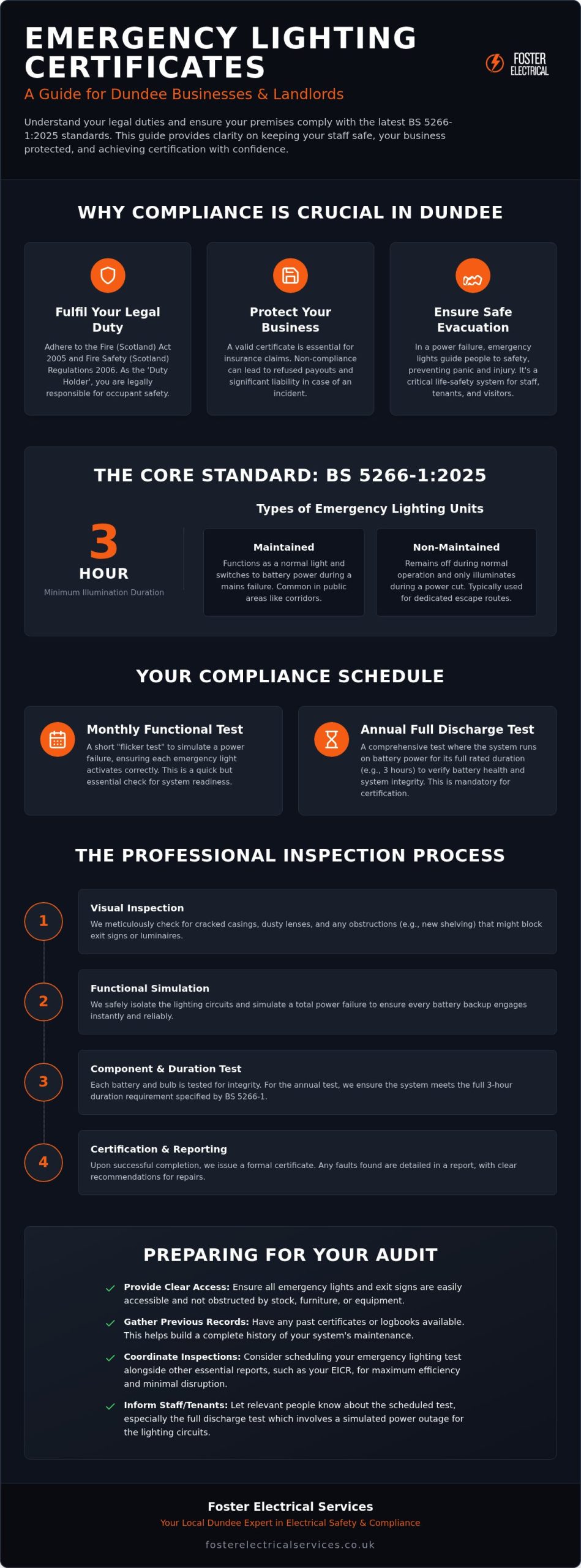
The code of practice governing these systems is BS 5266-1:2025. This standard ensures that if the lights go out, your building doesn’t become a dark, dangerous trap. A key requirement is that the lighting must stay active for at least three hours. This duration provides enough time for everyone to evacuate and for emergency services to conduct their work. You’ll generally find two types of units in most commercial spaces:
- Maintained: These units function like normal lights but switch to battery power if the electricity fails.
- Non-maintained: These only turn on during a power cut, remaining dark during normal operation.
We include thorough checks for both types as part of our services, keeping your records accurate and your building safe. By maintaining a consistent testing rhythm, you avoid the stress of last-minute repairs before an audit.
The Testing Process: How We Organise Your Inspection
Organising a site visit shouldn’t feel like a disruption to your working day. We take personal pride in being meticulous about tidiness; we treat your commercial space with the same respect we’d show our own homes. When we arrive to conduct your emergency lighting certificate dundee inspection, we start with a thorough visual check. We aren’t just looking for lights that turn on; we’re looking for cracked luminaires, dusty lenses, or exit signs that have been obscured by new shelving or stock.
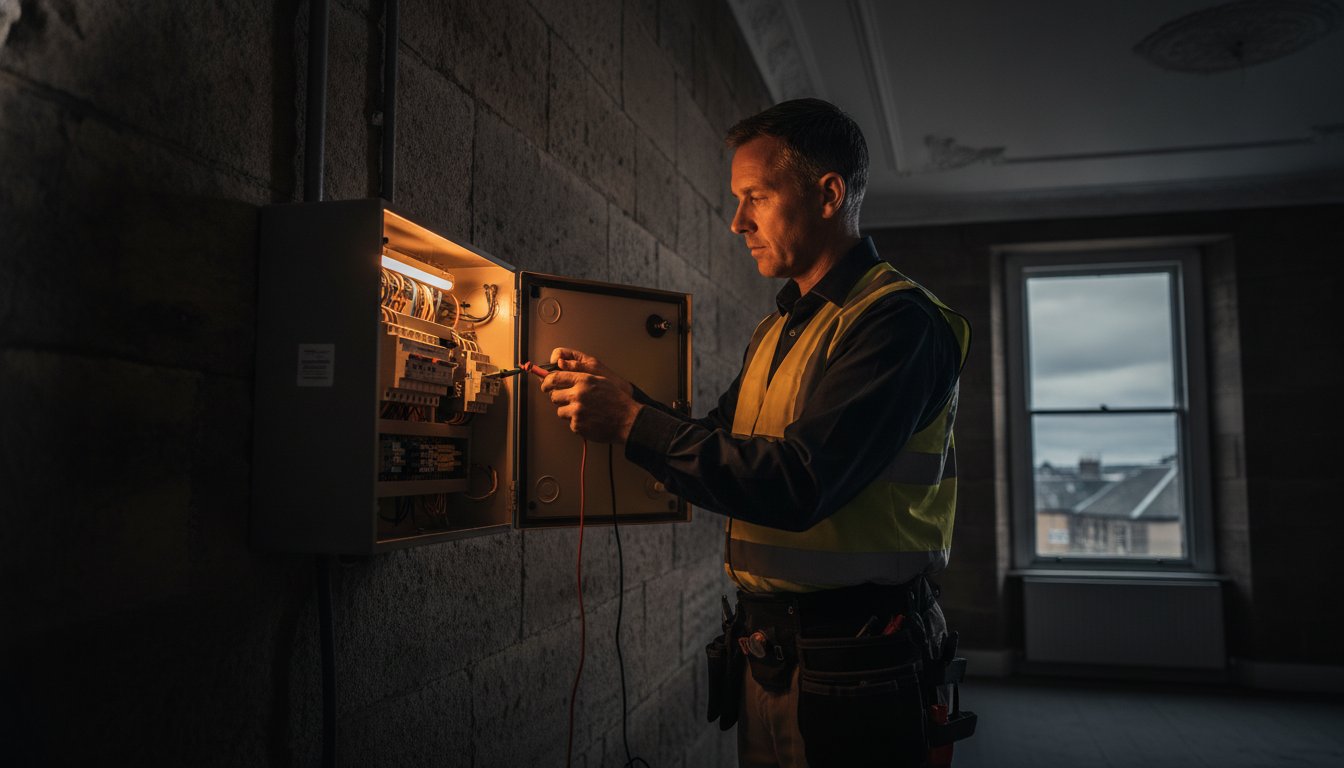
Once the visual checks are complete, we move to the functional testing phase. This involves simulating a total power failure to your lighting circuits to ensure the battery backups are actually up to the task. We follow the BS 5266 Code of Practice to the letter, ensuring every component of your system is reliable. If we find any issues, we’re specialists in fault finding and repairs, often fixing small problems on the spot to save you a second visit.
Step-by-Step: The Professional Audit
Our process is steady and logical. We begin by identifying the specific circuits and ensuring safety isolation so our work doesn’t interfere with your essential equipment. We then test every individual battery backup and bulb for integrity. Finally, we verify that your exit signs are correctly placed to guide occupants along the quickest escape routes. This thoroughness is a core part of our services, reflecting our commitment to high standards and honest workmanship.
Identifying Common Failures and Faults
During our years of service in Tayside, we’ve seen where systems typically fall short. The most frequent culprit is aged batteries. These might work for a few minutes but fail to hold a charge for the required three hours. Securing a valid emergency lighting certificate dundee inspectors will approve depends on catching these small issues before they become legal liabilities. We also frequently find LED upgrades that don’t meet fire regulations because they were installed without considering the specific battery requirements of the unit. Lastly, missing or outdated signage is a common failure. If a tenant can’t see the exit in a smoky corridor, the best lighting in the world won’t help them.
If you’re unsure when your lights were last tested, get in touch with us for a straightforward chat about your needs. We’re here to help you stay compliant without the corporate headache.
Monthly vs Annual Testing: Staying Compliant Year-Round
Maintaining a safe environment for your staff and tenants requires a steady, logical rhythm. Safety isn’t a one-off task; it’s a personal commitment to diligence that lasts the whole year. We often find that confusion over testing frequencies is what leads to failed audits. To remain fully compliant, you must balance your own simple monthly checks with a professional annual inspection. Both are equally important for the longevity of your system.
A Fire Safety Logbook is your primary tool for this. It serves as the essential diary that must accompany your emergency lighting certificate dundee. Every time a test is performed, whether by you or by us, it needs to be recorded. This documentation proves to insurers and local authorities that your building is a protected environment. We can help you organise these schedules to prevent any last-minute rushes or lapses in your certification.
The Monthly “Flicker” Check: A DIY Guide
The monthly functional test, often called the “flicker test”, is something you or a designated staff member can handle. It doesn’t require a full power cut to the building. Instead, you use a test switch or a “fish key” to briefly interrupt the power to the lighting units. You’re simply checking that the lamps illuminate and that the internal batteries are functioning correctly. Whilst doing your rounds, ensure the green LED indicator on each unit is lit; this shows the battery is charging. If a light fails to kick in or the LED is dark, you’ve found a fault that needs attention. Always record these results in your logbook to bridge the gap between our professional visits.
The Annual 3-Hour Discharge Test
Once a year, your system requires a much deeper level of scrutiny. This full discharge test must be performed by a professional electrician Dundee property owners trust. We simulate a total power failure for a continuous three-hour period. This process drains the batteries completely to verify they can meet the 180-minute requirement set by British Standards. If a battery dies after only two hours, it’s no longer fit for purpose. After we confirm every unit has passed this rigorous endurance test, we’ll issue your formal emergency lighting certificate dundee. This document is your guarantee of safety and legal compliance for the next twelve months.
Preparing for Your Fire Safety Audit in Dundee
Getting ready for an official inspection shouldn’t feel like a last-minute scramble. We believe that preparation is the foundation of a safe, compliant building. Before we arrive to issue your emergency lighting certificate dundee landlords and property managers should go through a simple internal checklist to ensure everything is in order. This proactive approach saves time and ensures your tenants remain undisturbed during the process.
- Locate your Fire Safety Logbook and ensure all previous monthly “flicker” tests are recorded.
- Walk the escape routes to ensure no stock, furniture, or packaging is obscuring exit signs.
- Check the green LED charging indicators on every unit; if one is dark, the battery may be faulty.
- Verify that your EICR certificates in Dundee are current, as inspectors often view electrical safety as a single, holistic package.
We also find that clients who have invested in LED lighting upgrades face far fewer issues during audits. These modern luminaires are exceptionally reliable and reduce the frequency of bulb failures. By switching to LED, you’re choosing a more durable, honest solution that protects your bottom line and your tenants’ safety. It’s a straightforward way to modernise your building whilst meeting your legal duties.
HMO and Multi-Let Compliance in Tayside
Dundee City Council maintains high standards for HMO (House in Multiple Occupation) licensing. If you manage a shared flat or a multi-let property, your obligations are particularly strict. Shared corridors and stairwells must have adequate illumination to guide residents out in total darkness. Under the Scottish Repairing Standard, it’s your duty to ensure these systems are functional. We often help landlords ensure their emergency units work in perfect harmony with their interlinked smoke and heat alarms, providing a comprehensive safety net for the property.
Maintaining Your Fire Safety Logbook
When an inspector asks to see your testing history, they’re looking for the proof behind your emergency lighting certificate dundee. They want to see a consistent rhythm of monthly and annual checks. Whilst digital records are increasingly popular for their ease of sharing, many traditional Dundee businesses still value a physical logbook kept on-site. We provide the clear, professional documentation you need to pass any audit with confidence. Our reports are detailed and straightforward, stripping away technical jargon in favour of honest, practical information. If you’re worried about an upcoming inspection, book your pre-audit check with us to ensure your property meets every local requirement.
Professional Certification with Foster Electrical
Choosing a partner for your fire safety shouldn’t feel like a transaction with an anonymous call centre. We build our service on traditional sincerity and grounded professionalism, treating every property as if it were our own. When it comes to securing the emergency lighting certificate dundee businesses require, we act as a protective guardian of your environment. We reject opaque pricing structures and high-pressure sales tactics in favour of a calm, service-oriented approach that puts your safety first. Our goal is to provide a sense of nostalgic reliability that’s often missing in the modern world.
We believe in the value of honesty and hard work. Our team takes personal pride in maintaining high standards of execution; we don’t just tick boxes; we ensure your system is truly robust. By choosing us, you’re opting for a relationship built on trust and respect. We invite you to reach out for a straightforward consultation where we can discuss your obligations without the technical complexity often found elsewhere. It’s about providing you with a valid certificate that satisfies both the council and your insurers with total transparency.
Why Local Expertise Matters in Dundee
Dundee is a city of architectural contrasts, and we’ve spent years learning the nuances of every building type. We understand the specific challenges of installing and maintaining safety systems in high-ceilinged Victorian tenements just as well as we do in modern, glass-fronted office blocks. This deep local knowledge allows us to work efficiently and effectively amongst the unique layouts of Tayside properties. Unlike national corporations, we offer a person-to-person service where you can speak directly to the expert handling your audit.
Our commitment to the community means we’re fiercely proud of our reputation for punctuality and tidiness. We understand the privilege of entering your private business space, so we make it a point of honour to leave every site exactly as we found it. We’re the diligent neighbours you can rely on to show up when promised and complete the work to a meticulous standard. This artisanal approach to electrical service ensures that your compliance doesn’t come at the cost of a messy workspace or a disrupted day.
Booking Your Compliance Audit
Taking the next step toward full compliance is simple and stress-free. We offer straightforward, no-obligation quotes that reflect our commitment to fair treatment and clear communication. You can gain true peace of mind knowing that any necessary Fault Finding and Repairs are handled by experts who value durability and moral character. We don’t believe in cutting corners; we believe in doing the job correctly the first time.
If you’re ready to ensure your business remains a safe, compliant environment, we’re here to help. Our steady, logical process will lead you toward your emergency lighting certificate dundee with quiet confidence. You can find more details about our full range of safety inspections by visiting our services page. Let us take the weight of fire safety off your shoulders so you can focus on what you do best, knowing your building is in safe hands.
Securing Your Peace of Mind in Tayside
Ensuring your building remains a safe environment is a continuous journey of diligence and care. By now, you understand that staying compliant with the latest BS 5266-1:2025 standards protects both your livelihood and the people under your roof. We take personal pride in helping you maintain this safety net, stripping away the stress of fire safety audits through honest, artisanal service. Whether you’re managing a historic tenement or a modern shopfront, the right emergency lighting certificate dundee inspectors look for is within your reach.
As your trusted local experts and members of respected trade bodies, we’re committed to providing a protective guardian approach to your business. We don’t believe in impersonal corporate templates or hidden fees; we believe in straightforward, person-to-person support that respects your property and your time. Let us handle the technical complexities whilst you focus on running your business with quiet confidence. If you’re ready for a calm, professional audit that keeps your compliance on track, please Contact Foster Electrical for your Emergency Lighting Certificate in Dundee. We look forward to helping you keep our community safe and secure.
Frequently Asked Questions
Is an emergency lighting certificate a legal requirement for my Dundee business?
Yes, it is a legal requirement under the Fire (Scotland) Act 2005. Business owners and landlords in Dundee have a statutory duty to ensure all fire safety systems, including emergency lighting, are maintained in good working order. Local authorities and fire officers will ask to see your valid certificate during a routine audit. Failing to produce this documentation can lead to severe penalties, legal liability, and may even void your commercial insurance policy.
How much does an emergency lighting certificate cost in Dundee?
The cost of securing an emergency lighting certificate dundee depends on the size of your premises and the number of units requiring testing. Factors such as the age of the system and the complexity of the circuits also play a role. We focus on providing a fair, transparent service without opaque pricing or high-pressure sales. For an honest, no-obligation quote tailored to your specific building, we recommend reaching out for a direct consultation.
How long does an emergency lighting discharge test take?
A full annual discharge test typically takes just over three hours to complete. This duration is necessary because we must drain the batteries completely to ensure they can sustain illumination for the full 180-minute period required by British Standards. We also include time for a thorough visual inspection and circuit identification. We organise our visits to cause minimal disruption to your tenants or staff, often working quietly in the background whilst the test runs.
Can I perform the emergency lighting tests myself?
You are encouraged to perform the monthly “flicker” tests yourself using a test switch or fish key. These short functional checks ensure the units activate and should be recorded in your Fire Safety Logbook. However, the annual three-hour discharge test must be carried out by a competent professional. We provide the technical expertise and formal documentation needed to satisfy legal requirements, ensuring your system is truly robust and compliant with BS 5266-1:2025.
What happens if my emergency lighting fails the annual test?
If a unit fails to stay lit for the full three hours, we will identify the specific fault, such as an aged battery or a failed lamp. As specialists in fault finding and repairs, we can often resolve these issues promptly. Once the repairs are completed, we’ll re-test the system to ensure it meets the required standards before issuing your certificate. Our goal is to act as a protective guardian, ensuring your building is a safe and legal environment.
How often should emergency lighting be replaced in commercial properties?
Most internal batteries in emergency units have a lifespan of three to five years before they lose their ability to hold a full charge. The luminaires themselves can last ten years or more, though we often recommend LED lighting upgrades for better reliability and lower maintenance costs. Regular testing identifies when components are nearing the end of their life. Replacing parts proactively prevents system failures during a real power cut and keeps your safety standards high.
What is the difference between an EICR and an emergency lighting certificate?
An EICR is a comprehensive report on the overall safety of your building’s fixed wiring and electrical installations. In contrast, an emergency lighting certificate focuses specifically on the backup systems designed to activate during a power failure. Whilst they are separate documents, they work together to provide a complete picture of your property’s safety. We specialise in both, helping Dundee landlords and businesses manage their compliance through one trusted, local point of contact.
Do I need emergency lighting for a small HMO in Dundee?
Yes, Dundee City Council requires adequate emergency lighting in the shared escape routes of HMO properties. This ensures that tenants can safely navigate corridors and stairwells in the event of a fire or power failure. Even in smaller flats, your obligations under the Scottish Repairing Standard are clear. We can assess your property to ensure your lighting works in harmony with your interlinked smoke alarms, providing a safe environment that meets all local licensing criteria.