Imagine you’ve just brought home a new electric vehicle or a high-spec kitchen appliance, but the moment you power it up, your old fuse box simply gives up. It’s a frustrating situation that many of our neighbours across Dundee face, especially when older electrical systems are pushed beyond their original limits. We understand that worrying about electrical fires or the constant annoyance of tripping switches can be a heavy burden on any homeowner. You want a home that feels safe and functions without fuss, yet the complexity of modern UK wiring regulations often feels more confusing than helpful.
Recognising the specific signs you need a new consumer unit is the first step toward reclaiming that peace of mind. We believe in providing straightforward, honest advice to help you protect your family and your property. This guide will show you how to identify critical warning signs of an ageing system and explain why upgrading to a modern consumer unit is essential for today’s technology. We will look at the safety benefits of the 18th Edition standards, the importance of surge protection, and how a professional upgrade ensures your home remains a secure sanctuary for years to come.
Key Takeaways
- Understand the vital role of the modern consumer unit as the central hub that organises and protects every electrical circuit in your home.
- Learn to identify the physical signs you need a new consumer unit, including hazardous wooden backboards and outdated plastic or cast iron enclosures.
- Discover how performance issues like flickering lights or frequently tripping switches signal that your current system is struggling to cope with modern appliance demands.
- Explore the safety benefits of the 18th Edition Wiring Regulations and how life-saving RCD protection works to prevent fatal electric shocks.
- Find out how a professional upgrade begins with a meticulous EICR to ensure your home meets the highest standards of electrical integrity.
What is a Consumer Unit and Why is it Critical for Your Safety?
A consumer unit is the modern, safer version of what many people still call a fuse box. It acts as the central hub of your home’s electrical system, functioning as a gatekeeper that organises and protects every individual circuit. Whilst many Dundee tenements and Angus cottages still rely on older equipment, these units are often no longer fit for purpose. Our homes have changed significantly in recent decades. We now rely on laptops, high-speed internet routers, and power-hungry appliances like heat pumps or EV chargers. This modern life puts a massive strain on older electrics that were never designed to handle such high loads. Recognising the signs you need a new consumer unit isn’t just about convenience; it’s about ensuring your home can safely handle the way you live today.
The “Brain” of Your Home’s Electrical System
Think of the consumer unit as the “brain” of your property. Its primary job is to monitor the flow of electricity and detect faults within milliseconds. When a problem occurs, it instantly cuts the power to prevent electrical fires or lethal shocks. There’s a fundamental difference between old-fashioned fuses and modern units. Traditional fuses were primarily designed to protect the wiring from melting. In contrast, modern Residual Current Devices (RCDs) are designed to protect people. We always emphasise that professional installation is vital. It isn’t just about getting the lights back on; it’s about safety compliance and ensuring your home insurance remains valid. A correctly installed board is your first line of defence against domestic hazards.
Fuse Box vs. Modern Consumer Unit
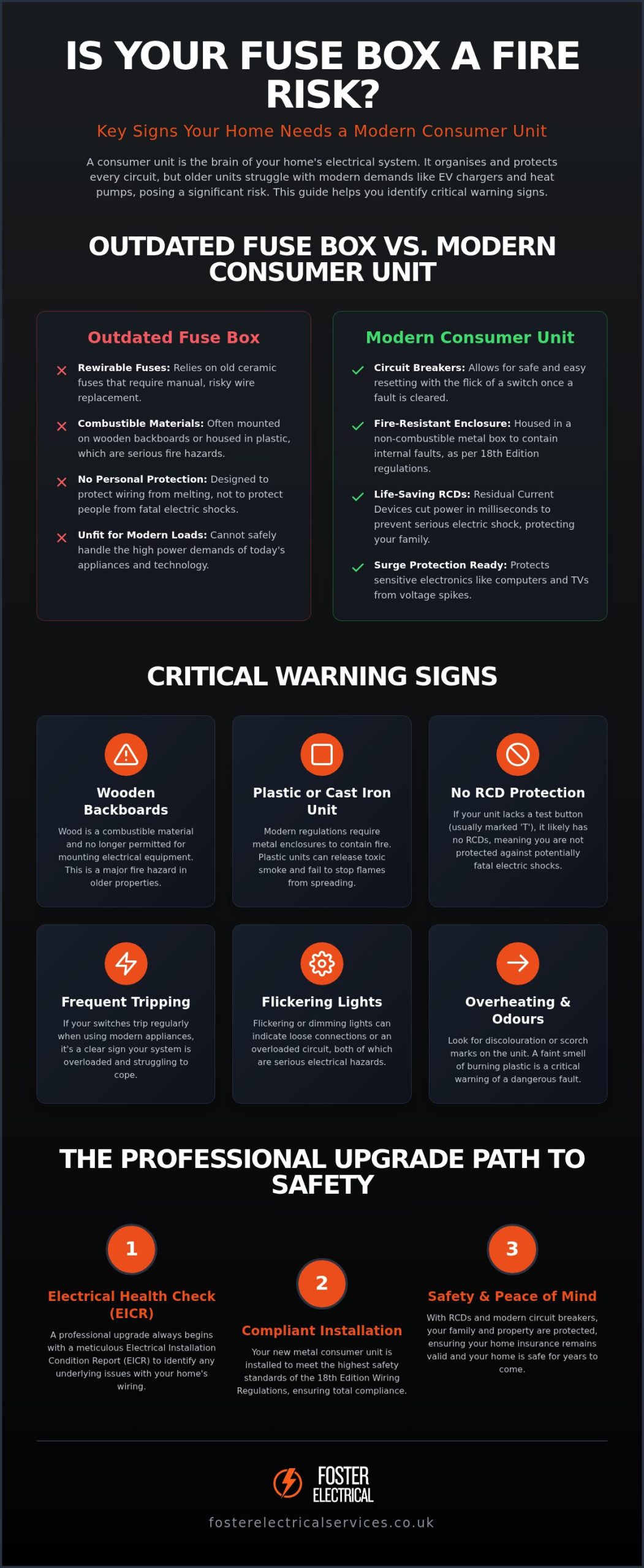
It’s usually quite easy to spot an outdated system if you know what to look for. Old fuse boxes often feature ceramic pull-out fuses or are mounted on a wooden backboard. These wooden backings are a major fire hazard, especially in older Tayside properties where they may have been in place for over fifty years. Unlike modern metal enclosures, which are non-combustible, these older materials can actually fuel a fire if a connection becomes loose or overheated. “Wired” fuses require you to manually replace a piece of fuse wire when they blow, which is both inconvenient and risky if the wrong gauge of wire is used. Modern circuit breakers simply require a flick of a switch to reset once the fault is cleared. If you’re still dealing with rewirable fuses, it’s one of the clearest signs you need a new consumer unit to bring your property up to current safety standards. You can learn about our Consumer Unit Upgrades and how we help local homeowners modernise their systems with minimal fuss.
5 Visible Signs You Need a New Consumer Unit Immediately
You don’t need to be a qualified electrician to spot the most obvious signs you need a new consumer unit. A quick visual check of where the electricity enters your home can reveal hidden dangers that may have been lurking for years. We often find that homeowners in Dundee’s older residential areas are living with equipment that was outdated decades ago. If you see any of the following markers, your family’s safety is likely compromised and requires professional attention.
The Danger of Wooden Backboards and Plastic Enclosures
Older properties across Tayside frequently have electrical gear mounted on a wooden backboard. Because wood is a combustible material, it’s no longer permitted as a mounting surface for modern electrical equipment. Following the 18th Edition updates, there has been a mandatory shift to metal consumer units to ensure any internal electrical fire is contained within the box itself. Plastic units are now considered a significant fire risk because they can release toxic smoke and fail to contain flames if a fault occurs in a hallway or primary exit route. If your unit is housed in cast iron or plastic, it’s a clear indication that the system is based on obsolete safety standards.
Another red flag is a mixture of different fuse types or circuit breakers within the same board. This often signals “DIY” alterations where various parts have been cobbled together over time, potentially masking hidden faults or poorly rated circuits. You should also look for any physical signs of overheating. This includes discolouration on the casing, scorch marks around the switches, or a faint, acrid smell of burning plastic. These are critical warnings that a connection is loose or a circuit is severely overloaded and could ignite at any moment.
Identifying the Missing “Test” Button
The easiest way for any homeowner to check for modern protection is to look for a “Test” button, usually labelled with a simple ‘T’. This button indicates the presence of a Residual Current Device (RCD), which is a life-saving component that cuts power in a fraction of a second if it detects an electrical leak. You can find more details on these legal requirements in the official Understanding Safety Standards: The 18th Edition and RCDs guidance. If your unit lacks this button, you’re at a much higher risk of fatal electric shocks. Even if you have a button, you should press it occasionally; if it doesn’t “trip” the power instantly, the mechanism has failed. A lack of functioning RCD protection results in an automatic “Unsatisfactory” rating on an EICR certificate. Staying vigilant about these physical markers helps you act before a minor fault becomes a major emergency. If you’ve spotted any of these concerns in your own home, we are here to provide a professional safety assessment to put your mind at rest.
Performance Issues: When Your Electrics Struggle to Keep Up
Sometimes, the most telling signs you need a new consumer unit aren’t visible at all; they’re felt through the daily performance of your home. If you find yourself trekking to the cupboard under the stairs because the kettle blows the fuse every time the toaster is on, your system is trying to tell you something. We often see homeowners struggling with flickering lights, which many dismiss as a “quirk” of an old house. In reality, this behaviour often points to loose connections or a system that is fundamentally overloaded by modern living. Your electrics shouldn’t be a source of daily frustration, and they certainly shouldn’t struggle with standard domestic tasks.
Nuisance Tripping and Overloaded Circuits
Most older properties in Dundee were originally wired for 30-amp or 60-amp total capacities. That was plenty for a few lightbulbs and a radio, but it’s nowhere near enough for today’s high-demand environment. When we “daisy-chain” extension leads together because there aren’t enough sockets, we’re asking an ageing fuse box to do a job it wasn’t built for. This leads to nuisance tripping, where the system shuts down as a desperate safety measure to prevent wires from melting. You can read more about the Common causes of tripping circuits to see why your specific appliances might be causing grief. Constant tripping isn’t just a nuisance; it’s a sign that your electrical “brain” is at its limit.
Buzzing, Crackling, and Unusual Odours
Any sound coming from your consumer unit area should be treated as a priority. A buzzing or crackling noise is usually a sign of “arcing,” which happens when electricity jumps across a gap in a loose or damaged connection. This generates intense heat and is a primary cause of house fires. Interestingly, electrical arcing often produces a distinct, fishy smell rather than a typical bonfire scent. This is the smell of plastic components or insulation beginning to fail under extreme temperatures. If you ever detect a mysterious fishy odour near your fuse box, don’t ignore it.
We take great pride in our meticulous approach to fault finding, ensuring we identify the root cause with minimal disruption to your day. Following industry Upgrading with Foster Electrical: What to Expect guidelines, we ensure every repair or replacement meets the highest safety benchmarks. Identifying these signs you need a new consumer unit early prevents a minor inconvenience from escalating into a dangerous situation. We treat every client’s property with the same care we’d give our own, keeping things tidy and transparent throughout the process. A quiet, odour-free consumer unit is a sign of a healthy, safe home.
Understanding Safety Standards: The 18th Edition and RCDs
Electrical regulations aren’t just bureaucratic red tape; they’re the benchmark for keeping your family safe. The current standard for UK wiring is BS 7671:2018+A4:2026, often referred to as the 18th Edition. The latest update, Amendment 4, was published on April 15, 2026, and becomes mandatory on October 15, 2026. These rules change because technology evolves, and we discover better ways to prevent accidents. If your current equipment doesn’t meet these benchmarks, it’s one of the primary signs you need a new consumer unit. We believe it’s our duty to help you navigate these technical shifts without the headache of jargon or high-pressure sales.
What is an RCD and Why is it Non-Negotiable?
A Residual Current Device (RCD) is a life-saving switch designed to prevent you from getting a fatal electric shock. It constantly monitors the electricity flowing through a circuit; if it detects even a tiny “leak” to earth, it disconnects the power in a fraction of a second. This is especially vital for families with young children who might accidentally poke something into a socket. In Scotland, RCD protection is no longer just a recommendation; it’s a legal requirement for rental properties under current landlord legislation. We ensure that every upgrade we perform provides this essential layer of protection for every circuit in your home.
Surge Protection: Safeguarding Your Digital Life
Our homes are now filled with sensitive microchips, from smart TVs and PCs to expensive EV chargers. Power surges caused by lightning strikes or grid switching can fry this equipment in an instant. Modern consumer units now include Type 2 Surge Protection Devices (SPDs) as standard. These components act like a lightning rod for your electronics, diverting excess voltage safely away from your delicate gear. You can learn more about The importance of RCD protected units and how they integrate with surge protection to create a truly resilient system.
The latest safety technology also includes Arc Fault Detection Devices (AFDDs). These clever units detect the specific electrical signature of “arcing” (small sparks) that can occur inside walls or behind sockets. Whilst they’re mandatory in high-risk buildings like HMOs, we strongly recommend them for standard homes to catch hidden fire risks before they escalate. We take personal pride in installing these advanced safety features with the meticulous care your home deserves. If you’re unsure whether your current board is up to the task, please book a professional safety inspection with us today.
Upgrading with Foster Electrical: What to Expect
Once you’ve identified the signs you need a new consumer unit, the next step is ensuring the upgrade is handled with the care your home deserves. We understand that inviting a contractor into your private space is a matter of trust. That’s why we approach every project with a clear, logical plan designed to minimise disruption and maximise safety. Whether you live in a traditional Dundee tenement or a post-war semi in Fife, our goal is to provide a service that feels personal rather than industrial. We take full accountability for our work, arriving punctually and working diligently to get your home back to normal as quickly as possible.
From EICR Inspection to Certified Safety
We usually begin the journey with a thorough assessment of your home’s current health. This is why we often recommend Our EICR services for Dundee homeowners before swapping the unit. It allows us to verify the integrity of your existing wiring; there’s little point putting a high-tech “brain” on a system with hidden faults deep inside the walls. During the actual upgrade, we organise our tasks to ensure your power is off for the shortest time possible. Once the work is complete, we issue an Electrical Installation Certificate (EIC). This document carries significant legal weight, as you’ll need it for your home insurance to remain valid and it’s essential for any future house sale.
A Local, Personal Service for Tayside and Fife
Choosing a local expert over a national corporate firm makes a world of difference in the quality of care you receive. We aren’t just contractors; we’re your neighbours. This means we take personal pride in our reputation and our standards of execution. We follow a strict “no high-pressure” approach, offering honest advice on whether you truly need a full upgrade or if a partial repair will suffice. We also treat your property with the utmost respect. Being meticulous about tidiness isn’t just a policy for us; it’s a matter of integrity. We aim to leave your home exactly as we found it, just significantly safer. If you’re ready to move forward, please feel free to Contact Foster Electrical for a safety assessment and let us help you protect what matters most.
Securing Your Home’s Future with Modern Safety Standards
Identifying the signs you need a new consumer unit is more than just a maintenance task; it’s a vital step in protecting your home and family. Whether you’ve noticed outdated wooden backboards, experienced the frustration of tripping switches, or simply want to ensure your property meets the mandatory 18th Edition Wiring Regulations, acting early prevents minor faults from becoming dangerous emergencies. A modern unit doesn’t just provide reliable power for your digital devices; it offers the life-saving protection of RCDs and surge protection that older fuse boxes simply cannot match.
As NICEIC Approved Contractors and local Dundee experts, we take personal pride in helping our neighbours achieve lasting peace of mind. We believe in honest advice and meticulous workmanship, ensuring your property remains a safe sanctuary for years to come. Don’t leave your electrical safety to chance. You can Request a Professional Safety Inspection from Foster Electrical today. We are here to provide the diligent, expert care your home deserves, leaving everything tidy and fully compliant with the latest standards. Your safety is our priority, and we look forward to helping you future-proof your home.
Frequently Asked Questions
How much does it cost to replace a consumer unit in Dundee?
Replacing a consumer unit in Dundee involves costs that depend on the number of circuits and the specific safety features required, such as surge protection. Whilst industry data suggests UK averages, every home in Tayside is different. We recommend a professional assessment to determine the exact requirements for your property. This ensures you only pay for what is necessary to meet the latest 18th Edition safety standards and protect your family effectively.
How long does it take to install a new consumer unit?
For most residential properties in Dundee, a consumer unit upgrade takes approximately one full working day to complete. This timeframe includes the physical installation and the rigorous testing required to ensure every circuit is functioning correctly. We work diligently to keep our workspace tidy and ensure your home is safe before we leave. Providing a detailed Electrical Installation Certificate at the end is a vital part of this professional process.
Will my power be off during the consumer unit upgrade?
Yes, your electricity will be switched off for the majority of the installation day. We have to isolate the mains supply to work safely on the internal components of your board. We suggest planning ahead by charging devices and avoiding use of the fridge or freezer during this period. We always aim to organise our work efficiently to restore your power as quickly as possible without compromising on our high standards of execution.
Is it illegal to have an old fuse box in the UK?
It isn’t illegal to have an old fuse box in a private UK home, but it often means your property doesn’t meet modern safety benchmarks. If you are a landlord in Scotland, however, having an outdated unit without RCD protection will likely result in a failed EICR, making the property illegal to rent. Recognising the signs you need a new consumer unit helps you avoid these compliance issues and ensures your home remains a safe environment.
Do I need a certificate after my consumer unit is replaced?
You must receive an Electrical Installation Certificate (EIC) once the work is finished. This document is your proof that the installation was carried out by a qualified professional and complies with the latest UK wiring regulations. You’ll need this certificate if you ever decide to sell your house or if you need to make a claim on your home insurance. We handle all the paperwork and certification as part of our standard service for every client.
Can I replace a consumer unit myself if I am good at DIY?
No, you should never attempt to replace a consumer unit yourself, even if you are experienced with domestic DIY. This type of electrical work is “notifiable” under UK Building Regulations, meaning it must be carried out and certified by a registered electrician. Attempting it yourself is dangerous and can lead to serious legal and insurance problems. We provide the NICEIC-approved expertise needed to ensure the job is done correctly and safely for your peace of mind.
What is the difference between an RCD and a circuit breaker?
A circuit breaker is designed to protect your home’s wiring from catching fire due to an overload or short circuit. In contrast, a Residual Current Device (RCD) is a life-saving component designed to protect people from fatal electric shocks. Whilst both are essential parts of a modern board, the RCD is much more sensitive. It detects tiny electrical leaks and cuts the power in milliseconds, providing a level of safety that old-fashioned fuses simply cannot offer.
Will a new consumer unit stop my lights from flickering?
A new unit can stop lights from flickering if the problem is caused by loose connections or an overloaded system at the main board. During the installation, we perform a thorough check of your circuits, which often identifies these signs you need a new consumer unit before they become major hazards. If the flickering is caused by a fault further along the circuit, our fault-finding expertise will help pinpoint and repair the issue during the upgrade process.