Could a simple misunderstanding of the latest wiring rules leave your Scottish property legally unlettable or, worse, unprotected against modern electrical risks? It is completely understandable to feel a bit overwhelmed by the constant stream of technical updates, especially when trying to figure out which UK-wide rules actually apply to your home here in Scotland. You want to keep your family or your tenants safe, but the fear of failing an EICR or facing unexpected upgrade costs is a heavy burden to carry. We believe that electrical safety should not be a source of stress, but a foundation of a well-maintained home.
With the new consumer unit regulations 2026 scotland now in full effect following the publication of BS 7671:2018+A4:2026, the gap between “getting by” and “being compliant” has never been more important to bridge. We have put together this guide to help you master these standards, ensuring your property remains a secure haven whilst meeting every legal requirement with total integrity. We will walk you through the mandatory RCD and AFDD requirements, provide a clear checklist for landlord compliance, and give you the confidence to choose a local expert who treats your home with the respect it deserves.
Key Takeaways
- Discover how the latest BS 7671:2018+A4:2026 standards act as the “brain” of your home’s safety system, evolving to meet the demands of modern electrical appliances.
- Learn about the mandatory role of RCDs and the protective benefits of SPDs and AFDDs under the new consumer unit regulations 2026 scotland.
- Ensure your rental property meets the updated Scottish Repairing Standard to keep your tenants safe and your legal obligations fully satisfied.
- Identify the physical warning signs, such as wooden backings or old-fashioned fuses, that indicate your property is overdue for a modern safety upgrade.
- Understand why choosing a registered local expert is essential for a meticulous installation that prioritises both technical correctness and the tidiness of your home.
Understanding the 2026 Scottish Electrical Safety Standards and BS 7671
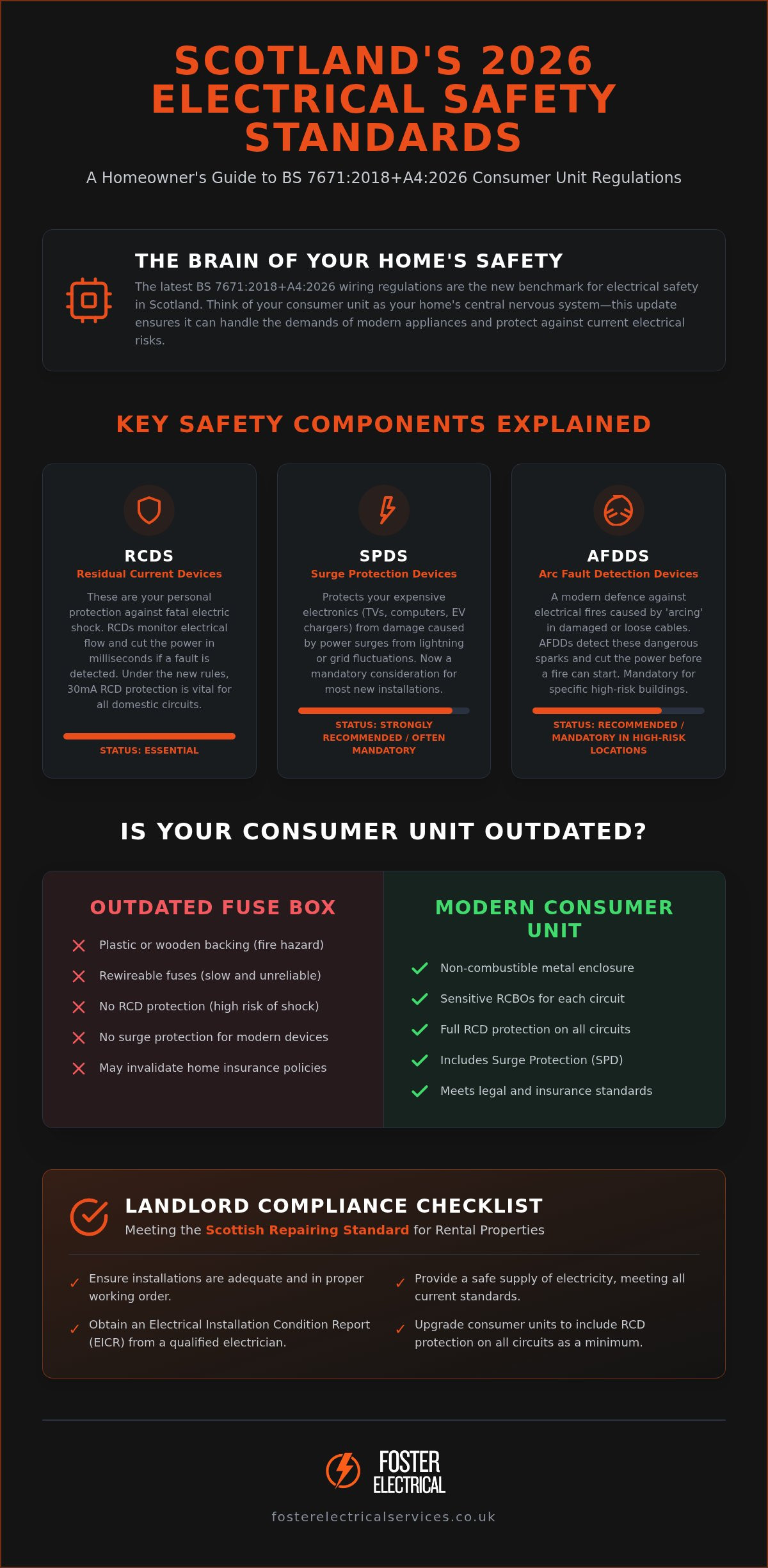
Think of your consumer unit as the diligent brain of your home’s electrical system. It quietly monitors every circuit, standing ready to cut power the instant a fault is detected. We often see homeowners overlook this metal box tucked away in a cupboard, yet it is the single most important guardian of your family’s safety. The foundation for this protection is the BS 7671 Wiring Regulations, a set of national standards that ensures electrical work is carried out to a high, uniform level. The most recent update, BS 7671:2018+A4:2026, represents the latest evolution in how we approach domestic safety.
Whilst these regulations apply across the United Kingdom, the new consumer unit regulations 2026 scotland carry a unique weight due to our specific property laws. In Scotland, we often see stricter timelines for implementation, particularly regarding the Repairing Standard for rental properties. Our legal framework ensures that safety updates move from “good advice” to “legal mandate” much faster than in other parts of the UK. This means that for Tayside residents, staying ahead of these changes isn’t just about modern technology; it’s about remaining on the right side of Scottish law.
What is Amendment 4 (A4) of the 18th Edition?
Amendment 4, published on 15 April 2026, focuses heavily on mitigating modern risks like electrical fires and power surges. We have seen a technical shift towards mandatory Arc Fault Detection Devices (AFDDs) in specific high-risk buildings and a much stronger emphasis on surge protection. If your installation was designed before the 15 October 2026 withdrawal of the previous standard, there is a brief transition period to consider. A4 compliance is the new benchmark for Scottish home safety.
Consumer Unit vs. Old Fuse Box: The Legal Gap
The days of fumbling with thin wire and porcelain fuses are long gone. Modern consumer units utilise Residual Current Breakers with Overcurrent (RCBOs), which are far more sensitive and reliable than old-fashioned rewireable fuses. We’ve noticed that “grandfather rights”, the idea that an old system is fine just because it’s already there, are rapidly disappearing in the eyes of Scottish insurers. Many providers now require proof of modern standards before they’ll offer full coverage. We take great pride in our role at Foster Electrical, where we carefully assess older Tayside boards to bridge this legal gap. We don’t just swap boxes; we ensure your home meets the moral and legal standards of 2026.
Key Safety Components: RCDs, SPDs, and the Rise of AFDDs
We believe a safe home starts with the right materials. This is why the latest standards insist on non-combustible, metal-clad enclosures for all new consumer units. It is a straightforward, honest way to ensure that if a fault does occur, any fire is contained within the box rather than spreading to the rest of your property. This physical barrier is your first line of defence, but the true protection lies in the sophisticated components we house inside.
The Vital Role of RCD Protection
RCDs are the silent heroes of your electrical system. They monitor the flow of electricity and disconnect the power in milliseconds if they detect a leak, which is often enough to prevent a fatal electric shock. Under the new consumer unit regulations 2026 scotland, having 30mA RCD protection on all domestic circuits isn’t just a recommendation; it is a vital safety requirement. We prefer using RCBOs, which combine the functions of a circuit breaker and an RCD for each individual circuit. This means if your kettle develops a fault, you won’t be plunged into darkness because only that one circuit will trip. You can find more detail on these components in our Consumer Unit Upgrades 2026 guide.
Surge Protection: Why 2026 Regulations Demand It
Surge Protection Devices (SPDs) are now a mandatory consideration for most new installations under Amendment 4. Our homes are full of expensive, sensitive electronics, from smart TVs to EV chargers, which can be easily ruined by transient overvoltages. These grid spikes are often caused by switching loads or lightning strikes. Given the unpredictable Scottish weather and the many rural properties in Angus supplied by overhead lines, surge protection is a sensible, necessary investment for your peace of mind. These devices are no longer an optional extra but a standard part of a modern, compliant home.
Finally, we must consider Arc Fault Detection Devices (AFDDs). These clever units detect the tiny arcs of electricity that can occur in damaged cables or loose connections, which are a frequent cause of house fires. For high-risk settings like Houses in Multiple Occupation (HMOs), care homes, or high-rise buildings in Dundee, these are now a legal necessity under BS 7671:2018+A4:2026. We take our responsibility as your local experts seriously, ensuring every component we install meets these exacting standards. If you are unsure if your current board has these features, we are always happy to chat through your options.
Compliance for Landlords: The Scottish Repairing Standard in 2026
For landlords across Tayside, the weight of responsibility is significant. You aren’t just providing a roof; you’re ensuring a safe environment for your tenants to call home. The Scottish Repairing Standard sets out the minimum safety requirements for private rentals, and by 2026, these rules have become even more stringent. Central to this is the Electrical Installation Condition Report (EICR), which must be carried out at least every five years by a qualified professional. We take great pride in helping local property owners navigate these duties with our EICR Certificate Dundee guide, which breaks down the specifics of these vital safety checks.
The consequences of ignoring these standards are severe. Beyond the obvious risk to life, a landlord who fails to maintain a satisfactory EICR faces substantial fines from local authorities. Perhaps most critically, under Scottish law, you cannot serve a valid eviction notice without a current, satisfactory safety certificate. Your insurance is also likely to be invalidated if a fire or shock occurs in a property that doesn’t meet the new consumer unit regulations 2026 scotland. We believe in getting it right the first time to protect both your investment and your reputation.
Mandatory RCD Protection for Rented Homes
Whilst the requirement for RCDs was introduced in March 2024, the 2026 enforcement period leaves no room for error. Every privately rented home in Scotland must have at least one 30mA RCD in the main consumer unit covering all socket-outlet circuits. If your property still relies on an old board without this protection, it will result in an automatic “Unsatisfactory” result during your next inspection. This isn’t just a technicality; it’s a fundamental shift in how we protect tenants from the hidden dangers of faulty appliances or damaged cables.
AFDDs in HMOs and Care Homes
The publication of Amendment 4 (A4) in April 2026 has introduced specific mandates for higher-occupancy buildings. If you manage a House in Multiple Occupation (HMO), a care home, or a purpose-built student block, you are now legally required to install Arc Fault Detection Devices (AFDDs) on all single-phase AC final circuits supplying socket outlets up to 32A. Fire safety is the primary driver here, as these devices catch the tiny electrical arcs that traditional breakers miss. We recommend organising these upgrades well in advance of your next EICR to avoid a last-minute rush or a failed report. We are here to help you plan these improvements meticulously, ensuring your building remains a safe, compliant place to live.
Signs Your Property Needs a Consumer Unit Upgrade
Identifying an outdated system doesn’t always require a technical degree. Sometimes, the signs are staring you right in the face. If your fuse box has a wooden backing or contains old-fashioned rewireable fuses, it is a clear relic of a different era. These older units were never designed to handle the electrical load of a modern 2026 household. Under the new consumer unit regulations 2026 scotland, plastic enclosures are also a significant concern because they don’t offer the fire containment properties of modern metal-clad units. We believe that a physical inspection is the first step toward peace of mind.
We often hear from residents in older Dundee tenements about flickering lights or breakers that trip for no apparent reason. These aren’t just minor annoyances; they are symptoms of a system struggling to keep up with contemporary demands. One of the simplest checks you can perform is looking for a “test” button on your board. If your unit lacks this basic feature, it means you don’t have RCD protection, which is a dangerous gap in your home’s safety. It’s also worth remembering that if you’re planning significant work, such as a kitchen rewire, a full board upgrade is now a mandatory part of the process to ensure the new circuits are properly protected.
The “Grandfather” Trap: Why Old Boards Fail Modern Tests
It is a common misconception that a board installed in the 1990s is still “safe” simply because it hasn’t caused a problem yet. When we carry out EICR inspections, we frequently find internal heat damage in older fuse boxes that have been neglected for decades. This “grandfather” trap can lead to an automatic failure under 2026 standards because the components simply cannot provide the millisecond response times required today. If you ever notice a faint burning smell or discolouration around your fuses, we encourage you to look at our Fault Finding and Repairs guide to understand the risks involved.
Future-Proofing for EV Chargers and Heat Pumps
Modern green technology demands a robust electrical foundation. Whether you are considering a heat pump or need an EV Charger Installation in Dundee, a 2026-standard consumer unit is essential. Upgrading your board now ensures you have the dedicated circuit capacity and surge protection required for these high-power devices. It’s a sensible way to save money in the long run by avoiding multiple call-outs when you finally decide to go green. We take pride in helping you build a home that is ready for the future.
We believe in providing honest, straightforward advice to keep your Tayside home secure. If your board shows any of these warning signs, it is time to book a professional assessment with our team today.
Professional Installation: Modernising Your Home with Foster Electrical
We believe your home is your sanctuary. Attempting to navigate the new consumer unit regulations 2026 scotland through DIY work is not just risky; it’s often illegal. Electrical work requires a level of precision that only comes with years of experience and formal certification. We’ve seen the consequences of “quick fixes” and they simply aren’t worth the risk to your family’s safety. Professional installation ensures that every connection is sound and every safety device is calibrated correctly to protect your property for years to come.
At Foster Electrical, we approach every job with a sense of traditional sincerity. We aren’t just here to swap parts; we’re here to provide a service rooted in diligence and integrity. Our team is meticulous about tidiness. We treat your private space with the sensitivity it deserves, ensuring that we leave your home exactly as we found it, but significantly safer. We take a calm, service-oriented approach that avoids high-pressure tactics, focusing instead on being a protective guardian of your environment. We take personal pride in every board we commission.
What Happens on the Day of Your Upgrade?
A consumer unit replacement is a methodical process. We typically require a power outage of between 4 and 8 hours to perform a safe swap. This period allows us to work without risk whilst meticulously connecting each circuit to its new protective device. Once the physical installation is complete, we don’t just pack up and leave. We conduct rigorous testing on every single circuit in your property to ensure everything is functioning correctly. Following the successful upgrade, we notify Building Standards and issue a full Electrical Installation Certificate (EIC). This document is your proof of compliance and a vital record for your insurance and future property sales.
Secure Your Safety with a Trusted Dundee Expert
Choosing a local expert makes a world of difference. We understand the unique challenges of the housing stock across Dundee, Perth, and Angus, from historic stone cottages to modern developments. We pride ourselves on being a family-run business that rejects the impersonal nature of large corporate firms. When we enter your home, we bring a level of personal care that reflects our commitment to the Tayside community. We treat your property with the same high standards we would apply to our own. It’s a privilege to be the guardians of your home’s safety. We invite you to experience a more personal, artisanal way of working.
Contact Foster Electrical today for a compliant 2026 consumer unit upgrade.
Secure Your Home for the Future Today
We’ve explored how the shift to BS 7671:2018+A4:2026 transforms domestic safety from a simple recommendation into a robust legal mandate. Whether you’re a homeowner spotting the signs of an ageing fuse box or a landlord navigating the strict requirements of the Scottish Repairing Standard, the path to compliance is clear. Modern protection through RCDs, SPDs, and AFDDs isn’t just about ticking a box; it’s about the quiet confidence that comes from knowing your property is shielded against fire and shock.
Staying ahead of the new consumer unit regulations 2026 scotland is a responsibility we take to heart as your local experts. We’re proud to be an NICEIC Approved Contractor, specialising in the nuances of Scottish property law to keep Tayside homes safe and compliant. We believe in honest, artisanal service that treats your property with the same care we’d give our own. Our reputation across Dundee and Tayside is built on this commitment to excellence.
Book your 2026 electrical safety inspection or consumer unit upgrade with Foster Electrical to ensure your home remains a protected sanctuary. We look forward to helping you modernise your home with the diligence and integrity it deserves.
Frequently Asked Questions
Do I legally have to upgrade my consumer unit in Scotland by 2026?
You aren’t legally forced to upgrade an existing board just because the calendar hits 2026. However, the new consumer unit regulations 2026 scotland mandate that any new electrical work or significant alterations must meet the BS 7671:2018+A4:2026 standard. If you’re a landlord, you must ensure your property meets the Repairing Standard, which often requires modern RCD protection to pass a mandatory EICR inspection. We believe in being proactive about your family’s safety.
How much does a consumer unit upgrade cost in Dundee and Angus?
Every home in Dundee and Angus is unique, so we don’t believe in providing one-size-fits-all pricing that might mislead you. The total investment for an upgrade depends on several factors, including the number of circuits in your property and whether your specific building requires advanced components like AFDDs. We provide honest, transparent surveys to assess your needs. Choosing a local expert ensures you receive a meticulous installation that adds genuine value and protection to your home.
What is the difference between a fuse box and a modern consumer unit?
An old fuse box uses rewireable fuse wire that you have to manually replace if it blows. It’s an outdated system that offers very little protection against electric shocks. A modern consumer unit uses sensitive circuit breakers and RCBOs that trip in milliseconds to keep you safe. These new units are also housed in non-combustible metal enclosures, which is a vital safety feature for containing potential electrical fires in your Tayside property.
Does a new consumer unit come with an EICR certificate?
A new consumer unit installation actually comes with an EIC, which stands for an Electrical Installation Certificate. This document confirms the new board and its connections meet current safety standards. An EICR is a condition report for an entire existing system. Whilst we often perform an EICR before an upgrade to identify any hidden faults, the EIC is the legal proof that your new installation is correct and fully compliant with the latest wiring rules.
How long does it take an electrician to replace a fuse board?
Replacing a fuse board typically takes between 4 and 8 hours of dedicated work. It isn’t just a matter of swapping the box; we must meticulously test every circuit in your home to ensure they’re safe to connect to the new unit. We understand that being without power for a day is an inconvenience, so we work diligently to complete the task with minimal disruption. We always leave your space tidy and your system fully certified.
Are surge protection devices (SPDs) now mandatory in Scotland?
Surge protection devices are now a requirement for the vast majority of new installations in Scotland under Amendment 4. These devices are essential for shielding your sensitive electronics and smart home tech from transient overvoltages. In rural parts of Angus or Tayside where power is often supplied by overhead lines, SPDs provide a vital layer of security. They’re no longer considered an optional extra but a standard part of a modern, safety-conscious home.
Will a new consumer unit stop my lights from flickering or circuits tripping?
A new consumer unit provides a more reliable foundation, but it won’t always fix flickering lights on its own. These issues often stem from loose connections or faults within the wiring itself. However, a modern board with RCBOs makes fault finding much easier because it identifies exactly which circuit is causing the trouble. We use our expertise to investigate these symptoms during the installation process, ensuring your home’s electrical system is both stable and secure.
Can I sell my house in Scotland if I have an old-style fuse box?
You can sell your house with an old fuse box, but it will likely be highlighted in your Home Report. Many modern buyers in Dundee are aware of the new consumer unit regulations 2026 scotland and may ask for a price reduction to cover the cost of a modern upgrade. Having a compliant, metal-clad unit with RCD protection can make your property much more attractive to safety-conscious buyers. It shows you’ve taken personal pride in maintaining your home.