You open the EICR and see C1, C2, C3 or FI, but the report doesn’t make clear whether there’s a danger or simply room for improvement. If you need an eicr report explained to tenant in plain English, start with this: the codes describe different findings and don’t all call for the same response.
It’s understandable to feel unsure when an electrical report uses unfamiliar terms, especially if you’re not certain who to tell or what should happen next. This guide explains what an EICR checks, what it doesn’t cover and how to read its findings without jumping to conclusions.
We’ll look at the difference between urgent observations and recommended improvements, what an unsatisfactory result means, and how to raise concerns clearly with your landlord or letting agent. For tenants in Dundee, Perth, Angus, Fife and St Andrews, understanding the report is a practical first step towards getting clear answers about electrical safety. Foster Electrical carries out EICRs and electrical safety work locally, with explanations that help make technical findings easier to understand.
Key Takeaways
- An EICR records the condition of a property’s fixed electrical installation at the time of inspection. It can’t guarantee that faults won’t develop later.
- Read the overall result alongside the electrician’s observations. Each finding describes a specific condition, not necessarily the whole home.
- A C3 recommendation is different from findings that require prompt attention. Read the written explanation before deciding what action is needed.
- Keep a copy of the report, note anything you don’t understand and raise questions or electrical concerns with your landlord or property manager.
- This eicr report explained to tenant guide helps you understand the findings and practical next steps, including where to get EICR advice in Dundee, Perth, Angus, Fife and St Andrews.
EICR Report Explained to Tenants: What the Inspection Actually Covers
An Electrical Installation Condition Report, or EICR, records the condition of a property’s fixed electrical installation based on an electrician’s inspection and testing. It is a documented assessment, not just a quick visual check and not a promise that no fault will develop after the inspection.
If you’re looking for an eicr report explained to tenant in straightforward language, begin by distinguishing the property’s wiring from portable electrical items. The fixed installation is built into the home. Portable appliances, such as a tenant’s kettle or toaster, are separate and aren’t assessed as part of an EICR of the fixed installation.
Which parts of the property does an EICR assess?
An EICR can cover fixed wiring and connected parts of the system, including sockets, switches, lighting circuits and the consumer unit. The electrician inspects and tests accessible parts to assess their condition. A tenant’s lamp or phone charger isn’t fixed wiring, and an EICR shouldn’t be treated as an individual test of every appliance in the property.
Access also affects what can be inspected. Wiring hidden behind walls or beneath floors may not be visible, and the electrician may not be able to examine every part of the installation directly. Read the report with its stated scope and any recorded limitations in mind. For general background on UK installations and the standards they sit within, see UK Electrical Safety Standards.
What an EICR can and cannot tell a tenant
An EICR describes what the inspection found at that time. It can record defects or other observations that need attention, but it can’t guarantee future electrical performance. A fault might arise later, or a condition outside the inspection’s access and scope might not appear in the findings.
That distinction is useful when reading the report. A recorded issue relates to a particular part or condition of the installation. It doesn’t automatically mean every socket, light or appliance is unsafe. Equally, a report isn’t a substitute for raising a new concern. If you notice damage, unusual warmth, a burning smell or repeated loss of power, report it promptly to your landlord or property manager rather than relying on an earlier inspection.
Foster Electrical carries out EICRs and electrical safety work in Dundee, Perth, Angus, Fife and St Andrews. The inspection findings can help tenants and property owners understand the practical electrical issues recorded in a report.
How to Read an EICR Report: Sections, Observations and Overall Outcome
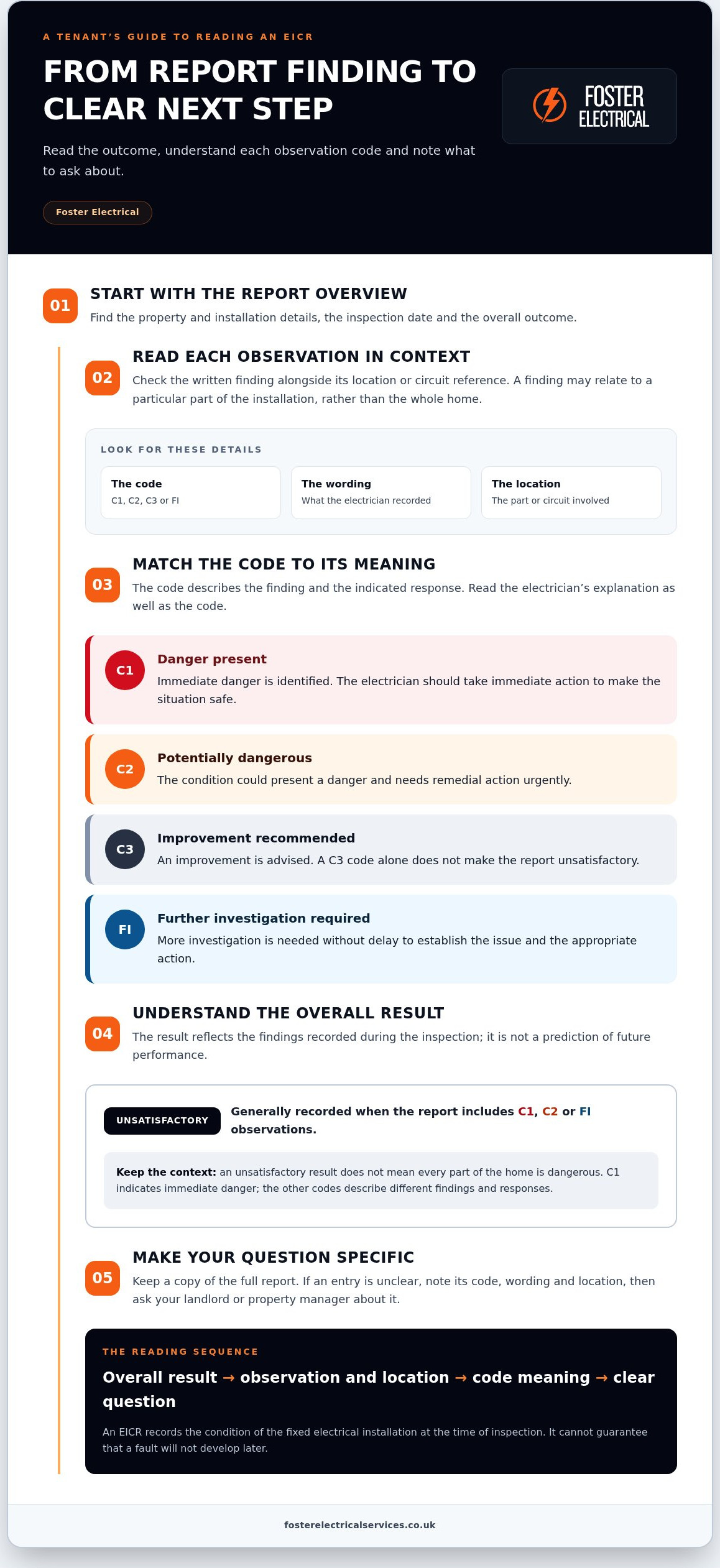
An EICR can look dense at first, but you don’t need to understand every technical detail to find the main points. Start with the property and installation details, the inspection date and the overall outcome. Then read each observation alongside its location or circuit reference. This can show whether a finding concerns a particular socket or lighting circuit, rather than the whole home.
Findings need their context
Keep the full report, not just a verbal summary or a note of the final result. The written observation explains what the electrician found, while its location helps identify the part of the installation involved. If an entry is unclear, note the code, wording and location reference so you can ask your landlord or property manager a specific question. The code is only one part of understanding a finding.
The overall outcome reflects the findings recorded during the inspection. It isn’t a prediction of how the installation will perform in future.
What the observation codes mean
- C1, Danger present: the observation identifies immediate danger. The electrician should take immediate action to make the situation safe.
- C2, Potentially dangerous: the condition could present a danger and needs remedial action urgently.
- C3, Improvement recommended: an improvement is advised, but a C3 code alone doesn’t make the report unsatisfactory.
- FI, Further investigation required: more investigation is needed without delay to establish the issue and the appropriate action.
A report is generally classed as unsatisfactory if it records C1, C2 or FI observations. That doesn’t mean every observation describes immediate danger. C1 indicates immediate danger, while C2, C3 and FI describe different circumstances and levels of action. Read the electrician’s written explanation as well as the code, and don’t assume a C3 means the same thing as C1 or C2.
For background, the official UK government guidance for tenants covers the private rented sector in England. Scottish tenancies have a distinct framework, so don’t treat England-specific guidance as a statement of Scottish requirements.
If a finding in your Dundee, Perth, Angus, Fife or St Andrews report is difficult to interpret, you can discuss an EICR concern with Foster Electrical for practical electrical guidance.
Does an Unsatisfactory EICR Mean Your Home Is Unsafe? Understand the Context
An “unsatisfactory” result means recorded findings need attention. It isn’t a verdict that every part of your home is dangerous. Read the observations and the electrician’s explanation to understand what was found, where it was found and what response is indicated. The code matters, but so do the specific condition and its context.
How to understand C1, C2, C3 and FI findings
In plain English, the codes distinguish between different types of observation:
- C1: Danger is present. The electrician should take immediate action to make the situation safe.
- C2: A potentially dangerous condition requires urgent remedial action.
- C3: An improvement is recommended. On its own, this code doesn’t make the report unsatisfactory.
- FI: Further investigation is required without delay to establish the issue.
An unsatisfactory outcome is associated with C1, C2 or FI findings. That doesn’t mean each one describes immediate danger. C1 identifies danger present, C2 indicates potential danger and FI means more investigation is needed. Check the written observation and location reference rather than relying on the code alone. This plain-English guide to an eicr report explained to tenant helps you understand the report without drawing conclusions it doesn’t support.
| Report outcome or code | What it broadly indicates | Sensible next step |
|---|---|---|
| Satisfactory, with no urgent observation | No recorded C1, C2 or FI finding requiring the report to be marked unsatisfactory. | Keep the report and raise any new electrical symptoms separately. |
| C1 | Danger is present. | Notify your landlord or property manager urgently and follow the electrician’s recorded advice. |
| C2 | A potentially dangerous condition needs urgent remedial action. | Bring the finding to the landlord or property manager’s attention promptly. |
| FI | Further investigation is needed without delay. | Ask what investigation is required and how the finding will be followed up. |
| C3 | An improvement is recommended; this alone doesn’t make the report unsatisfactory. | Read the explanation and note the recommendation for discussion. |
Why an EICR is not a reason to panic
An EICR records observations from an inspection at a particular time. It can’t predict every fault that might arise later, and an unsatisfactory result alone doesn’t tell you that the entire home is unsafe. Electrical Safety First also provides practical information for tenants. If you notice immediate signs of danger, keep away from the affected area and alert your landlord or property manager through their urgent reporting route. If you’re unsure how to interpret a finding, Foster Electrical provides practical electrical guidance alongside EICR and electrical safety work. You can discuss an EICR concern with the team.
What Should a Tenant Do After Receiving an EICR Report?
A clear next step can make a technical report feel more manageable. Read the overall outcome first, then note each observation, its location and the action the report recommends. Keep the complete document, even if you share only the relevant page or extract when raising a particular concern. This gives your landlord or property manager useful context without losing the rest of the inspection record.
For an eicr report explained to tenant in practical terms, focus on what the report says and what you need clarified, rather than trying to diagnose an electrical fault yourself. If a finding is unclear, note its wording and reference before getting in touch.
How to raise questions about a finding
Write calmly and stick to the facts. Ask which room, location or circuit the observation relates to, what the finding means in plain English, and what next step is recommended. Include the relevant report extract if it helps, but keep your full copy. Where practical, use a dated written message and save the reply with the report so there’s a clear record of what was raised and when.
Report any new electrical symptoms or visible damage promptly to your landlord or property manager. An earlier report describes the installation at the time it was inspected. It shouldn’t be used to dismiss a concern that has appeared since.
When an electrical concern needs urgent attention
Smoke, visible sparking, a burning smell or an electric shock should be treated seriously. Don’t try to repair the installation, touch exposed wiring or remove protective covers. Keep clear of the affected area and contact your landlord or property manager through their urgent reporting channel. If there’s a fire or an immediate threat to life, call 999.
These are practical safety steps, not a statement of Scottish tenancy law. If you’re unsure about an observation or how to describe an electrical concern, Foster Electrical provides practical advice alongside EICR and electrical safety work. Discuss an EICR finding with Foster Electrical.
EICR Help for Tenants in Dundee: Clear Findings and Practical Electrical Advice
Once you’ve read the report, focus on what was recorded, where it applies and whether it calls for urgent attention, further investigation or an improvement. Ask your landlord or property manager to explain anything that remains unclear, and report new electrical symptoms promptly. Keeping the report and your correspondence together makes it easier to refer back to the details.
A straightforward eicr report explained to tenant in plain English can help you understand what the electrician recorded without asking you to diagnose the installation yourself. Foster Electrical carries out EICRs and electrical safety work, including fault finding and repairs, and can explain technical observations and the inspection scope recorded in a report.
When professional electrical advice can help
Advice from an electrician can be useful if a code or circuit reference is difficult to interpret, or if you’re unsure what a recorded observation relates to. The report’s wording and scope are important. A clear explanation helps you understand what was inspected and what the finding says, without treating the report as a guarantee about future performance. If an observation points to a practical electrical concern, competent advice can make the issue clearer.
Foster Electrical is based in Dundee and serves Dundee, Perth, Angus, Fife and St Andrews. Its EICR and electrical safety services provide tenants and property owners with a local source of practical guidance. Foster Electrical also carries out fault finding and repairs when electrical issues need attention.
How to prepare before discussing an EICR
A little preparation helps keep the conversation focused. Have the complete report available, along with the page or observation reference you want to discuss. Note the property location and describe any symptoms or changes you’ve noticed, such as a damaged socket or a circuit repeatedly losing power. Share what you’ve observed, not a guessed diagnosis.
For a report finding, include the electrician’s wording and ask for it to be explained in everyday terms. For a new symptom or visible damage, contact your landlord or property manager promptly as well. Discussing a report with an electrician doesn’t replace reporting a concern through the appropriate property-management channel. If you’re in immediate danger, use the urgent channels outlined in the previous section.
For a clear explanation of an EICR or electrical safety concern, discuss your report with Foster Electrical.
Take Your Next Step with Confidence
An EICR is easier to act on when you separate the overall result from the individual observations. The report records what the electrician found at the time of inspection. Its codes and written explanations help show whether a finding calls for urgent attention, further investigation or an improvement.
Keep the complete report, note any unclear references and raise questions with your landlord or property manager. Report new symptoms or visible damage promptly, even if an earlier inspection didn’t record a problem. An eicr report explained to tenant can give you a useful starting point, but it can’t predict every fault that may develop later.
Foster Electrical provides EICRs and practical electrical safety expertise in Dundee, Perth, Angus, Fife and St Andrews. If you’d like help understanding an observation or discussing an electrical safety concern, talk to Foster Electrical about your EICR.
With the report to hand and the right questions ready, you can take the next step calmly and clearly.
Frequently Asked Questions
What does an EICR report tell a tenant?
An EICR tells you about the condition of the property’s fixed electrical installation at the time it was inspected. It records observations about parts such as wiring, sockets, lighting circuits and the consumer unit, along with an overall outcome. The codes and written notes help show whether a finding calls for urgent attention, further investigation or an improvement. It isn’t a guarantee that faults won’t develop after the inspection.
Is a tenant entitled to see an EICR report in Scotland?
In Scotland, a new tenant must be given a copy of the current EICR before their tenancy begins. If you’re already renting and haven’t received a copy, ask your landlord or letting agent for it in writing. Keep the complete report so you can refer to its overall result, recorded observations and any limitations. Scottish rented-property requirements differ from rules in England, so check Scottish guidance for jurisdiction-specific information.
What do C1, C2, C3 and FI mean on an EICR?
C1 means danger is present and the electrician should act immediately to make the situation safe. C2 identifies a potentially dangerous condition requiring urgent remedial action. C3 recommends an improvement and doesn’t by itself make the report unsatisfactory. FI means further investigation is required without delay. Read the written explanation and location reference as well as the code, since a code alone doesn’t explain the full context.
Can a tenant be charged for electrical repairs found in an EICR?
An EICR finding doesn’t automatically mean a tenant must pay for a repair. The landlord is responsible for arranging and paying for the EICR in a rented property in Scotland, but responsibility for a particular repair or any related charge can depend on the circumstances and tenancy terms. Don’t agree to a charge solely because an observation appears in the report. Ask for the reason in writing and seek independent housing advice if you’re unsure.
What should I do if my EICR is unsatisfactory?
Read the recorded observations and note their codes, location and recommended action. Raise unclear findings with your landlord or property manager, sharing the relevant report extract while keeping the full document. C1, C2 and FI indicate findings that need appropriate attention or investigation, but they don’t all describe the same level of risk. Report any new symptoms or visible damage promptly, and don’t attempt electrical repairs yourself.
Does an EICR check electrical appliances as well as wiring?
No. An EICR assesses the fixed electrical installation, such as wiring, sockets, switches, lighting circuits and the consumer unit. Portable appliances, including a kettle or toaster, aren’t individually tested as part of that report. In Scotland, portable appliances supplied by a landlord are subject to separate inspection and testing requirements. If you’re unsure whether an appliance or installation issue is covered, ask your landlord or property manager for clarification.
How long is an EICR valid for in a rented home?
In Scotland, an EICR for a rented home must be renewed at least every five years, although the electrician may recommend a shorter interval based on the installation’s age and condition. A new tenant doesn’t necessarily need a newly produced report if a current one remains valid. Check the inspection date and any recommended next inspection date on the document, and ask the landlord or letting agent if the report appears out of date.