A tidy property file can still leave you unsure whether you have the right electrical evidence in place. When reviewing the electrical requirements for airbnb scotland, treat compliance as a property-specific record trail, not a one-size-fits-all checklist. Fixed-wiring inspections, portable-appliance checks and alarm provision are separate parts of that trail.
Before welcoming guests or progressing a licence application, gather the records for your property and compare them with current Scottish Government guidance and the relevant licensing authority’s conditions. This guide explains how an Electrical Installation Condition Report differs from portable appliance testing, what to review in your alarm records, and how to track missing paperwork or recommended work.
Foster Electrical provides EICR inspections, PAT testing and interlinked smoke and heat alarm installation across Dundee, Perth, Angus, Fife and St Andrews. Use the steps below to identify what is already documented and what needs attention for a safe, guest-ready property.
Key Takeaways
- Organise the electrical requirements for airbnb scotland into a property-specific record trail instead of relying on a generic checklist.
- Keep fixed-wiring evidence, portable-appliance records and alarm information distinct. An EICR covers the fixed electrical installation, not portable appliances.
- Review current Scottish guidance alongside the conditions set by the licensing authority relevant to your property.
- Record missing documents and outstanding remedial actions, then follow them up before treating the property file as complete.
- Hosts in Dundee, Perth, Angus, Fife and St Andrews can use Foster Electrical’s EICR, PAT testing and interlinked smoke and heat alarm installation services.
Electrical requirements for Airbnb in Scotland: what hosts should check first
Start by gathering the electrical records for your property, then compare them with current Scottish Government guidance and the relevant licensing authority’s requirements. The electrical requirements for airbnb scotland sit alongside short-term-let licensing conditions, and the details to review can depend on the property and the authority responsible for licensing it.
Keep electrical checks separate from wider licensing and guest-management tasks. A licence application, guest information and booking arrangements do not replace checks of the fixed installation, appliances or alarms. For an initial review, sort your records into five areas: fixed wiring, portable appliances, smoke and heat alarms, supporting documents, and outstanding remedial actions.
Why electrical checks matter in a Scottish short-term let
Electrical checks and clear records help you see what has been inspected, what the findings were and whether follow-up work remains. An EICR, or Electrical Installation Condition Report, records the condition of a property’s fixed electrical installation at the time of inspection. It is not an appliance test or proof of every aspect of property safety.
Do not assume that paperwork kept for ordinary domestic use answers every short-term-let licensing question. Scottish licensing guidance identifies electrical evidence and portable-appliance checks as areas hosts need to review. For technical background on UK electrical wiring standards, consult the linked overview, then use current official guidance to establish the requirements for your let.
Start with the property and its licensing position
Record the property address, type of let and local authority responsible for licensing it. Scotland’s short-term-let licensing scheme applies nationally, but application processes and relevant conditions are administered locally. Use the current guidance for the authority covering your property, rather than assuming information for another council or type of let applies to yours.
Gather the latest EICR, portable-appliance records, alarm information and notes about electrical remedial work. Mark what is current, what is missing and what needs clarification. For landlord-focused background on reports and inspection findings, see our EICR inspection services information.
This is a practical starting point, not the whole licensing process. The following sections explain how to review each check and record, then compare your findings with the requirements for your property.
Fixed wiring, appliances and alarms: understand each electrical safety check
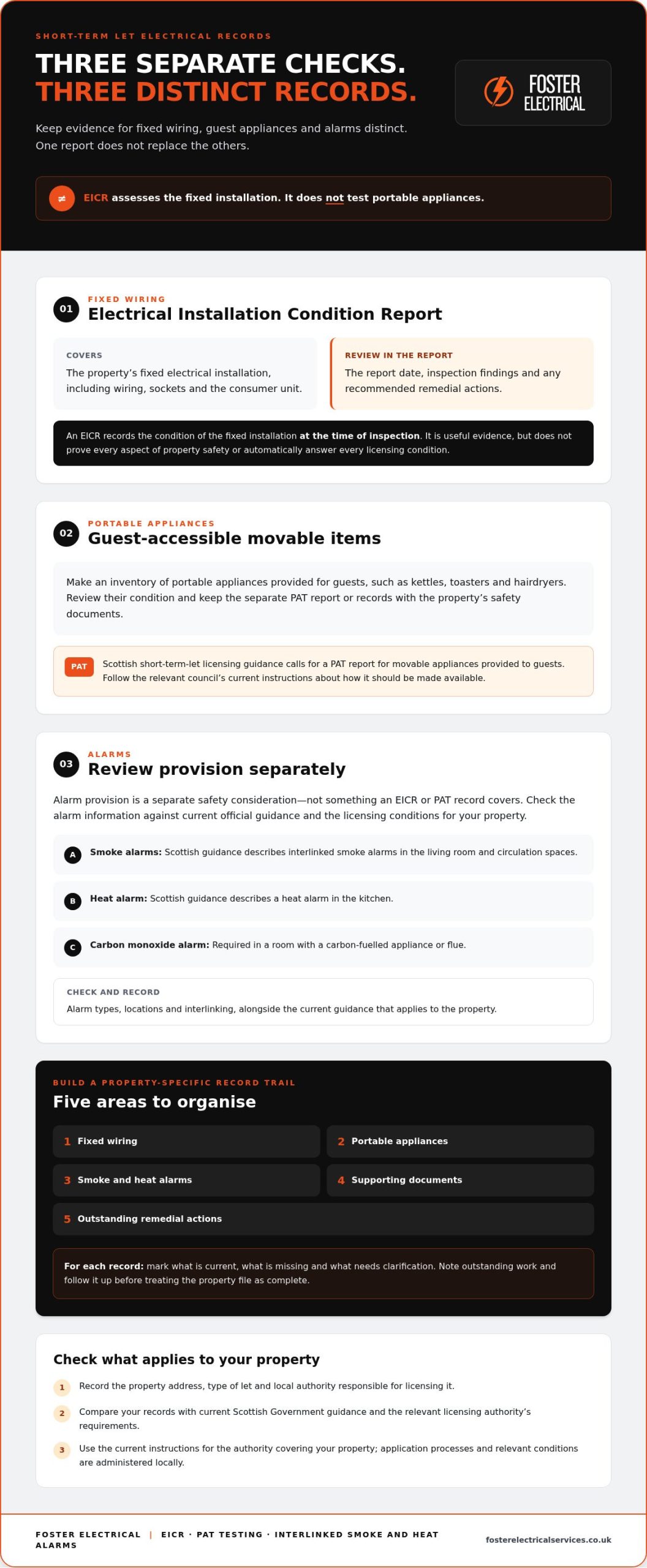
These checks cover different parts of a short-term let, so one record cannot stand in for another. Scottish licensing guidance sets out separate evidence for fixed wiring and movable appliances, while alarm provision is a distinct safety consideration. The mandatory electrical safety conditions are a useful official reference, alongside current conditions set by the relevant licensing authority.
| Area | What it covers | What to review |
|---|---|---|
| Fixed wiring | The property’s electrical installation, such as wiring, sockets and the consumer unit. | The EICR date, findings and any recommended remedial actions. |
| Portable appliances | Movable electrical items provided for guests, such as kettles, toasters and hairdryers. | Appliance condition and the separate PAT report or records. |
| Smoke and heat alarms | Alarm provision within the property, considered separately from electrical inspection reports. | Alarm types, locations, interlinking and applicable current guidance. |
What an EICR can and cannot tell a host
An Electrical Installation Condition Report (EICR) records the condition of the fixed electrical installation at the time it is inspected. An EICR assesses fixed wiring; it does not test portable appliances. Check the report’s date, read its findings and note any recommended remedial work. The report is useful evidence, but it does not prove every aspect of safety or automatically answer every licensing condition. Review the electrical requirements for airbnb scotland as a set of separate checks and records.
Portable appliances and smoke or heat alarms
Make an inventory of guest-accessible appliances, including kitchen equipment and any hairdryer supplied. PAT testing is separate from an EICR. Scottish short-term-let licensing guidance calls for a PAT report for movable appliances provided to guests. Keep the report with the property’s safety records and follow the relevant council’s current instructions about how it should be made available.
Review alarms separately. Scottish guidance describes interlinked smoke alarms in the living room and circulation spaces, and a heat alarm in the kitchen. A carbon monoxide alarm is also required in a room with a carbon-fuelled appliance or flue. Check current official guidance and local licensing conditions for your property’s circumstances, including alarm type and location. For inspections and alarm work in Dundee and nearby areas, see EICR, PAT testing and alarm services.
Scotland-wide guidance or local licensing conditions: how to check what applies
Use national guidance to understand the broad framework, then review the licensing authority’s current instructions for the property’s location. Scotland has a short-term-let licensing scheme, but the authority handling an application sets out its own process and relevant conditions. A checklist written for one location is useful background, not a substitute for guidance that applies to your let.
Commercial pages and host guides can explain common issues, but information written for a particular council or property type does not establish the rules for every Scottish property. Treat those summaries as prompts for your review, not as legal advice or a definitive statement of your obligations in Dundee, Perth, Angus, Fife or St Andrews.
How to identify the relevant licensing authority
Use the property address to identify the local authority responsible for short-term-let licensing. Visit its current licensing pages and review the conditions and application guidance for your type of let. Note the page or document you used and when you checked it, so you can revisit the source if guidance changes. Do not assume neighbouring areas have identical processes or conditions.
| Where to check | What to confirm |
|---|---|
| National guidance | The current Scottish short-term-let licensing framework and general electrical, appliance and alarm information. |
| Local authority | Application steps, relevant licence conditions and any instructions for your property or type of let. |
| Property records | Whether the reports, appliance records and alarm information you hold relate to this property and address applicable conditions. |
What details to verify before relying on a checklist
Check current official sources for the electrical inspection, portable-appliance and alarm conditions that apply. The Scottish Government’s short-term-let licensing guidance is a national starting point. Read it alongside the relevant council’s instructions, and check whether the guidance has changed or whether the property type and circumstances affect its application. If sources appear unclear or differ, do not treat an online summary as the final answer.
Compare the requirements with the records you hold. An EICR relates to the fixed installation, while portable-appliance evidence and alarm provision are separate matters. Foster Electrical provides EICR inspection services in Dundee, Perth, Angus, Fife and St Andrews. Checking the relevant sources and property records makes the electrical requirements for airbnb scotland easier to review without assuming one council’s guidance applies everywhere.
A host’s practical electrical checklist before welcoming guests
Turn your findings into a property file and a short action list. This helps you spot missing records, follow up on report findings and retrieve relevant documents when reviewing the electrical requirements for airbnb scotland or preparing for a licensing step.
- 1. Identify the property. Record its address, type of let and responsible licensing authority. Check the authority’s current guidance and note the conditions that apply.
- 2. Review the EICR. Match the report to the property address, check its date and read its findings and recommendations. It is not evidence about portable appliances or alarms.
- 3. Gather appliance records. List electrical items provided for guests, such as kettles, toasters and hairdryers. Keep relevant PAT records separate from the fixed-wiring report.
- 4. Check alarm information. Record alarm types and locations, then compare them with current Scottish guidance and relevant local licensing conditions.
- 5. Track outstanding work. Note recommended repairs or unclear findings, arrange appropriate electrical follow-up and retain evidence of completed work.
- 6. Review guest-facing features. Look for visible damage to sockets, switches, plugs and supplied appliances. Do not use damaged items. Record concerns and arrange a suitable assessment.
Organise reports, appliance checks and remedial work
Keep the EICR, PAT records, alarm information, invoices and follow-up notes together in a paper or digital property file. Label each document with the property address and date, and keep a simple list of actions still open. Do not assume a renewal interval from a generic checklist. Use applicable current guidance and the information in your report.
If a report is missing, its findings are hard to understand, or recommended work remains outstanding, do not mark that item complete. Clarify the record and arrange appropriate inspection or remedial work. File evidence of completed work with the document that raised the issue, so the history is easy to follow.
Check guest-facing electrical features and alarm provision
A visual walk-through can help you note obvious damage, loose covers or worn-looking appliances, but it is not a substitute for an electrical inspection. Check alarm details against current official guidance rather than relying on a general list, as property circumstances and local licensing conditions matter.
Foster Electrical provides EICR inspections, PAT testing and interlinked smoke and heat alarm installation in Dundee, Perth, Angus, Fife and St Andrews. Arrange electrical checks for your short-term let and keep the resulting records with your property file.
Electrical support for short-term-let hosts in Dundee and nearby areas
Once you have reviewed the records and identified gaps, address the electrical work relevant to your property. An inspection or installation can provide useful evidence for your property file. Clear notes on findings and completed work also help keep the record trail organised. These steps support careful property management, but they do not guarantee that a licensing application will be approved.
Foster Electrical provides EICR inspections, PAT testing and interlinked smoke and heat alarm installation for hosts in Dundee, Perth, Angus, Fife and St Andrews. The work needed depends on the property, the condition of its electrical installation and the records you hold. Our inspection and installation services can help you address relevant checks as you prepare a safe, guest-ready let.
When an EICR or electrical remedial work may be relevant
An EICR reports on the condition of the fixed electrical installation at the time of inspection. Review its findings alongside previous reports and note any unresolved recommendations. The work needed, if any, depends on the report and property. It may involve further investigation or appropriate remedial work, rather than a standard solution for every let.
Keep invoices or other records of completed work with the report that identified the concern. This makes the history easier to follow when you update your property file or review the electrical requirements for airbnb scotland. A clear record distinguishes the original finding from the action taken afterwards.
Arrange local electrical help for your short-term let
Before getting in touch, note the property’s location, the check or installation needed and any relevant report findings. If an EICR recommendation is unclear, have the report available so the concern can be discussed in context. Foster Electrical provides EICR inspections as part of its local electrical inspection services.
Hosts in Dundee, Perth, Angus, Fife and St Andrews can contact Foster Electrical about their property’s electrical needs, including an EICR, PAT testing or interlinked smoke and heat alarm installation. Contact Foster Electrical to discuss electrical checks for your short-term let.
Put your short-let’s electrical records in order
A well-organised property file shows what has been checked and what still needs attention. Keep fixed-wiring evidence separate from portable-appliance records, review alarm information against current official and local guidance, and follow up on report recommendations. This practical approach helps you work through the electrical requirements for airbnb scotland without relying on a generic checklist.
Foster Electrical provides EICR inspections, PAT testing and interlinked smoke and heat alarm installation in Dundee, Perth, Angus, Fife and St Andrews. If you have identified a missing report, an unclear finding or electrical work to arrange, discuss electrical safety work for your short-term let.
Take it one step at a time. Clear records and considered electrical checks can help you prepare your property with greater confidence.
Frequently Asked Questions
Do Airbnb properties in Scotland need an EICR?
Whether an EICR is required depends on current short-term-let rules, licensing conditions and the property’s circumstances. Check the latest Scottish Government guidance and the relevant licensing authority’s conditions before relying on a general answer. An Electrical Installation Condition Report assesses the fixed electrical installation. It does not document checks on portable appliances or alarm provision, so review those separately.
Is PAT testing a legal requirement for Airbnb hosts in Scotland?
Check current Scottish guidance and the relevant licensing authority’s conditions to establish what applies to your short-term let. PAT testing is separate from an EICR: it concerns portable electrical appliances, not the fixed installation. If you provide items such as a kettle or toaster, organise the relevant appliance information separately and keep the records together. Review any findings and arrange appropriate follow-up where needed. An EICR does not cover every electrical check.
What electrical documents should an Airbnb host keep?
Keep the electrical records relevant to your property, which may include an EICR, appliance-check information, alarm details and evidence of completed remedial work. The records to retain can depend on current rules and licensing conditions. Check official guidance for the property’s location, then label documents with the address and date. An organised file makes it easier to retrieve information and identify outstanding actions.
Do short-term lets in Scotland need interlinked smoke and heat alarms?
Check current Scottish guidance and the licensing authority’s conditions for the alarm requirements that apply to your property. Do not rely on an old checklist or assume every let has identical circumstances. Record the types and locations of alarms already installed, then compare those details with current official information. Verify any specific requirements before treating an arrangement as compliant, and arrange appropriate installation or remedial work if your review identifies a gap.
Does an EICR cover appliances supplied to Airbnb guests?
No. An EICR assesses the fixed electrical installation, not portable appliances supplied for guest use. Keep appliance-check information separate and verify the current requirements for your property and licensing conditions. A fixed-wiring report should not be treated as a record of checks on a guest-accessible kettle or hairdryer. A clear filing system helps distinguish installation findings from appliance records and track follow-up.
What should I do if an electrical report identifies a problem?
Read the findings and recommendations, then arrange appropriate remedial electrical work rather than assuming every issue has been resolved. The work needed depends on the report and property. Keep evidence of completed work with the original report, so the record shows both the finding and the action taken. If the concern relates to a licensing condition, review the relevant authority’s current instructions and retain the records for the property.
Can the same electrical checklist be used for every Airbnb in Scotland?
A general checklist is a helpful starting point, but it cannot replace checking current rules and licensing conditions for your property’s location and circumstances. Use it to organise fixed-installation information, appliance records, alarm details and remedial actions, then verify what applies through official guidance and the relevant licensing authority. This property-specific approach is central to reviewing the electrical requirements for airbnb scotland, including for hosts in Dundee, Perth, Angus, Fife and St Andrews.