What if your next electrical safety inspection wasn’t a nerve-wracking exam for your home, but a simple health check-up that provides total peace of mind? We know that many Dundee homeowners feel a sense of dread when booking an electrician. You might worry about a failure result leading to unexpected costs, or perhaps you’re confused about the difference between an EICR and PAT testing. We believe that looking after your property should be a straightforward, honest process rather than a source of stress or disruption.
We understand that your home is your sanctuary, and we treat it with the care it deserves. Our aim is to help you feel confident and prepared before we even step through the door. In this guide, you will discover exactly what happens during a professional electrical safety inspection and how to get your property ready for a stress-free experience. We will walk you through the current 18th Edition standards, explain how we keep your living space tidy, and show you how a valid EICR protects your family from electrical fires while satisfying your insurance requirements.
Key Takeaways
- Learn why an Electrical Installation Condition Report (EICR) is the official standard for an electrical safety inspection and how it protects your home.
- Discover the critical components we check during a visit, from the safety of your consumer unit to the condition of wiring in traditional Dundee properties.
- Understand the C1, C2, and C3 classification codes to help you prioritise any necessary repairs without feeling overwhelmed by technical jargon.
- Follow our practical preparation checklist to ensure a tidy and efficient visit, allowing us to access your sockets and switches with minimal disruption.
- Recognise the value of local expertise when assessing Dundee’s diverse housing, ensuring your property is treated with the respect and diligence it deserves.
What is an Electrical Safety Inspection (EICR)?
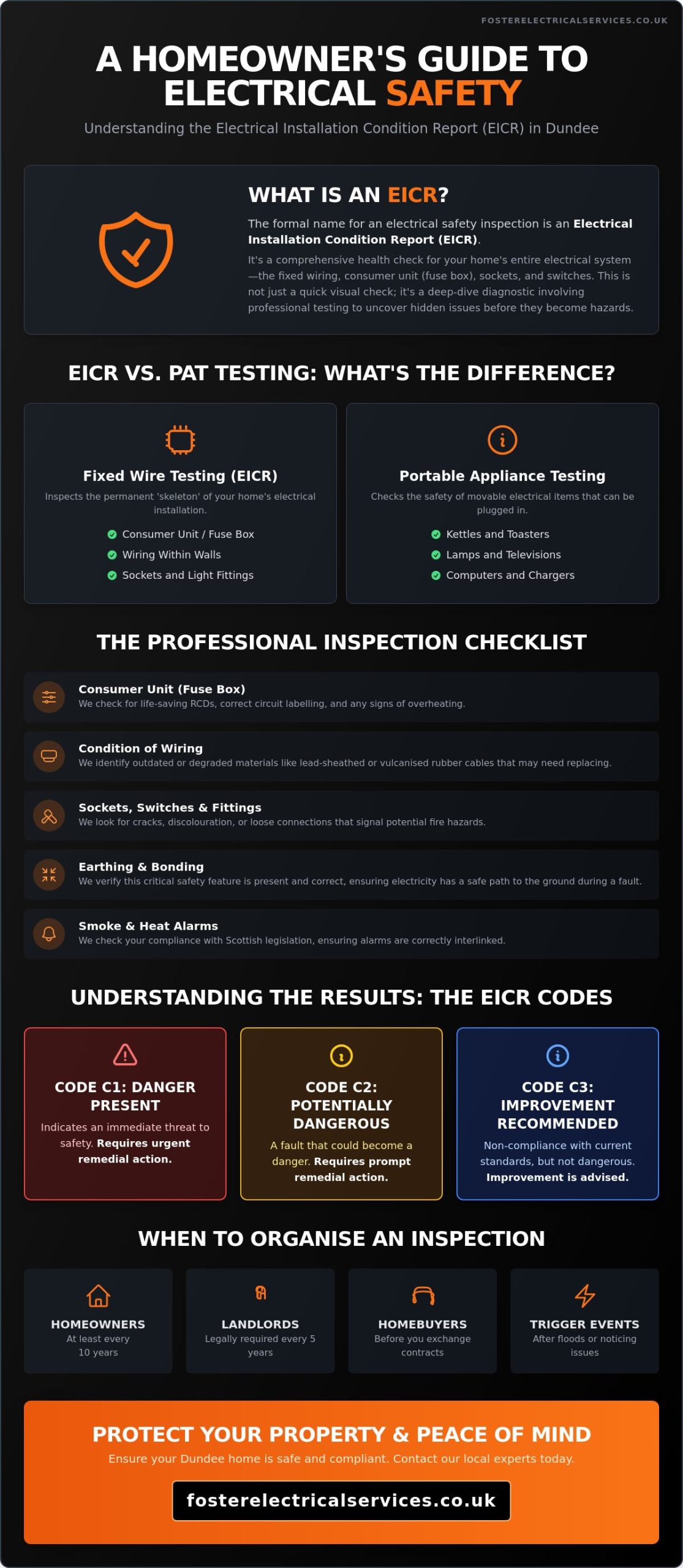
Whilst many of our neighbours in Dundee simply call it an electrical safety inspection, the formal industry name is an Electrical Installation Condition Report, or EICR. This document is much more than a simple tick-box exercise. It’s a deep-dive diagnostic into the very heart of your home’s electrical system. Unlike a quick visual check, which only spots obvious cracks or burns, a formal domestic inspection involves testing the hidden circuits that run behind your walls and under your floorboards. We believe in providing a service that goes beyond the surface, ensuring every connection is as secure as it was the day it was installed.
Every property undergoes wear and tear. Over time, electrical components can degrade due to heat, environmental factors, and simple daily use. In the UK, all installations must adhere to the UK wiring regulations, specifically BS 7671. As of 2026, we work to the latest standards including Amendment 4, ensuring your home meets the most modern safety criteria. A professional electrical safety inspection identifies these gradual changes before they become hazards, providing a clear roadmap for any necessary maintenance. It’s a proactive way to look after your property rather than waiting for a fault to occur.
For private landlords in Scotland, these inspections are a legal necessity every five years under the Housing (Scotland) Act 2006. This ensures that tenants are living in a safe environment and that the property owner is fully compliant with national safety standards. For homeowners, whilst not mandated by law, an EICR is a vital safeguard for your family and is often a requirement for your home insurance provider. We treat every domestic property with the same level of diligence, whether it’s a legal requirement or a personal choice for peace of mind.
Fixed Wire Testing vs. PAT Testing
It’s easy to confuse different types of electrical checks. Fixed wire testing, which is the core of an EICR, looks at the permanent infrastructure of your home. This includes everything from the consumer unit to the cables buried in your walls and the sockets themselves. In contrast, PAT testing is specifically for portable appliances like kettles, toasters, and lamps. Our home safety inspections focus on the “skeleton” of the house, ensuring the foundation of your power supply is robust and reliable.
When Should You Organise an Inspection?
For most domestic properties, we recommend a full inspection at least every 10 years. However, if you are a homebuyer in Angus or Dundee, you should insist on an EICR before you exchange contracts. It’s the only way to know the true state of the electrics in a new property. You should also consider booking an inspection if you’ve experienced a trigger event, such as a flood, or if you notice warning signs like flickering lights or persistent burning smells. For guidance on what these warning signs might mean, our detailed resource on fault finding and repairs can help you identify common problems safely before calling us out. We are here to help you navigate these situations with honest, expert advice.
The Professional Checklist: What Your Electrician Inspects
We approach every home with a meticulous eye for detail. An electrical safety inspection isn’t just about ticking boxes; it’s about verifying that the core infrastructure of your property is sound. In Dundee, we often encounter a mix of beautiful Victorian tenements and modern builds. Each requires a specific understanding of how wiring ages and how different eras of craftsmanship interact. We take pride in our thoroughness, ensuring that no stone is left unturned when it comes to your family’s protection.
We start at the heart of the system: the consumer unit. We check for Residual Current Devices (RCDs), which are life-saving switches that trip if they detect a fault. Proper labelling is equally vital so you know exactly which circuit controls which room. When we move to the wiring itself, we look for signs of historical materials. In older areas of Dundee, it’s not uncommon to find lead-sheathed or vulcanised rubber cables. These materials have served their time and often require a partial or full property rewire to meet modern safety standards.
We examine sockets and switches for discolouration, which often signals overheating or loose internal connections. We also verify your earthing and bonding. This ensures that if a fault occurs, the electricity has a safe path to the ground rather than through a person. Crucially, we check your compliance with Scottish legislation regarding interlinked smoke and heat alarms. Since February 2022, every home in Scotland must have these alarms connected so that if one goes off, they all do. We ensure your system is loud, clear, and fully integrated.
Visual Inspection: The First Line of Defence
Before we pick up our testing tools, we perform a thorough walk-through of your property. We look for “cowboy” DIY attempts from previous renovations and ensure that electrical fittings in “special zones”, like bathrooms, are correctly rated for moisture. This home electrical safety guidance provides an excellent overview of the common hazards we look for during this stage. We also check for any exposed live parts or damaged cable insulation that could pose an immediate risk.
Dead and Live Testing Procedures
Once the visual checks are complete, we use specialised equipment for technical testing. We perform insulation resistance testing to check if current is leaking where it shouldn’t be. We also carry out continuity testing to ensure there are no breaks in your circuit loops. Finally, we conduct RCD trip testing. We simulate a fault to make sure your safety switches react in milliseconds, providing the essential protection your home needs.
Understanding the Results: Codes C1, C2, and C3
We believe that a professional report should offer clarity rather than confusion. When your electrical safety inspection is complete, you won’t simply receive a “pass” or “fail” mark. Instead, you’ll get a detailed Electrical Installation Condition Report (EICR) that uses specific codes to categorise the health of your home’s wiring. This nuanced approach helps you understand exactly where your property stands in relation to current safety requirements. We take the time to walk you through these findings, ensuring you feel informed rather than overwhelmed.
The codes are straightforward when explained clearly. A C1 code indicates that danger is present and there is an immediate risk of injury. We don’t leave these issues unattended; we act to make the installation safe before we leave your property. A C2 code means the situation is potentially dangerous and requires urgent remedial action. Whilst homeowners have more flexibility than landlords, who must follow strict government electrical safety standards, we always recommend addressing C2 faults promptly to protect your family. An electrical safety inspection that uncovers these issues is a success, as it allows us to prevent accidents before they happen.
A C3 code is often where the most confusion lies. It simply means that an improvement is recommended. Your installation might not meet the very latest 18th Edition regulations, but it isn’t necessarily unsafe. Unlike C1 or C2 results, a C3 code does not result in an “unsatisfactory” report. Finally, an FI code means we’ve spotted something that requires further investigation, often involving hidden parts of the system that weren’t accessible during the initial visit.
What Happens if Your Home is “Unsatisfactory”?
If your report comes back as unsatisfactory, don’t panic. This usually means a C1 or C2 fault was found. We will provide a transparent remedial quote that outlines exactly what’s needed to bring your home back to a safe standard. For a deeper understanding of how professionals methodically trace and resolve these kinds of issues, our guide to fault finding and repairs for homeowners explains the step-by-step process in plain language. We always prioritise these critical repairs over aesthetic upgrades. Our goal is to ensure your consumer unit and circuits are robust and reliable, giving you one less thing to worry about. We treat every repair with the same integrity and diligence we’d apply to our own homes.
The EICR Certificate and Documentation
Your EICR is a multi-page document that serves as a vital record for your property. We encourage you to keep this safe, especially if you plan to sell your home in the future. A valid certificate from a SELECT or NICEIC accredited electrician proves that you’ve maintained your property with care. It offers potential buyers and insurers the peace of mind that the electrical work has been carried out to a high standard by a trusted local expert. This document is your proof of safety and a testament to the high standards you maintain in your home.
A Homeowner’s Preparation Checklist for Inspection Day
Preparing for your electrical safety inspection doesn’t have to be a chore. A little bit of foresight ensures the day runs smoothly and allows us to focus entirely on the technical health of your home. We find that a few simple steps can transform the experience from a logistical puzzle into a straightforward, stress-free visit. Our goal is to work efficiently whilst maintaining the high standards of care your property deserves. By following this checklist, you help us provide the most thorough assessment possible without unnecessary delays.
We recommend starting with the basics of access. Please ensure we have a clear, unobstructed path to your consumer unit, which is often tucked away in a cupboard under the stairs or in a hallway. If you have heavy furniture or stored boxes blocking sockets and switches, moving them beforehand prevents any accidental bumps and saves time. It’s also helpful to locate your electric metre and ensure any external cupboards or padlocks are unlocked before we arrive. We believe in a service that is as much about human connection as it is about wiring, and clear communication is the first step toward a successful day.
- Unplug sensitive electronics: Turn off and unplug computers, servers, and game consoles to protect them during testing.
- Warn the household: Make sure everyone knows the power will be off so they aren’t caught off guard.
- Clear the work areas: Move any clutter away from the fuse box and a sample of sockets in each room.
- Secure your pets: Ensure four-legged family members are in a comfortable, safe space whilst we move between rooms.
If you’re ready to secure your home’s future with a team that values integrity and diligence, you can book your EICR with us today for a professional, person-to-person service.
Managing the Power Cut
To get an accurate reading during “dead testing”, the power must be switched off at the mains. For a standard home in Dundee, this usually lasts between one and three hours. If you’re working from home, we suggest charging your laptop fully and setting up a mobile hotspot on your phone before we arrive. This way, your day continues without a hitch whilst we work diligently in the background to verify your system’s safety.
Access Requirements and Tidiness
We need to check a sample of sockets and switches in every single room to ensure the whole circuit is sound. This might include popping into the loft or looking at under-floor spaces if wiring is visible there. We know that letting a contractor into your private space is a privilege. Our promise is simple: we treat your property with personal care and respect. We’re meticulous about tidiness and take pride in leaving your home exactly as we found it.
Why Choose a Local Dundee Expert for Your Inspection?
Choosing the right person for your electrical safety inspection is about more than just finding a qualified name on a list. It’s about inviting someone into your home who understands the unique character of Dundee’s buildings. From the high ceilings of Victorian villas in the West End to the compact efficiency of modern flats at the Waterfront, we know how these properties were built. We understand the quirks of traditional wiring and the requirements of contemporary installations. This local knowledge allows us to work with a level of precision that national corporate firms simply cannot match.
We value the human connection that comes with every job. You won’t find yourself trapped in a loop with an automated call centre or speaking to a distant manager. Instead, you’ll deal directly with a sincere, local team that treats you like a neighbour. Our pricing is transparent and grounded in honesty. We don’t believe in hidden fees or manufacturing faults to generate extra work. We are committed to the safety of our Tayside community, and we see ourselves as protective guardians of the homes we visit. When we identify a fault, we explain it in plain language, ensuring you understand the reason behind every safety recommendation.
The Foster Electrical Difference
We approach every safety check with a “diligent neighbour” philosophy. This means we take personal pride in the quality of our work and the state of your home. We maintain meticulous standards of execution, ensuring that every circuit is tested thoroughly according to the latest regulations. Once the job is finished, we don’t leave a mess behind. We are known for our tidiness because we respect your private space and treat it with care. Our reputation in Dundee is our most valuable asset, and we protect it through hard work and integrity. We don’t just leave you with a list of problems; we provide the support needed to resolve them correctly.
Booking Your Safety Inspection
Getting started is simple and stress-free. When you call our friendly local team, you’ll get a straightforward, honest quote without any high-pressure sales tactics. We don’t just hand over a report and walk away; we offer full post-inspection support to help you understand the next steps for your property. Whether you need a Consumer Unit Upgrade or just some professional advice, we are here to help. Organise your electrical safety inspection with Foster Electrical today and experience a service built on trust and traditional values.
Securing Your Home’s Future with Confidence
We’ve looked at how an EICR is more than just a certificate; it’s a vital health check for your home’s hidden infrastructure. By understanding the C1 to C3 codes and following a simple preparation checklist, you can ensure your property remains a safe haven for your family. We take pride in bridging the gap between technical standards and domestic comfort, treating every Dundee home with the same diligence we’d give our own. Your safety shouldn’t be a source of stress or confusion.
As a trusted local Dundee business, we focus on property safety through honest, person-to-person service. We are SELECT Registered Electricians and expert fault finding specialists who value integrity over corporate sales tactics. We believe that looking after our neighbours is the highest standard of work there is. Our goal is to leave you feeling secure and informed after every electrical safety inspection. Book your expert electrical safety inspection in Dundee now to gain total peace of mind and secure your home for years to come. We look forward to helping you protect what matters most.
Frequently Asked Questions
How long does a domestic electrical safety inspection take?
A standard electrical safety inspection typically takes between two and four hours to complete. This timeframe varies depending on the number of circuits in your home and the overall size of the property. We work diligently to ensure a thorough check whilst keeping the disruption to your daily routine as minimal as possible. We always aim to be punctual and efficient so you can get back to your day.
Will the electrician need to lift my floorboards or damage my decor?
We pride ourselves on a non-destructive approach that treats your home with the utmost respect. We don’t lift floorboards or cut into walls unless we identify a critical fault that requires immediate access for your safety. Our testing focuses on visible wiring, sockets, and the consumer unit, ensuring your decor remains exactly as we found it. We treat your property with the same care we’d give our own.
Does an EICR cover my appliances like the washing machine or oven?
No, an EICR focuses strictly on the fixed wiring and infrastructure of your home. Whilst we check the sockets your appliances plug into, the machines themselves are not part of this specific report. If you need your appliances checked, we offer PAT testing as a separate service to ensure your kettles, toasters, and white goods are safe to use. We don’t offer domestic appliance repairs, so we focus purely on the safety of the connection.
Can I stay in the house whilst the electrical inspection is happening?
You are more than welcome to stay in your home whilst we carry out our work. However, please remember that the power will be switched off for a significant portion of the visit to allow for safe testing. We suggest planning ahead by charging your devices or finishing any chores that require electricity before we arrive. We’ll always let you know exactly when the power is going off and when it’s back on.
What is the most common reason for a property to fail an EICR?
The most frequent cause for an unsatisfactory result is a lack of adequate RCD protection in the consumer unit. Many older Dundee properties still use dated fuse boards that don’t meet modern safety standards. Other common issues include poor earthing or DIY improvements that haven’t been carried out to a professional standard. We identify these risks so they can be corrected before they cause a fire or injury.
Is an electrical safety inspection a legal requirement for homeowners in Scotland?
For homeowners, an electrical safety inspection is not a legal mandate, but it is highly recommended every ten years. In contrast, Scottish landlords are legally required to have an EICR carried out at least every five years. Many homeowners choose to book an inspection for peace of mind or to satisfy the requirements of their building insurance provider. It’s a sensible way to ensure your family is protected.
How much does an EICR certificate cost for a 3-bedroom house in Dundee?
The cost of an EICR depends on the complexity of your electrical system and the number of circuits we need to test. Every home is unique, from traditional Victorian villas to modern detached houses. We provide honest, transparent quotes based on your specific property rather than using a one-size-fits-all approach. We believe in fair, straightforward pricing without any hidden fees or technical jargon.
Will I get my report on the same day as the inspection?
We typically issue your formal report within a few working days of the visit. This allows us time to carefully review the data gathered and ensure every detail is correct before the certificate is finalised. Once the report is ready, we’ll send it over and take the time to discuss any findings with you. We don’t just leave you with a document; we make sure you understand what it means for your home.