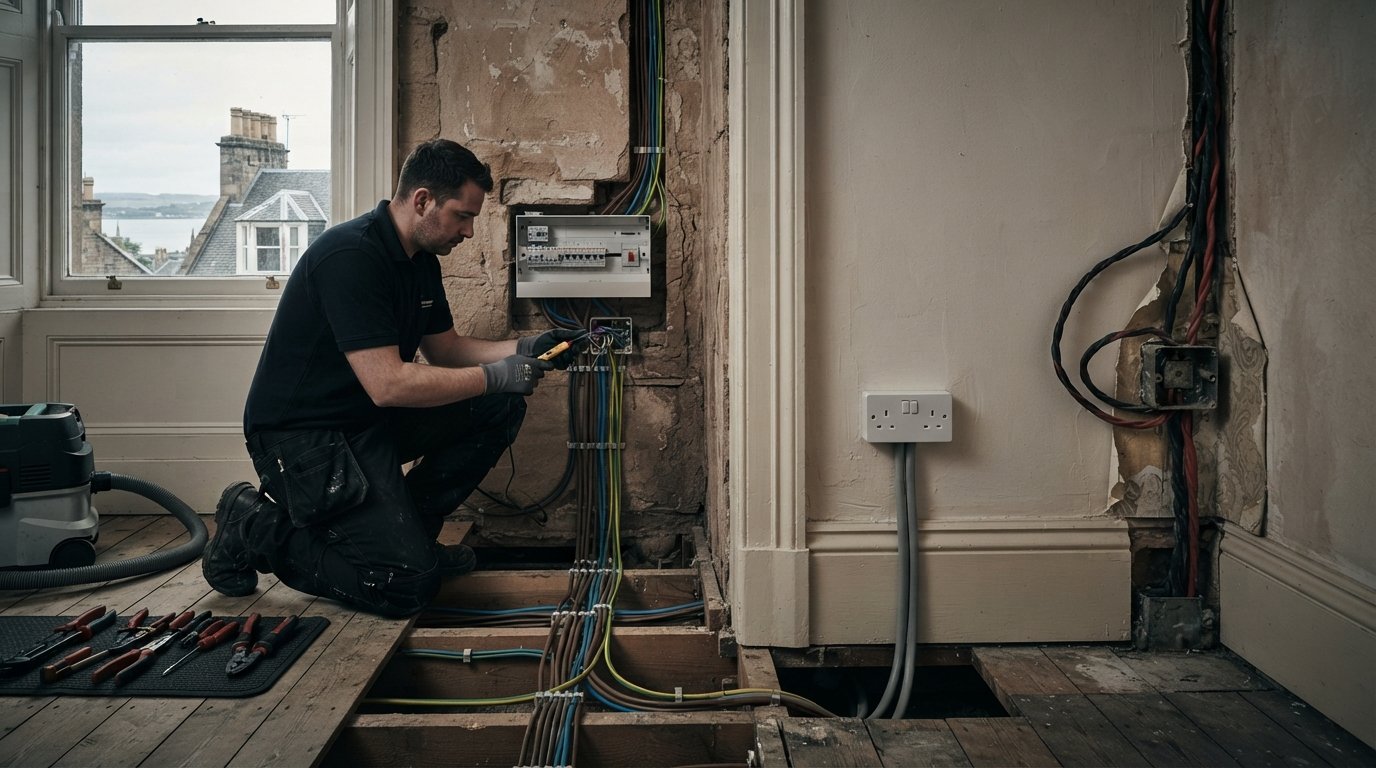
Circuit integrity and safety dictate rewiring scope, not a convenient budget. When facing aging cables, the dread of lifting floorboards, chasing fresh plaster, and living amidst brick dust is genuinely daunting. You’re likely wondering whether you can update just one troublesome circuit or if your property demands a complete overhaul. To protect your household and avoid costly surprises, weighing the full rewire vs partial rewire pros and cons is the essential first step.
We know how difficult it is to balance domestic disruption against strict safety regulations. Here, you’ll discover the honest advantages, drawbacks, and hidden implications of both options so you can choose the safest, most practical path forward. We’ll examine how older wiring copes with modern consumer units, outline when a partial rewire meets British Safety Standards (BS 7671), and give you total confidence when reviewing electrical reports with a local professional.
Key Takeaways
- Evaluating the full rewire vs partial rewire pros and cons helps you strike the right balance between household disruption and lasting domestic safety.
- A complete overhaul delivers total circuit reliability and lets you tailor socket layouts, resetting your electrical infrastructure for decades to come.
- Targeted rewiring offers a practical solution for extensions or renovations, though unaddressed legacy wiring can introduce compatibility challenges with modern consumer units.
- Diagnostic testing via an Electrical Installation Condition Report (EICR) pinpoints hidden circuit faults, preventing unnecessary expenditure and protecting your decorative finishes.
- Understanding the criteria for BS 7671 British Safety Standards ensures you can discuss recommendations with certified local electricians with total clarity.
Understanding Electrical Rewires: Full vs Partial Explained
Every home relies on a network of cables hidden behind plaster and under floorboards. Over decades, domestic installations suffer natural wear and tear. Traditional lead or vulcanised rubber cabling inevitably degrades, turning brittle and increasing the risk of short circuits or electrical fires. At the same time, the demands placed on residential electrical wiring systems have shifted dramatically. From induction hobs and power showers to electric vehicle chargers, modern households draw far more current than legacy systems were designed to handle. Understanding the full rewire vs partial rewire pros and cons begins with recognising how these two approaches physically address that strain.
What Does a Full Property Rewire Involve?
A full rewire replaces every single inch of electrical infrastructure across the entire home. We strip out all redundant cabling back to the incoming mains supply, pulling fresh twin-and-earth cables throughout walls, ceilings, and joists. This comprehensive process includes:
- Removing all degraded cabling across power, lighting, and cooker circuits
- Replacing the consumer unit with a modern, metal-clad board fitted with RCD and surge protection devices
- Installing new flush backboxes, switches, and sockets to your preferred positions
- Fitting mains-powered, interlinked smoke and heat alarms to satisfy current building standards
To learn more about how we manage this complete transformation, read our full property rewires guide.
What Constitutes a Partial Electrical Rewire?
A partial rewire focuses strictly on specific zones, high-load additions, or isolated circuits rather than the entire property. Homeowners often choose this path during targeted kitchen renovations, bathroom refits, or building extensions where modern appliances require dedicated feeds. The work involves:
- Running new, dedicated circuits for high-draw appliances without disturbing untouched living areas
- Extending current circuits into new extensions while keeping intact, compliant existing runs
- Connecting new circuits into the existing consumer unit, provided thorough testing confirms it can safely handle the additional capacity
Evaluating the full rewire vs partial rewire pros and cons comes down to whether your unaffected circuits are genuinely sound, or simply hiding obsolete wiring that will cause nuisance tripping down the line.
Full Rewire: In-Depth Pros, Cons, and Long-Term Value
A full rewire fundamentally resets your property’s electrical infrastructure for forty to fifty years. When weighing the full rewire vs partial rewire pros and cons, the chief virtue of a whole-home overhaul is unconditional peace of mind. You aren’t leaving old, deteriorating cables spliced behind freshly decorated walls, nor are you gambling on whether ancient neutral conductors will hold. A full rewire guarantees total compliance with current BS 7671 standards. It pairs seamlessly with modern consumer unit upgrades, ensuring sensitive protective devices function smoothly without phantom tripping caused by compromised legacy circuits.
The Advantages of a Complete Electrical Overhaul
Starting with a clean slate allows complete architectural freedom. You can tailor your home exactly to your living patterns, positioning sockets where they are actually needed, designing layered lighting circuits, and running dedicated feeds for electric vehicle chargers or heavy kitchen appliances. Beyond day-to-day usability, replacing obsolete cable types eliminates genuine hazards highlighted in guidance like the CPSC home wiring safety recommendations, which identify deteriorated insulation and overloaded paths as primary fire risks. Crucially, a complete replacement provides an Electrical Installation Certificate covering your whole home. This offers indisputable proof of safety for prospective buyers and insurance providers.
The Drawbacks and Disruption Homeowners Must Manage
The primary trade-off of a full rewire is domestic upheaval. Because cables must traverse every ceiling, floor, and partition, electricians must lift floorboards and chase narrow channels into existing plaster. Even with industrial dust extraction and protective sheeting, the physical mess is substantial. Rooms must be cleared of furniture, and every chased wall will require bonding, skim plastering, and redecorating once second-fix electrical work finishes.
Occupying the home during this process requires careful phasing, and many households choose to vacate for the duration of first-fix work. It represents a major project that requires forward planning and realistic expectations regarding cosmetic reinstatement. If you’re weighing whether your property warrants this level of intervention, you can always speak with our team for honest advice on managing disruption.
Partial Rewire: Benefits, Hidden Limitations, and Risks
Targeted rewiring has earned its place in domestic renovations. When you only need to overhaul a kitchen, add a garden room, or convert a loft, addressing specific circuits makes practical sense. Comparing the full rewire vs partial rewire pros and cons often reveals that a partial update serves as an effective compromise, shielding your broader living spaces from dust while supplying modern capacity where it is needed most. Yet, joining brand-new installations to untouched circuits requires careful technical navigation.
Where a Partial Rewire Succeeds
Isolating your electrical work to single areas substantially reduces disruption. Unaffected bedrooms, living rooms, and hallways remain tidy, functional, and fully livable throughout the project. Homeowners often weigh the cost considerations for rewiring a home when planning extensions or kitchen remodels, finding that targeted cable runs keep decorative remedial works contained to the active building site. Work completes in a fraction of the time, letting other trades proceed without unnecessary delays.
The Inherent Technical Risks and Limitations
Splicing new wiring into an older property is rarely straightforward. Modern building standards demand specific protective systems that legacy installations often cannot accommodate without substantial modifications. Key complications include:
- Consumer unit incompatibilities: Older fuse boxes rarely possess spare ways or modern safety features like residual current devices (RCDs). Adding a new circuit frequently triggers a mandatory consumer unit replacement.
- Main earthing and bonding deficiencies: Current regulations dictate strict sizing for main protective bonding conductors to gas and water pipework. Splicing into an installation with undersized or missing earthing creates non-compliance immediately.
- Persistent phantom tripping: Fitting sensitive safety switches to modernise a consumer unit often causes legacy circuits to trip continuously due to latent neutral-to-earth faults buried in untouched walls.
- Restricted safety certification: An electrician can only issue an Electrical Installation Certificate for the specific runs they personally installed, leaving untouched cabling uncertified.
These hidden hurdles mean a partial fix can quickly become a false economy. Assessing the full rewire vs partial rewire pros and cons requires an honest look at your existing network, because leaving deteriorated circuits in place merely postpones inevitable repairs.

Comparing Full vs Partial Rewiring: Head-to-Head Decision Matrix
Deciding between these two paths requires balancing immediate disruption against lasting reliability. In traditional stone tenements across Dundee or post-war cottages in Perth and Fife, wall construction and legacy layouts heavily influence this choice. The table below cuts through the noise, laying out the practical realities side by side so you can weigh the full rewire vs partial rewire pros and cons effectively.
| Factor | Full Rewire | Partial Rewire |
|---|---|---|
| Expected Lifespan | 40 to 50 years of clean, hassle-free service. | Variable; legacy runs may demand attention in 3 to 10 years. |
| Domestic Disruption | High; floorboards lifted and walls chased throughout. Vacating recommended. | Low to moderate; contained entirely to the active renovation zone. |
| Certification Scope | Whole-property Electrical Installation Certificate (EIC). | Minor Works Certificate or EIC covering updated circuits only. |
| Circuit Layout Flexibility | Complete freedom to position switches, sockets, and downlights anywhere. | Limited strictly to the renovated zones; older rooms stay as they are. |
Safety, Certification, and Building Regulations
Certification separates genuine improvements from liability risks. A whole-home rewire yields an Electrical Installation Certificate that covers every terminal and conductor. In contrast, partial work covers solely what was physically added or replaced. If older, untouched circuits develop issues later, having that partial certificate won’t shield you from insurer inquiries should an electrical incident occur. Furthermore, when selling Scottish residential properties, Home Report surveyors regularly flag dated fuse arrangements as a category 2 or 3 repair requirement, potentially slowing down transactions.
Future-Proofing for Modern Lifestyle Demands
Modern homes consume power very differently from homes fifty years ago. Splicing a new kitchen run into an existing board won’t solve systemic capacity problems. If your family relies on extension leads daisy-chained behind bedroom desks, a partial fix leaves that underlying hazard unaddressed. When unresolved circuits trip modern protective devices unexpectedly, you’ll need professional electrical fault finding to identify hidden insulation breakdown. If you are balancing the full rewire vs partial rewire pros and cons for your property, speak with our local team to receive honest, practical guidance tailored to your home.
How to Choose the Right Rewiring Solution for Your Property
Pinpointing whether your home requires an isolated upgrade or whole-house intervention comes down to empirical evidence, not guesswork. Throughout Dundee, Perth, Angus, and Fife, residential stock ranges from solid-stone Victorian tenements to post-war local authority builds. Each era brings its own wiring profile. When balancing the full rewire vs partial rewire pros and cons, starting with a diagnostic inspection protects your decorative finishes and ensures every pound goes toward genuine safety rather than unnecessary demolition.
Key Warning Signs That Demand an Immediate Rewire
Before commissioning testing, walk through your home and look for visible cues of deteriorating infrastructure. Physical signs indicating immediate attention include:
- Outdated cable sheathing: Lead-sheathed cabling, black vulcanised rubber (VIR), or fabric-braided flex visible at fittings or the mains board
- Legacy consumer units: Wooden-backed fuse boards, rewirable porcelain fuse carriers, or units lacking any RCD protection
- Absence of circuit earthing: Lighting circuits installed before the late 1960s that lack an integral circuit protective conductor (earth wire)
- Operational red flags: Discoloured or scorched faceplates, persistent burning odours, or switches that emit an audible crackle when toggled
Step-by-Step Assessment with a Certified Electrician
Never rely on visual checks alone. The safest initial step is commissioning an Electrical Installation Condition Report (EICR). Our electricians perform dead and live testing across every run, measuring insulation resistance, earth fault loop impedance, and polarity. You can read our guide on landlord and domestic EICRs to see how this technical inspection functions.
The resulting report categorises issues using standard observation codes. A C1 (danger present) or multiple C2 codes (potentially dangerous) across several circuits usually means localized repairs won’t suffice. If the report identifies issues contained strictly to one area while the remaining circuits show robust insulation readings, a partial rewire remains entirely viable. We take pride in offering transparent advice, meticulous tidiness, and traditional craftsmanship. To get definitive answers about your wiring, explore our comprehensive range of professional domestic electrical services, or arrange an electrical safety inspection with Foster Electrical today.
Securing Your Home with the Right Rewiring Decision
Balancing short-term convenience against lasting safety is the real crux when weighing the full rewire vs partial rewire pros and cons. While targeted circuit upgrades protect intact living spaces during focused renovations, only a complete overhaul removes every hidden hazard and resets your infrastructure for decades ahead. Testing your circuits with an EICR removes the guesswork, ensuring you invest wisely in the exact level of protection your property warrants.
As trusted local specialists serving Dundee, Perth, Angus, and Fife, we believe in straightforward advice and meticulous domestic care. We don’t cut corners or push unnecessary work. Every project we undertake strictly adheres to British Standard BS 7671 wiring regulations, backed by thorough certification and absolute respect for your floorboards and finishes. When you’re ready for clear answers, contact Foster Electrical for an honest rewiring assessment and secure your home with complete confidence.
Frequently Asked Questions
Can I live in the house whilst a full rewire is being carried out?
Yes, though it requires strict coordination. Power must be isolated during the working day, meaning you’ll manage without running electricity until circuits are temporarily restored each evening. Because electricians must lift floor coverings and channel masonry across every living space, the environment becomes dusty and noisy. Many residents in Dundee choose to stay with friends or vacate during the disruptive first-fix stage to ensure their daily routines remain manageable.
How do I know if my property has never had a full electrical rewire?
Visible indicators at the consumer unit and fittings offer clear proof. Properties that have never undergone a full rewire often retain black vulcanised rubber cables, fabric-sheathed flex, or cast-iron and wooden fuse boxes with rewirable copper fuses. Another telltale clue is round-pin wall plugs or lighting circuits that entirely lack an integrated earth conductor, typical of pre-1966 domestic installations throughout Angus and Perthshire.
Is a partial rewire fully compliant with British Safety Standards?
Yes, but compliance applies strictly to the newly altered circuits. Under BS 7671 regulations, every newly installed cable and protective device must meet current 18th Edition standards. However, work carried out on isolated runs cannot certify untouched legacy wiring. When reviewing full rewire vs partial rewire pros and cons, remember that untouched circuits remain the homeowner’s responsibility and must be independently safe.
Will a partial rewire require replacing my existing consumer unit?
Often, yes. Modern additions must connect to sensitive residual current devices (RCDs) and modern miniature circuit breakers to satisfy safety codes. If your current board is an obsolete fuse box without spare ways or modern safety trip mechanisms, our electricians must install a modern, metal-clad unit before safely powering your updated zones.
How long does a full rewire typically take compared to a partial rewire?
A full rewire usually takes between 5 to 10 working days, divided into first-fix chasing and second-fix accessory installation. By contrast, a partial rewire typically takes just 1 to 3 days depending on circuit complexity. This significant difference in timescale is a major factor when weighing full rewire vs partial rewire pros and cons during active domestic renovations.
Can I rewire just the ground floor or kitchen of my property?
Yes, you can isolate specific functional zones provided your incoming supply and earthing are sound. This approach works well for kitchen refits or single-floor extensions across Fife homes. Our team pulls fresh cabling directly from the distribution board to feed new appliances, leaving sound upper-floor circuits completely untouched to protect intact plasterwork and decorative cornicing.
What paperwork should my electrician supply after completing a rewire?
You should receive an Electrical Installation Certificate (EIC) alongside an accompanying schedule of circuit test results. A full rewire generates a comprehensive certificate covering the complete installation, whereas partial works receive an EIC or Minor Electrical Installation Works Certificate detailing only the circuits updated. Both provide essential documentation for home insurance providers and future property sales.