Would you believe that even with rising energy prices, your home’s driveway remains the most cost-effective way to fuel your journey? Many drivers feel a sense of unease when they see public rapid charging rates hitting a weighted average of 79p per kilowatt-hour, wondering if the switch to electric was truly the right choice for their budget. We understand that confusion. You want to know exactly how much does it cost to charge an electric car without being caught out by opaque pricing or unexpected electrical issues. It’s about more than just a car; it’s about ensuring your home remains a safe, efficient sanctuary for your family.
In this guide, we provide a clear breakdown of monthly costs and explain how to find the best value amongst the latest Scottish tariffs, such as the 43p per kilowatt-hour rate found at ScotRail car parks. We’ll show you how to find the cheapest off-peak rates and make the most of the increased £500 EV chargepoint grant available since April 2026. By the end of this article, you’ll have a reliable estimate for your monthly bills and the peace of mind that your home’s electrical system is prepared for the future. We believe in straightforward advice and diligent work, helping you move forward with quiet confidence and total safety.
- We’ll explain why charging at home is still your most affordable choice whilst keeping your monthly bills predictable and manageable.
- Understand how much does it cost to charge an electric car by looking at the fundamental price per kilowatt-hour across home and public networks.
- Learn how a dedicated home circuit and a smart meter work together to provide the safest and most efficient way to power your car.
- We provide a clear look at current Scottish charging rates and the grants available to help you install a high-standard home charging point.
- Discover why a professional approach to your electrical installation is a long-term investment in your home’s safety and your own peace of mind.
Understanding the True Cost of Charging an Electric Car in 2026
Switching from a petrol or diesel vehicle to an electric one is a significant change for any household. The first thing you’ll notice is that the familiar “price per litre” has been replaced by the “price per kilowatt-hour” (kWh). This is the fundamental unit of fuel for your new car. When clients ask us how much does it cost to charge an electric car, we always start with the basics of battery capacity. If you drive a car with a 60kWh battery, think of that as a 60-unit tank. Filling that tank from empty at home on a standard tariff is vastly different from using a rapid charger at a motorway service station. It’s a simple shift in mindset, but it’s the key to mastering your monthly budget.
The total price you pay is never a fixed figure. It’s a result of where you plug in and how fast you need that energy delivered. We’ve seen that the most successful EV owners in Dundee are those who treat their car like a mobile phone, charging it whilst they sleep to take advantage of the lowest possible rates. By focusing on the cost-per-mile metric, you can see the true efficiency of your vehicle. It’s the most accurate way to track your spending and compare it to your old internal combustion engine (ICE) habits.
The Three Pillars of EV Charging Costs
Domestic charging remains the gold standard for affordability. It’s the cheapest way to fuel your vehicle because you’re accessing residential energy rates, which are significantly lower than commercial equivalents. For most drivers in Angus, this happens overnight on a driveway. Whilst you’ll find various electric vehicle charging stations across the country, public charging carries a premium. You’re paying for the high-speed infrastructure and the convenience of a quick top-up during a long journey. Many Dundee businesses are also now installing workplace chargers as a staff benefit. This often provides a middle ground, offering more speed than a home socket but at a lower cost than public rapid hubs.
EV vs Internal Combustion: The 2026 Price Gap
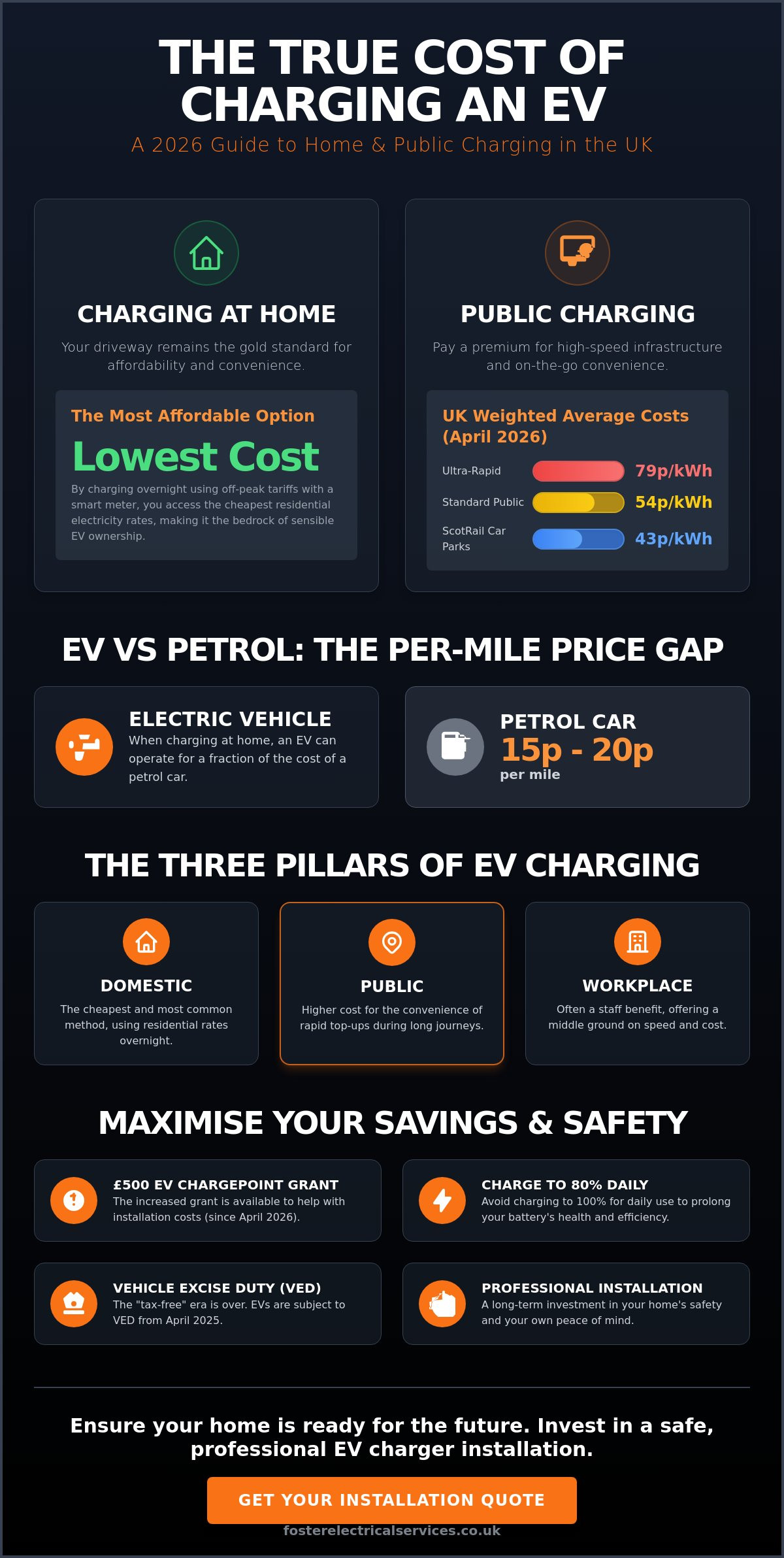
Despite fluctuations in the energy market, electric cars maintain a firm lead in running costs. As of April 2026, the weighted average pay-as-you-go price for public rapid charging in the UK reached 79p/kWh, whilst standard public chargers sat at 54p/kWh. Even at these higher public rates, the cost-per-mile often remains competitive with petrol. However, the real savings are found at home. When you consider that a petrol car might cost between 15p and 20p per mile to run, a home-charged EV can often operate for a fraction of that. You should also account for the fact that as of April 2025, EVs are now subject to Vehicle Excise Duty (VED), meaning the “tax-free” era has ended. Even with this change, the lack of moving parts and lower fuel costs keep the electric option ahead for the diligent driver.
Understanding how much does it cost to charge an electric car requires looking at your specific driving patterns. If you do most of your charging at home, your savings will be substantial. If you rely solely on the public network, your costs will be higher, but the reliability of the Scottish charging infrastructure continues to improve, making it a viable choice for everyone.
Calculating Home Charging Costs: Your Most Affordable Option
Charging at home is the bedrock of sensible electric vehicle ownership. It’s where the most significant savings happen, effectively turning your driveway into a private filling station that operates whilst you sleep. When you sit down to work out how much does it cost to charge an electric car, the answer depends almost entirely on your home energy setup and your charging habits. A smart meter is no longer just a modern gadget; it’s a vital tool that communicates with your supplier to unlock the lowest rates available. By aligning your charging with these low-demand periods, you protect your household budget from the higher costs found on the public network.
To accurately calculate your costs, you must look at your car’s battery capacity. A smaller city car with a 40kWh battery will naturally cost less to fill than a long-range SUV with a 100kWh battery. However, the most diligent drivers rarely charge to 100% every night. We recommend the habit of charging to 80% for daily use. This approach is kinder to the battery’s long-term health and ensures you aren’t paying for the slower, less efficient “trickle” charge that occurs at the top end of the battery’s capacity. According to UK government EV charging statistics, home charging remains the most cost-effective method for the vast majority of UK motorists.
Smart EV Tariffs: Octopus, British Gas, and Beyond
We often see Tayside homeowners overwhelmed by the variety of energy plans on offer. The key is to find a dedicated EV tariff that offers a significant “off-peak” window, usually between midnight and 5am. Some providers offer fixed-rate overnight windows, whilst others use “agile” pricing that fluctuates based on wholesale demand. A typical EV tariff in 2026 provides a discounted off-peak rate, often between 7p and 10p per kWh, specifically for charging during the night. This small window of time is where the real magic happens for your wallet. If you want to automate this process entirely, our Ohme Home Pro review for Dundee homeowners explains how this smart charger can access rates as low as 7.5p per kWh by automatically scheduling your sessions around the cheapest tariff windows.
The Impact of Charging Speed on Your Bill
Speed is another factor that influences your long-term costs. Whilst a three-pin “granny cable” might seem convenient, it’s slow and wasn’t designed for the heavy, sustained load of modern EV batteries. A dedicated 7kW home charger provides a safer, more efficient balance for a domestic electrical system. It allows you to complete a full charge within that cheap off-peak window, avoiding the need to top up at expensive peak rates during the day. If you’re concerned about your current setup, a professional EV charger installation ensures your home infrastructure is both safe and capable of handling these loads for years to come. Professional installation isn’t just about speed; it’s about the integrity of your home’s electrical heart.
Public Charging in Scotland: From Free to Ultra-Rapid
Whilst home charging is the most affordable way to fuel, there are times when you’ll need the public network to keep you moving. In Dundee and across the Angus region, we’re fortunate to have some of the best infrastructure in the country. However, the convenience of a quick top-up comes at a price. When you’re standing at a charging hub, the question of how much does it cost to charge an electric car depends largely on the speed of the hardware you’ve chosen. Rapid and ultra-rapid chargers require significant investment in grid connection and cooling technology, which is why operators pass these costs on to the driver.
Since April 2026, the Scottish Government has provided 100% relief from Non-Domestic Rates for eligible charging points. This encourages more businesses to install hubs, but it hasn’t necessarily led to lower prices for the end user. Understanding the electric vehicle charging costs associated with different providers is essential for keeping your travel budget under control. You’ll find that standard public charging (up to 49kW) averaged around 54p/kWh in early 2026, whilst rapid chargers jumped to 79p/kWh. Subscription models can lower these rates, but they only make sense if you’re using the public network multiple times a month.
ChargePlace Scotland and Local Authority Charging
ChargePlace Scotland is our national network, and it operates differently from private giants like bp pulse. In the past, many Dundee City Council chargers were free to use, but those days have largely ended to ensure the network remains sustainable. As of January 2026, even ScotRail car parks have introduced a tariff of 43p per kilowatt-hour. We always suggest carrying a ChargePlace Scotland RFID card; it’s often more reliable than mobile apps when you’re in more remote parts of Angus. Using these local authority chargers is generally cheaper than private motorway hubs, provided you don’t mind a slightly slower charge whilst you’re parked up.
Rapid Charging: When Convenience Outweighs Cost
Rapid charging is a tool, not a daily habit. If you rely on 150kW+ ultra-rapid chargers, you’ll see your running costs climb quickly. To get the best value, follow the 20-80% rule. Most electric cars slow down their charging speed significantly once the battery hits 80% to protect the cells. If you’re paying 79p/kWh at a rapid hub, staying for that last 20% is a waste of both time and money. You should also watch out for hidden costs like parking fees and overstay penalties. Many hubs in busy areas now charge a penalty if you stay plugged in for more than 60 or 90 minutes, as they need to keep the bays clear for other drivers. It’s about being a considerate neighbour whilst protecting your wallet.
Hidden Factors That Influence Your Charging Efficiency
Most drivers focus entirely on the unit price of electricity, but the efficiency of your setup plays a silent, crucial role in your monthly spend. When you consider how much does it cost to charge an electric car, you have to account for the energy that never actually reaches your battery. We often see homeowners in Angus struggling with slow charging speeds or high bills because their home’s “electrical heart” is outdated. An old consumer unit can act as a bottleneck, throttling the performance of a modern 7kW charger and leading to energy loss through heat. Upgrading your infrastructure ensures every penny you spend on your tariff is working as hard as possible for your vehicle.
The health of your battery also dictates how much energy is required for a “full tank.” We recommend the habit of battery pre-conditioning, especially during the colder months. By using mains power to warm the battery whilst the car is still plugged in, you avoid using the battery’s own stored energy to reach its optimum operating temperature once you’re on the road. This simple step protects your range and ensures your car operates at peak efficiency from the moment you leave your driveway. It’s a small adjustment that leads to significant long-term savings and a more reliable driving experience.
Environmental Factors and Energy Loss
The British climate is a major variable in your charging arithmetic. Cold weather significantly reduces battery efficiency, meaning you’ll spend more on electricity to cover the same distance during a Scottish winter than in the height of summer. You should also be aware of “vampire drain,” which is the small amount of energy your car consumes whilst parked to keep its systems active. Whilst AC charging at home is generally more efficient for the battery’s long-term health, DC public charging involves different conversion losses. Minimising these losses is about smart habits, such as parking in a sheltered spot or keeping the battery within its favourite temperature range.
The Vital Importance of Electrical Safety
We believe that a safe home is an efficient home. Before you commit to a new charger, we strongly recommend a professional EICR (Electrical Installation Condition Report) to identify any underlying issues in your property’s wiring. Proper RCD protection is essential; it prevents costly electrical faults and ensures your charging sessions aren’t interrupted by safety trips. Additionally, high-quality data cabling can significantly improve the “smart” features of your charger, allowing it to communicate perfectly with your energy provider’s app. If you’re unsure about your home’s readiness, we can provide a thorough assessment and any necessary Consumer Unit Upgrades to bring your system up to modern standards. It’s about giving you the peace of mind that your home and your car are protected by the highest standards of execution.
Why Professional Installation is a Long-Term Investment
Whilst the previous sections have focused on the figures, the physical installation is where those savings are secured. It’s tempting to think only about the car, but the home’s wiring is the foundation of your new driving habit. Moving beyond a DIY mindset is essential because a modern EV charger pulls a significant, sustained load that standard domestic circuits weren’t designed to handle. We believe that a dedicated circuit is a non-negotiable requirement for safety and performance. When you consider how much does it cost to charge an electric car, you must also factor in the longevity of your home’s electrical heart. A professional installation ensures you aren’t just saving on fuel, but protecting your property from the risks of overheating and electrical fatigue.
Choosing a local Dundee Trusted Trader provides a level of accountability that large, anonymous corporations simply cannot match. We’ve seen the market change rapidly, with record EV registrations reaching over 86,000 in March 2026 alone. This surge means many households in Angus are now preparing for a future with two electric vehicles. Future-proofing your home now by ensuring your consumer unit can handle multiple high-load appliances will save you from expensive corrective work later. It’s about doing the job correctly the first time, using time-tested methods that prioritise your family’s safety over a quick, cheap fix.
The Foster Electrical Approach to EV Safety
Our commitment is rooted in sincere, honest advice. We don’t believe in high-pressure sales; instead, we offer a grounded assessment of your home’s current capacity. Every EV Charger Installation we undertake meets the rigorous standards of the latest 18th Edition Wiring Regulations. We take immense pride in our reputation for diligence and integrity. This means we treat your home with the same care as our own, staying meticulous about tidiness and ensuring the workspace is left in perfect order. We see it as a privilege to enter your private space, and we honour that by delivering high standards of execution in every corner of the job.
Next Steps for Dundee Homeowners
If you’re ready to make the switch, the first step is a thorough safety assessment. We can help you integrate your new charger with your existing systems, ensuring your Interlinked Smoke & Heat Alarms and other safety features are fully accounted for during the installation. With the maximum grant for residents increasing to £500 per socket in April 2026, there has never been a better time to organise your home infrastructure. We are here to act as the protective guardian of your environment, providing the technical expertise you need with the personal service you deserve. You can Contact Foster Electrical for a reliable EV charger installation quote to begin your journey with quiet confidence and total peace of mind.
Preparing Your Home for a Sustainable Future
Mastering your travel budget in 2026 comes down to two simple factors: choosing the right tariff and ensuring your home’s electrical system is fit for purpose. We’ve explored how off-peak domestic rates can significantly undercut public rapid chargers, whilst smart habits like battery pre-conditioning help you maintain efficiency through the Scottish winter. Understanding exactly how much does it cost to charge an electric car is the first step toward long-term savings and a more predictable household budget. It isn’t just about the vehicle; it’s about the safety and integrity of the property where you plug it in every night.
We take immense pride in helping our neighbours make this transition with total confidence. As a Dundee Trusted Trader approved business, our expert 18th Edition certified electricians specialise in everything from full property rewires to safety compliance. We believe in honest advice and meticulous standards of execution. Whether you need a consumer unit upgrade or a dedicated circuit for your vehicle, we treat your home with the respect it deserves. You can Get a Professional EV Charger Installation Quote in Dundee to ensure your journey into electric driving is safe, efficient, and built on a foundation of quality. We look forward to helping you move forward with certainty.
Frequently Asked Questions
Is it cheaper to charge an electric car at night in the UK?
It is almost always cheaper to charge at night if you have switched to a dedicated EV energy tariff. Most providers offer a discounted window between midnight and 5am when demand on the grid is at its lowest. By organising your charging habits to fit this schedule, you can secure rates as low as 7p to 10p per kWh. This is the most effective way to manage how much does it cost to charge an electric car over the long term.
How much does it cost to charge a Tesla at a Supercharger in Scotland?
The cost to charge at a Tesla Supercharger depends on the specific location and whether you are charging during peak or off-peak hours. Whilst Tesla often provides more competitive rates than other ultra-rapid networks, you are still paying a premium for the 250kW delivery speed. You should check the Tesla app for live pricing at Scottish hubs like Dundee or Perth, as rates fluctuate based on local grid demand and membership status.
Can I charge my electric car for free in Dundee?
Free public charging has become increasingly rare in Dundee as the city council moves toward a sustainable, paid model for its infrastructure. Most local authority bays now require payment via the ChargePlace Scotland network to ensure the equipment is properly maintained. Whilst some workplaces or supermarkets might still offer complimentary top-ups as a benefit, you should generally budget for a paid session when using the city’s public hubs.
Do I need to upgrade my fuse box to install an EV charger at home?
You may need a Consumer Unit Upgrade if your current fuse box is outdated or lacks the necessary safety components to handle a sustained 7kW load. A modern EV charger requires specific RCD protection to prevent faults and keep your home safe. We always recommend a thorough inspection of your existing wiring to determine if your infrastructure can safely support the additional demand of a dedicated charging circuit.
How much does it cost to install a home charging point in 2026?
The total investment for a home charging point depends on the complexity of the electrical work and the distance from your consumer unit to the driveway. As of April 2026, the UK government has increased the maximum grant for eligible residents to £500, which helps offset a portion of the professional installation. Every home is unique, so a tailored assessment is the only way to get a clear picture of the requirements for your property. For homeowners considering a smart unit, our detailed Ohme Home Pro review covers how this intelligent charger performs in Scottish conditions and what to expect from a professional installation that meets the latest 2026 building regulations.
How much does it cost to charge an electric car per mile compared to petrol?
Charging an electric vehicle at home remains significantly cheaper than fueling a traditional petrol or diesel car. Whilst a petrol car might cost between 15p and 20p per mile to run, a home-charged EV operates for a fraction of that cost. This price gap is the primary reason why many drivers in Angus are making the switch, as the long-term savings on fuel quickly outweigh the initial setup costs. It is about making a sensible choice for your daily commute.
Is public charging more expensive than home charging?
Public charging is considerably more expensive than home charging because you are paying for the maintenance of high-speed infrastructure. In early 2026, the weighted average price for UK public rapid charging reached 79p/kWh, whilst standard public chargers sat at 54p/kWh. We believe public hubs are an excellent tool for long journeys, but how much does it cost to charge an electric car will always be lowest when you plug in on your own driveway.
What is the cheapest EV energy tariff currently available?
The cheapest options are currently found amongst “agile” or dedicated EV tariffs offered by major suppliers like Octopus Energy and British Gas. These plans are designed for households with smart meters and provide very low rates during the night. Because the energy market changes frequently, you should compare the specific off-peak windows and standing charges to find the best fit for your Angus home and driving patterns.