What if the quiet confidence you feel in your Dundee home is actually resting on a decades-old circuit hidden behind the coats in your hallway? It’s completely normal to feel a sense of worry when an electrician is scheduled to visit, especially if you’re concerned about the power being off for hours or the potential for a mess in your living space. We understand that your home is your sanctuary, and inviting a professional in to scrutinise your wiring can feel intrusive. That’s why knowing how to prepare for an eicr inspection is the best way to turn a daunting task into a straightforward, stress-free morning.
Our goal is to ensure you receive that satisfactory pass certificate with as little disruption to your routine as possible. In this guide, we’ll show you exactly how to ready your property to avoid common pitfalls and ensure your electrician can work efficiently and tidily. We’ll preview the essential steps for clearing access, managing your appliances, and understanding what the final report codes mean for your safety. By the time you’ve finished reading, you’ll have a clear roadmap for a successful inspection that keeps your family safe and your home’s integrity intact.
Key Takeaways
- Learn the practical steps on how to prepare for an eicr inspection to ensure your electrician has clear access and can work efficiently.
- Discover why clearing space around your consumer unit and a selection of sockets is the most effective way to minimise disruption to your day.
- Find out which essential documents and technical records you should gather beforehand to help your inspector verify your home’s safety history.
- Understand what happens whilst the power is switched off and how simple “freezer etiquette” protects your belongings during the check.
- Gain clarity on the industry-standard coding system so you can interpret your final report and any necessary repairs with total confidence.
Understanding the EICR: Why Preparation Saves Time and Money
We believe your home should be your safest place. An Electrical Installation Condition Report (EICR) is much more than a simple piece of paper; it is a deep-dive safety health check for your property’s hidden nervous system. Whilst it is a legal necessity for Dundee landlords, it is a vital tool for any homeowner who values peace of mind. Learning exactly how to prepare for an eicr inspection prevents us from spending valuable time moving clutter or searching for hidden fuse boxes. This preparation keeps your costs down and allows us to focus our expertise on the task at hand. A well-prepared home ensures a more thorough and accurate assessment of your safety, leaving no stone unturned.
The Legal Landscape for Dundee Landlords
In Scotland, the rules are clear and strict. Under the Housing (Scotland) Act 2006, private landlords must ensure an EICR is carried out at least every five years. You must also arrange a check at every change of tenancy to protect new residents. For those managing properties in the city centre or the West End, local authorities in Dundee require valid reports for HMO licensing. Beyond the law, many Tayside insurance providers now insist on a current certificate to maintain your coverage. We take this responsibility seriously. A valid report is your shield against liability and your proof of diligence as a property owner.
The Difference Between a Visual Check and a Full EICR
Many people mistake a quick visual glance for a proper inspection. A true EICR involves physical testing of every circuit in the building. This process, often called “Fixed Wire Testing”, covers everything from your consumer unit to the very last socket on your wall. We look behind the faceplates and test the integrity of the cables hidden within your floors and ceilings. An EICR is a rigorous assessment of a property’s hidden electrical infrastructure. All our inspections are measured against current electrical wiring standards to identify any deterioration or defects that a simple visual check would miss. We don’t just look for problems. We verify that your home remains a protective environment for you and your family through time-tested methods and honest reporting.
Practical Steps to Organise Your Property for the Inspector
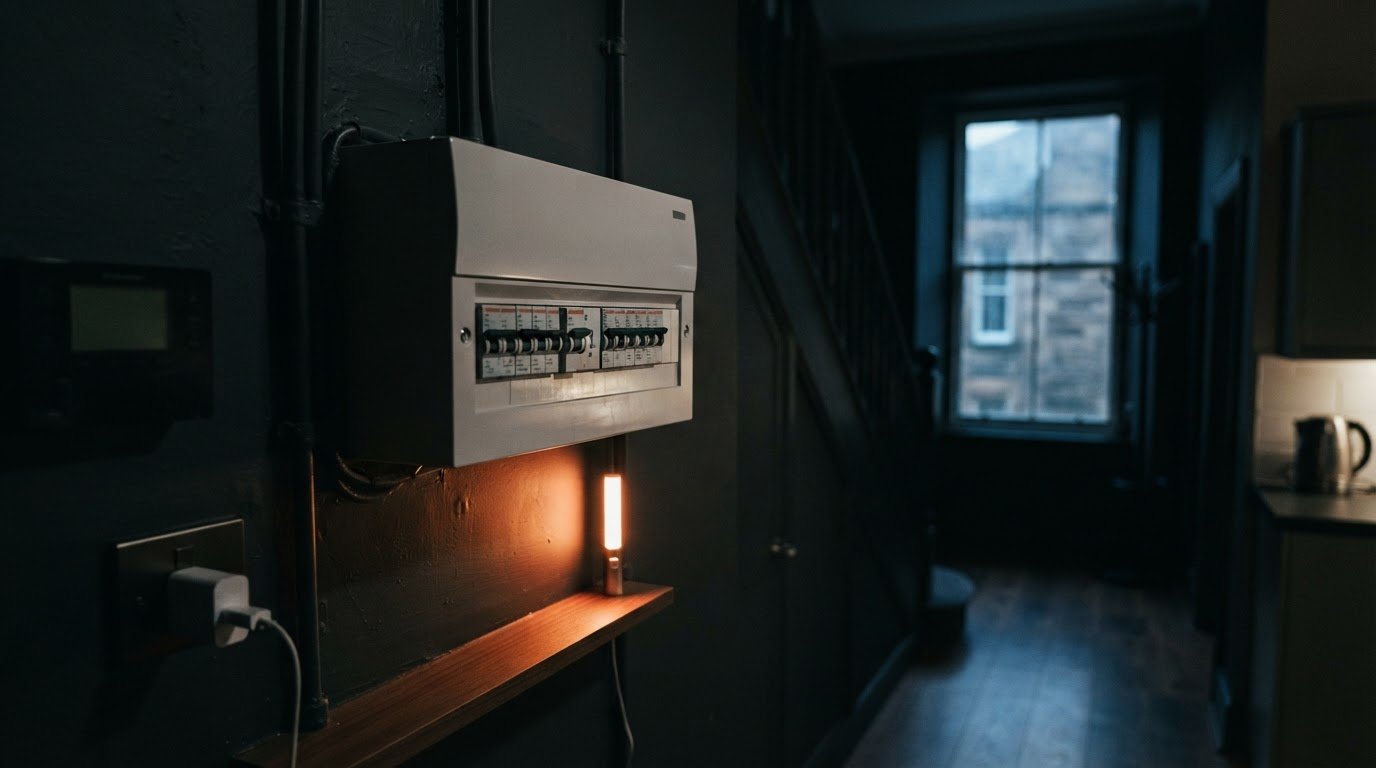
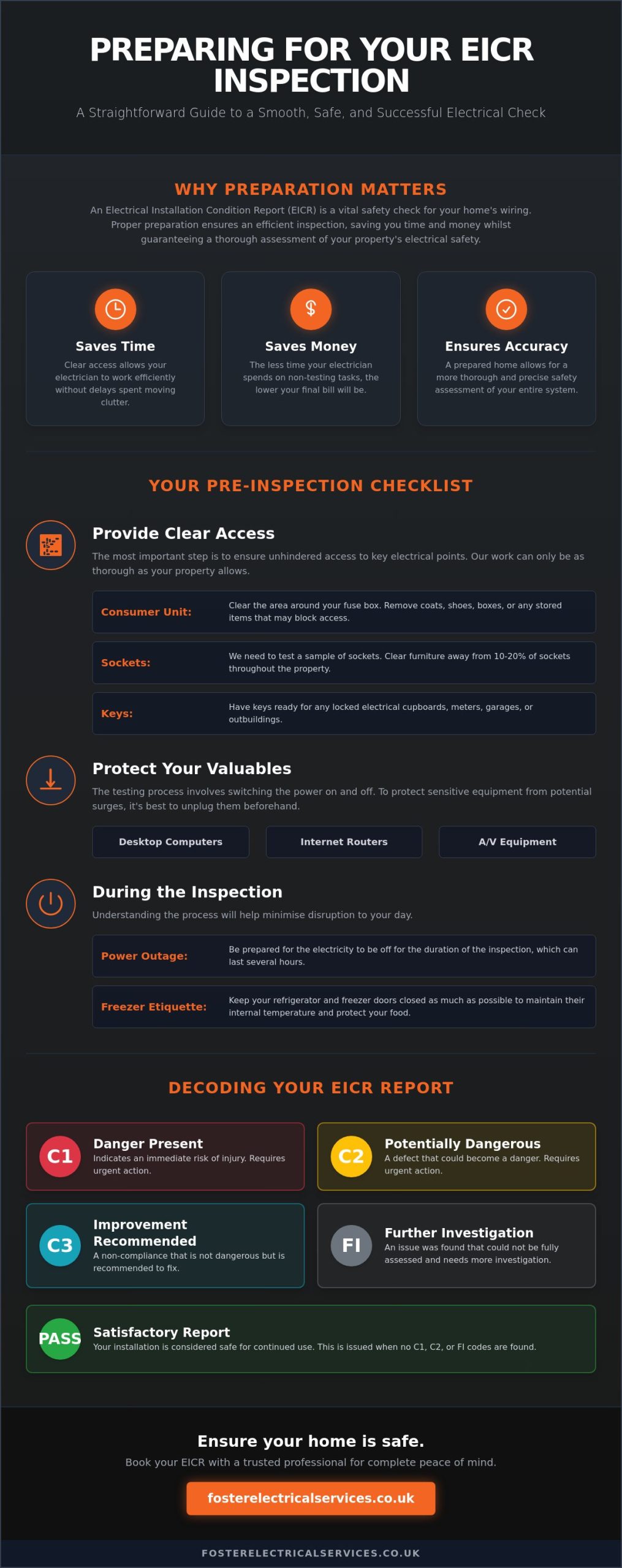
Preparing your home isn’t about hiding faults; it’s about giving us the space to do our job correctly and safely. We take great pride in our meticulous approach, but we can only be as thorough as your property allows. The most important first step in how to prepare for an eicr inspection is ensuring we have clear, unhindered access to your consumer unit. Often tucked away in dark cupboards or under the stairs, these units are the heart of your home’s safety system. Please take a moment to clear away the coats, shoes, or boxes that might be blocking our path. This simple act of diligence ensures we can begin our work immediately without a struggle.
Beyond the fuse board, we need to reach your sockets and switches. You don’t need to move every piece of furniture, but clearing the space around at least 10-20% of your sockets across the property is incredibly helpful. We also recommend unplugging sensitive electronic equipment before we arrive. Desktop computers, internet routers, and high-end audio-visual gear can be sensitive to the power being switched on and off during testing. By unplugging them, you protect your valuable electronics whilst we verify the integrity of your circuits. If you have any concerns about specific appliances, our team at Foster Electrical is always happy to offer advice before we start.
Clearing the Way: Access is Key
Dundee homeowners often face unique challenges, especially in our beautiful stone-built tenements. If you live in a flat, your meter or main switch might be located in a communal hallway or a high-level cupboard that requires a ladder. Please ensure you have the keys for any locked electrical cupboards or external outbuildings like garages and sheds. Moving heavy furniture away from at least one or two sockets in each room saves a significant amount of time. Industry experts at British Engineering Services provide excellent guidance on how to prepare for an inspection, emphasising that clear access is the foundation of a smooth visit.
The Pre-Inspection “Quick Wins” Checklist
Before our arrival, a quick walk-through of your home can prevent unnecessary delays. Check for any visibly damaged sockets, cracked switches, or scorched plastic. These are immediate safety concerns that we’ll need to address. Another vital task is checking your light bulbs. A blown bulb can sometimes mimic a circuit fault during our technical tests, leading to confusion. Finally, check that your consumer unit is clearly labelled. If we have to spend an hour identifying which switch controls the kitchen and which handles the upstairs lighting, the inspection will take much longer. If you’ve had any recent DIY work, ensure it’s finished and made safe so we can include it in our report with confidence. Taking these small steps is the best way to understand how to prepare for an eicr inspection and ensure your property is ready for a professional assessment.
Essential Documentation and Technical History to Have Ready
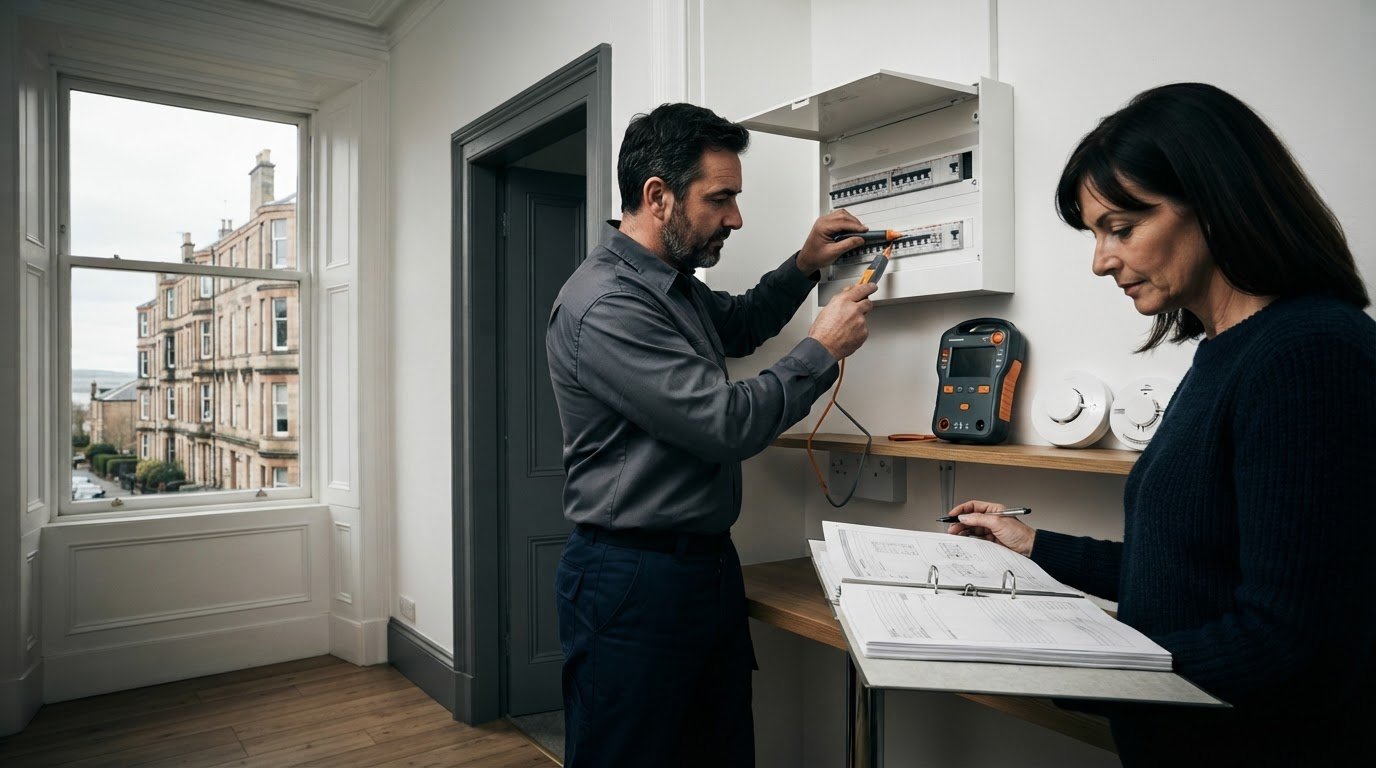
Whilst our technical instruments provide the data, your knowledge of your home’s history provides the context. We view an electrical inspection as a partnership between the professional and the property owner. Part of knowing how to prepare for an eicr inspection involves gathering the “story” of your wiring. This administrative preparation is just as vital as clearing the physical space around your sockets. If you have any previous EICR reports or Domestic Electrical Installation Certificates (DEICs) from past work, please have them ready for us to review. These documents act as a roadmap, showing us what has been changed, upgraded, or repaired over the years.
We also suggest locating manuals or installation records for any specialised equipment you might have. This includes EV chargers, electric heating systems, or complex data cabling setups. Having these technical details to hand saves us from searching for manufacturer specifications and allows us to verify that the installation meets the required standards. If you have recently undertaken renovations or a partial rewire, a clear list of these changes is incredibly helpful. We want to ensure that every new addition to your home’s infrastructure is safe and correctly integrated into your existing system.
Why Previous Reports Matter
Previous reports often contain “limitations”, which are specific areas of the property that could not be accessed or tested during the last visit. By showing us these records, you help us focus our attention on neglected areas that might need a closer look this time around. Providing evidence of past remedial work builds a picture of a well-maintained home and demonstrates a responsible attitude toward property management. It gives us confidence that the electrical system has been cared for with the same diligence we bring to our own work. This transparency leads to a more accurate and reliable safety assessment for everyone involved.
Identifying “Known Issues” for the Electrician
We encourage total honesty about the small quirks of your home. If you have that “one socket that never works” or a flickering light in the kitchen, please tell us before we begin. It is far better to identify a fault now than to leave it to become a future emergency. Fault-finding is a standard and essential part of the inspection process. We take great pride in solving these long-standing domestic mysteries for our clients in Dundee. Sharing these recurring issues allows us to investigate the root cause efficiently, ensuring your home remains the protective sanctuary it should be. Gathering this history is a key step in how to prepare for an eicr inspection that ensures no detail is overlooked.
Managing Disruption: What to Expect Whilst the Power is Off
We understand that the thought of a power cut can be unsettling. Your daily routine likely relies on a steady stream of electricity, and any break in that service feels like a major hurdle. However, switching off the supply is a fundamental part of our safety testing. For a standard home in Dundee, you should expect the power to be off for the majority of the inspection, typically lasting between two and four hours. Knowing how to prepare for an eicr inspection means planning for this quiet period so it doesn’t catch you off guard. We always recommend a bit of “freezer etiquette” to our clients; simply keep the freezer door shut and your food will remain perfectly frozen for the duration of the test.
If you work from home, the loss of internet can be the biggest challenge. We suggest setting up a mobile hotspot on your phone or perhaps visiting one of our local Dundee cafes for a few hours. This ensures your productivity stays high whilst we focus on the safety of your wiring. We also advise considering the comfort of your pets. The presence of a stranger moving between rooms, combined with the occasional beeping of our testing equipment, can be stressful for some animals. Taking these small, thoughtful steps is a vital part of how to prepare for an eicr inspection to ensure the day goes smoothly for every member of your household.
Working Around the Inspection
To stay connected, we recommend charging all laptops, tablets, and mobile phones to 100% before we arrive. It is also worth remembering that electric gates or garage doors will need to be operated manually whilst the power is isolated. If you hear a rhythmic beeping sound during our visit, please don’t be alarmed. That is simply our tester verifying that your earth connections are solid and safe. This is a standard part of our time-tested methods, providing you with the certainty that your home’s protection is functioning exactly as it should. We believe in transparency, so we are always happy to explain what each sound means as we work.
Safety for Vulnerable Residents and Pets
We are particularly sensitive to households with vulnerable residents. If you use medical equipment that requires constant power, such as a CPAP machine, please let us know in advance. We can then discuss the best way to manage the isolation periods to keep everyone comfortable. For your pets, we suggest keeping dogs in a separate room or the garden whilst we move through the house. We treat your property with the same care as our own, and we are always meticulous about keeping doors shut to ensure your pets remain safe and secure. If you are ready to secure your home’s safety, you can arrange your EICR with our expert team today.
After the Inspection: Interpreting Your Report with Foster Electrical
Once we finish our testing, we won’t just hand you a stack of papers and leave. We believe our job includes helping you understand every detail of the final Electrical Installation Condition Report. A “Satisfactory” result is the outcome every homeowner hopes for, but it’s important to remember that this doesn’t mean your home is perfect; it simply means it is safe for continued use. By following our guide on how to prepare for an eicr inspection, you have already done the hard work of ensuring we could see your system clearly. If your property receives an “Unsatisfactory” result, don’t panic. This just means we’ve identified specific areas that need attention to meet current safety standards.
We’re committed to being your local partner in Dundee, providing transparent and fair-priced quotes for any necessary remedial works. If repairs are needed, we explain exactly why and how we will fix them, avoiding technical jargon in favour of plain, honest conversation. Our goal is to bridge the gap between technical expertise and your domestic comfort. We take great pride in our reputation for integrity, ensuring that any follow-up work is handled with the same diligence as the inspection itself. We treat your home as a sanctuary, not just another job site.
Decoding the C-Codes
A C1 code requires immediate action to prevent injury or fire, as it indicates a present danger that we must address right away. In contrast, C3 codes are often “best practice” suggestions rather than mandatory fixes, representing ways you could improve your system’s efficiency or modernise your setup. We find that a C2 code is the most common reason for an unsatisfactory report; whilst it sounds serious, it is usually fixable in a day and represents a potential danger that needs urgent attention. Understanding these codes is the final step in learning how to prepare for an eicr inspection, as it removes the fear of the unknown and gives you a clear path to a safer home.
The Foster Electrical Guarantee of Tidiness
We understand that having a tradesperson in your home can feel intrusive. That’s why we have a firm commitment to leaving your property exactly as we found it, minus any electrical hazards we’ve cleared away. Our “trusted trader” reputation amongst the Dundee community is built on this respect for your private space and our meticulous attention to detail. We act as diligent neighbours who happen to be experts, taking personal pride in high standards of execution and cleanliness. If you’re ready to ensure your home’s safety with a team that values your comfort as much as your circuits, Book your Dundee EICR inspection with Foster Electrical today.
Protecting Your Home and Your Peace of Mind
We’ve walked through the vital steps of readying your property for a professional safety check. By clearing access to your consumer unit and gathering your technical records, you ensure that the inspection remains efficient and thorough. Understanding how to prepare for an eicr inspection isn’t just about ticking boxes; it’s about safeguarding the hidden infrastructure that keeps your household safe every day. We believe this proactive approach is the best way to maintain a secure and comfortable living environment for you and your family.
We take great pride in our role as your local electrical experts. As a NICEIC Approved Contractor and a proud member of the Dundee Trusted Trader scheme, we bring a level of traditional diligence and honesty to every visit. We are specialists in Scottish Landlord Compliance, ensuring that every Dundee property we inspect meets the highest safety standards with total transparency. Secure your Dundee property today – Book your EICR with Foster Electrical. We look forward to treating your home with the same care and respect we would our own.
Frequently Asked Questions
How long does a typical EICR inspection take for a 3-bedroom house?
A typical inspection for a three-bedroom property usually takes between three and four hours to complete. This timeframe allows us to be meticulous in our testing without rushing the process. The exact duration depends on the complexity of your home’s wiring and the number of circuits we need to test. We always aim to work efficiently to minimise the time your power is isolated.
Will the electrician need to lift my floorboards during the EICR?
We rarely need to lift floorboards during a standard inspection. An EICR is primarily a non-destructive test designed to assess the safety of your visible and accessible wiring. If we identify a serious fault that requires deeper investigation, we will always discuss this with you first. Our priority is to protect your property and ensure your home remains tidy throughout our visit.
What happens if my property fails the EICR inspection?
If your property receives an unsatisfactory result, we will provide a detailed report highlighting the specific C1 or C2 codes that caused the failure. For Dundee landlords, remedial work must be completed within 28 days to remain compliant with Scottish law. We can provide a transparent quote for these repairs, helping you move from an unsatisfactory status to a safe, satisfactory one.
Do I need to be at home whilst the EICR is being carried out?
You don’t need to be present for the entire duration, provided we have clear access to the property. However, many homeowners find it helpful to be there at the start to show us the location of the consumer unit and any hidden meters. Learning how to prepare for an eicr inspection in advance means you can leave us to work diligently whilst you get on with your day.
Is an EICR the same as PAT testing?
An EICR is not the same as PAT testing. An EICR focuses on the fixed electrical installation, such as the wiring, sockets, and consumer unit. PAT testing (Portable Appliance Testing) is a separate check for individual items like kettles, heaters, and lamps. Both are important for overall safety, but they involve very different technical procedures and requirements.
Can I use my own electrician to fix faults found during an EICR?
You are entirely free to use any qualified electrician to carry out remedial works found during our visit. Whilst we take pride in offering fair-priced repairs ourselves, we never use high-pressure tactics to secure that work. Our main goal is simply to ensure your home is safe, regardless of who carries out the final fixes to your installation.
How much notice should I give my tenants before an EICR?
You must give your tenants at least 24 hours’ written notice before an inspection, though we recommend providing more whenever possible. Giving them ample time helps them understand how to prepare for an eicr inspection by clearing access and protecting their pets. This courtesy ensures a smoother visit for the electrician and maintains a good relationship with your residents.
Does a new-build house in Dundee need an EICR?
A brand-new house in Dundee generally doesn’t require an EICR immediately. When a home is built, it is issued with an Electrical Installation Certificate (EIC), which typically covers the property for the first five to ten years. You should check your original paperwork to see when your first periodic inspection is due to ensure you remain compliant with current safety standards.