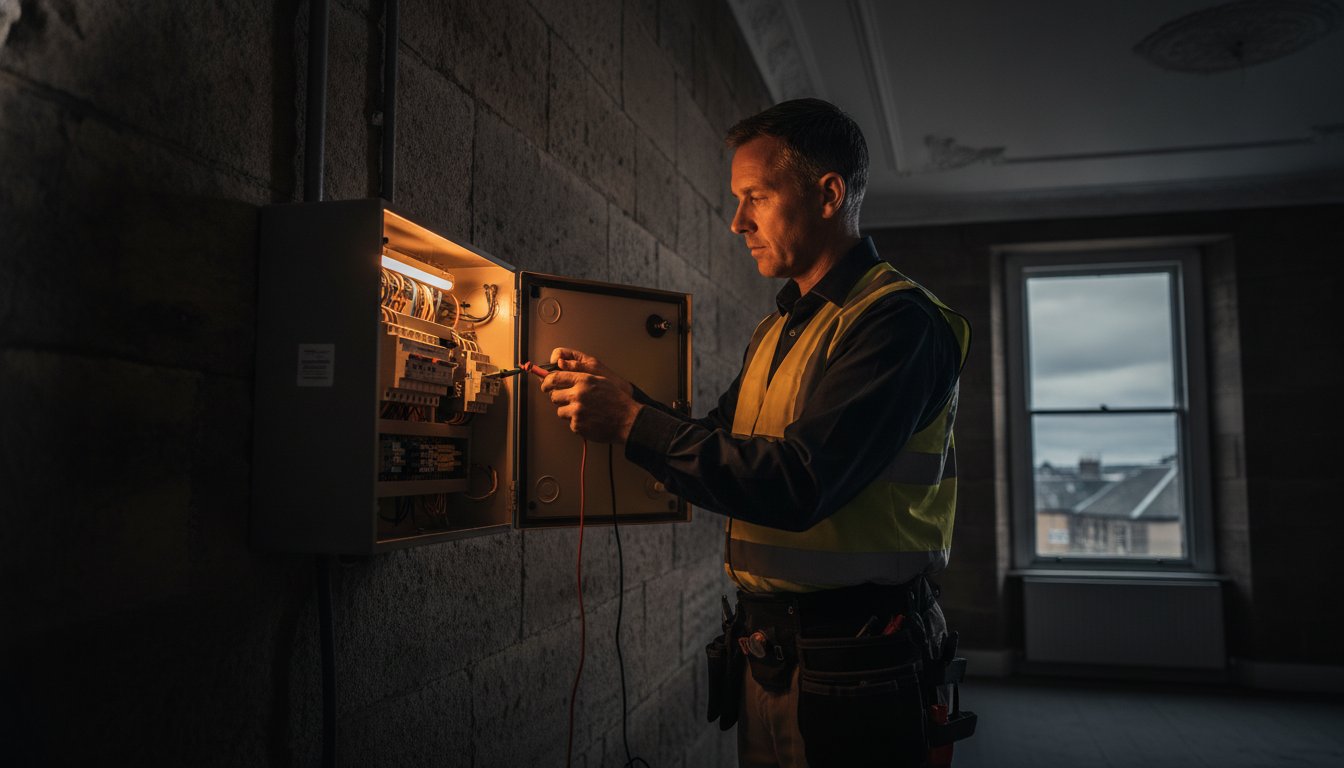
What if the fuse box you’ve relied on for years is actually blind to the very faults that cause house fires and fatal shocks? It’s a sobering thought, yet many homeowners in Dundee don’t realise there’s a vital gap in their safety when looking at the rcd vs mcb debate. While a standard circuit breaker protects your cables from melting, it’s the RCD that acts as a diligent guardian for your family, reacting to tiny leaks of electricity that a traditional fuse would simply ignore.
We know that technical jargon can feel overwhelming, and the prospect of upgrading your consumer unit often brings worries about cost and disruption. We’re here to clear away that confusion. You’ll learn exactly how an RCD prevents fire and injury, why these devices are now mandatory under the 2026 “Orange Book” standards, and how to tell if your own home is truly protected. It’s about providing the honest, straightforward advice you need to keep your Tayside property safe and sound for the future.
Key Takeaways
- Understand how an RCD acts as a life-saving switch by detecting tiny electrical leaks that standard fuses simply cannot see.
- Learn the critical distinction of rcd vs mcb to see why standard circuit breakers alone aren’t enough to protect your family from electrocution.
- Discover the latest 2026 Scottish safety regulations and why RCD protection is now a legal necessity for all private rental properties.
- Gain a simple routine for testing your safety devices every six months to ensure they remain in perfect working order.
- See how a modern consumer unit upgrade from a diligent local expert can bring your older Dundee home up to the highest current safety standards.
What is an RCD and How Does it Protect Your Dundee Home?
We believe that every home in Dundee deserves a level of safety that goes beyond the bare minimum. While many people are familiar with the switches in their fuse box, they often don’t realise that the Residual Current Device (RCD) is the most critical component of all. Essentially, an RCD is a life-saving electromagnetic switch designed to prevent you from receiving a fatal electric shock. If you’ve ever wondered What is a Residual Current Device (RCD), it’s a piece of technology that monitors the electrical heartbeat of your property. It constantly measures the current flowing into a circuit against the current flowing out.
Under normal circumstances, these two values are perfectly balanced. But if electricity finds an unintended path, perhaps through a person touching a bare wire or a damp fault in a washing machine, that balance is broken. The RCD detects this tiny discrepancy and cuts the power instantly. It acts in milliseconds. This is significantly faster than a single human heartbeat, providing a level of protection that manual intervention or older technology could never match. We take personal pride in ensuring these devices are fitted correctly, as they are the final line of defence for your family.
The Science of Detection: Why Fuses Aren’t Enough
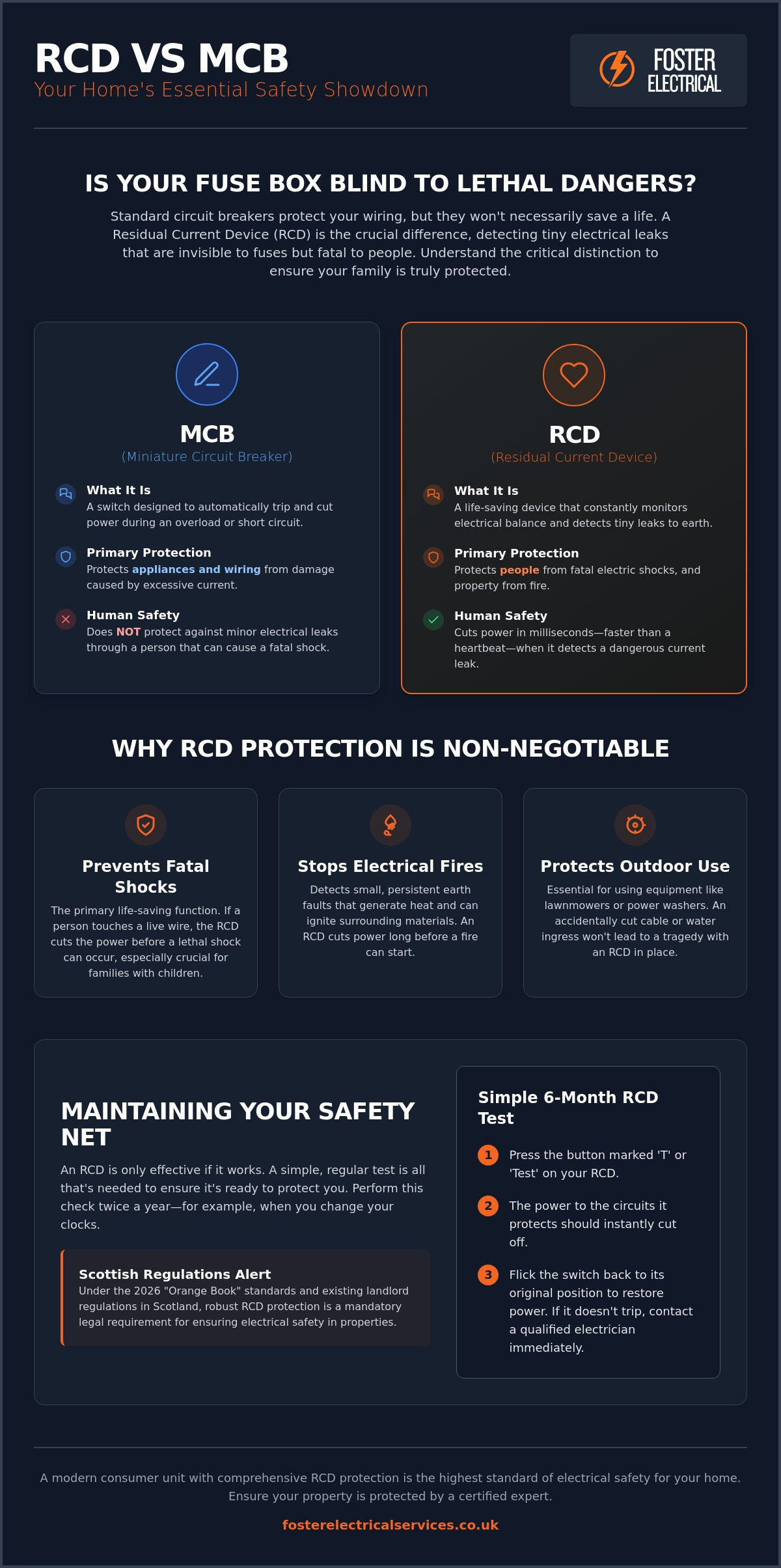
It’s a common misconception that a standard fuse or circuit breaker provides total safety for people. When comparing rcd vs mcb (Miniature Circuit Breaker), it’s vital to understand their different roles. An MCB is designed to protect your house’s wiring from overheating and catching fire due to an overload. It won’t necessarily trip if you’re being electrocuted, as long as the total current doesn’t exceed the cable’s limit. In contrast, the RCD is there specifically to protect human life by detecting leakage. Residual current is simply the electricity that has gone astray from its intended circuit, leaking towards the earth.
The Three Main Types of RCD Protection
We find that most properties in the Tayside area benefit from a combination of these three protection methods to meet modern standards:
- Fixed RCDs: These are the gold standard. They’re built directly into your consumer unit, providing whole-house safety for every circuit and appliance in the property.
- Socket-outlet RCDs: These are specialised wall sockets with a built-in RCD. We often recommend these for higher-risk areas like workshops or garages where heavy-duty tools are used.
- Portable RCDs: These plug-in adapters are essential for outdoor tasks. If you’re using a lawnmower or hedge trimmer, a portable RCD ensures that an accidental cut to the cable doesn’t lead to a tragedy.
The Compelling RCD Safety Benefits for Modern Households
We view the RCD as a silent sentry, standing watch over your home and family. While the previous section touched on the technical rcd vs mcb distinction, the real value lies in the immediate, life-saving outcomes these devices provide. For families in Dundee, especially those with young children, the peace of mind is immeasurable. If a curious toddler were to poke a metal object into a socket, a correctly functioning RCD would trip the power in a fraction of a second. It’s the difference between a minor fright and a life-altering tragedy.
This protection extends to every appliance you use daily. From your morning kettle to the power tools in your garage, the RCD provides continuous monitoring. It doesn’t just wait for a massive surge; it looks for the smallest hint that something is wrong. For those managing rental properties, staying up to date with Compliance and Scottish Law is vital, as these safety standards are now a mandatory part of modern property management. We take personal pride in helping our neighbours navigate these requirements without the headache of technical jargon.
Preventing Electrical Fires Before They Start
Many homeowners don’t realise that electrical fires often start as tiny, smouldering leaks of electricity known as earth faults. These leaks generate heat over time, potentially igniting nearby insulation or dust. A standard fuse or MCB is often blind to these small leaks because they don’t draw enough current to trigger a trip. An RCD, however, is designed to detect these minute imbalances. It cuts the power long before the heat can lead to ignition, offering a proactive layer of defence that older fuse boards simply cannot match. If you’re concerned about the age of your wiring, you might want to arrange a thorough safety inspection with us.
Guardian of the Garden: Safe Outdoor Power
The Scottish weather brings its own set of challenges to electrical safety. Damp conditions in Dundee and Angus make outdoor sockets and lighting much higher-risk areas. Whether you’re mowing the lawn or enjoying garden lights, the presence of moisture increases the risk of a fatal shock if a cable is accidentally damaged. This is why RCD protection is absolutely essential for outdoor power and lighting. A lawnmower accident whilst gardening could be fatal without an RCD to kill the power instantly. We ensure that every outdoor installation we touch is backed by robust, reliable protection that stands up to our local climate.
RCD vs. MCB: Understanding the Difference in Protective Power
When we discuss rcd vs mcb with our clients in Dundee, we often use the analogy of a bodyguard versus a building inspector. A Miniature Circuit Breaker (MCB) is the building inspector; it ensures the wiring isn’t overloaded, preventing the house cables from overheating. However, it is largely indifferent to whether a person is receiving a shock. A standard socket circuit is usually fused at 32 Amps. To put that in perspective, it takes less than 0.1 Amps to stop a human heart. This means you could be undergoing a fatal electrocution and the MCB would simply keep the power flowing, as it hasn’t seen a “surge” large enough to trip.
The RCD is the bodyguard. It doesn’t wait for a massive surge. Instead, it looks for tiny imbalances. Modern consumer unit upgrades combine both of these technologies to ensure your property and your family are equally protected. This shift towards dual protection is a core part of the UK government electrical safety standards, which have become increasingly stringent to reduce domestic accidents. We also appreciate the practical convenience: when an RCD trips, you simply flick a switch back up. There is no more hunting for fuse wire in the dark or struggling with tiny screws whilst holding a torch.
Sensitivity and Speed: The RCD Advantage
The 30mA standard is the magic number for domestic safety. This represents 30 milliamperes, a tiny fraction of the 32,000 milliamperes (32 Amps) needed to blow a standard socket fuse. Because the RCD is so sensitive, it can detect electricity leaving the circuit through a person’s body and shut off the supply in less than 40 milliseconds. In the world of electrical safety, this sensitivity is literally the difference between life and death. It provides a level of precision that traditional fuses were never designed to achieve.
Reliability and the Test Button
Data indicates that RCDs have a reliability rate of approximately 97%, but this figure only stays high if the device is exercised. We recommend pressing the “Test” or “T” button on your consumer unit every six months. Many of our neighbours worry that tripping the RCD will damage their computers or televisions. Rest assured, it’s no different from a standard power cut. The internal components of your electronics are designed to handle a sudden loss of power. This simple test ensures the internal mechanism hasn’t seized up over time, keeping your guardian ready for action amongst the daily bustle of a busy home.
Maintaining Safety: Testing, Compliance, and Scottish Law
We believe that safety shouldn’t be a set and forget affair. While the technical debate of rcd vs mcb highlights why the RCD is the superior life-saver, its effectiveness depends on regular care. We recommend a simple testing schedule for every Dundee household: press that test button every six months. It’s a small task that ensures the internal mechanism hasn’t become stiff or sluggish over time. In our experience, a quick check twice a year is the best way to keep your home’s guardian in peak condition.
For those of us managing property in Tayside, the rules are very clear and strictly enforced. As of 1 March 2024, the Repairing Standard in Scotland explicitly requires appropriate RCD protection on circuits in all private rented homes. When we conduct an EICR certificate, we don’t just look for the device’s presence. We use calibrated instruments to measure the exact trip time in milliseconds. If a device fails to trip within the required safety window, it’s often coded as a C2 (potentially dangerous) defect. This must be rectified to keep the property legally compliant and your tenants safe.
Landlord Responsibilities and the Law in Scotland
Scottish law takes electrical safety seriously, and for good reason. Under the Housing (Scotland) Act 2006, landlords have a duty to ensure their properties meet a specific standard of safety. This includes mandatory RCD protection. Failure to provide a valid EICR or ignoring necessary repairs can lead to significant fines and, perhaps more worryingly, invalidated insurance policies. We take personal pride in helping local landlords stay on the right side of the law, providing clear reports that strip away the technical complexity and focus on what needs to be done to maintain a safe environment.
What to Do When Your RCD Trips
A tripping RCD can be frustrating, but it’s usually doing exactly what it was designed for. It’s a common question when comparing the protective power of rcd vs mcb units: what happens if the switch won’t stay up? If your power cuts out, start by unplugging everything on that circuit. Reset the RCD and plug items back in one by one. If it trips again when a specific kettle or toaster is connected, you’ve found your culprit. However, if the trips seem random or frequent, it might indicate a more serious issue with your fixed wiring. This is where professional Fault Finding and Repairs become essential. We follow the latest 18th Edition standards, specifically the 2026 “Orange Book” updates, to ensure every installation is as robust as it is safe. If you’re unsure about the health of your consumer unit, reach out to us for a straightforward safety check.
Modernising Your Property with Foster Electrical
At Foster Electrical, we believe that providing a service is about more than just wires and switches; it’s about the privilege of being invited into your private space. We approach every job with a sense of traditional sincerity and grounded professionalism that is often lost in the modern world. When you decide to bridge the safety gap in the rcd vs mcb debate, you aren’t just getting a new piece of hardware. You’re gaining a commitment to excellence from a team that views itself as a protective guardian of your home’s environment. This same dedication to safe, supportive environments is essential for those receiving specialised assistance, and you can learn more about Mighty Mentors WA to see how professional mentoring and in-home care can empower individuals to live safely and independently.
Our process for a consumer unit upgrade is steady and transparent. It begins with a thorough initial survey of your existing installation to identify any hidden faults that might interfere with your new protection. Once we commence the work, we exercise artisanal care to ensure your home remains tidy and secure throughout the day. We don’t leave a mess for you to clear up. The project concludes with final testing and official certification, giving you the certainty that your property meets the highest modern standards. We take personal pride in this high standard of execution, ensuring every connection is correct and reliable.
Why Choose a Local Dundee Expert?
There is a distinct value in working with a diligent neighbour who truly knows the local housing stock across Dundee, Perth, and Angus. We reject the impersonal corporate infrastructure of national firms in favour of direct, human interaction. You won’t find yourself trapped in an automated phone menu here. By choosing a local expert, you’re opting for honest pricing and a level of accountability that only comes from a business fiercely proud of its community reputation. We treat your property with the same meticulous care we would apply to our own.
Your Next Steps to a Safer Home
We encourage you to take a moment today to look at your fuse board. If you cannot see a button marked with a ‘T’ or the word ‘Test’, your home is likely missing the vital life-saving protection we’ve discussed. This means you are currently relying on the “all or nothing” approach of older breakers, missing the crucial sensitivity that defines the rcd vs mcb distinction. We invite you to have a no-obligation safety conversation with us to explore how we can modernise your property. You can find more details about our full range of electrical services online, or simply get in touch with us to book your assessment. We’re here to help you move toward a safer future with quiet confidence.
Securing Your Family’s Future with Modern Protection
Your home is more than just a building; it’s the place where your family should feel most secure. We’ve explored how the sensitivity of an RCD offers a level of protection that a standard fuse simply cannot match. By understanding the critical rcd vs mcb distinction, you’ve taken the first step toward a safer household. Whether you’re a homeowner looking for peace of mind or a landlord requiring 18th Edition compliant installations to meet Scottish law, we’re here to help.
As a trusted Dundee local service and EICR specialists for Angus & Fife, we take personal pride in bringing older properties up to the highest current standards. We don’t believe in high-pressure sales; we believe in honest, diligent work that keeps our neighbours safe. Don’t leave your electrical safety to chance or outdated technology. You can Book a Safety Assessment with Foster Electrical today to ensure your home’s guardian is ready for action. We look forward to treating your property with the same care and respect we would our own.
Frequently Asked Questions
Is it a legal requirement to have an RCD in my house?
Yes, it is a mandatory legal requirement for all private rented properties in Scotland under the Repairing Standard as of March 2024. For homeowners, whilst it is not strictly compulsory for older existing installations, any new electrical work or circuit alterations must comply with the latest 18th Edition regulations. We believe that regardless of the law, modern protection is a vital moral obligation for any family home in Dundee.
Why does my RCD keep tripping even when no appliances are on?
This usually indicates a fault within the fixed wiring of your property or a problem caused by moisture in outdoor sockets. It can also happen due to “earth leakage” where several modern electronics each leak a tiny, safe amount of current that eventually adds up to trip the switch. We use specialised diagnostic tools to trace these hidden faults, ensuring we find the root cause without causing unnecessary disruption to your décor.
Can I install an RCD myself or do I need an electrician?
You must use a qualified and competent electrician to install an RCD or upgrade a consumer unit. This type of work is not a DIY task; it involves working with the main electrical supply and requires specialised testing to ensure the device trips at the correct speed. Whether you are local to Scotland or looking to learn more about APW Electrical and their services in Western Australia, always prioritise professional expertise. We provide full certification for every installation, giving you the legal paperwork and peace of mind that the work was executed to the highest professional standards.
How much does it cost to add RCD protection to an old fuse box?
The cost varies depending on the age of your current board and the number of circuits in your home. In many older Tayside properties with wooden-backed fuse boxes, it is often safer and more cost-effective to perform a full consumer unit upgrade rather than attempting to “bolt on” modern components. We provide clear, honest assessments after viewing your specific setup, ensuring you don’t pay for unnecessary work whilst keeping your home’s safety as our priority.
What is the difference between an RCD and an RCBO?
An RCD typically protects a group of circuits, meaning a single fault can turn off all the lights or sockets at once. An RCBO combines the functions of an RCD and an MCB into one device for an individual circuit. When we discuss rcd vs mcb options with clients, we often recommend RCBOs because they ensure that a fault in the kitchen won’t leave your home office in the dark, providing better convenience and safety.
Will an RCD protect me if I touch both live and neutral wires?
No, an RCD will not trip if you touch the live and neutral wires at the same time. In this specific and dangerous situation, the device sees your body as a legitimate “load,” much like a lightbulb or a toaster, and it won’t detect an imbalance. This is why we always remind our neighbours that whilst these devices are life-savers, they are never a substitute for cautious behaviour and regular professional safety inspections.
How often should I press the Test button on my RCD?
You should press the “Test” or “T” button on your RCD every six months. This simple action makes the internal mechanism move, ensuring it hasn’t become stuck or sluggish due to dust or inactivity. We suggest doing this when the clocks change in spring and autumn. It’s a quick habit that ensures your home’s most important guardian is always ready to react in a genuine emergency.
Do RCDs wear out over time and need replacing?
Yes, like any mechanical device, an RCD can wear out or suffer from internal component failure over time. If you press the test button and the switch doesn’t trip instantly, the device is faulty and no longer provides protection. We find that RCDs in damp environments or those that haven’t been tested for years are most at risk. If your device fails its six-monthly test, it’s essential to have it replaced by a professional immediately.