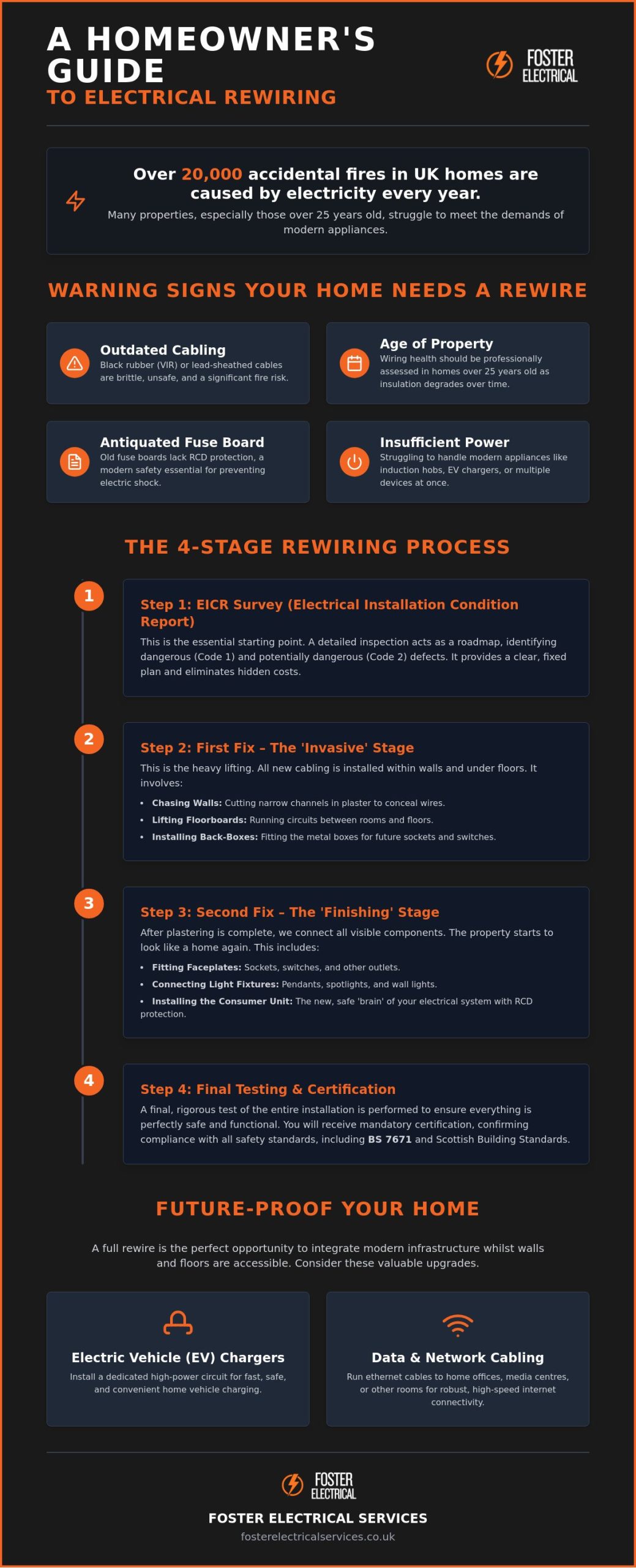
Did you know that over 20,000 accidental fires in UK homes are caused by electricity every year? With nearly 40% of our housing stock dating back to before 1946, many Dundee properties are currently struggling to keep up with the heavy demands of modern appliances. We know that the thought of an electrical rewiring process can feel overwhelming. You likely worry about the inevitable mess, the disruption to your home office, or the confusing technical jargon used by larger, more anonymous companies.
We believe your home should be a sanctuary, not a building site, and it must be treated with the highest level of care and respect. This guide provides a straightforward, step-by-step look at how we manage a full rewire, ensuring your property meets the latest April 2026 Amendment 4 safety standards. We will explain the difference between first and second fixes, offer a realistic project timeline, and share our professional tips for preparing your rooms to keep dust at bay whilst we work.
Key Takeaways
- Identify the signs that your property needs a full rewire and why homes over 25 years old require a professional assessment to meet modern safety standards.
- Gain a clear understanding of the electrical rewiring process by breaking down the two-stage workflow of first and second fix installations.
- Prepare your living space effectively with our checklist designed to minimise mess, protect your floorboards, and manage daily disruption.
- Future-proof your home by integrating essential modern infrastructure such as EV chargers and data cabling whilst the walls are already open.
- Learn about the mandatory certification and Scottish Building Standards notifications required to keep your property legal and safe.
The Electrical Rewiring Process: Understanding the Scope and Necessity
A full rewire is much more than a simple maintenance task; it is a fundamental restoration of your home’s nervous system. We define this as the total replacement of every electrical cable, socket, and switch, culminating in the installation of a modern consumer unit. This work ensures your property can safely handle the high-power demands of modern life, from induction hobs to electric vehicle chargers. Most properties require a professional assessment of their wiring health every 25 years. Beyond this age, the protective insulation on cables begins to degrade, which significantly increases the risk of faults or even domestic fires.
In many of Dundee’s older homes and tenements, we still encounter “danger signs” that indicate a system is reaching the end of its life. If you spot black rubber (VIR) cabling or lead-sheathed wires, your system is likely brittle and unsafe. These materials were standard decades ago but cannot meet the safety requirements of the current BS 7671:2018 Amendment 4 regulations. For a broader electrical wiring overview, one can see how these standards have evolved to protect families from modern electrical hazards. We take a meticulous approach to identifying these risks, treating your property with the same care we would our own.
Full vs. Partial Rewires: Which Does Your Property Need?
A partial rewire is often suitable when you are only renovating a specific area, such as a kitchen extension or an attic conversion. However, we must be careful about “mixing” old and new technology. Modern circuits require RCD (Residual Current Device) protection to meet safety standards. Connecting new wiring to an antiquated fuse board can create dangerous gaps in your home’s protection. We always suggest reviewing our guide on Full Property Rewires in Dundee to understand why a comprehensive upgrade is often the most reliable way to future-proof your investment.
The Role of the EICR in Planning Your Upgrade
The electrical rewiring process always begins with a detailed Electrical Installation Condition Report (EICR). We use this report as a roadmap for the entire project. It identifies Code 1 (Immediate Danger) and Code 2 (Potentially Dangerous) defects that must be addressed to ensure your home is compliant. Whilst an EICR is a legal requirement for Scottish landlords every five years, it is also a vital tool for homeowners who want an honest, transparent assessment of their property’s safety. You can find more detail on these requirements at our EICR Certificate Dundee page. This initial survey allows us to provide a clear, fixed plan, eliminating the anxiety of hidden costs later in the project.
The Two-Stage Workflow: First Fix and Second Fix Explained
Once the initial EICR has provided our roadmap, we begin the physical transformation of your home. We break the project into two distinct phases to maintain order and ensure the highest standards of safety. This structured approach allows us to manage the complexity of a full rewire whilst keeping your living space as tidy as possible. The electrical rewiring process is a logical sequence of Survey, First Fix, Second Fix, and Final Testing. By following this steady rhythm, we eliminate the guesswork and provide you with a clear timeline for the project.
First Fix: Cables, Chasing, and Floorboards
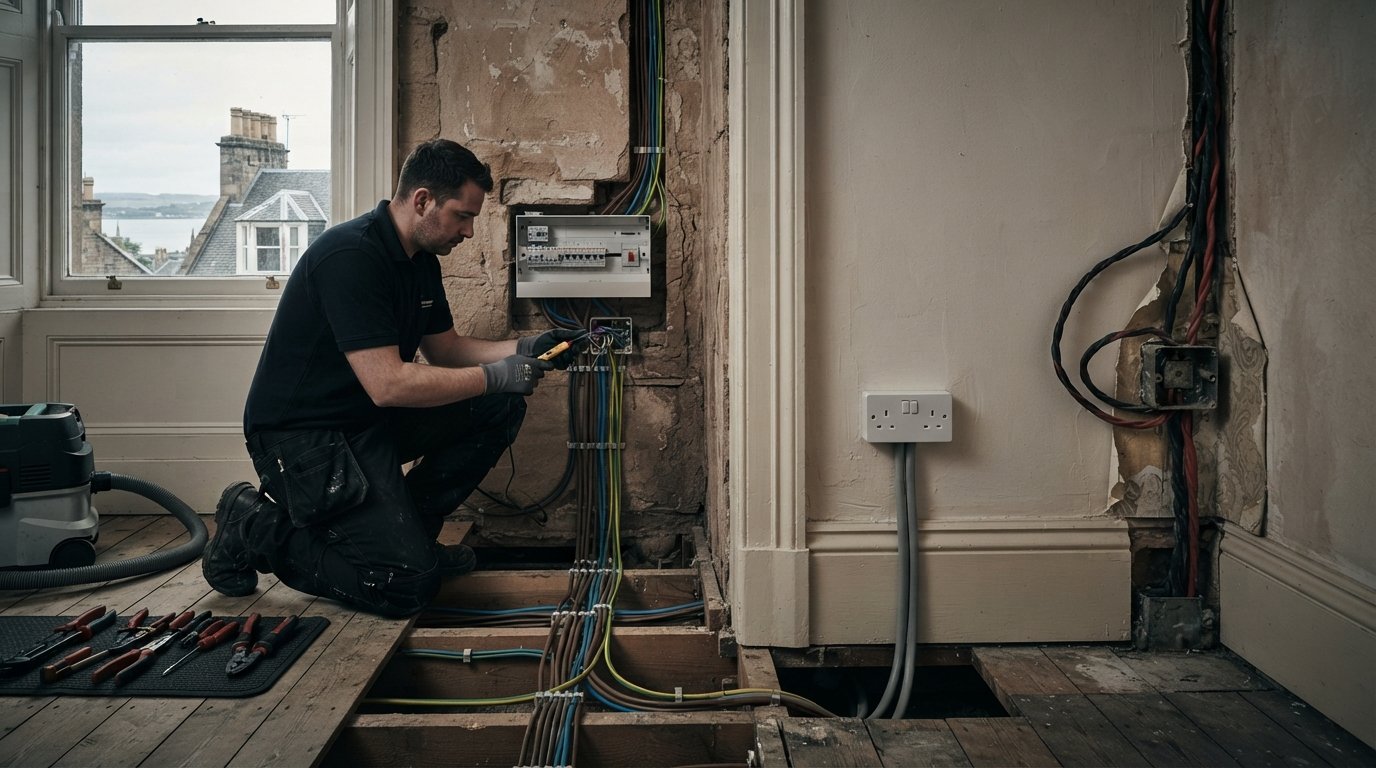
This is the most invasive part of the project. During the first fix, we install all the new cabling and the metal back-boxes that will eventually house your sockets and switches. It involves “chasing” the walls, which means cutting narrow channels into the plaster to hide the wires from view. We also lift floorboards to run circuits between floors and rooms. We understand that many Dundee homes feature beautiful, traditional floorboards. We take meticulous care to lift and replace them with precision; we avoid the splintering and damage often seen with larger, less personal firms. By keeping our work areas clean and organised, we minimise the dust that naturally occurs during this heavy lifting phase.
Second Fix: Fitting Sockets, Switches, and the Consumer Unit
After the walls are made good and the “bones” of the system are safely in place, we move to the second fix. This is the assembly phase where your property begins to look like a home again. We connect all the visible components, including your chosen faceplates, light fixtures, and a modern RCD-protected consumer unit. This modern board acts as the brain of your home, providing vital protection against electrical shocks and fires. You can learn more about the specific safety benefits of these modern installations in our guide to Consumer Unit Upgrades 2026.
This phase also includes the integration of interlinked smoke and heat alarms to ensure full compliance with Scottish safety regulations. We follow rigorous protocols, similar to the high-level OSHA electrical safety standards, to ensure every connection is secure and compliant. We don’t just test at the end; we verify circuit integrity at every stage to guarantee the durability of our work. If you are curious about how these stages would work in your own home, please get in touch with us for a straightforward, honest discussion about your needs.
Managing Disruption: Preparing Your Home for a Rewire
We understand that the primary concern for most homeowners isn’t the technicality of the copper wires; it’s the state of their carpets and decor. The electrical rewiring process is undeniably disruptive, as it requires us to access almost every corner of your living space. We view ourselves as protective guardians of your environment. This means we take personal responsibility for minimising the impact on your daily life. We don’t just see a project; we see your home. By preparing properly, we can work together to keep the chaos at bay.
Preparation is the key to a smooth experience. We recommend following this simple checklist to help us work efficiently whilst protecting your belongings:
- Move furniture at least one metre away from walls to provide clear access for chasing and socket installation.
- Roll up and remove rugs or valuable floor coverings to prevent them from catching dust or debris.
- Clear out cupboards that house the consumer unit or any existing electrical points identified in your survey.
- Cover large items of furniture with heavy-duty plastic sheeting to provide an extra layer of protection.
You won’t be left entirely without power. We organise temporary power stations for essentials like your fridge, freezer, and Wi-Fi router so you can still function. At the end of every working day, we perform a thorough, meticulous tidy-up. We don’t believe in leaving a client to navigate a building site in the evening; we ensure your home is respectable and safe before we head away.
The Dust Factor: Protecting Your Decor
Whilst a rewire is best performed in an empty property, we have perfected the art of working in occupied homes. We use industrial dust extraction tools and isolate work areas with protective sheeting to keep the mess contained. We always advise our clients to delay any planned redecorating or final plastering until after the First Fix is complete. This ensures your new paintwork isn’t compromised by the heavy lifting required during the early stages of the electrical rewiring process.
Living in the Property During a Rewire
Expect a certain level of noise. Hammering and drilling are necessary parts of the job, and we will be moving amongst your private rooms. We respect this privilege and maintain a professional, quiet demeanour. Each evening, we establish a “safe zone” for your family. This area will have working lights and sockets so you can relax in comfort. For those with pets, we suggest keeping them in a secure, quiet room or with a neighbour. This keeps them away from the noise and ensures they don’t accidentally wander into an active work zone.
Future-Proofing: Modern Upgrades to Consider During a Rewire
We believe that a rewire is more than a safety necessity; it’s a once-in-a-generation opportunity to modernise your home’s capabilities. Because the electrical rewiring process involves accessing the hidden spaces behind your walls and beneath your floors, it’s the most cost-effective time to install infrastructure that would be difficult to add later. We take a long-term view of your property. Our goal is to ensure your home remains functional and high-performing for the next thirty years, saving you the expense and hassle of future remedial work.
One of the most common regrets we hear from homeowners is that they didn’t add enough sockets. Modern Dundee families use significantly more technology than previous generations, and relying on unsightly extension leads can actually overload your new circuits. We recommend doubling the socket count in home offices and media centres. We also suggest installing dedicated circuits for high-load appliances. This prevents your lights from flickering when the washing machine or oven kicks in, providing a steady, reliable flow of power throughout the house.
EV Charging and External Power
The transition to electric vehicles is accelerating. Even if you don’t currently own an EV, we strongly advise pre-wiring for a home charging point whilst the walls are open. Installing the heavy-duty cabling now is a fraction of the cost of a standalone installation later. You can explore the benefits of this preparation in our guide to EV Charger Installation Dundee. We also suggest adding weatherproof outdoor sockets. These are invaluable for garden maintenance, security lighting, or even festive displays, and they eliminate the need to run dangerous cables through open windows.
Smart Home and Data Cabling
Dundee’s traditional stone-built homes often suffer from Wi-Fi “dead zones” due to their thick internal walls. We can solve this during the electrical rewiring process by installing Cat6 data cabling. This provides a hard-wired internet connection to every room, ensuring seamless 4K streaming and reliable home working. We can also integrate smart dimmers and app-controlled lighting during the Second Fix phase. These systems offer incredible convenience and pair perfectly with a modern LED Lighting Upgrade Dundee, which can significantly reduce your monthly energy bills. If you’re ready to transform your property into a modern, efficient home, please contact us today to discuss your upgrade options.
Certification and Choosing a Trusted Dundee Electrician
Selecting the right contractor for your home is a decision rooted in trust. You aren’t simply buying copper and plastic; you’re investing in the long-term safety of your family and the integrity of your property. The electrical rewiring process concludes with a suite of legal paperwork that proves your home is safe and compliant. We urge Dundee homeowners to be wary of “cowboy” contractors who offer cut-price rewires. These individuals often skip the essential testing phases or fail to provide the legal documentation required by Scottish law. A cheap quote today can lead to incredibly expensive remedial work tomorrow.
In Scotland, a full rewire is a significant undertaking that must be notified to Building Standards. This isn’t just red tape; it’s a vital safety check. We take full responsibility for this, providing you with a formal Electrical Installation Certificate (EIC) upon completion. This document is a declaration that every circuit, socket, and connection in your home complies with the BS 7671:2018 Amendment 4 regulations. We believe in transparency and honesty, ensuring you have every piece of paper you need to protect your investment.
The Importance of NICEIC Registration
We are proud to be NICEIC registered, which serves as a mark of our grounded professionalism. This isn’t a one-off badge; we undergo rigorous annual assessments to prove our technical standards remain at the highest level. This accreditation protects you through the NICEIC Platinum Promise. If any work is found to be non-compliant, the NICEIC ensures it is corrected at no extra cost to you. We prefer this artisanal, person-to-person approach over the anonymous service provided by large national firms. We act as your diligent neighbour, taking personal pride in every connection we make and every floorboard we carefully replace.
Final Testing and Handover
The electrical rewiring process isn’t officially finished until the final inspection is complete. We perform a series of technical tests on every circuit to ensure they meet the strict 18th Edition regulations. Once we are satisfied that the system is perfect, we hand over your EIC. This certificate is a critical asset for your household. Without it, you may find your home insurance is void in the event of an electrical fault, and you will certainly face significant delays when you eventually come to sell your property. Once the dust has settled and your home is safe, we remain available for your future needs. We invite you to view our full range of services for any ongoing maintenance or further upgrades your home may require.
Secure Your Home’s Future with Professional Care
A full rewire is one of the most significant investments you can make in your property. It transforms a hidden safety hazard into a high-performance system ready for the demands of 2026 and beyond. By understanding each stage of the electrical rewiring process, you can manage the disruption and focus on the long-term benefits of a safe, compliant home. We take personal pride in our meticulous standards of tidiness and our expertise as 18th Edition compliant experts. We don’t just pull cables; we protect your sanctuary.
As an NICEIC Registered Contractor, we provide the honest, person-to-person service that Dundee homeowners deserve. We treat your floorboards and decor with the same care we would our own, ensuring every connection is durable and every certificate is correct. If you are ready to modernise your property and gain total peace of mind, we are here to help. Request a meticulous property survey from Dundee’s trusted electricians. We look forward to helping you build a safer, brighter future for your home.
Frequently Asked Questions
How long does the electrical rewiring process typically take for a 3-bedroom house?
A standard 3-bedroom house typically takes between 5 and 10 working days to complete. The exact duration depends on the property’s layout and whether it is occupied whilst we work. We provide a firm schedule after our initial survey so you can plan your week with confidence. Our team works diligently to maintain a steady rhythm, ensuring we meet our deadlines without compromising on our high standards of execution.
Can I stay in my home whilst the rewiring is being carried out?
Yes, you can stay in your property, though you should expect a level of disruption. We manage the electrical rewiring process by creating “safe zones” each evening. This ensures your family has access to essential power and lighting once we finish for the day. Whilst it is easier to work in an empty house, our meticulous approach to tidiness makes living through a rewire much more manageable for local families.
Will a house rewire cause a lot of damage to my walls and ceilings?
Some disruption to your plasterwork is inevitable because we must “chase” channels into the walls to hide the new cabling. We take great care to keep these channels narrow and tidy. You will need a professional plasterer to skim these areas once the First Fix is complete. We always advise our clients to delay any planned redecorating until after we have finished our work to ensure a perfect, long-lasting finish.
Do I need to be out of the house during the First Fix stage?
You don’t have to leave, but the First Fix is the loudest and dustiest part of the project. Many homeowners prefer to be out during the day whilst we are cutting channels and lifting floorboards. We act as protective guardians of your space, ensuring the property is secure and respectable before you return each evening. We always prioritise your comfort and safety throughout this intensive phase of the project.
Is it possible to rewire a house without removing the floorboards?
It is rarely possible to perform a comprehensive rewire without lifting at least some floorboards. Cables must run through the floor voids to reach your sockets and light fittings safely. We pride ourselves on our artisanal ability to lift and replace traditional Scottish floorboards with precision. We avoid the splintering and damage often seen with less careful contractors, ensuring your home’s character is preserved whilst the system is modernised.
What is the average cost of a full property rewire in Dundee for 2026?
The cost of a rewire depends entirely on the specific requirements of your property and your choice of modern upgrades. We don’t provide generic estimates because every Dundee home is unique. Instead, we offer a meticulous survey to provide a transparent, fixed price for our high-standard work. This avoids the hidden costs often associated with larger corporations and ensures you receive an honest, person-to-person quote tailored to your home.
How do I know if my fuse box needs to be replaced during the rewire?
If your current fuse box has a wooden back, uses replaceable fuse wire, or lacks modern RCD protection, it will certainly need replacing. A modern consumer unit is a standard component of the electrical rewiring process. It acts as the brain of your home, providing vital protection against electrical shocks and fires. We ensure your new board is fully compliant with the latest April 2026 Amendment 4 safety regulations.
Will I receive a safety certificate once the rewiring process is complete?
You will receive a formal Electrical Installation Certificate (EIC) once our final testing is finished. This document is your legal proof that the work complies with the 18th Edition Wiring Regulations. It is a vital asset for your home insurance and is required by solicitors if you ever choose to sell your property. We also handle the mandatory Building Standards notifications to ensure your project is fully documented and legal.