Saving a few hundred pounds by fitting your own charging point seems like a sensible weekend project, but the reality is that “can I install my own ev charger uk” is less about your DIY skills and more about the strict legal framework protecting your home. It’s perfectly natural to feel frustrated by high installation quotes or confused by talk of Part P and BS 7671 regulations. We understand that you want a fair price without the corporate jargon, yet cutting corners with high-voltage electricity puts your vehicle, your property, and your family at risk.
In this article, we’ll explain the legal requirements for a “competent person” and why your home insurance might be void if you pick up the drill yourself. We’ll show you the specific safety risks involved and how to ensure your installation meets the latest 18th Edition wiring standards. We’ll also discuss how to find a reliable local expert in Dundee who values your safety as much as you do. By the end, you’ll have a clear path to getting your EV charger running safely and legally, ensuring your peace of mind is never compromised for the sake of a quick fix.
Key Takeaways
- Understand why the answer to “can i install my own ev charger uk” is legally restricted to hardware mounting, as the final connection requires certification under UK Building Regulations.
- Discover the hidden safety risks of thermal stress and DC leakage that make professional installation a necessity for protecting your family and property.
- Learn how to safeguard your home insurance policy and vehicle battery warranty by securing the correct electrical certification.
- See how professional load balancing prevents your home’s main fuse from tripping during high-demand charging sessions.
- Recognise the value of a local Dundee specialist who prioritises traditional diligence and a tidy, artisanal finish over impersonal corporate speed.
The Legal Reality: Can You Legally Install an EV Charger in the UK?
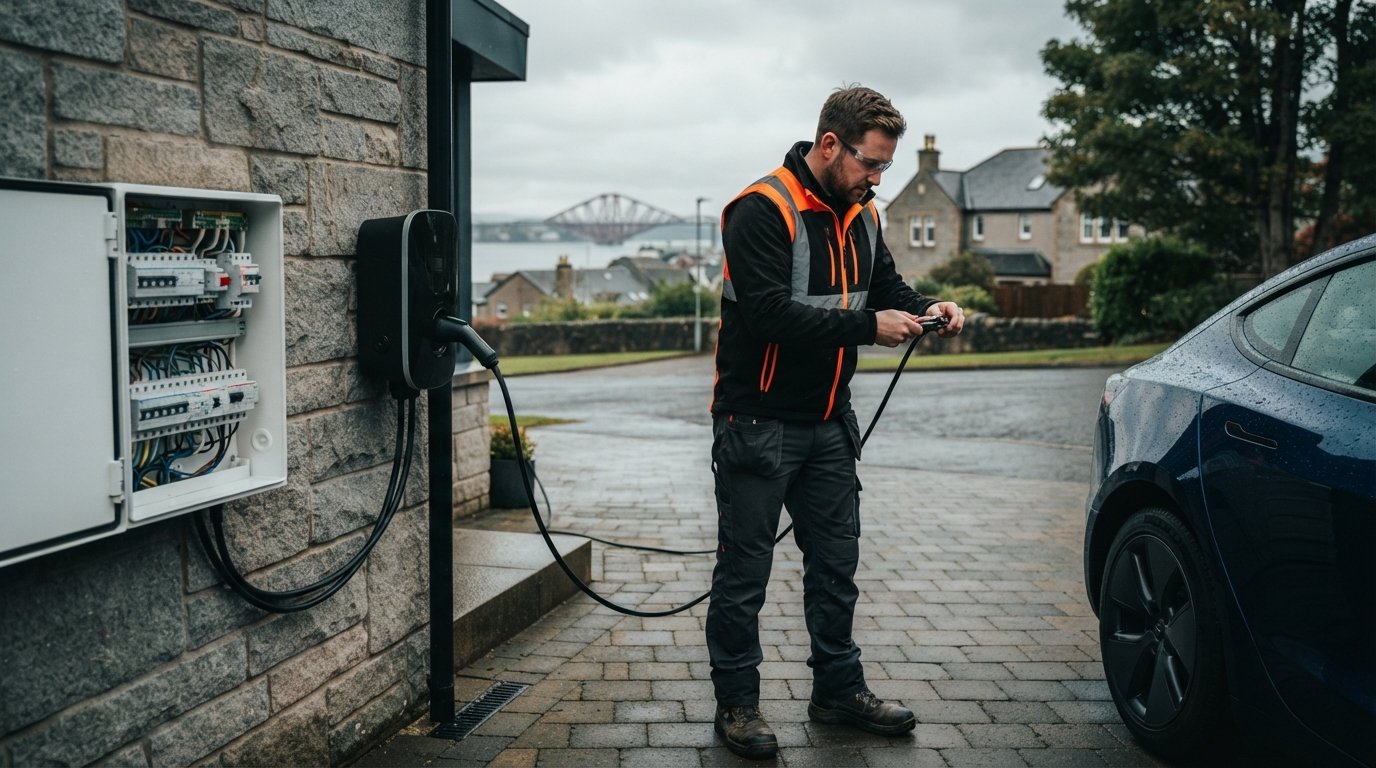
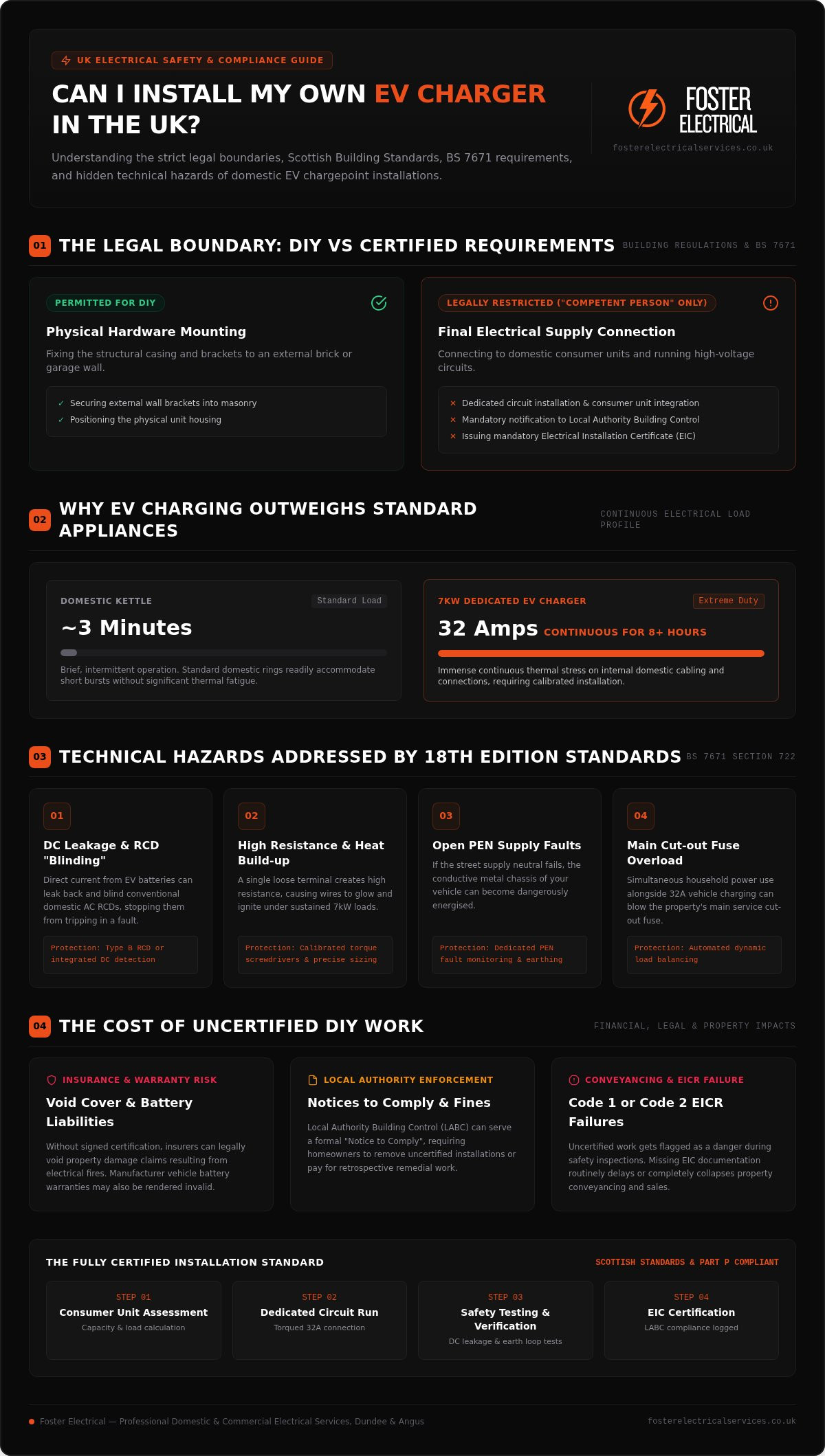
Many homeowners ask, “can i install my own ev charger uk” whilst looking at the mounting brackets in the box. Technically, you can fix the hardware to your external wall. However, the law draws a firm line at the point where that charger meets your home’s electrical supply. Under UK Building Regulations, installing a dedicated circuit for an electric vehicle is not a simple DIY task. It requires a “competent person” to ensure the work meets the rigorous BS 7671 wiring regulations. These standards, specifically Section 722, dictate how high-current devices must be protected to prevent fire or electric shock. We take this responsibility seriously, acting as guardians of your home’s safety.
Understanding Part P and Scottish Building Standards
While England uses “Part P” to govern domestic electrical safety, we operate under the Scottish Building Standards here in Dundee and Angus. Any new circuit installation, such as an EV charger, is a “notifiable” work. This means you must inform your Local Authority Building Control (LABC) of the changes. We handle this process for our clients by issuing an Electrical Installation Certificate (EIC) upon completion. This document is your legal proof that the work is safe. Without it, you are essentially operating outside the law, which can lead to complications if you ever need to claim on your home insurance. We believe in transparency and honesty, ensuring every job we finish is fully documented and legal.
The Risk of Uncertified Electrical Work
Choosing to bypass professional certification carries heavy consequences. If a local authority discovers uncertified work, they can issue a “notice to comply,” which often results in fines or the requirement to rip out the installation at your own expense. Selling your home in Tayside becomes significantly harder too. Solicitors now routinely ask for electrical safety paperwork during the conveyancing process. If you cannot produce an EIC, you might find your sale falling through. Additionally, uncertified work will be flagged as a “Code 1” or “Code 2” danger during a future EICR inspection. We often see DIY attempts that fail these tests, requiring costly remedial work to bring the electrical services up to modern safety standards.
Safety First: Why EV Charging is More Complex Than a Standard Socket
Charging an electric vehicle is not like plugging in a lamp or even a powerful kettle. A kettle runs for three minutes; a car charger pulls 32 amps of current continuously for eight hours or more. This creates immense thermal stress on your home’s infrastructure. When people ask, “can i install my own ev charger uk”, they often overlook that domestic wiring isn’t naturally designed for this level of endurance. We see our role as protective guardians, ensuring that this heavy load doesn’t compromise the integrity of your property.
One of the most complex risks involves “DC leakage”. Most homes have standard RCDs designed for alternating current (AC). However, EV batteries use direct current (DC). If a fault occurs, DC can leak back into your system and “blind” a standard RCD, preventing it from tripping when you need it most. Following the UK government chargepoint specifications requires specific Type B RCDs or built-in protection. This is why a modern consumer unit is vital. It provides the necessary foundation to handle these sophisticated safety requirements without putting your family at risk.
The Threat of Electrical Fires and Overheating
A single poorly tightened terminal can become a point of high resistance. Under a constant 7kW load, that terminal will glow and eventually ignite. We use calibrated torque screwdrivers to ensure every connection is perfect. We also calculate cable sizing meticulously. Using a cable that is too thin causes a voltage drop, which translates directly into heat trapped behind your walls or under floorboards. Our electrical services focus on these artisanal details that a DIY approach might miss.
PEN Fault Protection and Earthing
Earthing is perhaps the most misunderstood part of EV charging. If the main supply neutral fails in the street, known as a PEN fault, the metal chassis of your car could become live. Touching the car whilst standing on the ground could then result in a fatal shock. Professional installers use chargers with internal PEN fault detection or install dedicated earth rods. When considering “can i install my own ev charger uk”, ask yourself if you have the testing equipment to verify these safety paths. If you feel unsure about your current earthing setup, speaking with a local specialist can provide the clarity you need to stay safe.
The Financial Pitfalls: Insurance, Warranties, and Hidden Costs
The initial thought of saving money by handling the installation yourself often disappears when you look at the long-term financial risks. While the question “can i install my own ev charger uk” is usually born from a desire to be frugal, the hidden costs of a DIY mistake can be devastating. We see ourselves as protective guardians of your investment. A professional installation isn’t just a service; it’s a layer of financial security for your future.
Invalidating Your Home Insurance
Insurers may refuse to pay out for fire damage caused by uncertified electrical work. If the worst should happen and a fault in your charger leads to a fire, your insurance provider will almost certainly ask for the Electrical Installation Certificate (EIC). Major UK insurers do not recognise “self-certification” by anyone other than a registered, competent professional. Without this paperwork, you could be left to cover the entire cost of property repairs yourself. We provide all the necessary certification as standard, ensuring your policy remains a robust safety net for your home.
Impact on Vehicle Warranties
Your electric vehicle is likely one of the most expensive items you own, and its battery is its most sensitive component. Manufacturers like Tesla, VW, and Hyundai often specify that charging equipment must be installed to local standards to maintain the vehicle’s warranty. A poorly installed unit can suffer from voltage spikes or “surges” that damage the car’s onboard charger. Saving a few hundred pounds today on a DIY project could easily lead to a repair bill in the thousands if the manufacturer determines the fault was caused by an uncertified home setup. Following the Energy Saving Trust EV charging guide is the best way to ensure your car and its warranty remain protected.
There are also broader financial implications regarding government support and property value. Eligibility for the OZEV grant, where it still applies for certain property types, is strictly tied to professional, accredited installations. In Scotland, a professional installation adds tangible value to your property’s Home Report. If you decide to sell your home, having a certified, safe charging point is a major selling point for potential buyers in Dundee. It shows that the home has been maintained with diligence and respect for modern safety standards. Ultimately, whilst you might ask can i install my own ev charger uk to save money, the professional route protects the financial future of your home and vehicle.
The Professional Installation Process: What to Expect
When you move past the question “can i install my own ev charger uk” and decide to hire a specialist, you aren’t just paying for a box on a wall. You’re investing in a meticulous, multi-stage process designed to protect your home’s electrical integrity. We approach every installation with the diligence of a protective guardian, ensuring that your new charging point integrates seamlessly with your existing electrical services. Our artisanal approach means we care as much about the neatness of the cable routing as we do about the technical safety of the connection.
Step 1: The Site Survey and Load Assessment
The process begins long before we pick up a drill. We start with a thorough assessment of your property’s main incoming fuse. Many older homes in Dundee and the surrounding areas have a 60A main fuse, while modern EV chargers require a dedicated 32A supply. We calculate your total household demand to ensure that using your shower and oven at the same time as charging your car won’t overload your system. This load balancing is critical; without it, you risk a total power failure at the most inconvenient times. We also plan the most discreet route for the heavy-duty armoured cable, ensuring we preserve the structural integrity and aesthetic of your property. If you have solar panels, we’ll also plan for smart CT clamps to help you charge using your own green energy.
Step 2: Installation and Safety Testing
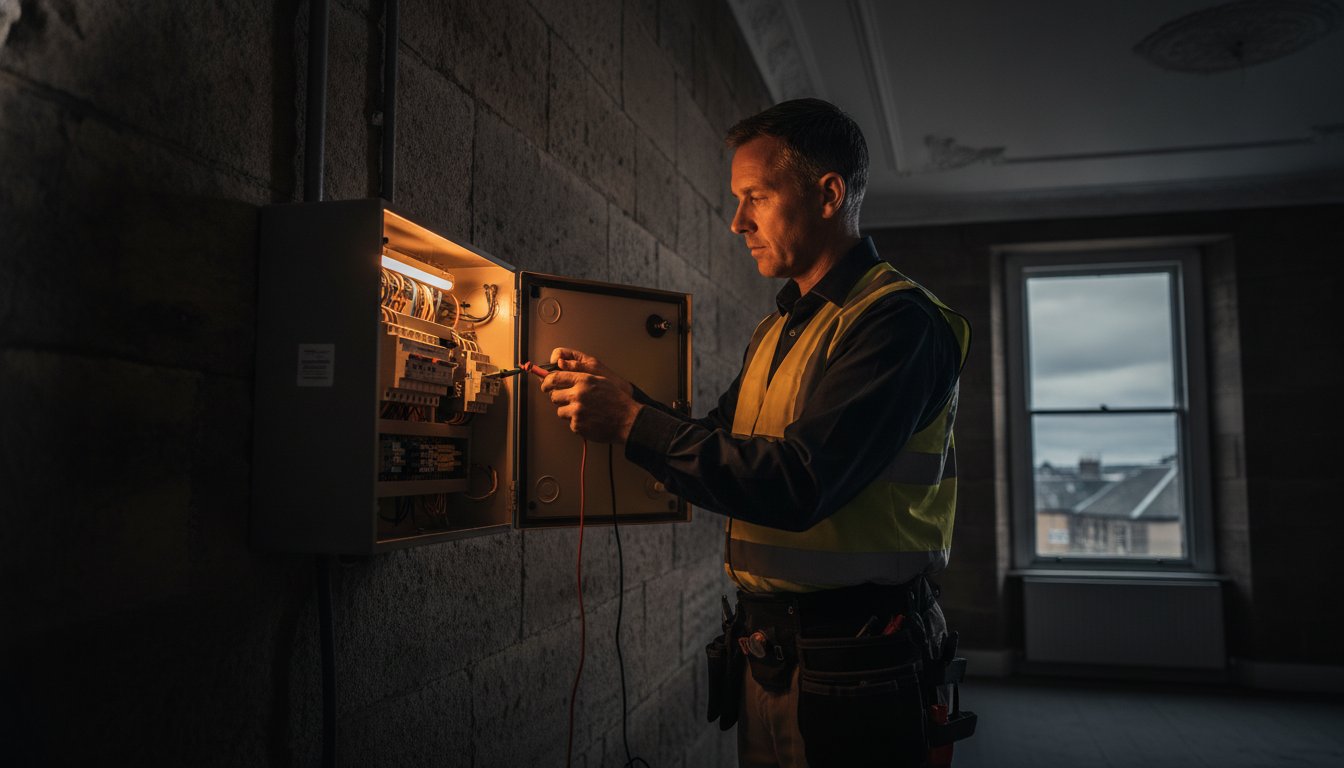
On the day of installation, we mount the charging unit and install a dedicated circuit protected by a high-specification RCBO or RCD. This isn’t just about making the car charge; it’s about ensuring the system can disconnect in milliseconds if a fault occurs. We use specialist EVSE (Electric Vehicle Supply Equipment) testers to simulate a vehicle connection and verify that all safety protocols are active. We specifically measure the earth loop impedance and RCD trip times to meet the strict 18th Edition standards. Once we’re satisfied that the installation is perfect, we’ll walk you through the charger’s smart app and safety features. We take pride in leaving your home exactly as we found it, only now it’s equipped for the future of transport. If you want to ensure your home is ready for the transition to electric, contact our local Dundee team for a professional assessment.
By choosing this professional path, you gain more than just a functional charger. You receive the peace of mind that comes from knowing every connection has been tightened to the correct torque and every safety path has been electronically verified. We don’t believe in the “quick fix” culture of larger, anonymous corporations. Instead, we provide a steady, logical service that puts your safety and domestic comfort at the very centre of everything we do.
Trusting a Local Dundee Expert for Your EV Home Charging
We believe that your home is your sanctuary, and any change to its structure deserves a high level of care and respect. When you find yourself asking “can i install my own ev charger uk”, the motivation is often a desire to take charge of your home’s upgrade whilst saving on costs. However, true peace of mind comes from knowing the job was done correctly by someone who values durability and moral character. We offer a personal, artisanal approach to EV charger installation in Dundee that prioritises your family’s safety above all else. We treat every property with the respect it deserves, ensuring a tidy, meticulous finish that larger, volume-based companies simply don’t have the time to provide.
As a local business, we possess a deep understanding of the unique electrical character of Tayside’s housing stock. From the thick stone walls of traditional tenements in the city centre to the specific consumer unit configurations in modern developments in Angus, we’ve navigated every technical challenge. We don’t use high-pressure sales tactics or hide behind automated call centres. Instead, you’ll speak directly with a diligent expert who cares about your project. We see ourselves as your neighbours, and we take personal pride in maintaining the highest standards of execution for every client we serve. This grounded professionalism ensures that your transition to electric driving is handled with honesty and integrity.
Why a Local Electrician Beats a National Firm
Choosing a local expert means choosing accountability and long-term support. We live and work alongside our clients, so we value our reputation for integrity and punctuality above a quick profit. If you ever face an issue with your setup in the future, we are just around the corner to provide fault finding and repairs. National firms often struggle with the nuances of the Scottish climate or the specific energy tariffs available to residents in Dundee and Perth. We provide tailored, honest advice that helps you get the most out of your charger whilst keeping your home’s system in perfect health for years to come. Our commitment is to the person, not just the transaction.
Get Your Professional Quote Today
We invite you to skip the confusion of technical jargon and the significant risks of DIY attempts. Our goal is to make your transition to electric driving as smooth and secure as possible. We provide transparent, logical advice rooted in traditional values of sincerity and hard work. By organising a professional site survey, you’ll receive a clear, steady plan that ensures your home is safe, legal, and ready for the future of transport. Let us act as the guardian of your environment, providing a high-standard installation that protects your vehicle and your property with quiet confidence. Contact us today to discuss how we can help you move forward safely and correctly.
Secure Your Home’s Future with Professional EV Charging
Protecting your home is a responsibility that requires diligence and traditional expertise. We’ve explored the complex legal requirements and the significant safety risks that high-voltage charging brings to your domestic environment. Whilst the question can i install my own ev charger uk is often asked to save on costs, the reality of voided insurance and potential electrical fires makes professional certification a non-negotiable necessity. Our expert 18th Edition certified electricians ensure your property remains safe, legal, and fully compliant with Scottish Building Standards.
By choosing a local expert, you’re investing in a meticulous standard of service that values your safety as much as the transaction. Foster Electrical takes immense pride in serving our neighbours across Dundee, Perth, Angus, and Fife with honesty and integrity. Don’t leave your vehicle’s warranty or your home’s security to chance when you can have the peace of mind that comes from a job done correctly. Book a professional EV charger consultation in Dundee today to ensure your home is ready for the future of transport. We look forward to helping you make the switch to electric driving with absolute confidence.
Frequently Asked Questions
Is it illegal to install an EV charger yourself in the UK?
Connecting a dedicated circuit for an electric vehicle to your mains supply is a notifiable work under UK Building Regulations. Whilst you can physically mount the unit, only a certified “competent person” can legally sign off the electrical connection. Attempting this yourself breaches safety laws and leaves you without the mandatory certification required for your property’s legal compliance. We ensure every installation meets the strict 18th Edition standards for your total peace of mind.
Can I mount the EV charger myself and have an electrician wire it?
You can physically fix the hardware to your wall, but many professional electricians won’t sign off an installation they didn’t complete from start to finish. For a specialist to issue an Electrical Installation Certificate, they must verify the cable routing and mounting meet safety standards. It’s often more straightforward to let us handle the entire process. This ensures the structural integrity of your home is preserved and the manufacturer’s warranty remains fully intact.
Do I need to notify my DNO (Distribution Network Operator) about a new EV charger?
Yes, your local Distribution Network Operator must be notified about any new EV charger installation to manage the local grid load. When we carry out an installation in Dundee or Angus, we handle this notification process for you. We assess your home’s main fuse capacity to ensure the additional 32A load doesn’t cause issues for you or your neighbours. This professional oversight prevents unexpected power cuts and ensures the local network remains stable.
Will a DIY EV charger installation void my home insurance?
Most UK home insurance policies require all significant electrical work to be carried out by a certified professional. If you wonder, “can i install my own ev charger uk”, you must consider that an uncertified installation can void your cover. If a fire occurs and you cannot provide an Electrical Installation Certificate, your insurer may refuse to pay out for damages. We act as protective guardians of your home by providing the legal paperwork your insurer demands.
What is an Electrical Installation Certificate (EIC) and why do I need one?
An EIC is a legal document that proves your new electrical circuit has been designed, installed, and tested to national safety standards. You need this certificate to prove your home is safe for insurance purposes and to satisfy solicitors when you eventually sell your property. We provide this documentation as standard with every EV installation. It’s a firm promise of quality that demonstrates the work was completed with the highest level of diligence and integrity.
Can I use a 3-pin plug to charge my electric car instead of a wallbox?
You can use a 3-pin plug for emergency charging, but it’s not recommended for daily use. Standard domestic sockets aren’t designed to pull high current for eight hours or more, which can lead to overheating and fire risks. A dedicated wallbox is much faster and includes specific safety features like PEN fault protection and DC leakage detection. We recommend a professional wallbox installation to protect your vehicle’s battery and your home’s electrical system from unnecessary stress.
How much does a professional EV charger installation cost in Dundee?
The cost of a professional installation in Dundee depends on several factors, including the distance from your consumer unit to the charger and the type of hardware you choose. We reject opaque pricing structures and instead provide transparent, honest advice based on your specific property needs. Every home is different, so we conduct a thorough site survey to give you a fair and accurate quote. This artisanal approach ensures you only pay for the high-standard work your home requires.
What happens if I install an EV charger without a permit or notification?
Installing a charger without the correct notifications can lead to enforcement action from Building Standards and significant fines. You’ll also struggle to sell your home in Tayside without the mandatory electrical certification. More importantly, you risk the safety of your family by bypassing the rigorous testing required by the 18th Edition regulations. We ensure your installation is fully legal and safe, so you never have to worry about these hidden complications or future legal headaches.