If a fire safety inspector walked through your front door this afternoon, would your documentation prove you are a diligent guardian of your building, or would it reveal a worrying gap in your compliance? We know that keeping up with the emergency lighting log book requirements uk can feel like a heavy burden, especially with the recent shift to the BS 5266-1:2025 standards. It is natural to feel a sense of anxiety about technicalities or the fear of failing an audit when you are already busy managing the daily needs of a property.
We believe that fire safety should be rooted in honest protection rather than confusing paperwork. This guide will help you discover exactly what your business needs to record to remain legally compliant with the latest UK standards. We will provide a clear checklist for your log book entries and a straightforward breakdown of mandatory testing frequencies. Our goal is to give you the practical knowledge to organise your schedules with confidence, ensuring your premises remain a safe, secure, and welcoming environment for everyone who steps inside.
Key Takeaways
- Learn exactly what the law requires of you as a ‘Responsible Person’ to ensure your building remains fully compliant with the latest fire safety standards.
- Discover the specific emergency lighting log book requirements uk for 2026, from recording battery types to maintaining an accurate site plan for every luminaire.
- Master the essential testing frequencies, including how to correctly document daily visual checks and monthly functional tests without any technical confusion.
- Evaluate whether a traditional physical log or a modern digital solution is the best fit for your property’s specific needs and inspection readiness.
- Understand how professional maintenance support can bridge the gap between complex technical standards and the practical safety of your local business.
The Legal Framework: Why Your Log Book is Mandatory in 2026
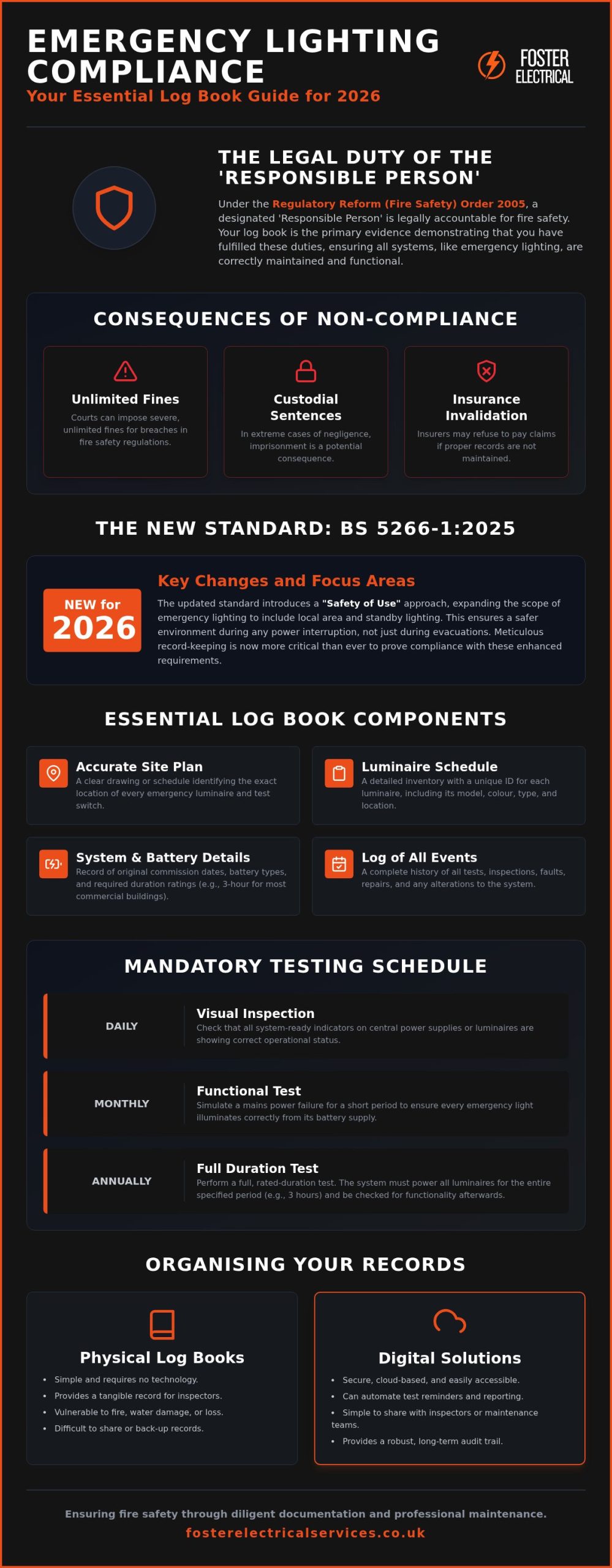
The Regulatory Reform (Fire Safety) Order 2005 is the legal foundation for fire safety in England and Wales, while similar stringent duties apply under Scottish law. In 2026, the focus on documented proof has intensified. For every business owner or landlord, the “Responsible Person” is the individual legally accountable for the safety of everyone inside the building. This role isn’t a mere formality. It requires you to ensure that all fire safety systems, including emergency lighting, are in good working order. Your log book is the only way to prove you’ve met these obligations. Without it, you are essentially operating in the dark, legally speaking.
Insurance companies have become significantly stricter regarding documentation. They view an incomplete or missing log book as a failure to manage risk. If an incident occurs and you cannot provide evidence of UK emergency lighting testing, your insurer may refuse to pay out. This leaves you personally liable for damages and legal costs. We’ve seen how a lack of simple record-keeping can jeopardise the future of a family-run business. It is a risk that is simply not worth taking when clear documentation is so straightforward to maintain.
Understanding BS 5266-1 Standards
BS 5266-1:2025 is the current code of practice that we follow to keep your premises safe. This updated standard, published in late 2025, introduced a “Safety of Use” approach. It expands the scope of emergency lighting to include local area and standby lighting, ensuring that people aren’t left in total darkness during any power cut. The standard dictates how your safety systems should behave and requires meticulous record-keeping to satisfy the latest emergency lighting log book requirements uk. It isn’t just about whether the lights turn on; it’s about proving they stay on for the required duration to protect lives.
Consequences of Non-Compliance in the UK
Neglecting your log book can lead to unlimited fines or even custodial sentences in extreme cases. For Tayside business owners, a fire service audit that reveals poor documentation can result in an enforcement notice, effectively halting your operations until the issue is rectified. Since the new PEEPs (Personal Emergency Evacuation Plans) regulations came into force on 6 April 2026, the scrutiny on residential and commercial landlords has never been higher. We act as a protective guardian for your property, handling the technical details so you don’t have to. You can find more about our professional electrical services and how we simplify compliance for our neighbours in Dundee and the surrounding areas.
Essential Components of a Compliant Emergency Lighting Log Book
A compliant log book serves as the definitive safety roadmap for your property. It isn’t merely a collection of signatures; it’s a detailed record that proves your diligence as a building owner. Under The Regulatory Reform (Fire Safety) Order 2005, you must maintain these records to satisfy fire inspectors and insurance providers alike. A well-organised log book should include the original commission dates, battery types, and specific luminaire models installed throughout your premises. This level of detail ensures that when a component reaches the end of its life, you can replace it with the correct, high-standard part without any guesswork.
The site plan is perhaps the most vital part of meeting the emergency lighting log book requirements uk. You need a clear drawing or schedule that identifies the exact location of every emergency light and test switch. If you’ve recently modified your system or added new LED units, these changes must be documented immediately. We take pride in helping our neighbours maintain these records with artisanal care, ensuring that every entry is accurate and every modification is accounted for.
Identifying Your Safety Infrastructure
We recommend creating a unique ID for each luminaire. This simple step transforms a confusing list into an easy-to-track inventory. Your records should note the colour and type of each unit, alongside its duration rating. Most UK commercial buildings require a 3-hour duration to allow for safe evacuation and the arrival of emergency services. By recording these specifics, you demonstrate a level of thoroughness that reassures both residents and regulators that their safety is in expert hands. It’s about building a cumulative sense of security through honest, clear documentation.
The Log of Events and Faults
Don’t be afraid to record a failure. A log book that shows only perfect results over many years can actually look suspicious to an auditor. What matters is how you respond. Every time a bulb flickers or a battery fails a duration test, you must note the date, the nature of the fault, and the remedial action taken. Linking these entries to your Fault Finding and Repairs documentation shows a continuous chain of care. If you’re unsure if your current records would pass a fire safety audit, we’d be happy to review your documentation and help you get back on track.
Testing Frequencies and Recording Protocols
Maintaining a safe building requires a steady, logical rhythm of testing. We believe that regular diligence is the best way to bridge the gap between technical standards and the practical comfort of your occupants. Your testing schedule should follow a clear sequence: daily visual checks, monthly functional tests, and an annual full-duration discharge. These routines ensure that your safety infrastructure is always ready to perform its role as a protective guardian.
Daily visual checks are simple but vital. You should ensure the green or red LED indicators on each luminaire are illuminated, which confirms the battery is charging and the circuit is healthy. While you don’t necessarily need a signature for every daily check, a quick walk-around demonstrates the kind of personal pride in high standards that fire inspectors value. It’s about catching small issues before they become safety pitfalls.
The Monthly ‘Flick Test’ Protocol
The monthly functional test is a core part of emergency lighting log book requirements uk. Often called the “flick test,” this involves simulating a power failure for a short period, typically around 30 seconds to one minute. We recommend assigning a specific member of staff to this task to ensure consistency. They should use a test key to isolate the circuit and then walk the site to confirm every lamp illuminates correctly. When recording the result, use clear and direct wording. A simple entry such as “Monthly functional test completed; all luminaires operated successfully” is sufficient for a pass. If a unit fails, record its unique ID and the nature of the fault immediately to maintain a transparent chain of accountability.
Annual Duration Testing Requirements
Once a year, your system must undergo a full-duration discharge test. This is a rigorous three-hour test designed to prove the batteries can support the luminaires for the full duration required by law. Unlike monthly checks, this annual test requires professional oversight. It is risky to perform this internally because the building is left vulnerable while the batteries recharge, which can take up to 24 hours. We provide a professional sign-off that includes a certificate of compliance, giving you a sense of security that your building is safe and your liability is protected. We take the technical burden off your shoulders, handling the discharge and recharge cycle with artisanal care. If you are due for your yearly inspection, you can contact Foster Electrical for expert testing and a reliable, honest service.
Organising Your Records: Digital vs Physical Log Books
Choosing how to store your safety records is a personal decision for any business owner. Traditional paper log books offer a sense of nostalgic reliability. They don’t require a password or an internet connection during a fire inspection. However, modern digital solutions are becoming the standard in 2026. These platforms provide automated reminders and cloud storage, ensuring you never miss a deadline. To meet the latest emergency lighting log book requirements uk, digital records must be tamper-proof. This means they should have an audit trail that shows exactly when an entry was made and by whom, preventing any retrospective changes that could undermine your compliance.
We believe that whether you choose a physical book or a digital portal, the most important factor is consistency. A log book is a living safety roadmap. It shouldn’t be tucked away and forgotten until an audit looms. If you use a digital system, ensure that more than one person has access to the login details. If you prefer paper, make sure the handwriting is legible and the pages are kept in good condition. Both methods are legally acceptable as long as they provide a clear, chronological history of your system’s maintenance and performance.
Maintaining a Physical Master File
We recommend keeping your log book at the centre of your safety strategy. It should be stored in a known, accessible location, such as next to the main fire alarm panel or within the building manager’s office. Protecting these records from fire, water damage, or loss is essential; a simple fire-resistant folder or a locked cabinet can save years of vital data. When a contractor visits to perform maintenance, they must be able to locate the file without delay. This transparency builds trust with visiting inspectors and ensures a seamless flow of information between you and your electrical partners.
Rectifying Faults and Remedial Actions
A common point of confusion for many landlords is what to do when a luminaire fails a test. You have a legal duty to record the fault and the subsequent repair within a reasonable timeframe. We often see business owners worry that a “fail” entry looks bad on their record, but it actually proves your system is being monitored with diligence. Log the initial failure with its unique ID, then record the date of the repair and the “pass” result of the re-test. This creates a clear, honest history of your building’s safety. This process should be closely linked to your EICR Certificate Dundee records, providing a comprehensive overview of your electrical health. If you’re unsure how to document a recent repair or need a professional to verify your system, you can get in touch with our local team for friendly, expert advice.
Professional Support for Your Emergency Lighting Compliance
We know that managing emergency lighting log book requirements uk can feel like a daunting task when you’re already juggling the responsibilities of running a business or managing a property portfolio. Our team at Foster Electrical is here to lift that technical burden from your shoulders. We specialise in providing clear, honest support to landlords across Dundee, Perth, and the wider Tayside area, ensuring that your documentation is not just a checkbox exercise, but a robust shield against liability. Our goal is to make the transition to the 2026 standards as smooth and stress-free as possible.
By choosing a regular maintenance contract with us, you gain more than just a certificate. You gain a partnership with local experts who care about the safety of your community. We offer transparent and straightforward pricing for all our safety checks, avoiding the opaque structures often found in larger, more anonymous corporations. This steady, logical approach ensures that your building remains compliant year after year without any unexpected stress or high-pressure sales tactics. We believe that professional testing should be accessible and easy to understand, bridging the gap between technical complexity and your peace of mind.
Our Diligent Approach to Safety
We treat every commercial property with the same meticulous care that we would bring to a residential home. Our signature is rooted in punctuality, tidiness, and moral integrity; we believe that the way we conduct our work is just as important as the technical result. By ensuring your lighting system is a reliable protective guardian for your staff and visitors, we help you meet the latest emergency lighting log book requirements uk with total confidence. We take personal pride in high standards of execution, from the way we handle your property to the accuracy of every signature we place in your records.
Get Started with a Safety Audit
If you’re unsure where to begin or if your current records are incomplete, our safety audit is the perfect starting point. During our first visit to your Dundee or Perth site, we’ll assess your existing infrastructure and help you set up a compliant log book from scratch if needed. We walk you through the necessary testing protocols and ensure your site plan is up to date, leaving you with a clear roadmap for future compliance. This initial assessment eliminates ambiguity and sets a high standard for your building’s ongoing safety. We invite you to book your emergency lighting inspection today to secure your premises and protect your occupants with the help of a trusted local expert.
Protecting Your People and Your Reputation
Staying on top of fire safety is a continuous commitment to the people who live and work in your building. We’ve explored how a meticulous log book acts as your primary shield against legal liability and insurance complications. By understanding the essential components of your system and maintaining a steady rhythm of monthly and annual checks, you move beyond simple paperwork into true stewardship of your environment. It’s about ensuring that your safety systems perform exactly as they should when they are needed most.
Mastering the emergency lighting log book requirements uk is a vital step in proving you are a diligent owner. Our team brings expert knowledge of BS 5266-1 to every site visit, ensuring your documentation is robust and audit-ready. As local specialists in Dundee and Angus, we pride ourselves on providing a transparent, anti-corporate service that prioritises your peace of mind. We believe in straightforward, person-to-person interaction that focuses on the safety of your premises rather than complex technical jargon.
Secure your property’s safety – Contact Foster Electrical for a compliance audit.
We are here to help you navigate these regulations with ease, ensuring your property remains a safe and welcoming space for everyone who enters.
Frequently Asked Questions
Is an emergency lighting log book a legal requirement for small businesses?
Yes, it is a mandatory requirement for all UK businesses, including small shops and offices. The law doesn’t distinguish between a large corporation and a local Dundee café when it comes to life safety. You must be able to prove that your system is maintained through documented evidence. Failing to keep a log book can lead to enforcement notices or fines, as it leaves you unable to demonstrate compliance during a fire safety audit.
How long should I keep my old emergency lighting records for?
We recommend keeping your records for a minimum of three to five years. While the current year is the most critical for an inspector, having a historical trail shows a consistent pattern of diligence and care. This long-term record is particularly useful if you ever need to make an insurance claim or if an auditor wants to see the life cycle and repair history of specific luminaires in your building.
What should I do if my emergency lighting log book is lost?
You should start a new record immediately and conduct a full system audit to re-establish your baseline data. This involves identifying every luminaire, its location, and its duration rating. We often help our neighbours in Angus and Fife recreate these records from scratch. It is better to have a fresh, accurate log book than to have no documentation at all when a fire officer arrives for an inspection.
Can any electrician sign off on my annual emergency lighting test?
While the law mentions a “competent person,” it is safest to use a qualified electrician who understands the technicalities of BS 5266-1:2025. An expert sign-off provides a level of security that a general handyman cannot offer. For businesses in Perth and Tayside, using a specialist ensures that your emergency lighting log book requirements uk are met correctly, protecting your liability and the safety of your staff.
Do I need a separate log book for fire alarms and emergency lighting?
You don’t necessarily need separate physical books, but the records must be clearly organised into distinct sections. Many landlords use a single “Fire Safety Log Book” that contains partitions for fire alarm testing, emergency lighting, and extinguisher service records. As long as the information is accessible and easy for an inspector to navigate, keeping them together in one secure master file is a practical and efficient choice.
How often should I update the site plan in my log book?
Your site plan must be updated whenever you modify the system or add new units, such as during an LED lighting upgrade. An outdated plan is a common safety pitfall that can cause confusion during an emergency or a professional audit. We suggest reviewing the plan annually during your full duration test to ensure every luminaire is still correctly identified and located on your building’s safety roadmap.
What are the common failures inspectors look for in a log book?
Inspectors often look for gaps in monthly “flick tests” or faults that have been recorded but never signed off as repaired. They also check for missing commission dates and battery duration ratings. A log book that only shows passes for ten years without any recorded maintenance can also raise red flags. Honest, clear documentation of both failures and their subsequent repairs shows that you are actively managing your building’s safety.
Are there specific log book requirements for HMOs in Scotland?
Scottish HMO regulations are particularly stringent regarding tenant safety. Landlords in Dundee and across Scotland must provide documented proof of regular testing to maintain their license. This includes keeping a meticulous log book that details monthly functional checks and annual discharge tests. Failure to produce these records can result in the loss of your HMO license and significant legal challenges from local authorities.