Receiving an “Unsatisfactory” report doesn’t mean you’ve failed as a landlord; it means your property’s safety roadmap has just been clearly defined. With the 2026 updates to the Scottish Repairing Standard and the potential for fines reaching £40,000, the pressure to act quickly is understandable. Discovering you have a failed eicr scotland can feel like a heavy burden, especially when you’re staring at C1 or C2 codes and wondering how to move forward.
We know you take pride in providing a safe, comfortable home for your tenants. The worry of local authority fines or the confusion over technical safety requirements can be overwhelming for any property owner. This guide helps you manage the remedial process with absolute confidence, ensuring your Dundee or Tayside property remains both legal and protected. We provide a clear roadmap through the 28-day remedial window, explain exactly what those safety codes mean for your obligations, and offer peace of mind that your investment is in safe hands.
Key Takeaways
- Learn what an “Unsatisfactory” result means for your property’s legal standing and how it differs from a “Satisfactory” report with recommendations.
- Understand the critical differences between C1 and C2 codes so you can prioritise urgent repairs and keep your tenants safe.
- Navigate the strict 28-day deadline for a failed eicr scotland to avoid local authority intervention and heavy fines.
- Discover how to organise remedial works efficiently by choosing the right contractor and requesting itemised quotes based on specific safety codes.
- Ensure your Tayside property meets the 2026 Repairing Standard with honest, fact-based feedback from a trusted local expert.
My EICR has Failed: Understanding the ‘Unsatisfactory’ Result
When we hand over a report, the word “Unsatisfactory” can feel like a personal critique of your property management. It is helpful to remember that it isn’t. In the context of an Electrical Installation Condition Report (EICR), this term simply means the installation does not meet the safety standards required for a private tenancy in Scotland. Under the Housing (Scotland) Act 2006, specifically the Repairing Standard, every landlord has a duty to ensure their property is electrically safe. If our inspection uncovers faults that could lead to fire or electric shock, the report must be marked as a “fail.”
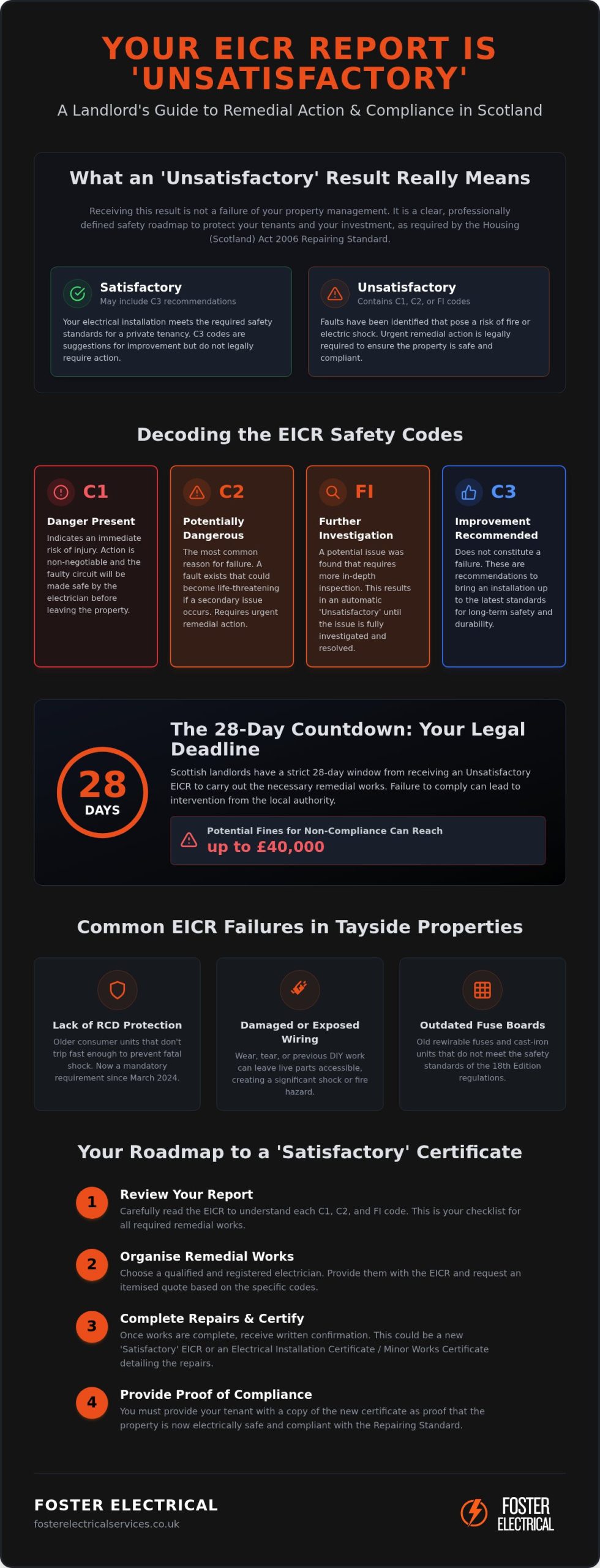
We view ourselves as the protective guardians of your environment. Our role during an inspection is to act as a safety inspector, not just a contractor looking for a job. We look for facts to ensure your tenants are safe and your investment is protected. A “Satisfactory” report might still include C3 codes, which are recommendations for improvements that don’t legally require action. However, a failed eicr scotland involves C1, C2, or FI codes that demand immediate or urgent attention to restore the property to a compliant state. You can view our full range of electrical services to see how we handle these specific safety requirements.
Unsatisfactory vs. Dangerous: What’s the Difference?
A report can be unsatisfactory without the building being on the verge of an immediate fire. Most failures occur because of “potentially dangerous” (C2) issues. These are faults that might not cause harm today but could become lethal if a secondary fault occurs. We also use the “Further Investigation” (FI) code when we observe something suspicious that cannot be fully verified during the initial inspection. Because we cannot guarantee safety without that deeper look, an FI code automatically triggers an unsatisfactory result until the issue is resolved.
Common Reasons for a Failed EICR in Scotland
We frequently encounter specific issues across the Tayside area’s unique housing stock that lead to a failed eicr scotland. These include:
- Lack of RCD protection: Many older Dundee tenements still have consumer units that do not trip fast enough to prevent a fatal shock. Since March 2024, appropriate RCD protection has been a mandatory requirement under the updated Repairing Standard.
- Damaged or exposed wiring: Years of DIY repairs or simple wear and tear can leave live parts accessible, posing a significant shock risk.
- Outdated fuse boards: Properties still using old rewirable fuses often fail to meet the rigorous safety standards of the 18th Edition Amendment 2 regulations.
Our approach is always to provide clear, honest feedback. We don’t believe in technical complexity for its own sake; we believe in straightforward safety.
Decoding EICR Codes: C1, C2, and the Dreaded FI
An EICR is more than a simple tick-box exercise. It’s a precise diagnostic tool that uses specific codes to categorise the condition of your electrical installation. According to the Scottish Government’s Repairing Standard, any report containing a C1, C2, or FI code results in a failed eicr scotland. Understanding these codes helps you see exactly where your property stands and what needs to happen next.
- Code C1 (Danger Present): This indicates an immediate risk of injury. We cannot leave a property in this state. Usually, we’ll isolate the circuit or make it safe before we pack our tools to prevent any immediate harm to your tenants.
- Code C2 (Potentially Dangerous): This is the most common reason for an unsatisfactory result. While it might not be dangerous this second, a single fault elsewhere could create a life-threatening situation. It requires urgent remedial action.
- Code C3 (Improvement Recommended): These are suggestions to bring your home up to modern standards. They don’t cause a failure, but they’re worth considering for long-term durability and safety.
- Code FI (Further Investigation): This means we’ve found something that doesn’t look right, but we can’t confirm the danger without more time or access. Because we can’t say the property is safe, it’s an automatic fail.
How Codes Dictate Your Action Plan
Your priority must always be the C1 repairs. These are the emergency items that make the property “safe” in the short term, even if the overall report isn’t “satisfactory” yet. It’s a common misconception that multiple C3 codes can add up to a fail. They don’t. Our responsibility as professional inspectors is to be accurate and honest; we won’t upgrade a C3 to a C2 just to force a repair. We only report the facts as they are. If you’re staring at a report full of codes and aren’t sure where to start, you can reach out to our team for a straightforward explanation.
The ‘Further Investigation’ (FI) Hurdle
The FI code can be frustrating for landlords because it feels like an unfinished job. We typically use this when we can’t access a specific part of a circuit, perhaps due to heavy furniture or locked rooms, but the test results suggest a hidden fault. To resolve an FI code, we need to return for specific diagnostic work to confirm the safety of that circuit. You can read our guide on Fault Finding and Repairs to understand how we track down these elusive issues. Once the investigation is complete, the FI code is replaced with a C1, C2, C3, or a pass, allowing you to move your failed eicr scotland toward compliance.
The 28-Day Countdown: Legal Deadlines for Scottish Landlords
Once you hold a report confirming a failed eicr scotland, a strict legal timeline begins. You have exactly 28 days from the date of the inspection to complete all necessary remedial works. This isn’t just a recommendation; it’s a statutory requirement that ensures your property remains fit for habitation. We understand that this window can feel tight, especially if the report identifies complex issues, but the clock starts ticking the moment the “Unsatisfactory” result is issued.
Local authorities in Dundee and across Tayside have significantly increased enforcement as of 2026. Ignoring these deadlines can lead to severe penalties, with fines for non-compliance now reaching a maximum of £40,000. It’s also vital to keep your tenants informed whilst repairs are being organised. Clear, honest communication prevents misunderstandings and demonstrates that you take their safety seriously. We always advise landlords to maintain a meticulous paper trail of every “reasonable step” taken. If a tenant denies access or a specific part is delayed, having dated records proves you’ve acted with due diligence.
Meeting the Scottish Repairing Standard
A failed report means your property currently breaches the Scottish Repairing Standard. If these issues aren’t resolved within the 28-day window, tenants have the right to take the matter to the First-tier Tribunal (Housing and Property Chamber). In 2026, the standards are more rigorous than ever, placing a heavy emphasis on modern safety features like surge protection and interlinked smoke alarms. Following the Electrical Safety First guidance for landlords is the best way to ensure you stay on the right side of the law and protect your investment.
What if the Work Takes Longer Than 28 Days?
Sometimes, despite your best intentions, work might stretch beyond the four-week window. This often happens when specific components are on backorder or if complex fault finding is required. To show “due diligence” to councils in Dundee, Angus, or Fife, you must prove the delay was outside your control. We always provide our clients with immediate documentation once work is finished. This includes either an Electrical Installation Certificate (EIC) or a Minor Electrical Installation Works Certificate (MEIWC). These documents serve as your proof of compliance, turning your failed eicr scotland into a record of safety and care. You can explore our full range of electrical services to see how we help landlords meet these tight turnarounds.
Organising Remedial Works: From Fault Finding to Final Certification
Once the dust settles on a failed eicr scotland, your next step is choosing who carries out the repairs. You aren’t legally tied to the original inspector. However, using a local expert who already knows the specific layout of your property often saves time and effort. We always suggest that any professional quote you receive should be clearly itemised by the EICR codes. This transparency allows you to see exactly which costs relate to mandatory safety fixes and which are merely recommended improvements. Dealing with a failed eicr scotland is much simpler when you have a clear roadmap for the remedial phase.
We believe that every repair should be a permanent solution, not a temporary patch. Our team works through the list of faults methodically, starting with the most critical items. We ensure all work is logged with the relevant Scottish building standards where necessary, particularly for larger jobs like consumer unit replacements. This formal notification is a vital part of your paper trail, proving that your property has been brought back to a safe, compliant state by a qualified professional.
The Remedial Process at Foster Electrical
We understand that your rental property is a home, not just a building site. Our “no mess” reputation is something we guard fiercely. We treat every Dundee home with the same care we would our own, using protective coverings and tidy working practices to respect your tenant’s space. Our first priority is always clearing the C1 and C2 items to get your property legally compliant as quickly as possible. Sometimes, it’s more cost-effective to combine these repairs with Consumer Unit Upgrades. Modern boards with built-in surge protection offer long-term safety that old fuse boxes simply can’t match.
Final Re-certification and Paperwork
A common point of confusion for landlords is whether they need a brand-new EICR after the work is done. In most cases, you don’t. The original “Unsatisfactory” report, coupled with the relevant Electrical Installation Certificates (EIC) or Minor Works Certificates (MEIWC) for the repairs, is sufficient proof of compliance. We handle the full certification and notification processes, so you don’t have to worry about the bureaucracy. Once the work is finished, keep these documents safe. You’ll need them for future inspections, insurance claims, or if the local authority requests proof of your remedial actions.
Book your EICR Remedial Works with Foster Electrical today to ensure your property meets every safety standard with minimal fuss.
Why Dundee Landlords Trust Foster Electrical for EICR Compliance
We’ve spent many years working inside the varied architecture across Tayside. From the high ceilings of traditional Dundee tenements to the precision of modern new-builds, we understand the specific quirks of local wiring. This deep familiarity means we don’t guess; we know exactly what to look for in every property. When you’re facing a failed eicr scotland, you need an expert who sees the property as a home and a vital investment. We take immense pride in our reputation as a local, family-run business that puts safety and integrity above all else.
Our “Guardian of Safety” promise is the foundation of every inspection we conduct. We never invent faults or exaggerate risks to secure more work. We only find facts. This honest approach provides landlords with the absolute reassurance that their failed eicr scotland is being handled with traditional sincerity. We offer transparent pricing and clear, person-to-person communication so you’re never left wondering about the next step. Navigating the specific EICR Certificate Dundee requirements can be complex, but we’re here to guide you through every stage of the process.
A Local Service with High Professional Standards
We serve Dundee, Perth, Angus, and Fife with a level of accountability that only a local neighbour can provide. Being a family-run team means we’re personally invested in every job we take on. We don’t just fix wires; we protect the environment where your tenants live. Our commitment to a “no-mess” reputation ensures we keep your property tidy whilst we work. We respect the privilege of entering a private space and always work with a level of sensitivity that modern, anonymous corporations often lack.
Start Your Journey to Compliance Today
If you’ve received an unsatisfactory report from another provider and feel unsure about the codes, we’re here to help. We’re happy to provide a professional review of a failed report to confirm the necessary remedial works. Our simple process includes:
- Reviewing your existing report for accuracy and clarity
- Providing an itemised, transparent quote for the necessary repairs
- Organising the remedial works at a time that suits your tenants
- Issuing the final certification to ensure you meet the 2026 standards
Booking your repairs is a straightforward, human process with no automated phone menus. We’re here to turn your compliance worries into a clear, manageable plan with quiet confidence. We stand out amongst competitors by offering an artisanal, person-to-person service that prioritises your peace of mind.
Contact Foster Electrical for Expert EICR Support.
Moving Forward with Confidence and Safety
A failed eicr scotland is simply a checklist for safety. It provides the clarity you need to protect your tenants and your investment under the 2026 Repairing Standard. By acting within the statutory 28-day window and focusing on critical C1 and C2 codes, you ensure your property remains a safe, compliant home. We’ve seen how overwhelming the technical details can feel, but with the right local partner, the path to certification is straightforward and transparent.
As expert 18th Edition safety specialists, we take pride in our “no-mess” reputation and our commitment to high standards. We’re trusted by landlords across Tayside and Fife to deliver honest feedback and meticulous workmanship that meets SELECT or NICEIC equivalent standards. We treat your property with the care it deserves, ensuring every wire and socket is fit for the future. We believe in providing a service that’s rooted in diligence and integrity, acting as the guardian of your property’s safety.
Secure Your Property with Professional EICR Remedials today. We’re here to help you navigate the regulations with ease and provide the peace of mind that comes from knowing your home is truly safe.
Frequently Asked Questions
Can a tenant stay in a property if the EICR is unsatisfactory?
Yes, tenants can typically remain in the property whilst remedial works are organised. If we find a C1 “Danger Present” fault, we’ll isolate that specific circuit or make it safe immediately to protect the occupants. The property only becomes uninhabitable if the faults are so widespread that power must be cut to the entire building. We work quickly to ensure domestic comfort isn’t disrupted for longer than necessary.
How much do EICR remedial works typically cost in Dundee?
Costs for remedial works vary significantly based on the age and condition of your electrical installation. A single socket replacement is a minor expense, whereas a full consumer unit upgrade or partial rewire involves more labour and materials. We provide itemised, transparent quotes based on the specific codes found in your report. This ensures you only pay for the work required to turn your failed eicr scotland into a satisfactory result.
Do I need to get a completely new EICR after the repairs are finished?
You don’t usually need a brand-new EICR after the repairs are completed. The original “Unsatisfactory” report stays valid when paired with the Electrical Installation Certificate (EIC) or Minor Electrical Installation Works Certificate (MEIWC) issued for the remedial work. These documents together prove your compliance with the Scottish Repairing Standard. We handle all the necessary paperwork and notifications to ensure your records are tidy and legally sound for future inspections.
What happens if I don’t fix the C2 faults within 28 days?
Missing the 28-day deadline can lead to serious legal consequences, including intervention from the local authority or the First-tier Tribunal. In Scotland, landlords who fail to maintain the Repairing Standard face significant financial penalties, which were increased in 2026. Beyond the risk of fines, your insurance policy might be compromised if a fault causes damage. We recommend booking your remedial works immediately to ensure you stay within the statutory window and protect your tenants.
Can I carry out the EICR remedial works myself if I am good at DIY?
Landlords must ensure that all electrical work is carried out by a competent person, which usually means a registered electrician. DIY repairs are not acceptable for clearing a failed eicr scotland because you cannot self-certify that the work meets BS 7671 standards. We provide the official certification required by local councils and insurance providers. Using a professional ensures the work is executed with the high standards of execution that domestic safety demands.
Does a plastic consumer unit always cause an EICR to fail in Scotland?
A plastic consumer unit doesn’t automatically cause a failure, but its location and condition are critical factors. If the unit is under a wooden staircase or on a primary escape route, it may be coded as a C2 due to fire risk standards. However, in many cases, it is recorded as a C3 recommendation for improvement. We assess each property on its own merits, providing honest feedback based on the latest 18th Edition safety regulations.
Will my insurance be void if I have a failed EICR and a fire occurs?
Most insurance providers require that you maintain your property to a safe standard as a condition of your policy. If a fire occurs and is traced back to a fault identified in an “Unsatisfactory” EICR that you failed to repair, your claim is likely to be rejected. Keeping your electrical installation compliant isn’t just about avoiding fines; it’s about protecting your financial interests and the safety of everyone inside the building.
How do I know if my electrician is qualified to sign off EICR remedial work?
You should always check that your electrician is registered with a professional body such as SELECT or NICEIC. From October 2026, Scottish regulations require electricians to hold specific Level 3 qualifications for inspection and testing. We are proud of our professional standing and are happy to provide proof of our credentials. Choosing a registered contractor ensures that your remedial work is signed off correctly and that all local authority notifications are handled professionally.