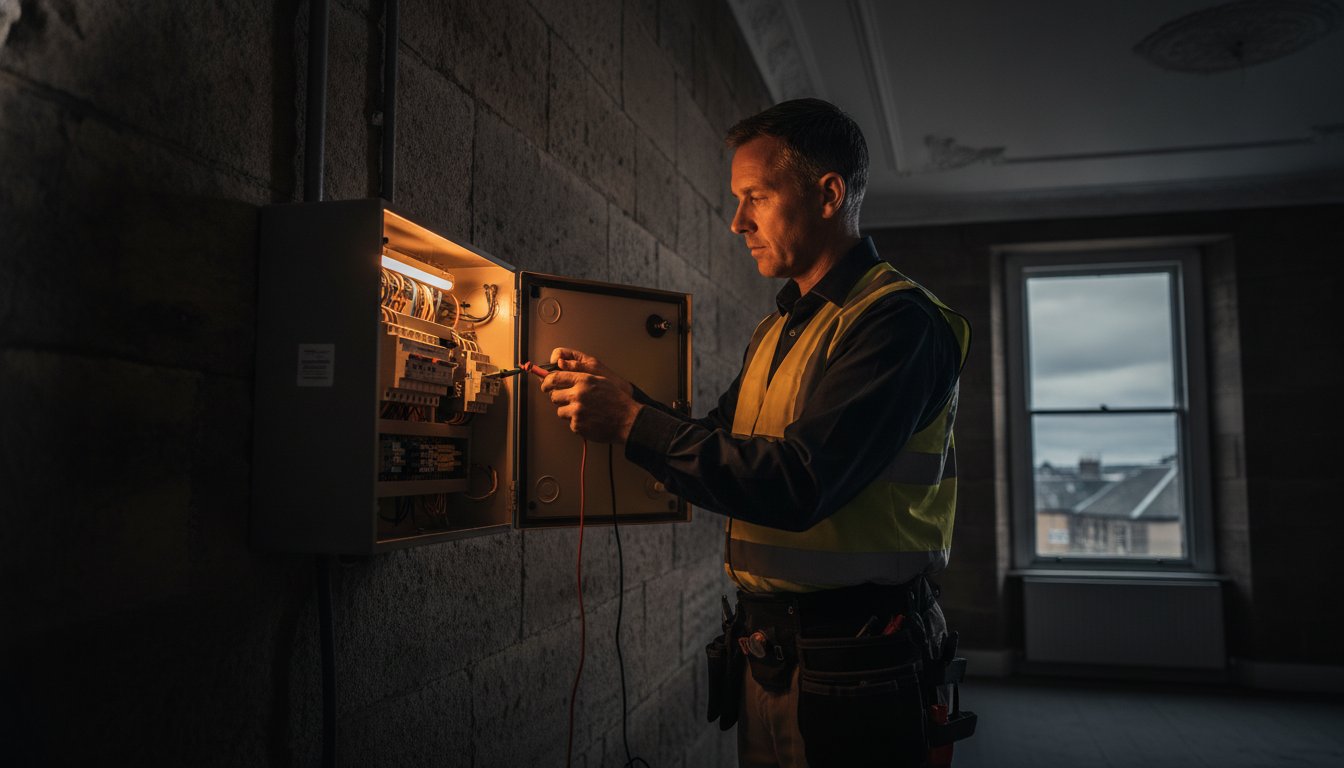
Could your traditional fuse box be silently ignoring a dangerous fault that is currently heating up behind your living room wall? For many families living in Dundee’s beautiful older properties, the electrical system is often a case of “out of sight, out of mind” until something goes wrong. We understand the quiet worry that comes with ageing wiring and the confusing jargon found in modern regulations. Understanding the RCD safety benefits of a modern consumer unit is the first step toward true peace of mind. These devices aren’t just switches; they’re high-precision guardians that can detect a tiny leakage of current and cut the power in less than 300 milliseconds.
We believe every home deserves the highest standard of protection, regardless of its age. You might feel that your old fuses are doing their job, but there’s a world of difference between a fuse that melts during a massive surge and an RCD that saves a life during a minor accident. This article explains how modern circuit protection works under the latest BS 7671:2018+A4:2026 standards. We’ll help you distinguish between various safety components and show why a straightforward upgrade is the most effective way to safeguard your property. There’s no corporate sales talk here; it’s just honest, local advice.
Key Takeaways
- Understand how an RCD functions as a sensitive guardian, constantly monitoring your electrical circuits to prevent accidents before they escalate.
- Explore the life-saving RCD safety benefits, such as near-instant power disconnection that prevents fatal shocks and significantly lowers the risk of electrical fires.
- Learn why modern circuit protection is far superior to traditional fuses, especially in older properties where outdated wiring can pose hidden dangers.
- Gain clear instructions on how to perform simple, regular safety tests at home to ensure your protective devices remain in perfect working order.
- Discover why professional installation and certified inspections are essential for keeping your home compliant with the latest 18th Edition safety regulations.
What is an RCD and How Does it Protect Your Home?
A Residual-current device (RCD) is a sensitive safety switch that’s designed to save lives by cutting off electricity the moment a fault is detected. Many people confuse them with standard circuit breakers, known as MCBs, but they serve very different purposes. While an MCB’s job is to protect your house’s cables from catching fire due to an overload, it won’t necessarily stop you from receiving a fatal shock. An RCD is specifically engineered to protect people rather than just the wiring. It’s a guardian that watches over your family’s safety every second of the day.
The device works by constantly monitoring the balance of electricity flowing through a circuit. It measures the current going out on the live wire and compares it to the current returning on the neutral wire. If these two don’t match perfectly, it means electricity is “leaking” somewhere it shouldn’t be. This leakage is a clear signal of a dangerous fault, such as current flowing through a person’s body to the ground. Even a tiny discrepancy triggers the switch instantly, preventing a minor incident from becoming a tragedy.
The Anatomy of a Life-Saving Switch
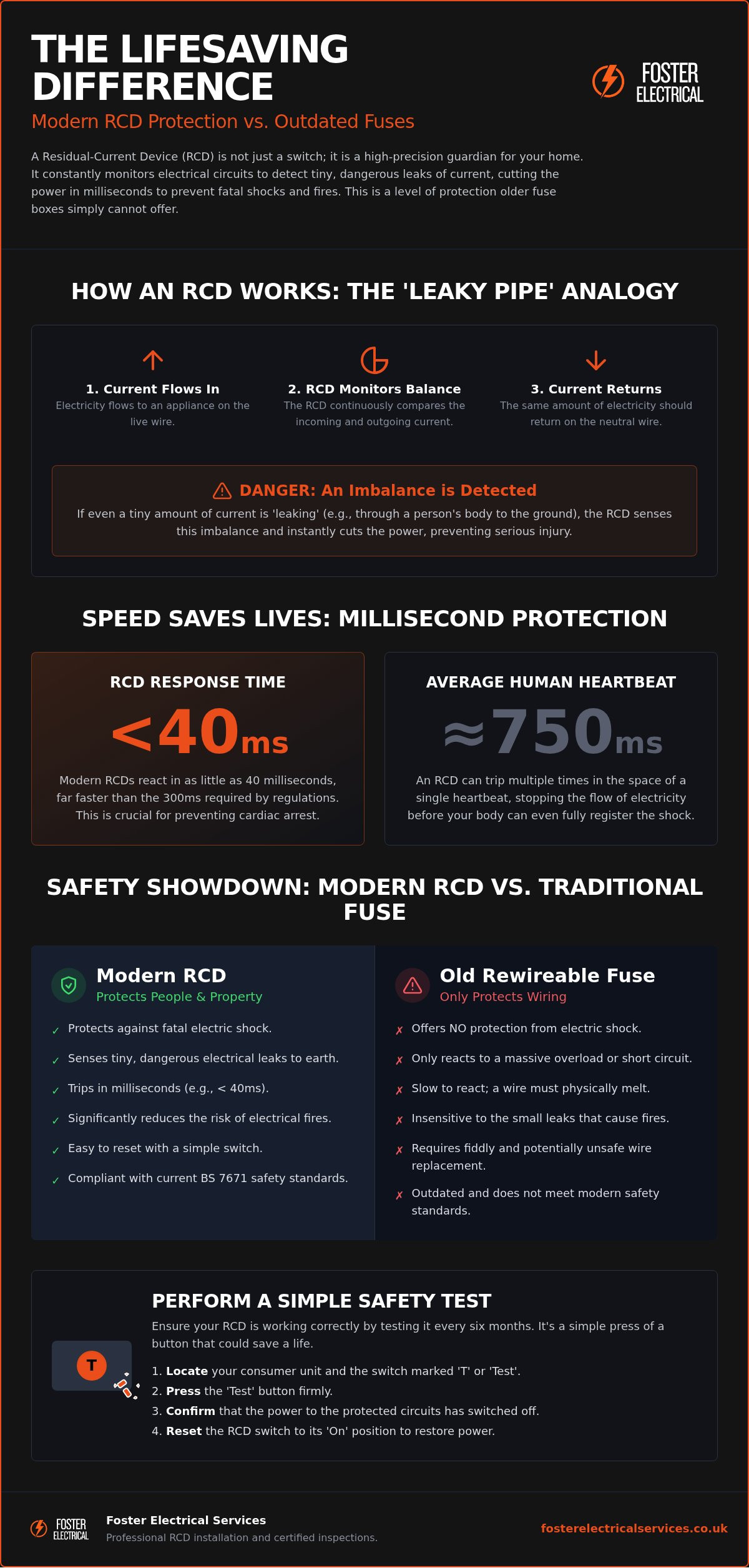
Think of your home’s electrical system like a water pipe. If you have ten litres of water going into a pipe but only nine coming out the other end, you know there’s a leak somewhere in the middle. In an electrical circuit, that missing current is often escaping to the earth through a faulty appliance or, worse, through a person. RCDs are incredibly sensitive; they can detect a tiny discrepancy and trip the power in less than 300 milliseconds. This speed is vital. It stops the flow of electricity before it can cause serious injury or heart failure. One of the primary RCD safety benefits is this near-instant disconnection, which provides protection against the most common cause of accidental electrocution in the home.
Where RCDs Live in Your Dundee Property
In most modern homes across Angus and Tayside, you’ll find RCDs located directly within the consumer unit. They’re usually wider than standard switches and feature a distinct “Test” button. You might also find RCD-protected sockets in areas like garages or gardens where the risk of dampness is higher. However, many older properties in Dundee still rely on outdated rewireable fuses that offer no protection against electrocution. Modern UK safety standards now require whole-house RCD protection to ensure every circuit is monitored. If your home still uses an old-fashioned fuse box, you’re missing out on these essential RCD safety benefits. We often help local families transition to safer systems through our consumer unit upgrades, ensuring every room in the house is properly protected.
The Primary RCD Safety Benefits for Your Family
While we’ve discussed how these devices function, the real value lies in the peace of mind they provide for your household. The most significant RCD safety benefits centre on the preservation of life. Unlike older systems that might let electricity flow until a wire literally melts, an RCD acts as a sensitive observer. It’s particularly vital for those with young children or pets. We know that curious toddlers or animals chewing on cables can cause accidents in the blink of an eye. In these moments, the RCD is the only thing standing between a minor scare and a life-changing injury.
Faulty appliances are another common hazard in Angus homes. A washing machine or kettle with a degraded internal seal might cause its metal casing to become live. Without modern protection, you wouldn’t know there was a problem until you touched it. An RCD detects this leakage immediately and shuts down the circuit before you even come into contact with the metalwork. It transforms your home from a place of hidden risks into a guarded environment.
Millisecond Protection: Why Speed Saves Lives
The effectiveness of these devices comes down to sheer speed. While regulations require a standard 30mA RCD to disconnect in under 300 milliseconds, many modern units react in as little as 40 milliseconds. To put that in perspective, it’s significantly faster than the duration of a single human heartbeat. This rapid response is essential because it prevents the current from reaching the ‘let-go’ threshold, where your muscles contract and you cannot release the source of the shock. The trip time is the critical factor in preventing cardiac arrest during an accidental contact with live electricity.
Fire Prevention and Earth Fault Detection
Beyond shock prevention, RCDs are exceptional at spotting ‘silent’ fire risks. Traditional fuses and circuit breakers are designed to trip when a circuit is overloaded, such as when too many high-power heaters are plugged in at once. However, they are often blind to small leaks caused by dampness or degraded insulation. These small earth faults can generate intense heat over time, eventually leading to a fire behind your walls or under floorboards. This is a particular concern for older Tayside properties where wiring may have been in place for decades. By detecting these tiny imbalances, an RCD provides an early warning system that old technology simply ignores. If you have concerns about the age of your wiring, you can speak with us about a safety inspection to ensure your home is properly guarded.
RCDs vs Traditional Fuses: The Case for Upgrading
There is a stark difference between the way old-fashioned fuse boxes and modern consumer units handle a fault. If you live in an older property in Dundee, you might still have a system that uses rewireable fuses. When a fault occurs in these systems, the fuse wire melts to break the circuit. This usually leaves you fumbling in the dark with a torch, trying to thread tiny silver wire through a ceramic carrier. In contrast, a modern unit uses a simple switch that flips down. Restoring power is as easy as flicking it back up once the fault is cleared. However, the convenience of a switch is secondary to the life-saving RCD safety benefits that these modern systems provide.
Modern consumer units are now required to be non-combustible, meaning they are housed in sturdy metal enclosures. This design is specifically intended to contain any internal electrical fire, preventing it from spreading to the rest of your home. Older plastic fuse boxes, which were common until a few years ago, don’t offer this same level of fire containment. When we modernise a home’s protection, we aren’t just making it easier to use; we’re installing a robust shield that meets the most recent BS 7671:2018+A4:2026 standards.
The Risk of Older Fuse Boxes
One of the greatest dangers with traditional wire-bridge systems is the risk of “over-fusing”. We often see cases in Angus where a homeowner has accidentally used a thicker piece of wire than the circuit can safely handle. This prevents the fuse from blowing when it should, allowing the cables to overheat and potentially start a fire behind the walls. Traditional fuses are also blunt instruments; they only react to massive surges of power and are often too slow to prevent a fatal shock. If you’re unsure whether your current setup is up to the task, our Consumer Unit Upgrades 2026: The Homeowner’s Essential Guide to Electrical Safety provides a deeper look at what to look for.
Type AC vs Type A RCDs: What You Need to Know
The world of domestic electronics has changed rapidly, and our safety devices have had to keep pace. Older “Type AC” RCDs were designed for basic alternating current. Today, our homes are filled with LED lighting, computers, and EV chargers that can cause “blinding” in older RCDs, making them fail to trip during a fault. Under the current 18th Edition regulations, Type A RCDs are now the standard for most domestic installations because they can detect the pulsating DC currents produced by modern gadgets. We take personal pride in ensuring that every component we install is correctly matched to your home’s needs, providing the highest standard of protection without the “nuisance tripping” associated with poorly designed systems.
How to Identify and Test Your RCDs Safely
Owning a modern consumer unit is only half the battle; ensuring it remains in peak condition is where true safety lies. To enjoy the full RCD safety benefits, you must be able to identify the device and verify its operation. Most RCDs are easily spotted by their size and the presence of a small button marked with a “T” or the word “Test”. This button isn’t there for the electrician’s benefit alone. It’s a vital tool for you, the homeowner, to ensure the internal mechanical parts haven’t seized up over time.
We recommend following the “six-month rule” for testing. Much like checking the batteries in your smoke alarms, pressing the test button twice a year ensures the internal switch can move freely. If a device sits idle for years, dust or mechanical fatigue might prevent it from tripping during a real emergency. Beyond the test button, keep an eye out for physical warning signs. If you notice a faint buzzing sound, a smell of ozone, or if the casing feels warm to the touch, the device may be failing and requires immediate professional attention.
A Step-by-Step Guide to the RCD Push-Button Test
- Step 1: Locate the RCD in your consumer unit. It’s usually the largest switch and will have a “Test” button nearby.
- Step 2: Press the “T” or “Test” button. The switch should flip to the “Off” position immediately, cutting power to the protected circuits.
- Step 3: Reset the switch by flicking it back to the “On” position to restore power to your home.
If you press the button and the switch does not move, you have no protection against electric shocks. This is a serious safety failure. You should contact a qualified electrician immediately to have the unit replaced. We believe in getting these things done properly to keep your family safe.
Dealing with Nuisance Tripping in Dundee Homes
It can be frustrating when your power cuts out unexpectedly, but a “nuisance” trip is often the RCD doing its job by detecting a real leak. In many older Tayside properties, this is frequently caused by a faulty domestic appliance rather than the house wiring itself. If your RCD trips and won’t reset, try unplugging every appliance on that circuit before attempting to flip the switch again. For a more detailed walkthrough on identifying these issues, see our guide on Fault Finding and Repairs: A Homeowner’s Guide to Electrical Troubleshooting. We take personal pride in helping our neighbours resolve these worries with honest, straightforward advice.
Professional RCD Installation and Safety Inspections
Installing or modernising a consumer unit is a task that demands professional accountability and precise technical knowledge. It is not a project for a weekend DIY enthusiast. When we install these devices, we don’t just click a switch into place; we perform a series of instrument-based tests to ensure the disconnection times meet the strict requirements of BS 7671:2018+A4:2026. This professional verification is the only way to guarantee you are receiving the full RCD safety benefits. We take personal pride in our work, ensuring every connection is secure and every circuit is documented correctly.
Our approach is rooted in the “Foster Promise” of traditional sincerity and grounded professionalism. We understand that we are guests in your private space, so we maintain high standards of tidiness and respect for your property. Unlike national firms with impersonal call centres, we offer direct human interaction and local accountability. We provide honest assessments without the high-pressure sales tactics, focusing entirely on what is necessary to keep your environment safe and compliant.
The Importance of an EICR for Older Properties
For many residents in older Tayside homes, the first time they realise their protection is inadequate is during a safety inspection. An Electrical Installation Condition Report (EICR) is a thorough health check for your home’s wiring. It’s particularly vital for those moving into a new property or for landlords who must meet legal safety standards. In Dundee, landlords are required to ensure their properties have adequate RCD protection to protect tenants from harm. If you are managing a rental property, our EICR Certificate Dundee: The Complete Landlord’s Guide to Electrical Safety Compliance explains exactly what you need to stay on the right side of the law.
Safe Upgrades for Modern Living
As our homes evolve, so do our electrical needs. Driveways across Fife and Angus are increasingly featuring EV chargers, which introduce unique demands on your domestic supply. These installations require specific RCD protection, often involving Type B RCDs or specialized 6mA DC fault protection, to handle the specific currents used by electric vehicles. Similarly, when we install outdoor power or garden lighting, we ensure these circuits are guarded by sensitive RCDs to account for the increased risks posed by damp conditions. By choosing a local expert who treats your home with the diligence of a good neighbour, you ensure that every modern upgrade is built on a foundation of absolute safety.
Securing Your Home for the Future
We’ve explored how a modern consumer unit acts as a protective shield for your family. From the millisecond response times that prevent fatal shocks to the fire-prevention capabilities of Type A devices, the RCD safety benefits are clear. Modernising your electrical system isn’t just about meeting the latest 18th Edition regulations; it’s about the deep peace of mind that comes from knowing your home is guarded by current safety standards.
As a NICEIC Approved Contractor, we take personal pride in delivering honest, transparent advice to our neighbours across Dundee and Tayside. We’ve built our 5-star reputation on a foundation of diligence and integrity, ensuring every job is completed properly without hidden costs or corporate jargon. We treat your property with the same care we’d give our own homes, maintaining a tidy workspace and a respectful presence.
Ensure your home is safe; book a professional consumer unit inspection with Foster Electrical today. Taking this straightforward step now ensures your household remains a secure environment for your loved ones for years to come.
Frequently Asked Questions
What is the main benefit of an RCD over a traditional fuse?
The main benefit is that an RCD protects lives by detecting tiny leakages of current, whereas a traditional fuse only protects your house’s wiring from melting during a massive overload. In many older Dundee homes, rewireable fuses can take several seconds to blow, which is far too slow to prevent a fatal shock. An RCD reacts in milliseconds, cutting the power before the current can cause cardiac arrest or serious injury.
Does an RCD protect against all types of electric shocks?
No, an RCD doesn’t protect against every possible type of shock. It specifically guards against earth faults, where electricity flows through you to the ground. If you were to touch both the live and neutral wires simultaneously without touching the ground, the device wouldn’t see an imbalance and wouldn’t trip. This is why we always emphasise that RCD safety benefits are a vital layer of protection, but safe behaviour remains essential.
How often should I test the RCD in my Dundee home?
You should perform the push-button test on your consumer unit at least once every six months to ensure the mechanical parts are working. This simple check is something any homeowner in Tayside can do themselves. However, this doesn’t replace the need for professional instrument-based testing. A qualified electrician should carry out a timed test during an EICR every five years for domestic properties to verify the device still meets current safety standards.
Why does my RCD keep tripping even when no appliances are on?
If your RCD trips with no appliances plugged in, there’s likely a fault within the fixed wiring of your property. This could be caused by moisture in outdoor lighting, a cable damaged by rodents, or a degraded socket. In older Angus properties, dampness in walls can often trigger these sensitive devices. Since the fault is hidden behind your walls, you’ll need a professional fault finding service to identify the specific location safely.
Is it a legal requirement to have RCD protection in Scotland?
It’s a legal requirement for all private and social landlords in Scotland to ensure their properties have adequate RCD protection as part of a passing EICR. For homeowners, there’s no law forcing you to upgrade an existing old fuse box immediately. However, any new electrical work or consumer unit upgrades must comply with the 18th Edition regulations, which mandate RCD protection for almost all domestic circuits to ensure occupant safety.
Can I install an RCD myself if I have basic electrical knowledge?
No, you shouldn’t attempt to install an RCD yourself. This work must be carried out by a certified professional who can issue the correct safety certificates. Installation involves working inside the consumer unit where live parts are exposed. Once installed, the device must be verified using calibrated test equipment to ensure it trips within the required 300 milliseconds. We provide fully certified installations across Dundee to give you total peace of mind.
What is the difference between an RCD and an RCBO?
An RCD is a safety switch that usually protects a group of circuits, meaning a single fault can turn off half your house’s power. An RCBO is a more modern alternative that combines the functions of a circuit breaker and an RCD into one compact unit for a single circuit. This is a popular choice for our clients in Perth and Fife because it ensures that a fault in the kitchen won’t leave your home office in the dark.
Will an RCD prevent my electrical appliances from catching fire?
An RCD significantly reduces fire risks by detecting earth faults that generate heat, but it cannot prevent every type of electrical fire. It’s excellent at spotting current leaking through degraded insulation, which is a common cause of fires in older Tayside homes. However, it won’t detect arc faults caused by loose connections. For the best protection, we often recommend combining modern RCD safety benefits with regular maintenance to keep your home’s infrastructure healthy.